Duleeppore – 11 May
If the rebels had planned to abandon their position at Duleeppore, then either they started too late, or they had not intended to leave at all. Lugard emerged from the jungle to find they were waiting for him. His line of skirmishers managed with some difficulty to rout them back into the jungle in their rear, and he quickly ordered the artillery to throw a few rounds of grape at them, by way of opening the day’s proceedings. However, the rebels seemed to find this a minor irritation. They rapidly spread around to Lugard’s right and left, “through the thickest part of the jungle, where our soldiers could scarcely penetrate,” and proceeded to attack Lugard’s rear flanks. The companies of the 10th Foot opened fire and drove them back, allowing Lugard to push onwards towards the Chitoura bungalow, where the rebels made a more determined stand, but Lugard, equally determined, once again drove them off. While his men were thus engaged, from the south, there came the sound of guns. It was Colonel Corfield, and he was in the thick of things. The rebels had managed to separate their force after all, well before Lugard had come upon them, and a large portion of the force had taken control of a series of villages at the southern limit of the jungle where Corfield stumbled across them.
After detaching his cavalry and the Royal Artillery guns to support Lugard, Corfield heard firing from the direction of a large village named Juttrowa. His men were ready to march, and after an advance of just two miles, they had reached the entrance of the jungle. The rebels, well hidden in the undergrowth and protected by the trees, opened fire. Corfield advanced three companies of his infantry in skirmishing order and opened fire with his artillery. The opposition was fierce, but Corfield continued his attack.
“I brought up my right shoulder, driving the rebels towards my left” in the direction the detached cavalry and artillery had previously proceeded, then, as directed by Lugard, he stayed well out of the jungle, “unless I heard long continued firing in the Juttowra direction.” The rebel attack had stopped for now, and Corfield halted to watch the outlets of the jungle directly in front of him. Then, after half-an-hour of waiting, the rebels suddenly appeared on his left front, apparently intending to move back to their original position. Corfield quickly sent forward the skirmishers and, with a reinforcement of infantry in their rear, he advanced, closed around the nearest village which the rebels had re-occupied and stormed it. They quickly dashed towards the next village, with Corfield on their heels. One village after another fell to the flames, Corfield setting them ablaze as quickly as he took them, and pushed the rebels, step by step, towards Juttowra. By sunset, he was no nearer to forming a junction with Lugard, who was still fending off waves of attacks.
After driving the rebels out of Duleeppore, Lugard sent the Sikh Cavalry under Lieutenant Jennings through the jungle, following an easterly path, to cut off any fugitives of the rebel force who might attempt to escape through that route, something which would keep Jennings occupied until well after dark. Meanwhile, another rebel force, under Kunwar Singh’s brother, Amar, suddenly broke from the jungle just to the left of Duleepore and attacked Lieutenant-Colonel Robertson with his mixed force of artillery and cavalry – after a stiff fight, Robertson managed to drive them back. Meanwhile, another rebel force, no less than 300 in number, appeared on the edge of the jungle just southwest of Duleepore, but upon Lieutenant-Colonel Longden bringing up his guns, they hastily retired. By sunset, everyone had had enough – the rebels retraced their steps into the jungles, and Lugard sent a message to Corfield to join him at Juttowra, where Lugard now set up his camp for the night, well out of the steaming, oppressive jungle.
Unfortunately, Corfield had not taken the same precautions at Lugard. His men had fought the day through on an empty stomach, seven had died of sunstroke before the fight even began, and by the time the day was over, 60 men of the 6th Regiment had collapsed of exhaustion and needed to be carried back to camp. The 6th (Royal Warwickshire Regiment) had been stationed in South Africa for some years before the mutiny and had only arrived at Calcutta in December 1857. They had hardly acclimatised enough to deal with a scorching pre-monsoon India. They had only left Calcutta for Sasseram on 24 April, and now here they were in the thick of things in the Bihar jungles. So, although Lugard was more or less in earshot, Corfield refused to march his men a step further, leaving Lugard unaware until the next day that the firing he had heard from the other side of the jungle had indeed been Corfield.
Meanwhile, Lugard’s men settled down to another night out in the open with no tents and very little in the way of comfort. The camp was made decidedly less hospitable by putrid corpses. “The rebels suffered severely, as shown by the several masses of their dead lying about the extensive cordon of pickets, with which I surrounded our position during the night, preventing their being removed.”
For the 10th Regiment, two VCs should have been in order, but neither materialised. According to their regimental history, Corporal James Maher and Private Edward Walsh volunteered themselves for a near-suicidal mission: carrying dispatches to Buxar. At Buxar was the governmental stud, and it is likely that Lugard needed horses. However, it was not only raining, but Buxar was 40 miles away, and the men would need to ride through open country, exposed to not only the elements but also lurking rebels.
“The two men had to muffle their horses’ hoofs, and all the jingling parts of their accoutrements. Provided with a map of the route, which led through the outskirts of the enemy’s camps, they began their perilous journey….”
They were seen and challenged, leaving Maher and Walsh no alternative but to cut their way out of this scrap, leaving a few wounded outpost sentries behind them, but the noise had been enough to set the rebels on the alert, and the chase was on. For several miles, a party of sowars kept hard on their tails; it was only providence that ensured that Maher and Walsh arrived in Buxar intact. As the historical records point out, “The journey ended in the men having to be carried to hospital.”
The Skirmishing Continues
Of course, the rebels were not giving up. On the 13th, with Lugard now back in Piro, they attacked Jagdispur, forcing him to march back there only to discover, on his arrival, they had once again melted back into the jungle. The next day, on learning that the main bodies of the rebel force “lie concealed in the thickest part of the extensive jungle,” Lugard made an attempt to find them, but it proved impossible. With no roads as such, and a foe who knew his way around better than Lugard ever would, he fell back. He did, however, have a plan. If he could not get to the rebels on their terms, he would make them meet his.
“I am of the opinion that the only measure to be adopted for clearing this district of the rebels, or indeed for getting at them in the jungle, is to cut broad roads through it in several directions. I have already communicated with the civil authorities on the subject.”
Roads, no matter how rough, needed time to materialise, and until then, Lugard would have to deal with the jungle.
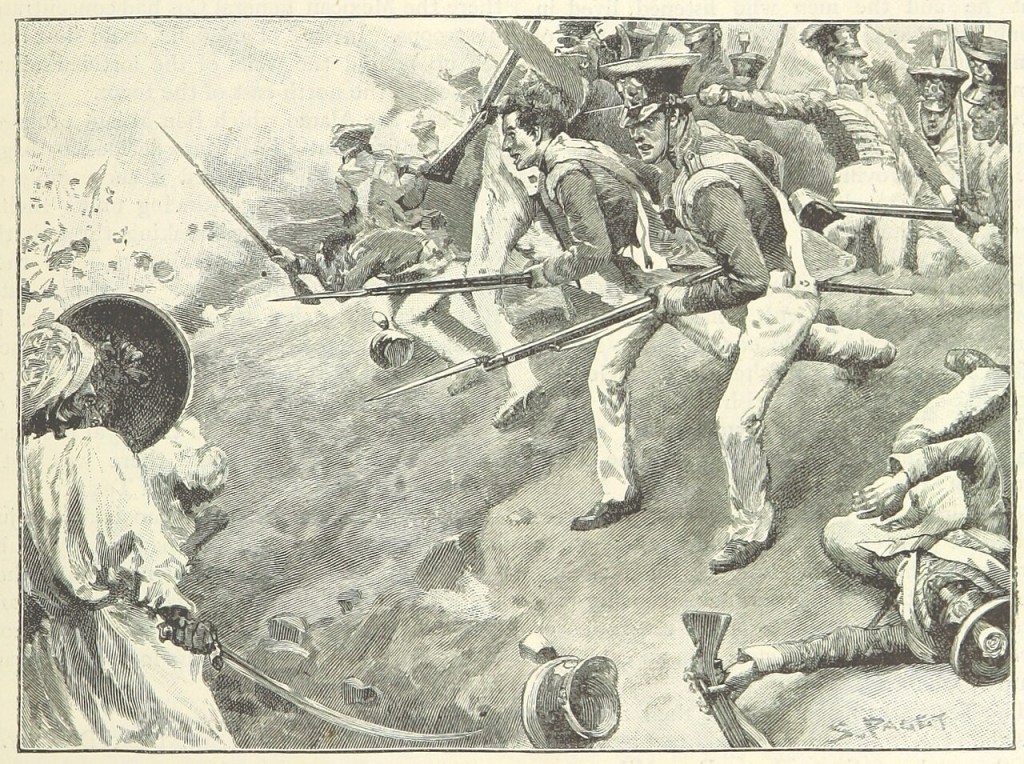
From now on, skirmishes would be a daily occurrence — when Lugard drove the rebels from the village of Hetmatpur, another body attacked Corfield, who succeeded in driving them back into the jungle. The rebels then reformed and attacked Lugard at Jetahin while Corfield drove them away from Duvim. Lugard would now find himself in what must have appeared as a massive game of tug-of-war. Having chased them away from Jagdispur again, on 16 May, Lugard dispatched Major Lightfoot of HM’s 84th to simply burn the house of a recalcitrant landowner named Hurkissen Singh and his village of Buradhee; while they were at it, Lightfoot torched the village of Uraila, the reasoning being, ” the inhabitants of which had aided the rebels and evinced an inimical spirit…”
The rebels, in their turn, now planted their flag barely two miles from Jagdispur, at Metahi, the stronghold of their leader, Ummer Singh and proceeded to entrench themselves. Realising that this was quite unacceptable, Lugard attacked them on the 18th.
“On our approach, the rebels opened fire from the two 12-pounder howitzers they captured from the Arrah party on the 23rd ultimo, and showed in great force; but so soon as the line of infantry advanced, they retired into the jungle, carrying away their guns; upon which I destroyed the house and village, and returned to camp; the loss of the rebels must have been severe, as the fire from the battery guns, under Lieutenants Campbell and Bradford, was very good.”
However, they had other ways to irritate Lugard.
On 20 May, with Mr Burrows – a railway engineer – cutting his way through the jungles around Jagdispur (in the direction of Arrah) to give Lugard the road he wanted, it became clear that this endeavour was fraught with danger. Concerned that the rebels might “creep up and fire on the workmen,” who most likely would abandon the work altogether, Lugard sent his horse artillery and cavalry, under Lieutenant-Colonel Robertson, around to the southwest of Duleeppore, where a body of rebels had now taken up residence, with the intention of diverting their attention away from the road. It worked a little better than Lugard had intended.
“In a few hours, receiving a report from the Lieutenant-Colonel that the enemy were following him into the open country in great numbers, I hastened from camp with a few companies of the 10th Foot, the battery guns, and some cavalry, direct upon Metahi, in the hope of getting between them and the jungle; in this I partially succeeded and inflicted severe punishment upon them. I regret, however, that Lieutenant Dawson, Military Train, was killed, and Lieutenant Maxwell, Royal Horse Artillery, with Serjeant H. Robinson, Royal Horse Artillery, and Private R. McGuire, 10th Foot, were wounded in this skirmish.”
Frustrated by the rebels’ ability to simply melt away into the jungle, and with no road to follow them on, Lugard surmised, “From the operation of the 20th instant, it seemed to me that, by a combined movement upon the rebels, I might possibly crush them, and capture their 2 guns, which they prized greatly, and invariably withdrew so rapidly into the jungle when we advanced, that there was little chance of taking them by any direct attack.” So he came up with another plan. Initially, he intended Colonel Corfield to cooperate with him from his position to the south of Duleeppore, but Corfield had apparently had enough of Bihar already and refused to offer him any assistance, leaving Lugard to make the attack with his own force. As plans go, it was simple enough. Lugard intended to draw the rebels out of the jungle and then “make a feeble attack” on Metahi to keep them busy while his main body of infantry moved down through the jungle directly from Jagdispur and took them in the rear. The force at his command included that of Brigadier Douglas, who had until now been holding Arrah.
Artillery
3 guns, E-Troop RHA – Major Michell
6 guns, A Company, 3rd Battalion, Madras Artillery – Major Cotter
Heavy Ordnance – Captains Thring and Waller
Cavalry
Detachment 6th Madras Cavalry – Captain Douglas
3rd Sikh Cavalry – Lieutenant Pearse, Lieutenant Jennings, Lieutenant Beadon
12th Irregular Cavalry – Sirdar Bahadur Mahomed Baksh
Infantry
HM’s 10th Foot – Lieutenant Colonel Fenwick & Captain Norman
HM’s 34th Foot – Lieutenant-Colonel Kelly
HM’s 84th Foot – Major Lightfoot
2 companies, Madras Rifles – Major Carr
Detachment Rattray’s Sikhs – Subadar Nehal Singh
Engineers
Detachment 4th Company Royal Engineers – Lieutenant Keith, Royal Engineers
Punjaub Pioneers – Lieutenant Fulford, Bengal Engineers
Military Train under Lieutenant-Colonel Robertson
Before daybreak on 26 May, Lugard was ready to put his plan into action.
 Mutiny Reflections