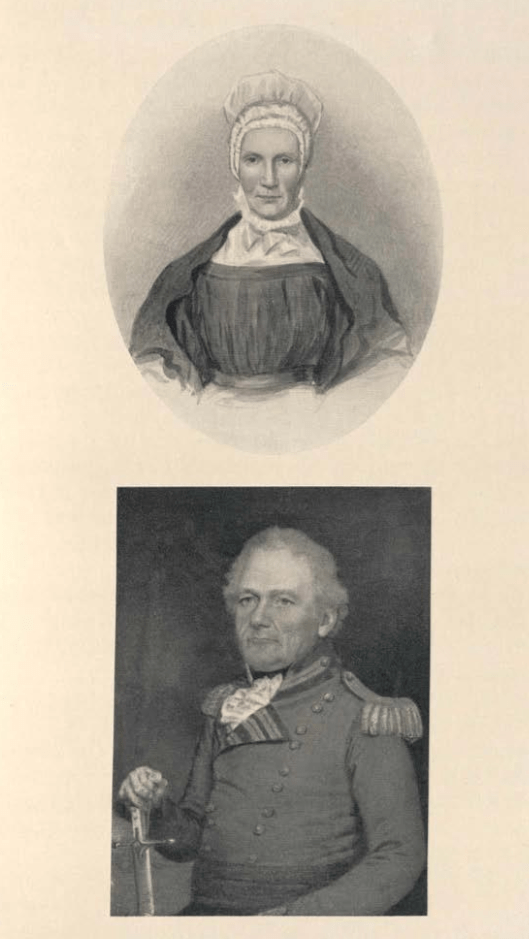
Lt. Col. Alexander Lawrence and his wife Letitia Catherine (née Knox)

The story of the Lawrence brothers starts in India; yet it was built on the trials and disappointments of another – their father, Colonel Alexander Lawrence.
The son of a mill-owner of Coleraine in County Derry, who died in 1776, leaving behind seven children, of whom five were boys. Three brothers left home shortly after their father’s death to seek their fortunes in America with only their inheritance in their pockets: all three disappeared in that wide land and were never heard from again. Alexander remained at home, cared for by his two elder sisters, who, as the years went by, were at a loss; what were they to do with this active, daring and impatient boy? One brother, named William, had taken his place in the navy as a surgeon, but for Alexander, there were but few prospects. Yet, he was quick to shake off his sisters’ care, and for a bounty of £5, Alexander joined his brother on board the cutter “Nimble” as a volunteer. He served on board until the war with America ended, and he received his discharge in 1783. Only a day after his discharge, still only 16 years old, this daring young man embarked on the EICo ship, the Stormont and set sail, once again a volunteer, with the HM’s 36th Regiment of Foot.
It was to custom of the day to take on, as volunteers, young men of good families but financially unable to buy a commission. They were treated as officers but drew no pay and had to live on their own resources. When a vacancy opened up among the regular ensigns, these young men were promoted as “acting ensigns by the commander-in-chief in the field” and, should the rank be approved by the War Office at home, they would be confirmed to the rank and become regular ensigns. So Alexander Lawrence, appointed by the Commander-in-Chief General Sir John Burgoyne as an ensign in the 101st Regiment, went off to fight a bitterly long campaign under Colonel Fullerton, happy in the knowledge that once it was over, his days as a volunteer would be over.
It was not to be. He was horrified to find that “the commission not confirmed at the Horse Guards, from it not having been stated in the recommendation that he was actually serving in India,” and the clerk who had made this error had further neglected to mention how the vacancy had come to pass. So Alexander Lawrence, instead of being a full-fledged ensign, was still a volunteer. He was rejected for a second recommendation, which was given instead to a half-pay officer in England. In 1787, he was finally gazetted, but only after he paid the full price of commission. A year later, he was promoted to lieutenant in the 77th Regiment.
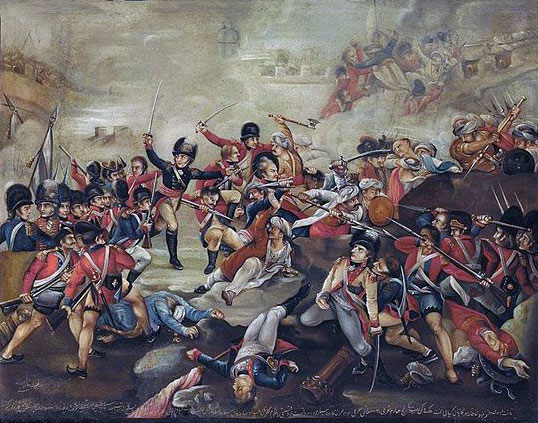
Qajar Persian picture of the Storming of Seringapatam on 4th May 1799 in the Fourth Mysore War

These were very warlike times in India, and Alexander would go through the brunt of it, from the fall of Cannanore in 1790, Cochin in 1795 and Colombo in 1796. It was, however, at the final assault on Seringapatam in 1799, that Alexander unveiled his full mettle.
In the same year he commanded the Grenadier company (of the 77th Regiment) the whole of the (second) siege of Seringapatam, the captain being left sick at the top of the Ghaut; ” in the course of which siege he twice distinguished himself; once on the night of the 22nd April, when two companies of the 77th, under his command, repulsed with great loss a sortie of the enemy; and still more conspicuously on the 4th May, when he was the only survivor of four lieutenants who, at their own request, were appointed to cover the Forlorn Hope at the memorable assault of that fortress; on which occasion he received two severe wounds, one by a ball in his left arm, which is still lodged there, and the other in his right hand, which carried oft one finger and shattered another into several pieces. The first ball hit him just as his party reached the top of the glacis, where they found that the storming party (Sergeant Graham’s) had formed and commenced a fire instead of rushing in. Lawrence, wounded as he was, ran from right to left (of the rear-rank of the Forlorn Hope), hurrahing to them to move on; but at last was obliged to run through the files to the front, calling out, ‘Now is the time for the breach! ‘ This had the desired effect. At the foot of the breach, he received the second ball, but even then “ did not give it up till he saw the few remaining men gain the breach; then, fainting from the loss of blood, he was removed to a less exposed place.”
Lawrence was saved by a soldier of the 77th, who, later in the day, as he strolled over the battlefield, recognised that this officer was not dead. He heaved Lawrence over his shoulder and staggered with his burden, who stood 6’2″ and “stout in proportion”, back to camp.
Barely recovered from his wounds, Alexander was back in the field to join the siege and assault on the fortress of Jumalabad; after this, his regiment was ordered, at the height of the monsoon rains, the proceed up the coast in open boats to Cochin. A dreadful gale wrecked the boats close to Cannanore, but it was Lawrence, once again, who stayed on the beach until every man was safely ashore, swimming out in the rough waters to bring them in. It would take him nearly a year to recover the use of his legs. As soon as he was well, he transferred to the 19th Regiment and joined them in Ceylon. In 1808, sick with rheumatic fever and liver disease, Alexander packed up his family and set sail for home. He arrived back in England broken in health to yet another disappointment. He had been superseded, yet again, for the majority, this time in his own regiment. His old Colonel, however, took some interest in Alexander’s fate and introduced him to the Duke of York, who enthusiastically offered him a promotion in 1809 to major in the 19th Foot and ordered him to Yorkshire to enlist recruits.
Three years later, his Royal Highness, ‘convinced of the ample manner in which this promotion has been earned by long and faithful services,appointed Major Lawrence to the Lieutenant-Colonelcy of the 4th Garrison Battalion at Guernsey; whence, in 1815, the regiment was ordered to Ostend, and Colonel Lawrence commanded the garrison there, consisting of four regiments and artillery, throughout the Waterloo campaign.”
It was his last campaign: when returning to Ireland in 1816, Alexander suffered from a burst abscess in his liver and was given up for dead while onboard the ship. However, whatever was left of his constitution did not desert him. Bidding his wife Catherine, to “stand aside!” he wrapped his cloak around him and walked, with a firm but shaky step, leaning heavily on his walking stick, onto the quayside. It was the end of his career.
“He had served his King and country with indefatigable zeal for thirty-five years and with many a hard struggle had reached that rank which might have been of service to his sons. All this must now be sacrificed. He could ‘safely say that he never made a guinea by the service’ and if he died, the value of his commission would be lost to his wife and children. So he sold out for their sakes, dragged slowly through a long sickness into a shattered convalescence, and found himself, after a life given to his country, with £3,500 (the price of his commission), and a pension from the Crown of £100 a year for his wounds, which, with some bitterness and much truth he said, “would do little more than pay his doctors.” He had made sure, under the rules of the King’s service, of getting a pension of £300 a year, and his disappointment was keen.”
With the hoped-for pension not forthcoming and only a letter of condolence from the Prince Regent’s secretary, who “did not feel at liberty ” to advise the Prince to do more for Alexander, he took up his case with the East India Company’s Board of Directors. These were resounding in their support of the battered colonel and awarded him a 100 guineas, a pension of £80 a year for life, which they generously raised to £130 as a mark of their respect for his services, which were, ultimately, on their behalf. Two years later, he once again applied to the War Office for the full pension which he considered was his by right – their reply was to say His Majesty would generously raise to £220 a year, “being, with the pension allowed you by the East India Company the rate assigned to the rank you hold.” The money secured after such trials would have to suffice for his large family, for when Colonel Lawrence sailed home from Ceylon, he had six children, and a further five followed shortly thereafter in England. In all their years in India, the Lawrences had only lost one child to illness, and one would die, aged 18, in the West Indies.
Colonel Lawrence, once a determined young man who had fought for his King, was now equally determined that his sons would not follow in his footsteps into this thankless service; instead, he would put them in the service of the East India Company.

Three of the Lawrence brothers were born in Ceylon: Alexander in 1803, George in 1804 in and Henry in 1806. Henry. Of the twelve Lawrence children, the eldest son, George (born 1799 in Cochin), died in Ceylon, aged only two. His death sadly occurred on the same day his sister Letitia was born in 1801. The shock of losing her son nearly cost their labouring mother her life. In all, Lieutenant Colonel Lawrence would send five sons to India, two of whom would reach startling prominence in the history of not only the East India Company but India under the Crown.

The first formative years back in England would not have been easy ones for the family, constrained by income and growing in size, they would shift from residence to residence as means allowed, until finally settling in Clifton. While money might have made up his father’s woes, the old soldier was determined it would not pass to his children – he insisted on their education, and four of his sons passed through the doors of Foyle College, then under the headmaster Reverend James Knox, his wife’s brother. While Reverend Knox might have been a kindly man with fine principles, the school as such was hardly a good one, and the boys left it barely better educated than when they had arrived. In 1818, Alexander secured a nomination to Addiscombe for his eldest son, also named Alexander and thus the first Lawrence boy left the fold, destined for India. George followed in 1819, and Henry was sent to Mr. Gough’s School in College Green, Bristol. Shortly after, John joined him.

With these words, we can now begin the lives of the Lawrence brothers.

Major General Alexander William Lawrence (1803-1868)

Alexander was the first son to set sail for India; having left Addiscombe in 1819 with good prospects, he was destined for the Madras Cavalry, where he would remain throughout his career. There is very little known about Alexander as such; he married Rosanna Lyster, the daughter of the late William Thomas Lyster, Esq., in 1828 in Sholapore. Their only son, Alexander William Knox Stewart, died in London at just 19 years old in 1848. Lieutenant Colonel Lawrence would serve in the Mutiny, albeit in the force of General Whitlock, commanding the Madras Light Cavalry. Alexander died, aged just 64, in Biarritz Basses, Aquitaine, France, on February 21 in 1868, with the final rank of Major General and Colonel-in-Chief of the 2nd Cavalry H.M.’s Indian Army, Madras Presidency.

Major General George St Patrick Lawrence (1804-1884)

Leaving Addiscombe in 1821, George followed Alexander’s footsteps into the cavalry, as a cornet in the Bengal Establishment. He arrived in India in September of the same year and was immediately posted to the 2nd Regiment, Light Cavalry. His career did not start, perhaps, on the footing any young man would have expected.
“I remained six weeks in the Cadet Barracks in Calcutta. The chief incidents during my stay there were my getting a severe fall the first time I mounted a horse in my cavalry uniform, from, I fancy, using my spurs unnecessarily. I was picked up senseless and taken into a good Samaritan’s house in Chowringhee.”
The next was a dinner at Lord Hastings’ residence, where the Governor-General admonished him for neglecting language studies and bade him to “Mind, you study the native languages, sir!” Advice Lawrence would find most beneficial later in life. His next adventure was of a more manly nature when he attempted to save the life of a fellow cornet who had injudiciously waded too far out in the Ganges, and being unable to swim, was soon caught in the current and carried off. George, seeing young Bradford’s distress, valiantly jumped in to his rescue, only to find he was well out of his depth. It would take the very bold efforts of George’s khidmatgar to save both their lives. A shaken but very much alive George Lawrence joined his new regiment in Keitah in Bundelkhand and nine months later was in charge of a troop. Two years later, he was promoted to lieutenant and appointed adjutant of his regiment, a position he resigned in September 1834.
His early years in India were not broken up by war or strife. He went on sick leave to Simla in 1827 where he was given an interview with Governor-General Lord William Bentinck. While the interview itself was not in any way spectacular for George’s career, it certainly would have an effect on his younger brother Henry.
“On entering his room, My lordship addressed me with, ‘Well, sir, what do you want ?’ ‘Nothing, my
lord, for myself,’ I replied. ‘Well,’ said the Governor-General, ‘you are the first man I have met in India who gave me that answer; but you must want something?’
‘Yes,’ I answered, ‘for my brother Henry, an artillery officer. I wish your lordship to be good enough to nominate him to the Revenue survey, for which he is qualified. For myself, I want nothing, as I am adjutant of my regiment, and perfectly content.’

‘Well, sir, I never promise, but go to my military secretary, Benson, who will put your brother’s name down, and I will see what can be done.’ I thanked his lordship and retired, and in six months thereafter, my brother received the appointment he desired.” How this one interview would change the course of Henry’s life will soon be told.
In 1838, his regiment was ordered to join the Army of the Indus, then collecting at Ferozepore on the Sutlej for service in Afghanistan. By now a married man (1830 to Charlotte Isabelle Browne), George had had the sense to pack off his wife and their three children to England before proceeding on active service, so he was spared the “worry and disappointment such events were causing to many others in our camp.”  With his regiment, he was present at the storming of Ghuznee on 23 July 1839, and in the attempt to capture Dost Mohammad Khan in his flight in August through the Bamyan pass.

Captain George Lawrence, 11th Light Cavalry, attached to the Political Service, 1842.
Coloured lithograph after Lieutenant Vincent Eyre, Bengal Artillery, 1842

When he returned to Kabul in September 1839, Lawrence now found himself as political assistant to Sir William Hay Macnaghten, the envoy to Afghanistan – he remained at Macnaghten’s side until his death, as his military secretary. It was not a position Lawrence had coveted nor indeed requested. However, the British, secure in their belief their tenure in Afghanistan would be long one, had decided to send for their families who were waiting for them in India – while Lieutenant Conolly was despatched to escort the ladies to Kabul, Lawrence was nominated in his place as political assistant and commandant of the envoy’s escort and even Lawrence had to admit, “The transition from purely regimental to civil duty was sudden and complete, and at first not a little embarrassing.” For a short time, with no chaplains available, George Lawrence even took on the role of impromptu chaplain, conducting divine service every Sunday for the Kabul Garrison.
If the British thought for a moment they could hold Afghanistan, they were sorely mistaken, and by 1840, the Afghans were doing their best to get them out. While we shall not dwell on the murder of Macnaghten on 23 December 1841, who the Afghans believed was double-dealing them, it nearly cost Lawrence his life.
Macnaghten ill-advisedly agreed to a conference with the Afghan chiefs, held 300 yards outside the cantonment close to the river.
“The Envoy dismounting, reclined on the slope, and Trevor and Mackenzie sat down beside him. At first, on dismounting, I stood behind him; but on being importuned by Mahomed Shah Khan to be seated, I knelt on one knee, the escort being drawn up a short distance in the rear. I had, on first arriving, remarked to Sir William the unusually large number of armed Afghans congregated around us, and suggested his requesting Akbar Khan to send them to a distance, as the meeting was confidential. The Envoy, in consequence, mentioned the subject to Mahomed Akbar, who said, 4 Oh, we are all in the same boat, and Lawrence Sahib need not be the least alarmed.’ Scarcely were the words uttered when my pistols were snatched from my waist, my sword drawn from the scabbard, and my arms pinioned by Mahomed Shah Khan, who raised me up from the ground, saying, ‘If you value your life, come along with me.I turned round and saw the Envoy, with his head down the declivity, struggling to rise, and his wrists locked in the grasp of Mahomed Akbar, horror and consternation being apparent in his face, Trevor and Mackenzie, I noticed, also in the same predicament as myself. Comprehending at a glance that resistance was useless, I said to Mahomed Shah Khan. ‘Lead on; I will follow you.’ At the same moment, swarms of Afghans, armed to the teeth, sprang up all around, yelling and demanding that I should be given up as a ‘koorban’—a sacrifice—to their vengeance.”
Lawrence and Mackenzie were both saved, but Trevor and Macnaghten were both dead. Macnaghten’s head was presented to the population of Kabul on a pike. As such, the stipulations placed on the British for their withdrawal from Afghanistan were the taking of hostages – four officers were offered up, and George Lawrence was one of them. By now, Lawrence believed no one would ever see India again, and when released from captivity, he was placed in charge of the ladies and children on 6 January 1842 at the start of the disastrous retreat from Kabul. Two days later, he was given up again as a hostage to Akbar Khan; Lawrence initially refused.
“Major Pottinger then offered to take my place, as he was wounded and could he of little or no use, whereas it was important that I should remain to take charge of the mission establishment, and he hoped that by his going, Akbar Khan might he satisfied with fewer hostages. Pottinger then proceeded to join Mahomed Akbar, but in about half an hour, he sent a note back stating that I must join him at once, as the Sirdar insisted on my being given over to him as a hostage. On my showing this note to the General he said he was sorry to lose me, but go I must, I therefore started in company with General Shelton, but had not proceeded beyond our own pickets ‘ when another note from Pottinger reached me, saying that Mahomed Akbar had agreed to dispense with General Shelton, and would be satisfied with Pottinger and myself, and a third officer, whomsoever Pottinger might select. He accordingly had named Captain Colin Mackenzie.”
They were by far not the only hostages for the wily Afghan who offered to protect the married officers and their families and the wounded officers, all the way to Jellalabad. Their march would be over the bodies of the dead comrades who had fallen on the road, shot by Afghan bullets or died from cold.


 Painting by Arthur David McCormick, 1909, depicting British troops trying to fight their way through the pass.

I recognised the body of the venerable old subalular of the Envoy’s escort, Appurnbul Singh, lying on the road by the side of his dun horse. It was told me that the Afghans offered him his life, for he was well known to them, if he would go over to them. ‘No,’ replied the grand old soldier, ‘ for forty-one years I have eaten the Company’s salt, and I will now show myself ready to die for them.’ For sixteen miles, we passed through these scenes of horror…” Things did not improve when, on the 13th of January, they passed through Jugdalack – the last two miles were strewn with the bodies of Europeans and Indians, all stripped of their clothes, among whom George recognised his friend Major Skinner.

“I saw hundreds of miserable sepoys and camp followers huddled together on the sides of the hills on each side of the road. They begged us with the most heartrending supplications to assist them, but alas! no aid could we afford; and indeed, had it been otherwise, they were beyond all human help, for the Afghans having stripped them of all their clothing had left them, to perish of cold and hunger, and the greater number of them were then, from the effects of the frost on their limbs, quite incapable of moving. I could not even do anything for them by supplicating Mahomed Akbar on their behalf, as otherwise I would have done, for the Sirdar had warned me not to come near him unless he sent for me, and I was surrounded by a guard of his own retainers.”

The Grove and Valley of Jugdulluk where Elphinstone’s Army made its last stand in the calamitous retreat; January 1842. As drawn on the spot by James Rattray.

The Kabul Army was destroyed nearly to a man, sacrificed, “to the incompetency, feebleness and want of skill” of their military leaders – a handful of sepoys and Dr Brydon were the only survivors; George Lawrence and the other hostages would remain in captivity until September 1842.
It hardly seems comprehensible that Lawrence was thrown straight back into his duties following his release from Afghanistan. On reaching Ferozepore, he appeared as a witness in several court martials of officers who had not been hostages but prisoners in the hands of the Afghans – to his relief, the men were acquitted. Then he was sent to join his regiment, the 11th Light Cavalry, in Cawnpore.
While in Cawnpore, however, his robust constitution finally broke down. Following a serious illness, Captain Lawrence was sent home to England on furlough, where he remained for three years, recovering his health. In September 1846, he returned to India.
George Lawrence now found himself appointed assistant political agent in the Punjab, but it was not all paper and pens. In the autumn of 1847, he led 2000 men against the hill tribes on the Swat border, defeating them in two separate actions; on the outbreak of the 2nd Sikh War, it was only due to Lawrence’s personal influence at Peshawar that his regiments remained faithful for a time, but eventually they broke and joined the Sikhs. Possibly no man in history has had so much experience with captivity – on 25 October 1848, he was handed over to Chuttur Singh as a prisoner, this time with his wife and children. They would remain his prisoners until 22 February 1849, following the Battle of Gujrat. Both houses of Parliament and the Governor-General took the time to thank Lawrence for “remaining at his post with such devotion.” Since Lawrence was proving himself rather useful in the Punjab, on 7 June 1849, he was promoted to brevet lieutenant-colonel and appointed deputy-commissioner of Peshawar. In his capacity as a political officer, he accompanied General Bradshaw’s force to Yusufzai country and was present at the capture of Pulee on the Swat border. Early in 1850, Lawrence, in command of militia, proceeded with Sir Charles Napier in the forcing of the Kohat Pass and acted as a guide through the defile.
Struck down again with a serious illness and realising he would most likely be sent against the Afridis again and back up Kohat, Lawrence practically begged Dalhousie to remove him from the Punjab. For once, Dalhousie appeared to be solicitous.

“In conferring this appointment upon Major Lawrence, Lord Dalhousie wrote to him the following gratifying letter:
I have considered the claims of the several officers who have applied for the appointment of the Meywar political agency, and I regard your claims as superior to any others which have been proposed. I feel sure that the office is one which will be satisfactory to yourself, and that you will fill it to the satisfaction of the Government. I shall be heartily sorry to lose you from the Punjaub, where you have played your part so much to my satisfaction, as well in peace as in war. But as that was to be from the first, I am glad to have it in my power to offer you this public mark of my satisfaction with the past.

(Signed) Dalhousie

For the next seven years, Lawrence occupied himself peaceably in Mewar, but on 13 March 1857, his brother Henry, who had been Chief Agent for the Governor-General in the Rajputana States, handed the reins of the entire province over to him. Henry was sent to Lucknow, and George took up his seat in Mount Abu. His successes and disasters in Rajputana in 1857 have been amply described. In May 1860, Lawrence was created a Companion of the Order of the Bath and one year later gazetted Major General. In 1864, he resigned his position in Rajputana and left India after 43 years of service. He received his good-service pension of £100 per annum and on May 24 1866, was created  Knight Commander of the Order of the Star of India and Companion of the Order of the Durrani Empire. He retired from the army on full pay on 29 October 1866 and was advanced to honorary lieutenant general on 11 January 1867. George Lawrence died in London on 16 November 1884, aged 80.

Major General Richard Charles Lawrence (1817-1896)
Although correctly, at this juncture, we should explore the lives of Henry and John; they will require more space than this post allows, and we shall turn our attention to the youngest of the Lawrence brothers, Richard.

Richard was born in England in 1817 – he would have been a mere toddler when his eldest brother, Alexander, left for India. Shortly after Richard completed Addiscombe in 1833 and set sail himself, things would change dramatically in the Lawrence family. Their father, in poor health, died in 1835. With his death, his pension ceased; his widow and two remaining, unmarried daughters would have been left penniless. However, her sons had not been remiss – Henry had set up, what would be called, the “Lawrence Fund” shortly after he arrived in India, but his own funds were barely sufficient to lay aside enough in the way of noteworthy assistance. However, Henry “rather dunned” John into taking it up. John, naturally cautious by nature, had not been convinced at first of Henry’s plan; however, he committed himself nevertheless to the scheme and put all “our other brothers to shame” with his zeal. Even Alexander, who was in far-off Madras, was commended for giving up his overpay, and George, though he does not mention it, would soon send whatever money he had to spare into the Lawrence Fund. Managed by John, who saw to the successive investments, the fund was sufficiently large to send a remittance to their mother when she sorely needed the assistance.

However, their father’s death was a sad blow for his sons, though a stern man, he had never been anything but a source of encouragement to his children; his stories of wars past had fuelled their imagination for the soldiering life, and his unceasing commitment to their futures had seen that they wanted for nothing. Yet distance and terms of service had not allowed for them to be at his deathbed, for only Alexander and Henry were able to return home before he died.

When Richard arrived in Calcutta on 1 December 1834, he would have been something of a stranger to his brothers, and they were far further afield than Calcutta, where he remained until March 1835, when he was posted as ensign to the 73rd Bengal Native Regiment. Richard would see his first fight in the 1st Sikh War, serving with his regiment at Sobraon; then, he secured a position as officiating second in command of the Ludhiana Regiment (15th Ludhiana Sikhs), raised in 1846. His position became permanent in 1847, and he remained with the regiment until 1849. Following his two-year furlough, he returned to India in 1852 to take up civil work as an assistant commissioner in the Punjab; however, this was followed quickly by a transfer as captain of the Police in the Lahore Division, a position he would return to after the mutiny until 1859. While still a young man with not many prospects, Lawrence married Ellen Youngson (youngest daughter of the late Lieut. Colonel W. Youngson) in Sylhet. Perhaps the ten years Henry had waited to marry were not altogether lost on Richard. They would have ten children in their long marriage, four of whom they buried as infants in India.

Maharaja Gulab Singh at Lahore, artist unknown

When the mutiny broke out in 1857, there was certain apprehension that the revolt would spread to Kashmir and the leader, Gulab Singh, would transfer his loyalty to the mutineers. While none of this proved true and Kashmir remained loyal to the British even after Singh’s death in August 1857. According to the terms of the Treaty of Amritsar signed in 1846, Maharaja Gulab Singh had been under no obligation to send troops to aid the British; it stipulated he was to give such assistance only when its troops “were employed in the hills or in the territories adjoining its provisions.” Yet Singh decided to take a different route -facing mounting criticism from the British for his mismanagement of Kashmir, the unpopularity of his rule and the very real threat that the British might just decide to boot him out of Kashmir, Singh decided he needed to take a side.
With forces desperately needed for operations at Delhi, John Lawrence was called upon by the government to persuade every loyal native Prince in the Punjab to send troops to Delhi. The only one Lawrence did not trust was Gulab Singh – he had proved himself duplicitous in nature and elusive in diplomacy, something Lawrence had experienced quite closely during the 2nd Sikh War. Cautious to the last, and knowing full well that if Singh chose to he had the means to start his own little war against the British, it took some wrangling on the part of Lawrence to convince himself that Singh could be trusted. Interviews with Singh’s Diwan followed, and Lawrence strongly pointed out the advantages Singh would reap if he sent a select body of hillmen to Delhi. The Assistant Commissioner of Peshawar, Lieutenant Urmston, who happened to be in Kashmir at the time and took up further negotiations with the Diwan, urged Lawrence to accept whatever aid Singh chose to give.
“It is said that when the news of the Mutiny reached Gulab Singh, he prophesied that ‘well, it will give the
British some trouble, cost them a good deal of money, but in a few months they will be alright again’. In a letter to British authorities, which conveyed a willingness to assist them during the course of the Mutiny, he wrote that ‘assistance may include in whatever manner possible, troops, material, and money. Moreover, strong forts and fortified castles as lofty as the firmament, such as those of Mongla Fort and others wherein the troops of the English Government could take shelter would be made available also. He also lent a loan of six lakh rupees at six percent interest to the Punjab Government when money was much wanted in the Punjab and the soldiers were in arrears.”

As such, any mutineer entering Kashmiri territory and expecting shelter was disappointed. Singh handed over 120 of them to the British and ensured that the remnants of the 55th NI who made a desperate bid for asylum never arrived in Kashmir. Another group of Sialkot mutineers were likewise dispensed with.
Swiftly, the Kashmir state raised a new artillery unit called Bijli Topkhana (later the famous 1st Jammu and Kashmir Battery who would win accolades in WWII); the Ragunath Battalion of Infantry under the command of Anant Singh added to the force, until Singh had accumulated a contingent of 2600 infantry, six horse artillery guns, 24 swine guns and 150 cavalry troops. Although rumours were circulating that these men would never march past Amritsar, and if they did get to Delhi, they would undoubtedly switch sides, John Lawrence paid no heed to the stories but he was practically wild with fury at the actions of General Wilson on the Ridge. In a letter to Herbert Edwardes, he wrote,
“General Wilson’s letter does not give me a favourable idea of his capacity or fitness for the post. First, it was said “Send the Jummoo troops;” then “we will not have them;” then, “send them, by all means; let them come quickly;” and now they begin to hedge. I feel rather sick of such vacillation.” It was only after Gulab Singh’s death in August that the force was finally ordered to march from Jammu under the command of Captain Richard Lawrence. John Lawrence personally inspected the men at Jallandhar to “convince himself of their trustworthiness.”
At Jalandhar, Lawrence presented khillat to the officers and offered the troops a marching allowance like what was enjoyed by the British regular native troops. The offer was, however, politely declined by Diwan Hari Chand, claiming that the Maharaja had already promised them an increase in the pay of 25 percent up to the river Sutlej and of 50 percent after crossing that river. The Chief Commissioner, nevertheless, promised a bounty of five thousand rupees and pensions to their heirs should they fall while fighting for the British cause. Gratuities called zukhmeana were also promised in case of getting wounded.” His problem remained General Wilson.
Wilson must have been something of a stout man to refuse the words of the Chief Commissioner of the Punjab, a man with the reputation of putting fear into the hearts of men with a single telegraph. He sternly wrote to Wilson that he was to ensure “not to render them useless by putting them to duties which they could not perform, or positively harmful by showing his suspicions of them.’In a letter to General Wilson, he assured him the trustworthiness of the contingent and advised him that: If by [the time the force gets to Ambala] and that time my brother [Lieutenant Richard Lawrence] has no reason for distrusting them, I would say, by all means, have them sent on to Delhi, and let them aid in the attack. If on the other hand, he finds ground for doubt, I would send them over to Meerut to put down rebellion and sedition. My own impression is that they will behave well. They are Hillmen, who have no sympathy with the Poorbeas.”

Yet he gave the English officers accompanying the force a different piece of advice – they were never to forget that Dewan Hari Chand and his officers commanded the Jammu troops, and they were to remind the English officers at Delhi of the same. “The latter will go into action with them and will assist their officers by their example and advice, but no more.”
Richard Lawrence led them to Delhi. He would be with his men when they formed part of the 4th Column under Major Reid; despite the distrust and suspicion they incurred on their arrival, they proved their worth during the siege – unfortunately, the 4th Column was the only column on that day that did not reach its objective but it was not through the fault of the Jammu troops.

“It is said that the mutineers on whom the fourth column was planning to attack had the support of heavy artillery, together with the formidable defense of high walls. On 14 September, a portion of the Jammu contingent, which had been sent to make a diversion at Idgar, prematurely engaged with the enemy. As a severe musketry fire was poured by the mutineers from loopholes in the wall, confusion was created within the ranks of the column. The panic-stricken Jammu troops forced their entry into the main column, resulting into the increase of disorder and made it difficult for the troops to distinguish between ‘friend and foe’. Captain Muter, who had assumed command in the wake of the chaos, ordered the troops to retreat.”

The Jammu troops were sadly unprepared and unused to this kind of warfare, and their reaction was hardly a surprise; their losses on 14 September were considerable. Somewhere in the mélee, Richard Lawrence was wounded.

The British Residency in Nepal ca. 1863


The remainder of Lawrence’s career would be very much a stable march up the ladder. He returned to his duties with the Police in the Lahore Division when he was sufficiently recovered. After his furlough in 1860, Lawrence transferred to the Staff Corps in 1861 and served as district commissioner for the Simla Hill States until 1862. His final position would be one his brother Henry had occupied many years before him – Resident to the Nepal Court, where he remained until 1872. He then returned to India to serve with the forces of the Maharaja of Jammu and Kashmir. Attaining his local rank of Lieutenant Colonel in the corps in 1875, shortly after, Lawrence returned home, a Companion of the Bath, and died with the final rank of Major General in 1896, in Biarritz. His wife died four years later.

In the final post, we shall explore the lives of the best-known Lawrence brothers, Henry and John. Two men so unlike in temper and character, and both would leave their impression on the history of India.

Sources:

Life of Sir Henry Lawrence, Vol I – H.B. Edwardes / H.Merivale (London: Smith, Elder & co., 1872)
List of Officers of the Bengal Army 1758-1834, Part III – Major V.C.P. Hodson (Phillimore & Co., Ltd. 1946)
Forty-Three Years in India – Sir George Lawrence (London: John Murray, 1874)
Lawrence of Lucknow – J.L. Morison (London: G. Bell & Sons Ltd, 1934)
Lord Lawrence – Sir Richard Temple (London: Macmillan & Co., 1889)

Lone, Amir Sultan. “PROFESSOR P.S. GUPTA MEMORIAL & PROFESSOR J.C. JHA PRIZE PAPER: REVOLT OF 1857 AND THE JAMMU AND KASHMIR STATE.” Proceedings of the Indian History Congress 79 (2018): 437–47. https://www.jstor.org/stable/26906277.


Leave a comment