Haldwani
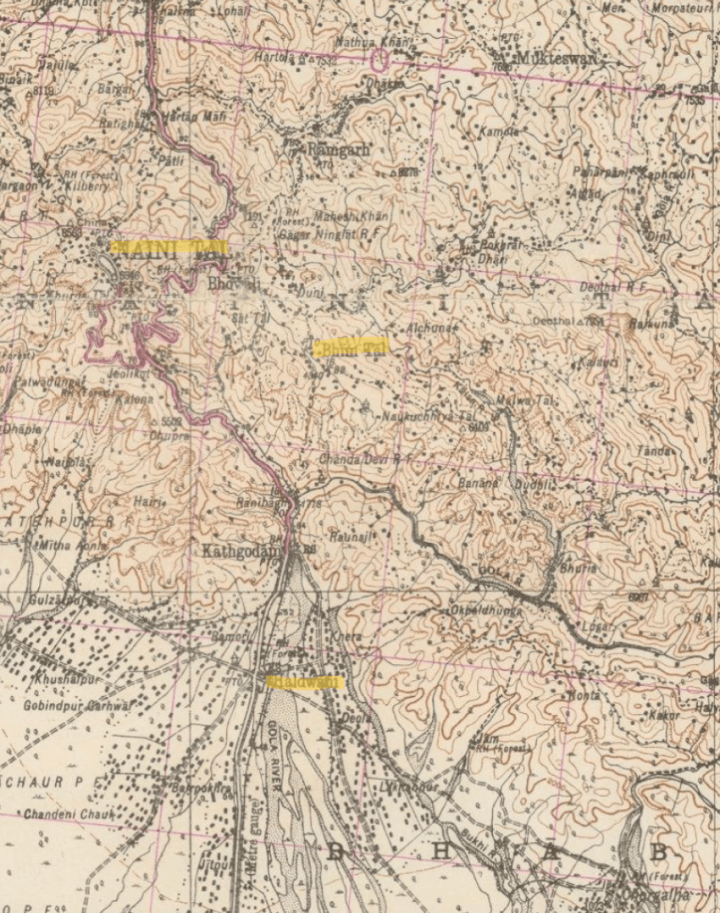
Haldwani is situated below the hills and was one of the areas ceded to the British in the Treaty of Sugauli. At the time of the treaty, it was sparsely inhabited, mostly by a native tribe known as the Buksa and the area towards Tehri with its thick forests, had once been a hunting ground favoured by the Mughals. The town was established in 1834 as a marketplace for the hill people who visited the foothills during the cold season. The first brick buildings made their appearance after 1850, although an English middle school was established in 1831. The name is derived from the haldu trees (Adina cordifolia) that flourished in the vicinity – “Haldu-vani” or forest of haldu, which the British turned into Haldwani. Its importance, however, was not the trees but that it served as a gateway to Kumaon. Whatever its charms might have been in the winter during the monsoon, it was a decidedly unhealthy place, and by September, the 66th were withdrawn back to the hills. The police sowars and burukundazes – men from the plains – in the employ of the British, were finding their encounters with the rebels too much for their liking – on 7 September they fled, leaving behind a small lev,y of hillmen.
Taking advantage of the situation that now presented itself, on 17 September, a rebel force, some 1000 strong, of horse and foot rode out from Bareilly and took Haldwani. Ramsay was not having any of this, and the next day, they were booted out by a detachment of troops under Captain Maxwell (with a party of Gurkhas, 40 men of the militia cavalry and the 8th Irregulars) who cut up 150 of the rebels in a relatively minor skirmish.
Ramsay likewise withdrew the local police to the entrance of the hills but kept a continuous patrol moving about the lower area of the Haldwani district. At the beginning of October, Khan Bahadur Khan decided Naini Tal was his objective; he had also been trying since July to convince his compatriot Bani Mir to attack the station. For his part, Mir did nothing until the raid on Haldwani in September. Khan, realising Mir needed a little more encouragement, sent another regiment of infantry and cavalry to advance on Haldwani. The British had decided not to hold the town, and when Khan’s force arrived, they burnt it to the ground and seized the canal buildings or godowns at the mouth of the valley leading to Naini Tal. Khan had a formidable force, estimated at 5000 strong.
7th October 1857
“The force was too strong to be attacked by the four companies of Gurkhas sent down under the command of Captain Ross of the 66th, but it was decided to attempt to cut up the cavalry part of it. Although the attempt to secure the cavalry failed, the British force succeeded in so alarming the enemy that, fearing an attack, they were seized with panic, cut the heel ropes of their horses, and made off helter-skelter, leaving behind all their gram and some other property. In this affair, the Gurkhas lost one man killed and one wounded. A rebel sowar was caught next morning and duly hanged. The rebel leader had been wounded in the affair of the 7th.”
Among the officers under McCausland was Thomas Sydney Gepp – an eager 21-year-old lieutenant who was finding life quite exciting. On 4 October, returning from week-long outpost duty, Gepp was ordered to take command of a company that had been ordered down to Haldwani to keep an eye on a force of rebels but lately arrived. Consisting of up to 3000 footmen and six guns, they were being watched by strong picquets set up by McCausland to guard the hill passes, but he wanted Gepp with some of the Naini Tal Militia to move down towards Haldwani.
Gepp found his entire command was perched on a hill from where they could spend their time “watching the scoundrels.” He decided he would not make the lives of the rebels easy. The paths up to his position, which was formed at the junction of two rivers, were devilishly steep, but Gepp built stockades to make things more complicated – he then broke up the bridge and sealed off his position completely. On the opposite side of the river was the road to Naini Tal, but his duty was to protect the Bhim Tal Road, which branched off towards Haldwani – three miles further down, McCausland had positioned another picquet, a mixed force of Gurkhas and the Militia. His idea was to draw the rebels up the hills, allow them to advance as far as the first picquet and then have Gepp sweep down to cut off their retreat. As Gepp was not on the direct road to Naini Tal, he would have been able to remain unseen until the last moment – had the rebels been obliging. Instead, they decided not to venture up just yet. Disappointed, Gepp was ordered to withdraw, but it was a ruse.
“Consequently, the Jhulee piquet was ordered up to Naini Tal again, and the one I was in was withdrawn to Bheem Tal. One night, when I had been at Bheem Tal a day or two, I received orders to start at 11 o’clock p.m. and proceed to that point from which the piquet had been withdrawn with fifty of my men. I started at the appointed hour. The night was very dark, the road steep and stony, and to add to our troubles, when we had marched about halfway, a tremendous tempest came on. We arrived at our old position rather drenched. I inquired if the detachment of our regiment, under Ross, which I was to join, had arrived. Being answered in the negative, we were glad to take shelter under some sheds from the rain, which was coming down with tropical violence. We waited there about four hours. As I was in perfect ignorance as to the object of this movement, you may fancy that I was speculating all the time about the purport of this secret expedition. When I was tired of waiting, we descended into the road. I found a moderately dry spot underneath a rock, and just as I was dropping off to sleep, the detachment came up. It consisted of two hundred and fifty of our men, and was divided into five companies of fifty men each.”
Captain Ross informed Gepp that the objective was to surprise a cavalry vedette at the canal buildings at the mouth of the valley, which led up to Naini Tal. Gepp was in position at dawn, and promptly at 8 am, the vedette, consisting of four sowars, arrived. At 150 yards distance, they spotted Gepp and his men hiding behind a rather thin hedge. Ordered not to shoot at them until they had passed, Gepp realised they were turning back towards Haldwani, but he had to let them go. Meanwhile, Commissioner Ramsay suggested Ross move his men further back, to thwart any rebels should they decide to dash further up the road.
Two hours later, the sowars came back with their comrades, but Ross and Gepp were ready.
“Soon we saw the red coats of the 8th Irregular Cavalry appear in sight (you may imagine how exciting it was) and a Native Officer with another “sowar” in advance of them. As soon as this Native Officer had
passed me, I ordered my men to fire. They did so, but unfortunately, the greater portion of them aimed at his horse instead of at the man himself. The horse was struck by fourteen bullets, and the “sowar ” was wounded in the leg. He then dismounted and, using his horse as a shield, fired, and with one barrel of his rifle shot one of my poor little Goorkhas in the stomach, and another man in the hand. At this time, the cavalry regiment was quite close, and the wounded “sowar” unfortunately made good his escape. If the cavalry regiment had had the pluck to charge us then, we should all have been cut to pieces, as my company only consisted of fifty men; but, fortunately for us, the other companies at this moment burst from their concealment, and fearing that they would be surrounded, they sent their horses along and halted at some distance off.”
With orders to not attack Haldwani or for that matter pursue the rebels through the jungles, Gepp ordered his men to retire a mile further up the road. While the rebels dispersed, Ross returned to Naini Tal and Gepp back to Bhim Tal. As such, Gepp blamed the whole affair on Ramsay – the companies were placed too far from each other and only Gepp’s men ended up under fire.
 Mutiny Reflections