Naini Tal
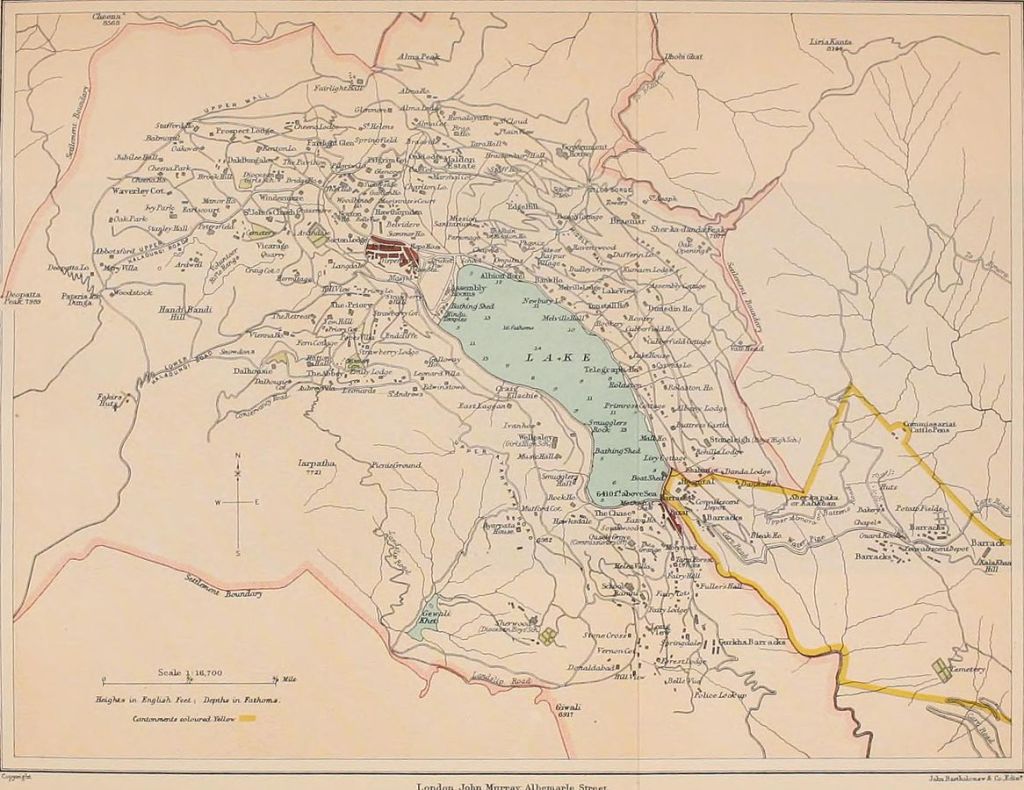
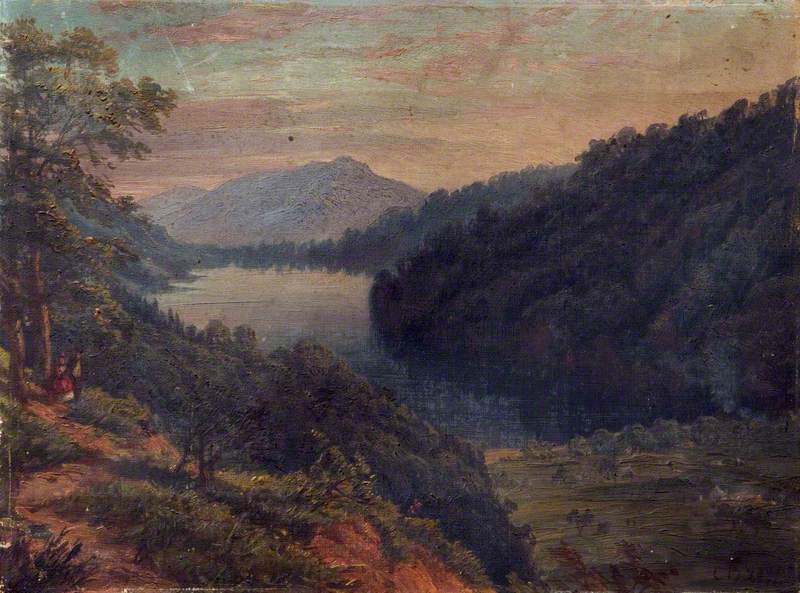
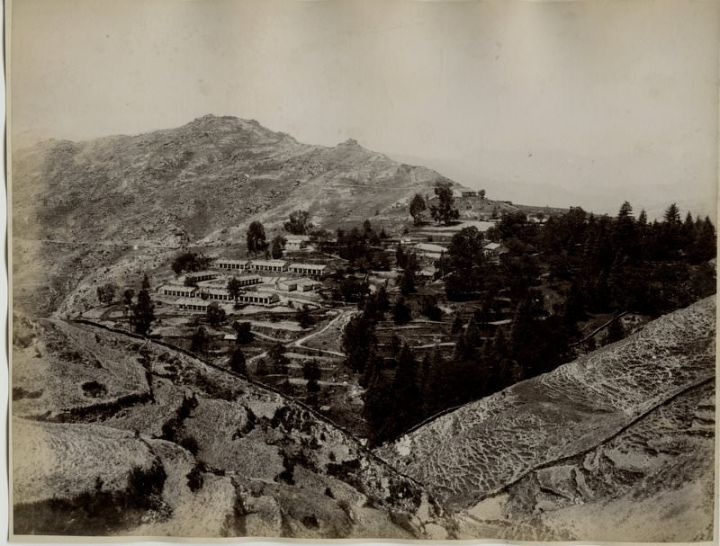
The Kumaon Hills came under British rule following the Anglo-Nepalese War, but Naini Tal itself was only established as a hill station in 1841 – the first European-style house, called Pilgrim Lodge, was built by a sugar trader, Mr P. Barron, who wanted a retreat from the heat of Shajanhanpur. He stumbled upon the beautiful valley quite by accident while on a hunting trip – to shoot bears – in the hills. By 1846, houses had sprung up on the surrounding hills. The town was centred around the lake, and very soon after, a hotel, a hospital, a church, schools and shops sprang up. Naini Tal Lake was found to be wonderful for boating – a popular pastime at 7’500 feet above sea level. Located in the Siwalik Range and surrounded by forested hills, with views of snow-capped mountains, being only 70 miles from Bareilly, Naini Tal was an ideal hill station for the British escaping the Rohilkhand’s summer heat.
In 1857, following the mutiny at Bareilly, Naini Tal was faced with a flood of women, children, officers and civilians fleeing the mutinies in Rohilkhand. On 1 June, the first refugees reached Haldwani, and those from Moradabad arrived three days later at the Kala Doongee (Kaladhungi) – by 6 June, all were safe in Naini Tal. Commissioner Henry Ramsay, not a man inclined to panic, quickly organised the gentlemen in the station into a militia; these gentlemen, besides the regular civilians residing in Naini Tal, were also military men on leave and officers who had escaped from their mutinous regiments in the plains. They were initially sent out on nightly patrols around the town to keep ruffians at bay, but would eventually be formed into the Naini Tal Militia.
Ramsay laid in supplies and stores to last three months, just in case the town was besieged. As such, Naini Tal was cut off from all communication with the plains, and it would not be until early July that a postal line could be established with the hill station of Mussoorie, nearly 180 miles distant.
Ramsay’s problems were not so much with the mutineers at first, but with hordes of dacoits (armed bands of robbers) from Rampore and Moradabad, intent on taking advantage of the lawlessness in the plains, to scavenge their way through the lower hills, pillaging villages, plundering cattle and stealing grain. Without sufficient men to patrol the lower hills, Ramsay confined his operations to the area surrounding Haldwani – when bands of “evil-disposed” Hill people began making trouble, Ramsay declared martial law in Kumaon to good effect.“In the first few cases of dacoity, I sentenced them to long terms of imprisonment: this was not sufficient, and I gave longer sentences, but without success, and at last I sentenced some dacoits to capital punishment. This was made known throughout the Province; the bad characters were frightened, the good men felt safe, and the country remained as peaceable as in former years.”
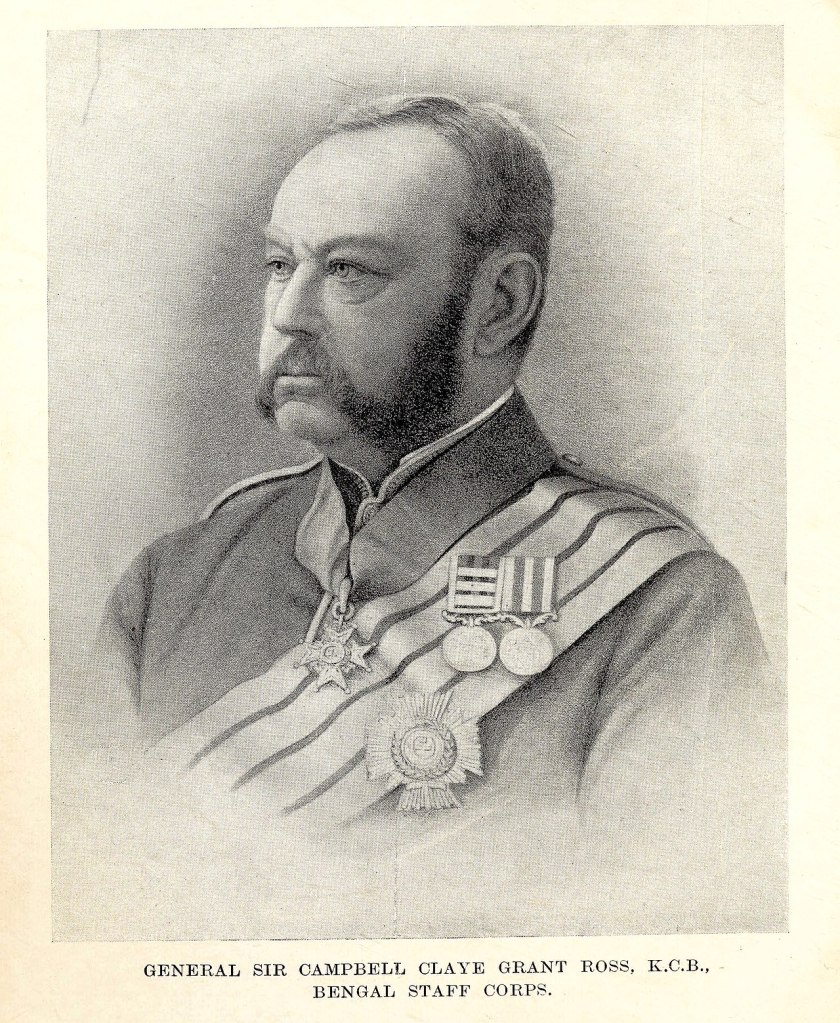
Following the defection of the artillery, the whole garrison at Kumaon consisted of the 66th Gurkhas and a few officers who had escaped the mutiny in the Rohilkhand districts. The Gurkhas manned the only two artillery guns Naini Tal had to offer. On 18 July, a new Gurkha regiment was raised by Lieutenant Macintyre at Pithoraghar and Lahughat to relieve the 66th of their many duties in Almora and the defence of Naini Tal. However, the 66th continued to be divided between Almora, Naini Tal, Bhim Tal and the defensive outposts at the foot of the hills towards Bareilly. The 66th Gurkhas were commanded by Lieutenant Colonel McCausland, who would eventually hand over his command to Captain Campbell Claye Grant Ross (later, Major General Sir C.C.G. Ross) upon the formation of the Kumaon Defence Force.
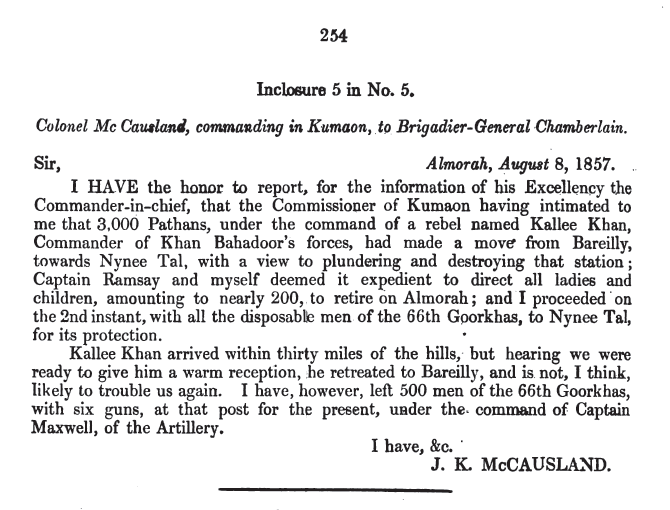
Even the best efforts of the 66th Gurkhas, however, could not prevent apprehension and panic in Naini Tal, and for a short time in July 1857, the 200 women and children were sent to Almora. The move had been precipitated by the beginning of the Eid festival – the Rampur Nawab, Yusef Ali Khan Bahadur, had done all he could to assist Ramsay, but on the advent of the festival, he was fearing for his life. Khan Bahadur Khan, among others of the Rohillas, had taken a dim view of Rampur’s allegiance with the EICo, and the milk was further soured by the Nawab providing refuge and safe passage to European fugitives fleeing Rohilkhand through his dominions to the hills. Declaring openly that he might well be killed and fearing an uprising in Rampur, he implored Ramsay to see to the safety of the women and children. Should he be killed, there would be no one left in his dominion to prevent an attack on Naini Tal. The festival passed off without any incident, the Nawab continued to hold his district, and the women and children returned to their lakeside refuge.
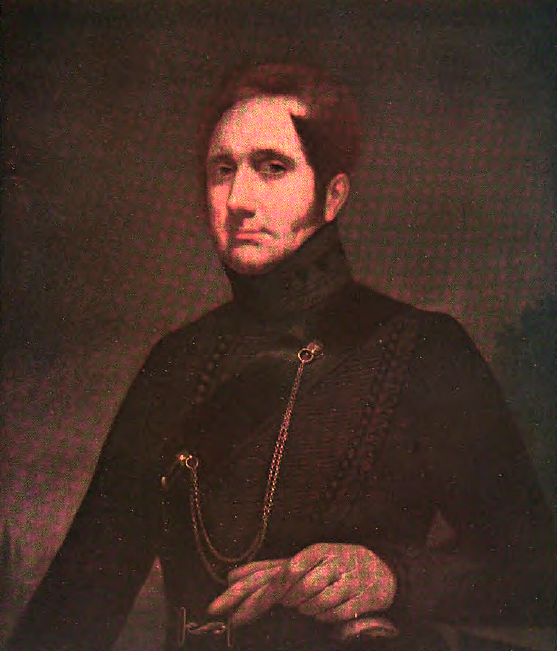
Lieutenant Colonel John Kennedy McCausland
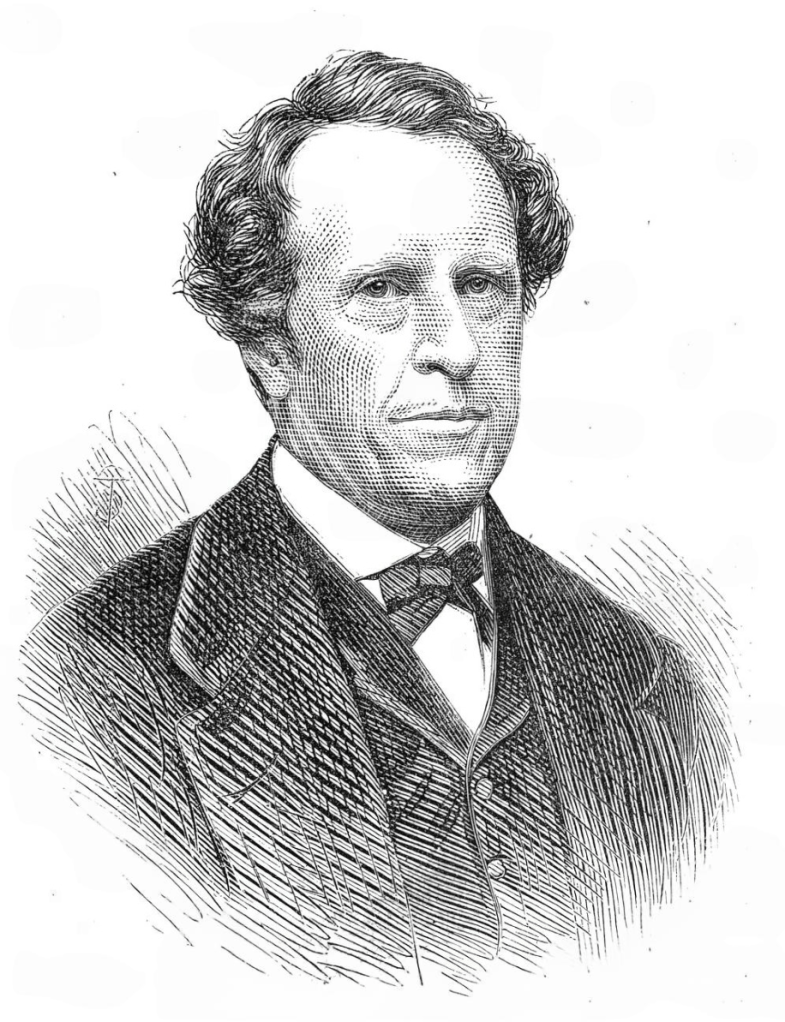
John Kennedy McCausland was born in 1803, the second son of Marcus Langford McCausland and his wife Maria, the second daughter of John Kennedy of Cultra. He joined the service of the EICo’s army in 1819 and received his first posting on his arrival in India in 1820 to 1/60th BNI. In 1821, now a lieutenant, he could be found doing duty with the Nasiri Battalion; although he transferred to the 4th BNI in 1823, he continued with the Nasiris for another year until August 1824; in the meantime, he transferred again to the 7th BNI in May 1824. The 7th was called up for the First Burma War and found himself in Cachar in 1825. Following Burma, he transferred to the 2nd Extra Regiment – later the 70th BNI – in May 1825, but the Nasiri Battalion seems to have been his calling after all; McCausland would be Adjutant to the 1st Nasiri Battalion in 1826 and by 3 May 1832, he was second in command. Raised to captain in 1836 and with no more promotions in sight, McCausland took a position in the political department, as an assistant in Subathu and then as superintendent of public buildings, a position he held until 1833. In 1835, he was back to commanding the Nasiri Battalion and continued with them until 1838. He returned briefly to the 70th, but it was back to the Nasiris again as their temporary commander in 1841 – a year later, he was asked to command the Arakan Local Battalion, where he remained until 1846.
He finally took his furlough in January 1846 and did not return to India until November 1847, the same year he received his majority. The Second Sikh War gave him plenty of service – Ramnagar, the passage of the Chenab, Chillinawallah and Gujerat. From January 1852 until July 1853, he was back on furlough, during which time he was posted as Lieutenant Colonel to the 2nd BNI. However, on his return to India, he took up employment with the 50th BNI instead and hopped over to the 54th BNI at the end of 1854. The same year, his daughter, Emma, married a promising young civilian, Robert Nisbett Lowis, in Simla.
In 1855, a position opened with the 1st Nasiri Battalion, renamed the 66th Gurkha Regiment. In October 1857, he was given command of the Kumaon District, but it was short-lived – Sir Colin Campbell would send McCausland to command Fatehgarh (where his daughter Emma had resided before her death at Cawnpore), in May 1858, where he remained until 1860, when he was posted as commander to Gwalior. A final transfer to the 29th BNI in 1860 and a promotion to Major General in August 1861 saw McCausland finally retire from the service 4 months later. He returned home and died, an Honorary Lieutenant General in Cheltenham on 23 July 1879.
 Mutiny Reflections