Dhar Fort
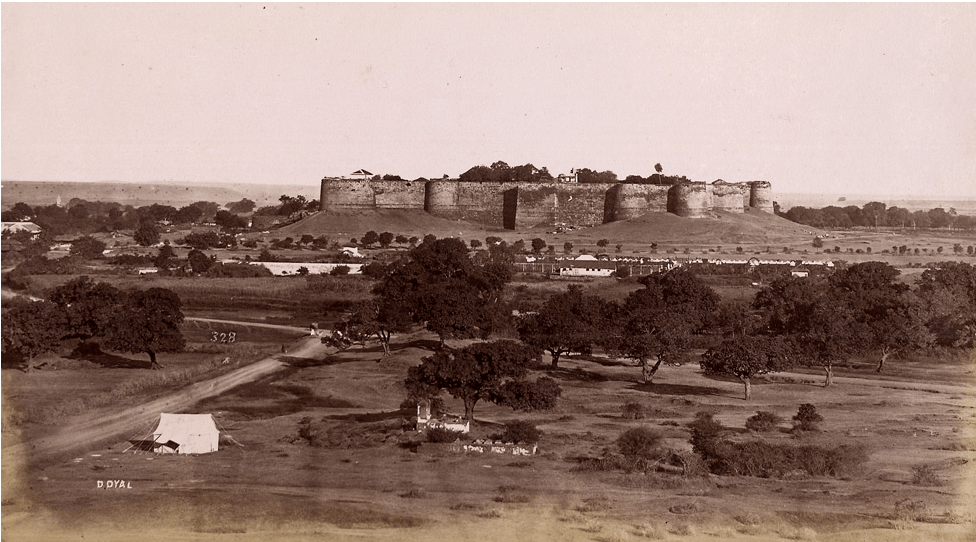
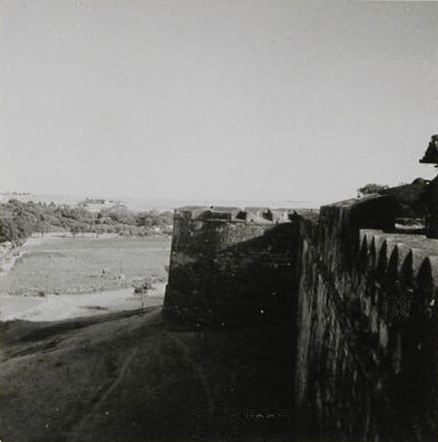
Built of red sandstone and standing on a ridge detached from the town, Dhar Fort boasted of massive stone walls some 30 feet in height, broken at intervals by towers. Attributed to Sultan Mahmud Tuglaq of Delhi, it was constructed in 1344 when Mahmud was on his campaign through the Deccan with the aim of conquest. A third gate bears an inscription stating it was built during the reign of the Mughal emperor Aurangzeb, so it is likely the Mughals made their additions to the structure at that later date. In its long and turbulent history, Dhar Fort witnessed battles, sieges and one famous birth – that of Peshwa Baji Rao II, who would, of course, grow in legend as the last Peshwa of the Maratha Confederacy and the man who adopted the Nana Sahib as his son. As such, it was a formidable place and one that would take Stuart the next six days to capture.
On Sunday, the 25th of October, it was decided the breaching battery would be placed, and the 86th with the Madras Sappers were sent off at 5 am through the gorge on the road leading to Dhar. They turned into the circuitous lane along the outskirts and soon found themselves, by advancing under cover of huts and mud walls, some 500 yards from the fort. A few trees were quickly chopped down, muddy nullahs filled, and walls knocked down to make way for the advance of the field batteries and heavy guns to their positions. As the troops came in sight of the fort, the insurgents opened up a “smart fire of musketry and round shot but the artillery dashed up and quickly opened fire on the bastions while the 86th returned fire with their Enfield rifles. However, no matter how much shot and shell they now poured into the fort, it had no effect on the walls. There was some damage – a house on the one of the southerly bastions and some of the parapets, but beneath these and the the crenelations of the curtains, the walls remained perfectly untouched. So, another line of attack was ordered from a high mound that extended the whole length of the western face and ended at a large lake. As the whole line was filled with houses protected from the fort by the mound, which rose three times the height of the houses, it provided not just excellent cover for Stuart’s men but safe accommodation. The 25th quickly took this as their headquarters as they could easily relieve their men along the entire parallel. From here, the entire west face of the fort was exposed as the south, east, and north provided too little cover and the sides rose almost perpendicularly from the ground, making climbing nearly impossible and the walls and bastions on these sides considerably higher.
So, on the west face, the breaching battery was erected on the long mound, only 400 yards distant and the weakest corner curtain was selected as the spot. The inhabitants of Dhar, especially those who resided by the mound, took flight – not that they had much say in the matter. “…red-turbaned sowars and very hairy dragoons came jingling, all heat and excitement among the stream, quartermasters and adjutants rushed backwards and forwards threading their way at a walk or dashing onward like messengers of death; obedient, bulky indispensable elephants with the needed engines of fort destruction moved slowly and ponderously along; crowds of Europeans and natives, sappers and artillerymen, the 25th and 86th, all hauling together, hooting and laughing, all very hot, and all aiding the transit of the siege guns to the front.” It seemed inexplicable that the insurgents, with such an impenetrable fortification, had left the one area not only unguarded but had woefully neglected the fact it provided an almost covered way for the very men who would soon be beating down their walls. While some of them had concealed themselves in the very houses the 25th intended to occupy, they spoiled their chances by not firing on the infantry but training the guns on the Woolcombe’s battery instead – the 86th men with a few sappers soon put an end to that idea.
During the day, under the direction of Major Boileau of the Madras Engineers, the site was selected, with the work of building the battery was completed that night, with improvements added the next day and the blinds placed on the embrasures. Not that the idea was lost on the insurgents. In their turn, they attempted to throw up a battery on the left but only provided practice for Woolcomb’s guns until they gave up. A mortar battery was then erected further to the left and closer to the gate, which, every quarter-hour, sent missiles whistling into the fort and smashing into the palace.
As soon as the battery was deemed ready, the heavy guns opened fire and little by little, “the thundering weight of metal continuously battering at one spot had its inevitable result.” Little by little, the stone walls crumbled as the 18-pounders continued their work. With each shot, a shower of bullets and balls answered from the fort, and occasionally, the balls from the cannons smacked into a house or a wall.
On the evening of the 26th, long after dark, the village at the foot of the fort was set on fire by Stuart’s men. They had only partially succeeded, and the next night, a second firing party volunteered to enter the remains between the British position and the fort to “attempt a more effectual destruction than followed the first trial.” The party returned, and behind them, the entire town stood in a mass of flames, creating, thus on the ashes, a clear line of sight.
It was not until the 29th that the 18-pounders and the 24-inch howitzer had finally managed a considerable hole in the curtain. Stones now rolled freely down the slope after each blast while the insurgents, still vigilant, continued their shooting.
“Rifle shooting against such walls availed but little…the enemy could walk leisurely along the ramparts inside, take their aim and discharge their pieces in perfect safety. By the time our riflemen saw the puff, and could take aim, they had sauntered away to some other part, and so 20 men behind walls could thus easily engage the attention and harass hundreds outside.”
By evening, a letter arrived for Brigadier Stuart; the breach was widening, and the fort now wanted to know what terms would be given if they surrendered. Stuart replied that surrender would be unconditional, to which the insurgents replied, “Very good, we don’t care. You are only destroying the Raja of Dhar’s property, not ours. We have only lost a few men, but our cattle are being killed by the shells.” The words might have represented a few as through the night, all along the north and east face of the fort, the insurgents were trying to escape using ropes and baskets. Most of them were captured by Stuart’s men.
On the 30th, a white flag “popped over the parapet” and at length, the cease-fire was called. The 18-pounders sent their final shots, and then all went quiet.
The staff came up, and a vakil was sent to the fort gate to hear what Durand and the others had to say.
Meanwhile, a strange standoff between the two armies proceeded – while the conference carried on, Stuart’s men swarmed out and proceeded along the mound, while the insurgents paraded on the bastions and parapets of the fort, each armed with his tulwar, shield and matchlock. Some walked back and forth while others sat and stared. A few “grey-bearded, gaudily dressed fellows” took the opportunity to examine the breech, which they did with as much thoroughness as time allowed. The conference yielded nothing, and the bombardment recommenced. It continued unabated for another 24 hours, smashing the roof of the palace and shell after shell fell into every part of the fort – the insurgents, on their part, were no longer showing themselves along the parapets, and those that were still alive were wary of showing their heads.
Finally, two corporals of the Madras sappers volunteered to examine the breach and storming parties were ordered to make ready. Thirty men of the 86th under Lieutenant Henry, 60 men of the 25th under Captain Little, while Captain Brown commanded 50 Madras Sappers formed the party. The volunteers, Corporals Hoskins and Clarke went off to the breach around 10 pm, the guns firing blank charges when they arrived at the fort. They went to the top, made their observations and returned, announcing the breach was by all means practicable.
Suddenly, to the northwest, beyond the lake, severe firing was heard – the dragoons and the irregulars rode out to meet it while the storming party charged the breach. And found the fort was empty. Down to a man, the insurgents had disappeared and were fleet-footed enough to avoid a pursuit by the dragoons and the irregulars. What they had left behind as mounds of gunpowder which, as Dr Butler of the Bombay Artillery, Lieutenant Thane of the Commissary and Lieutenant Giles of the 14th Dragoons jubilantly walked over the room in the dark, they injudiciously set alight with the embers of the cheroots.
“Lieutenant Thane was in flames in an instant, jumping in the open air like a wild man and crying out, ‘Put me out! Put me out!’ There lay Dr Butler, blown down, horribly burnt, listening to this cry of ‘Put me out’ while other grains of gunpowder quietly fizzed close to him and running away in tiny combustion in various directions – maybe to another heap, which would assuredly bring down the building about his inquisitive head. Lieutenant Giles was more singed than burnt.” All three were carried out in dhoolies, and the festivities of capturing the fort were given over to duty – the 25th was set to guard the palace, the gate and the breach, and walking in such a careless fashion around a dark fort ended.
The next morning a wiser though hardly kinder examination was given to the fort – all around the insurgents had left something behind, whether it was small piles of grain and heaps of clothes, everything was scattered about in the horrible remains of war – the smashed walls and the palace “torn to rags ” by Woolcomb’s mortars. Wounded men were found abandoned in corners, dead ones unburied, exposed and bloated lying next to copper pots, drums, spears, matchlocks, muskets and bayonets. Terrified, wounded horses and bullocks lowed around the fort, while their dead compatriots lent pestilence to the already foetid air in some of the furthest reaches of the fort. Every room opened was not inspected as much for its debris but for its plunder – and of that, the army found plenty.
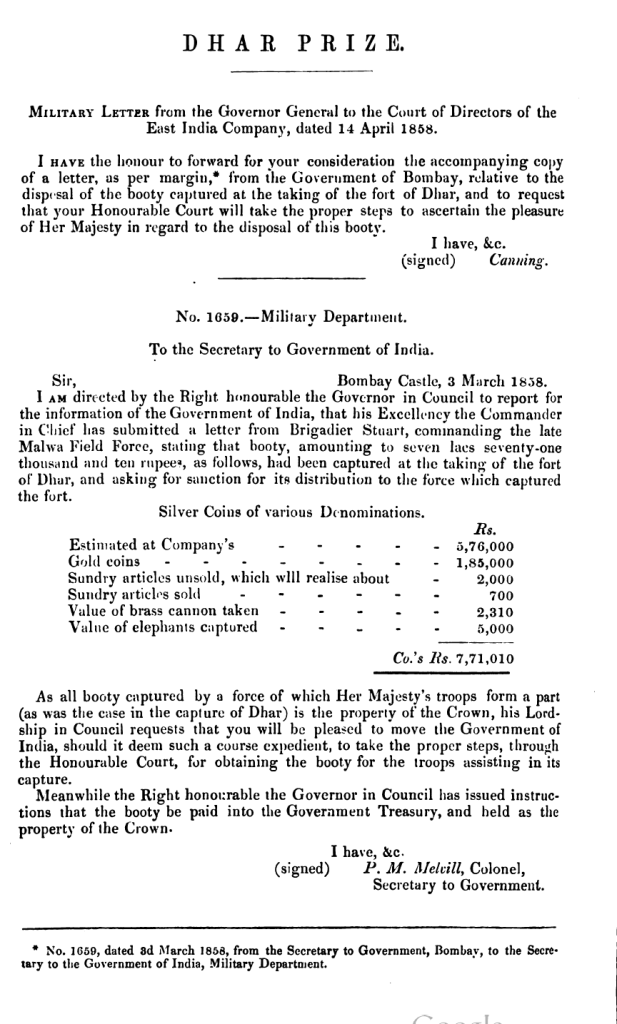
Enormous chests were located and flung open, revealing the treasury of Dhar and, above all, its treasure. Everything from the silver trappings for elephants to a chaos of “huge silver basins, dishes, plates, cups, lamps and vases beneath which lay great bags of silver…” The sappers continued their work, breaking open walls and tapping floors, searching for the legendary Dhar jewels. Still, these remained lost, even after the central tank was dragged and pillars, thought to be hollow, were brought crashing to the ground. While undoubtedly the more wily of Stuart’s men helped themselves liberally before the prize agents got to work, all that was collected was dispatched to Mhow – 9 lakhs seems a small amount compared to what was supposed to be at Dhar.
As for the fort, the bastions and curtains were partially destroyed by the sappers, rendering it indefensible; the wounded were sent back to Mhow, and the column marched onwards. As for the Dhar raja and his Darbar, Durand ordered the state confiscated and the raja removed until the government could complete their investigation of the events. It was eventually proved that the Dhar Darbar had ultimately little to do with the insurrection. They had been overwhelmed and finally overrun by the mercenaries they had employed. These came in their hundreds, plundered the government daks, terrorised the civil servants, and looted neighbouring villages while the Darbar eventually could only sit back and watch as the mercenaries took over the fort and set themselves up as the de facto government of Dhar. The Darbar, for their part, tried all they could, with tied hands, to stop the relentless plundering of the mercenaries. They sent their vakil to negotiate with them on behalf of the Bhopawar Agency and tried to prevent the sacking of Sirdarpur. They sent elephants to Durand to assist in the relief of Mhow and even succeeded in smuggling Captain Hutchinson and his wife to Mhow to prevent the mercenaries from killing them. They managed to prove their case to the parliament insofar that Maharaja Anandrao Puar III Bahadur was reinstated in 1860 with his territories intact and was granted the right of adoption by Sanad in 1862. The administration was, however, placed under supervision until such time as the raja came of age. In 1864, he was invested with full ruling powers.
Meanwhile, the Malwa Field Force continued their march and their battles had only but begun.
Sources:
Durand, H. M. The Life of Major-General Sir Henry Marion Durand. Vol. I. London: W. H. Allen & Co., 1883.
Intelligence Branch, comp. The Revolt in Central India 1857-59. Simla: Government Monotype Press, 1908.
Lowe, Thomas. Central India during the Rebellion of 1857-1858. London: Longman, Green, Longman & Roberts, 1860.
Malleson, G. B. History of the Indian Mutiny, commencing from the close of the 2nd Volume of Sir John Kaye’s History of the Sepoy War. Vol. I (1878); Vol. III (1888). London: Wm. H. Allen & Co.
Srivastava, Khushalilal. The Revolt of 1857 in Central India – Malwa. Bombay: Allied Publishers, 1966.
Sylvester, John Henry. Recollections of the Campaign in Malwa and Central India under Major General Sir Hugh Rose. Bombay: Smith, Taylor & Co., 1860.
 Mutiny Reflections
I am a History student. Reading this article from Dhar.
LikeLiked by 1 person