Brave in Duty – Private Denis Dempsey
We have already seen at Badli-ki- Serai that some men were not heroes of just one moment but were destined to be heroes of many. Such a man was Private Denis Dempsey of the 1st Battalion, 10th Regiment. Private Dempsey did not write about his exploits, nor is his bravery at Arrah mentioned in anything more than passing. Compared to what he did after Arrah, this was, if there is such a thing, the least of his deeds.
Born in Rathmichael Bray Dublin in 1826, Dempsey had enlisted in the 10th and, at the age of 31, found himself with his regiment in India. They were stationed at Dinapore when the mutiny broke out, and Dempsey was one of the 150 men chosen to march in the first relief of Arrah and the rescue of the stranded 37th. How he managed it we cannot know, but Dempsey survived the fateful night, having managed to evade being shot by sepoys and his own comrades alike, and in the morning, would be among the men who were retreating to the boats.
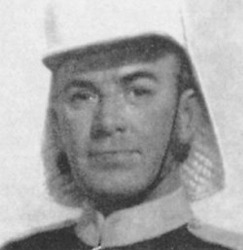
“The fighting 10th had made a name which is well known from one end of India to the other. In each and every war of that country, for the last twenty years, we find them always in the front, where their enduring valour and appearance have, on many occasions, received the marked approval of Sir Charles Napier, Lord Gough, General Franks, and many others. They were equalled by few and excelled by no regiment in the service; yet there was one manoeuvre with which they were unacquainted, and which they were now called upon to execute — to retreat. They seem to have lost all heart at this, for, shortly after starting, despite the endeavours of their officers, the men of the different regiments again got mixed together, all order was disregarded, the column disorganised, and the retreat became a rout.”
Somewhere in the confusion, Dempsey found the severely wounded Ensign Henry Jones Erskine of his own regiment. As Erskine lay there helpless, expecting to be bludgeoned or bayonetted by the enemy, Dempsey and another man lifted the officer and carried him to the boats. They managed to get Erskine to safety, but he died in Dinapore of his wounds.
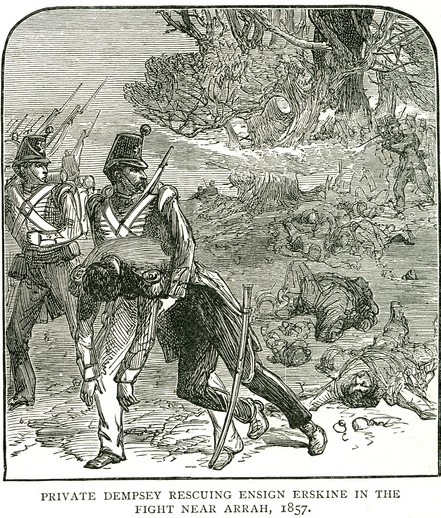
A memorial was raised to Captain Dunbar and Ensign Erskine at Dinapore which still stands today and is inscribed:
Erected by his brother Officers to the Memory of Captain Charles Dunbar HM’s 10th Regt killed in action with the Mutineers near Arrah July 29th 1857 Aged 51 years. Erected by his brother Officers to the Memory of Ensign Henry Jones Erskine HM’s 10th Regt who died at Dinapore July 31st 1857 from wounds received in action with the Mutineers near Arrah July 29th Aged 29 Years.
Private Dempsey was a man of duty and a man of his regiment. Barely recovered from the misery of Danbar’s folly, he found himself marching with Eyre’s force to Jugdispore in pursuit of Kunwar Singh. On the 12th of August, Dempsey would be the first man to enter the village under “a most galling fire…” and lead the men in a successful attack.
Dempsey would fight his way through the Indian Mutiny, and March 1858 would find him with the 10th Regiment as a part of the 20’000 reinforcements under Sir Colin Campbell, whose mission it was to retake Lucknow once and for all. The assault started on the 1st of March and would continue for over two weeks.
Sir Colin Campbell wanted a quick advance, and the one way to achieve this while keeping casualties low was, instead of engaging in street fighting, to use the artillery to blast a line through the city, annihilating walls and buildings in their way. However, the black powder needed to be carried forward by hand – no easy task, for as the sparks from the burning buildings reigned down on the city, they just as easily landed on the powder bags. It fell to men like Private Denis Dempsey to undertake this task. On the 14th of March, it was decided to blast a hole behind an enemy position, and it was none other than Denis Dempsey who was to carry the powder bag. Making his way through the burning buildings and ignoring the hot sparks settling on the powder bag in his hand, he appears to have had a very attentive guardian angel, for none of the bullets from the enemy sharpshooters hit the man. For this action, among others, he was awarded the Victoria Cross.
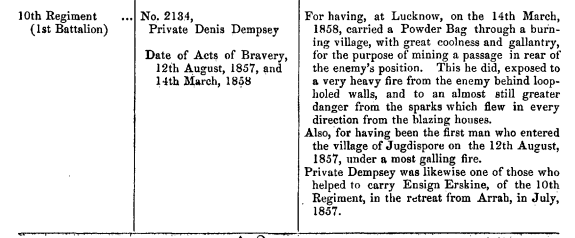
In 1859, the 10th Regiment returned to England after 16 years in India. Dempsey was presented with his Victoria Cross by Queen Victoria at Windsor Castle on 9 November 1860. However, his career was far from over. Dempsey would serve in Ireland, The Cape Colony in South Africa, Japan, Hong Kong and Singapore. In 1877, the 10th returned to England, where they would stay for 18 years. As for Private Dempsey, he left the army and moved to Canada, where he settled in Toronto and died in 1886 at the age of 60.
Quo Fata Vocant’ ‘Whither Destiny Takes Me’ – the Motto of the Royal Regiment of Fusiliers.
Sources:
Best, Brian. The Victoria Crosses that Saved an Empire: The Story of the VCs of the Indian Mutiny. Barnsley: Frontline Books, 2016.
Halls, John James. Two Months in Arrah in 1857. London: Longman, Green, Longman, & Roberts, 1860.
Halls, John James. Arrah in 1857. Reprinted with an account of the relief by Charles Kelly. Edited by G. F. T. Leather. Dover: “Express” Office, 1893.
Kaye, John William. A History of the Sepoy War in India, 1857-1858. Vol. III. London: W. H. Allen & Co., 1876.
Sieveking, I. Giberne. A Turning Point in the Indian Mutiny. London: David Nutt, 1910.
Tayler, William. The Patna Crisis; or, Three Months at Patna During the Insurrection of 1857. London: James Nisbet and Co., 1858.
Trevelyan, George Otto. The Competition Wallah. London: Macmillan and Co., 1864.
Links:
http://www.thelincolnshireregiment.org/vc.shtml
https://vcgca.org/
http://vconline.org.uk/
https://collection.nam.ac.uk/
 Mutiny Reflections