A Singular Act of Bravery – Mr William Fraser McDonell
Like Mangles, 27-year-old William Fraser McDonell joined the first relief force with a singular objective in mind, to assist his best of friends, Herwald Wake. His indignation that Lloyd would let the civilians in Arrah simply perish was equal to that of William Tayler and the two persuaded the dithering general (who Mangles believed was living “his second childhood”) to collect a force to relieve not just the 37th stranded on a sandbank in the river but to proceed with all haste to Arrah. McDonell’s estimation of the situation did not differ from Tayler’s – the fall of Arrah would mean the destruction of British rule in Bihar, and Kunwar Singh, with his now mighty army, would have free rein to go and do as he pleased.
McDonell offered his services to Captain Dunbar as a guide – he was acquainted with the river and road to Arrah, and he knew the shortest route to get there. What he did not foresee was Dunbar’s refusal to halt during the night, which was much against McDonell’s advice – as such, when the ambush happened, McDonell was next to Dunbar when he was fatally shot. Dunbar fell against McDonell, who found himself covered in Dunbar’s blood. In the melee that followed, Lieutenant Anderson was shot through the heart while trying to stop his men from firing into their comrades.
A ball hit me in the thigh, cutting it slightly only…I then shouted out that Dunbar was killed, that the first officer in command had best give orders. This brought another volley on us. … We then tried to join the main body and ran from tree to tree; the Europeans seeing us coming, all Sikhs nearly, thought we were the enemy, and fired into us, killing several; in fact, I fear as many of our men were killed by their own comrades as by the enemy. In the night, it was difficult to tell friend from foe; and after having to dodge round a tree, you, in the dark, could hardly tell where your friends were and where your foes. At last, most of us got together and beat a retreat towards a tank, near which was a high bank, and lay there all night, the enemy firing into us every five minutes, and foolishly, our men would return the shot. It was bad policy, it showed where we were, and we could not afford to throw away a single shot. . . .
As dawn broke, McDonell saw there were still 350 men of the force remaining, but the three native Dinapore regiments were drawn up in order with another 2000 of Kunwar Singh’s men, armed with long matchlocks. On the fringes stood a further 1000 men who had joined the leader’s call, all armed with swords, spears and clubs. To the horror of the retreating force, these men would make themselves “useful killing all the wounded, beating them like dogs…” When the retreat started, mayhem was let loose.
One officer already wounded carried between two others had both his ankles shot – unable to carry him any further, he lay on the ground and put a bullet in his brains, others shouted for help but no one dared venture back. They had to push forward to the river.
“It was in very truth a march of Death and Despair. There was nothing to be done but to go on, even though it meant going through the midst of a burning, fiery furnace; for to wait, or to stay behind their comrades, meant, besides the equal certainty of death, possible torture before death as well. Now and again, when the enemy drew nearer to them, the men would make a sudden bayonet rush, and clear a way through a mass of foes and scatter them right and left.”
With the river in sight, men rushed towards the boats which should carry them back to the flat and the steamer only to find the sepoys had anticipated this means of escape and had tampered with the boats and were laying in wait.
“By the time we reached the boats, 100 (men) must have been killed and then commenced the massacre. The boats which we expected to have been taken away were all there, so with a cheer, we all rushed to them, when/to our dismay, we found they had fastened them securely to the shore, and had dragged them up out of the water, and
had placed about 300 yards off a small cannon, with which they blazed into us. … The men, to escape the shot, got into the boats, and, of course, as long as they were in them it was impossible to push the boats off. So a number of men stripped themselves, throwing away their rifles and everything, and some of them managed to reach the other side. The wounded men, of course, could not swim, and some of us knew we could never reach the shore, so out we jumped and managed to get two of the boats off; well then we were at the mercy of the wind and stream, for not an oar had they left us.
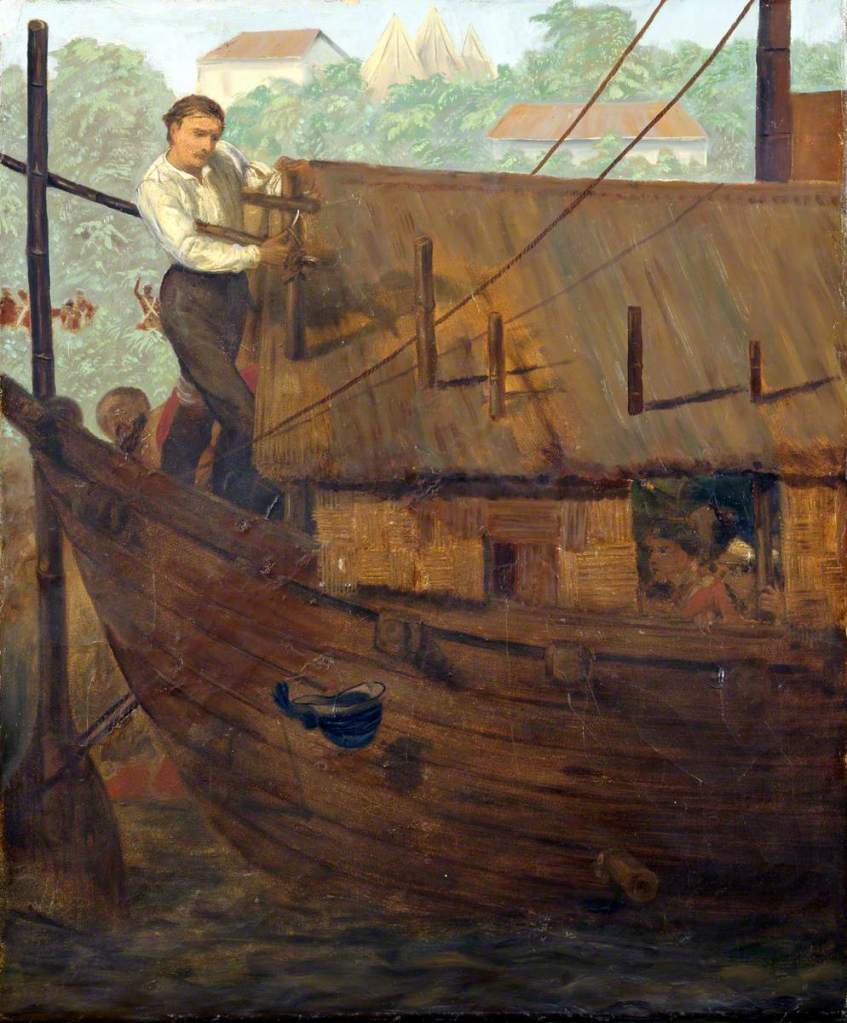
Oil on canvas, by Louis William Desanges, 1860 (c).
https://collection.nam.ac.uk/detail.php?acc=1958-12-50-1
The wind was favourable, and we started off splendidly, when, lo and behold, we gradually turned towards the shore, and then I saw they had tied our rudder, so as to bring us in again. I told the men to cut it, but no one moved, and so I got a knife and climbed up to the rudder. It was one of those country boats, covered in except just at the stern. The moment they saw what I was at they blazed at me, but God in His mercy preserved me. Two bullets went through my hat, but I was not touched. The rope was cut, and we were saved ; but about half-way across we struck on a sandbank, and then every one jumped overboard. One young officer jumped over as he was, with his sword on, and down he went; another, Ingleby, was shot in the head, and either drowned or killed. I threw my pistol overboard; my coat I had thrown away early in the morning, as, being a coloured one, it made me conspicuous among the soldiers, who were all in white. How I swam on shore I know not, as it is not an accomplishment I am a “dab” at. When once on shore we were pretty safe, and 250 out of 450 reached the steamer alive.”
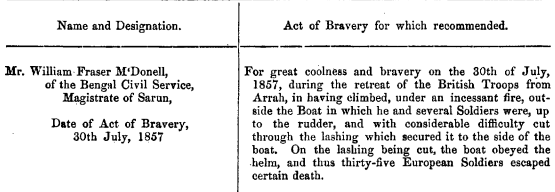
Born in 1829 in Cheltenham, William Fraser McDonell was the son of Aeneas Ranald McDonell of the Madras Civil Service and Juliana Charlotte Wade. He entered Cheltenham College in 1841 and completed his education at Haileybury in 1849.
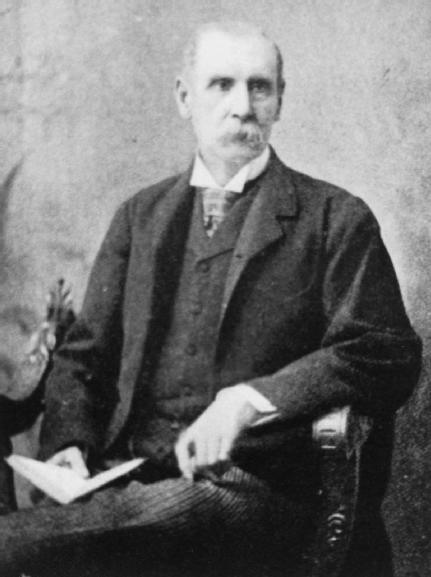
William then joined the Bengal Civil Service and became the Assistant Magistrate and Collector in Sarun from 1852-1855, and then Magistrate of Sarun from 1855-1859. He remained at his post with his lifelong friend R.J. Richardson until the outbreak of the mutiny. Following Tayler’s orders for all Civil Officers of the outlying areas to retreat to Patna, McDonell found himself effectively unemployed. The relief of Arrah solved at least that problem, and he volunteered his services as a guide to Dunbar’s force, the outcome of which we have already seen.
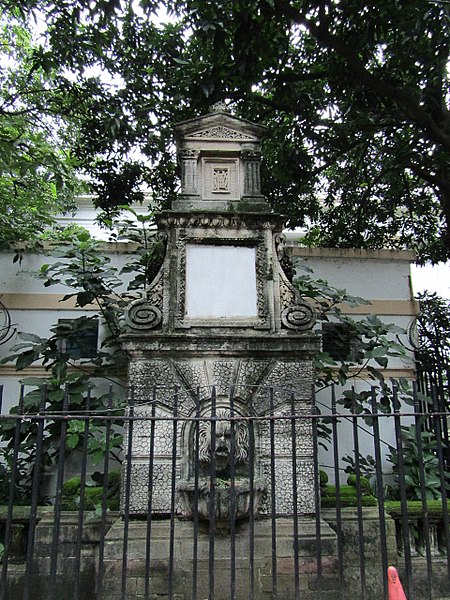
With the end of the mutiny in Bihar, McDonell was given the task of settling the confiscated estates of the rebel leader, Kunwar Singh, a task which took until June 1860 when he decided to return to England. Whilst there, on 9th November 1860, he attended his investiture at Windsor Castle and received his Victoria Cross. He returned to India in 1863 and was posted to Nuddea and remained there in the positions of Magistrate, Collector and then Judge, until July 1870. He later became a judge in Patna and eventually was promoted to the High Court at Calcutta in 1874. He resigned from the service in 1886. William McDonell died in Cheltenham of pneumonia, aged just 64, in 1894. He was buried in St Peter’s Churchyard, Leckhampton. Opposite the High Court at Calcutta, a fountain still stands today, albeit neglected and forgotten, dedicated to William Fraser McDonell.
 Mutiny Reflections