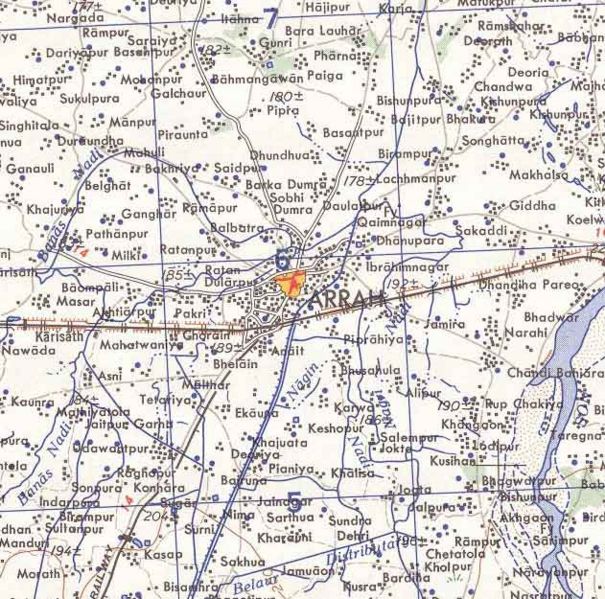
The objective of the mutineers from Dinapore was not Patna; it was not even Delhi. They were going to Arrah.
Arrah, a small civil station situated in the Shahabad district of Bihar near the junctions of the Ganges and Son Rivers, ten miles from the former and 8 from the latter, intersecting the Dinapore and Patna roads. That said, Arrah was a mere 25 miles from Dinapore – is it not curious then, when their fortunes were at their lowest, that Lloyd was unable to put together even a fraction of a force? In fact, Lloyd despaired only for himself – he expected the mutineers would ransack Arrah, kill the civilians and then return to hassle him. As such, the little station was left to its own devices.
No news of the mutiny reached Arrah. A message was received on the morning of the 25th that trouble was anticipated, but after that, nothing more was heard. By evening, the road to Arrrah was already in possession of the mutineers, and they ensured no messages reached the station.
On Sunday, the 26th of July, a sowar- who the Magistrate Mr Wake had stationed at Koelwar Ghat on the Son River – reported numbers of sepoys had been seen crossing the river, and more were coming. Wake quickly caught hold of Mr Palin, the Railway Engineer stationed at Koelwar and asked him about the boats. Palin replied he had drawn them over the other side the night before but had failed to destroy them.
The police force at Arrah did not have a stomach for a fight and, at the first sign of trouble, bolted to a man. Wake had no way to know how many rebels were coming to Arrah, and worse still, he barely had any means to defend himself. It was too late, anyway, to leave Arrah – there was nowhere left to go.
On Monday morning, the mutineers marched into Arrah. Their ranks had been swelled by sepoys who happened to be on leave and by armed men from other districts. They were not following the banner of Bahadur Shah – their leader was closer to home, and his name was Kunwar Singh. He brought with him his retainers, and the force numbered over 3000 men.
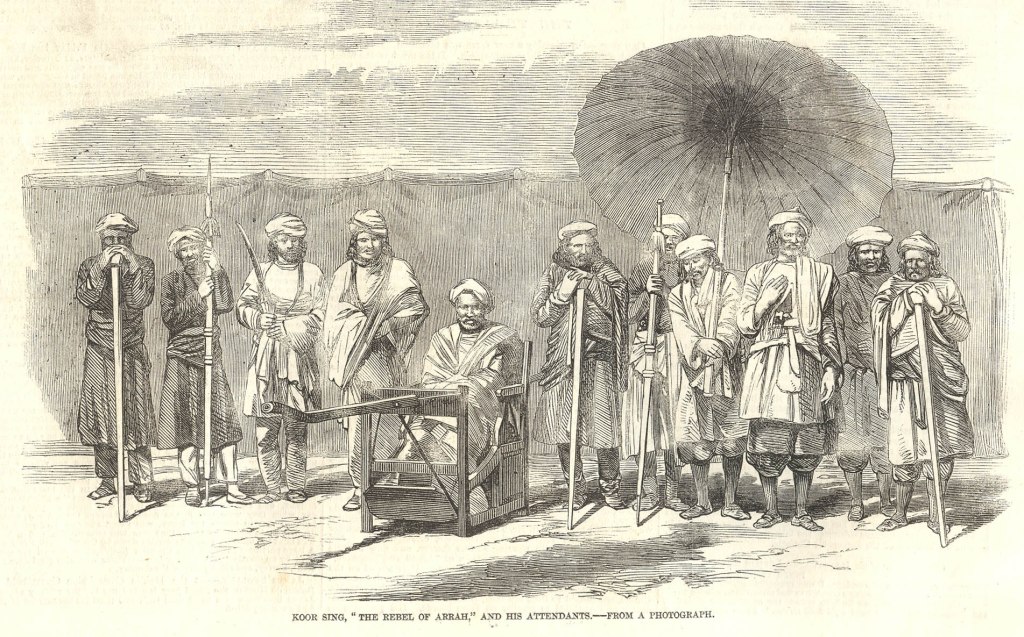
Kunwar Singh was not supposed to be a rebel. He should have been at home in Jagdishpur enjoying his retirement; after all, he was 80 years old and had already lived a lifetime longer than most. The EICo, however, had put an end to his idea of a quiet life.
Up to a point, Kunwar Singh had done everything the EICo had told him to do. As his estates were in some disarray, he had obtained an advance of money to the sum of 20 lakhs to pay off his debts. There was to have been a “gradual process of liquidation from the proceeds of his estates through the Collector at Shahabad”; however, the loan had never been thoroughly negotiated. Kunwar managed to obtain some of the money from other parties, and the rest was given as an advance. All of a sudden, for no reason at all, the Sudder Board of Revenue sent a message to William Tayler that unless Kunwar Singh managed to pay back the entire loan within a month, they “would recommend the Government withdraw all interference with his affairs and to abandon management of this estates.”
Although Kunwar Singh owned a vast estate, that one statement had turned him, in one stroke, into a pauper. He was “in reality, a ruined man” and could hardly gather together enough money to pay off the interest on his debts. He appealed to Tayler, who in turn sent letter after letter to Calcutta, fighting Kunwar Singh’s case. As late as June, Tayler was still arguing in Kunwar Singh’s favour. Tayler repeatedly invited Kunwar Singh to a council in Patna, but after what had happened to the Moulvies, he pleaded age and infirmity, knowing full well that if Tayler chose, he could imprison him too. As long as his case remained undecided in Calcutta, there was still hope. Yet bureaucrats are not well known for admitting they are wrong, and in Kunwar Singhs’ case, they refused to change their minds. The case was decided against him, and the old man realised the only way he would be able to retain his estates and keep his honour was to fight. He consented to lead the rebellion in Bihar. When the Dinapore regiments revolted, the whole Shahabad District rose, and Kunwar Singh took his place at the head of the insurgents. While Lloyd fretted in Dinapore, Kunwar Singh was marching to Arrah at the head of an army.
The men in Arrah had been aware something could happen and, acting on the intimation of Tayler, who warned them of the state of Patna, had sent their families to Dinapore in June. They then set about preparing themselves for the worst. Their only problem was none of them were military men. They were civilians and engineers.
 Mutiny Reflections
Fascinating. I must come back to read at leisure. My family lived in India for two centuries. Since the mid-1700’s to mid 20th century. My little sister and I were the last born there. On the Pakistan side, after the partition. Most of my ancestors were indigo planters. My great-grandfather worked for Scindia in Gwalior, after the Mutiny.
Thanks for your posts. I will be back.
Brian
LikeLike
Thank you Brian!
I have a few posts about Gwalior and Scindia though it isn’t quite finished – I hope you find it interesting.
That is fascinating about your family! If there is anything you would like to share to my site in regards to your family, that would be thrilling. The site started originally to examine the people of the Indian Mutiny, it has however morphed into something rather larger than I expected. I try to find my way back to the original intent when I can; there is just so much history!
Indigo features quite often in the history of the Indian Mutiny. The planters were men made of quite stern stuff! They deserve a history of their own. I just finished reading the history of indigo factories in Bihar, very fascinating.
Thank you again and I hope you continue to find my writing interesting!
LikeLiked by 1 person
Pleasure Eva. My great-grandmother was a Goutière. A family of Indigo planters near Calcutta. One of her nieces was Chritine Weston, née Goutière, born in India. She later became an American writer. Two of her novels, Indigo, and The Hoopoe are based on her childhood memories. I have all her books because though a generation “older”, she and her siblings were contemporaries of my father’s. Books might be available on Amazon though.
My father wrote a quite extensive family history, but it is inFrench. As strange as it may sound, we are French. I’ve been slowly translating the history into English, but I haven’t reached the India part yet. I will let you know.
And I will definitely come back to your Gwalior and Scindia posts and others…
🙏🏻
LikeLike
That is fascinating! Out of curiousity, I quickly searched Goutière in FIBIS (Families In British India Society) and I came up with quite a few names in the basic search, Births, Deaths and Marriages in Azimghar, Gorrackpur, Dinapore and Benares, Beoree Factory Gorruckpore, Chandernagore, Lucknow, Kanpur, Unao…basically all over northern India and and Indian Army Reserve Officer, serving in 1918 in the
2-69th Punjabis, Delhi who had previously served with the 4th Dragoon Guards, Jan-Mar 1916. FIBIS records are most 19th and early 20th century. It is wonderful to find a family with French roots in India – it is not a widely researched and deserves more attention!
LikeLiked by 1 person
Fascinating back. Thanks for the tip about FIBIS. My father did his research in the 70’s and 80’s. No Internet then. All written sources.
The French roots come from the French “counters” in India that we kept after Dupleix “lost” India to the Brits… Our “Indian” roots go back to Chandernagor. My Goutière great-gradnmother married a French Gentleman named Henri-Felix Onraet. The one who worked for Scindia. He was “Sarsubar”, chief of police or something like that. (I think the English liked to have “Europeans at key positions with the Indian princes after the Mutiny. His son Franck Onraet was later “head of hunts” for Scindia. He appears on several photos with the Prince of Wales (Later George V) on a tiger hunt.
The Onraets go back to Chandernagor where arrived during the French Revolution and married a Marie-Rose de Solminhac de Chaunes whose father, I believe, was Captain of the port of Pondichéry… (Can’t remember the current name of the city…)
I will definitely look up FIBIS. Thank you.
LikeLike
Very interesting! The British liked having their people in princely courts even before the mutiny, they were called Residents. In the case of Scindia of Gwalior, they were also European officers present in the Gwalior Contingent and often Europeans, many French for that matter were found to be in the employ of princely states as private officers. There is even a case of some beheadings for refusing to fight against the British in the Maharatta Wars.
Another family who were in the employ of the Oudh court for generations were the Orr family, the last being Alexander Orr. Their father and grandfather had been employed in various positions in the Oudh court, from the military to librarians until the annexation in 1856.
Keeping Europeans in the princely courts carried on in a greater or lesser degree until independence in 1947 and the posts were coveted for many reasons, besides being an ideal jumping board for higher political positions.
All this information from you is really making me more and more curious about the French in India. There were in all 5 French colonies in India Pondicherry, Karaikal in Tamil Nadu and Yanaon in Andhra Pradesh on the Coromandel Coast, Mahe in Kerala on the Malabar Coast and Chandernagore in West Bengal. A wealth of history to be explored!
If you like I can look through my books and see if I have anything more detailed regarding Scindia’s court, indigo factories and French India?
LikeLiked by 1 person
Beheadings? Hmmm. Those were dangerous times. I know my father wrote about the mutiny based on books and other sources he had access to.
I will see wether there is any reference to Mr. Orr in his writings.
My great-grandfather, Henry-Felix Onraet and all his family survived the Mutiny because they lived around Calcutta maybe? Again I have to look.
Henry-Felix was Scindia’s “sarsubar” whatever that means. I understand he fought and defeated the Dacoïts in Gwalior.
And yes, there were 5 counters in India. A lot of history to explore. Interestingly, in the case of my family they remained French. Signing up the children at Chandernagor every few years. Though the last generation had double nationality. (And were bilingual). My great-uncle René Onraët was born in Agra and eventually moved to Singapore, where he became Chief of Special Branch before WWII.
If you have time, and documents on Scindia, that would be lovely. There were many photos of the court in the family but the last cousin who had them died and I don’t know where those pictures are. What a loss.
I need to gather some material to send you.
I shall. In due time.
‘Best
Brian
LikeLike
I have found some traces of the Onraet family in Bihar as well – it was a district well known for indigo and for opium; I don’t know if Narainpore factory which was in or around Bhagalpur and was the abode of a P.T. Onraet in 1837 would be familiar? According to the history of the Bihar Indigo factories, there were some 300 people in Bihar directly involved with indigo in 1857 so it was fairly full of planters and their families.
Besides the occaisional panic Calcutta remained untouched by the mutiny directly and Chandernagore does not feature in any particular way unless one includes the dealings of one Mr La Font who was looking for a way to gain support of Nana Sahib of Kanpur infamy to help him overthrow the British! Nothing came of that, especially when the French realised that the overthrow of the British would very likely mean their own demise shortly after. In Calcutta the French merchants were among the first to send their offer of arming volunteers and putting them at the disposal of Canning’s goverment. They and all the others (Americans, Germans, Armenians. Italians..) were refused until Canning had no choice but to finally to accept their offers.
I also found an puzzling entry in FIBIS which reads: P. Onraet, 1797, District of Residence: Zillah of Nuddea, Place of Residence: Neemtollah, Employment: Iindigo Planter, Year Arrive India:1797, Authority to reside: Captured in a Ship. At the time of the entry he had been in the district 1 year. I am not sure what the captured in a ship is all about!
https://fibis.ourarchives.online/bin/aps_detail.php?id=930568
I even found an Onraet in my old home of Dhaka, Bangladesh. When I return to India next year, I shall certainly keep an eye out for all the surnames on your family tree when I go through the graveyards on my rather long list of places to visit!
I will send what I an about Gwalior as soon as I can. Best wishes, Eva
LikeLike
Hi Eva, thank you so much for spending the time.
P.T. Onraet would be Pierre-Thomas, my great-great grandfather. I will check next week my father’s notes on him. I seem to remember very little is known about him.
And P. Onraet was his father. He’s the one who sailed to India from France during the French Revolution. Though according to our records, he arrived in 1794… I’ll look your link up. “Captured in a ship”. The story my grandmother told was that they were two brothers who were set prisonners by the English on a pontoon, if you remember those demasted ships the English used on the Channel during the Napoleonic wars. But my parents’ research sort of contradicted that family story. Maybe he sailed on a French ship to Chandernagor and was captured on arrival? I know there was frequent squabble between the English and the French at Chandernagor, so maybe it was one of those.
And aas for an Onraet in Dacca it’s possible. My great-grandfather had several brothers. One ran a steamer on the Hooglie. The others I don’t know. One may possibly have “moved” to Dacca. (That was the old spelling of Dhaka, right? I get confused with Mumbay, Kolkatta and others…)
Cheers
Brian
LikeLiked by 1 person
You are most welcome! I find family stories fascinating and sometimes I can get quite stuck in histories. Yours is very interesting, and I am sure there is so much to find out. FIBIS is a good place to start. All the data is transribed by volunteers, I still do a bit on there from time to time and the people there are very helpful especially when it comes to deeper research. I have never used this site: http://www.archivesnationales.culture.gouv.fr/anom/fr/ but apparently it has a searchable section on French overseas territories.
LikeLiked by 1 person
Volunteers? You don’t say? Maybe that’s why 1794 came out as 1797? I have to check my father’s sources…
And you volunteer too? Compliments.
I’ll check your link to the Archives in “Frog”.
LikeLike
Just been there. As a typical public French site it might be a bit complicated… I need to spend a little time finding my way around. Thanks for the tip anyway.
have a great week… 🙏🏻
LikeLike
Just went to your link. That Fibis is quite amazing. My parents would have been delighted to have such tools at hand. Thanks for the tip.
LikeLiked by 1 person