At Dinapore
Meanwhile, on the 29th of July, the first relief force under Captain Dunbar sailed up the river to Arrah; 150 men of H.M.s 10th and several volunteers formed the party, who intended to be back in Dinapore by evening with the men of Arrah safe and sound. Not so. While the men valiantly held out in the little house, Dunbar botched the rescue. Of the gallant band of 400 men (200 of the 10th and the 200 stranded men of the 37th stranded the day before on a sandbank), 180 were killed, several officers were dead and not one survivor escaped injury. They had been most sorely beaten.
So what happened?
The party from Dinapore had picked up the stranded 37th around noon; after a delay which required procuring a few country boats, they proceeded by steamer to within 14 miles of Arrah. Along the way, although there were provisions enough for everyone on board, food was not served out and drink was but spare. When they disembarked at seven in the evening, tired and hungry, they still had 14 miles to march to Arrah.
The moon was shining bright enough for Dunbar to see where he was going, but he did not know the country, nor did he have any actual idea of what he was expected to do. He had a guide and marched with the Sikh detachment in front. They were within three miles of Arrah when they came to a bridge which seemed the ideal place for a halt. It was suggested to Dunbar to stop for the night and, barring that, at least serve out some rum and biscuits to the men, but the stubborn captain refused and insisted they push on to Arrah. Drawing in the Sikh skirmishers, Dunbar ordered the march. It was now nearing midnight; the moon was waning, and all around them, darkness was closing in. As they moved forward, a strong body of rebels, hiding unseen in a dense grove of mango trees, opened fire.
As ambushes go, it could not have been better.
Officers and men fell fast, their white uniforms presenting perfect targets to the hidden mutineers, and the first to fall was Captain Dunbar, killed in the very first volley from the grove of trees. From the front of the column, from the right and the left flank, came an unceasing shower of musket balls. With no one to lead them and no way to ascertain in which direction they should return fire, the force rapidly fell into confusion – they could not shoot back for fear of shooting each other, and it was not long before the march turned into a rout. At last, Captain Jones managed to rally the men and led them by bugle call to an enclosed field at some little distance from the grove, where they found shelter in a hollow. They could have lain here in comparative safety had the remaining officers been able to stop the men from firing – but the occasional crack of their shot revealed their position to the mutineers who now turned their fire on the hollow. Here they lay until dawn when the retreat was sounded.
The retreat was no better than the night had been.
“Fatigued and famished, and sore at heart, for the grievous necessity of leaving the wounded behind them was theirs, they set their faces again towards the river. That morning’s march will never be forgotten by the few who live to think of it. As they went, it seemed to them that the enemy were ubiquitous — that they started up on every side; from copses and coverts of all kinds, from walled enclosures and mud villages, from hollows and ditches and the roofs of houses came with destructive activity the fire of the insurgents. Against it our people, if far less exhausted and dispirited, could have done little or nothing. For when they formed and fired, as they sometimes did, there was no enemy to be seen; the aim of our people was directed only towards the puffs of smoke which indicated the position whence the fire had come, and every rebel volley was followed by a rapid retirement of the enemy. But these efforts soon ceased. Our retreat became a rout. Men thought of little but their own lives. All things were against them but one. As our men dropped by the wayside, the ammunition of their assailants was running short. This was a great deliverance. But for it, scarcely a man would have escaped.”
Fortunately the boats were still there where they had left them the night before.
“But the sight of them, presenting, as they seemed to do, the means of escape, extinguished the little discipline that was left in the retreating force. There was a scene of wild confusion — of crowding and huddling — at the ghaut, each man seeking his own safety, and. with a few bright exceptions, caring but little for his fellow-men. It was not strange, for the enemy were upon them — firing upon the fugitives from all sides, and striving hard to bum or to sink the boats. In this they were only too successful. Some of our people were shot ; some were burnt ; some were drowned. The commands and entreaties of their officers were of no avail. Many threw away their arms and accoutrements — some stripped themselves to the skin, and flung themselves in the water. It is stated that the last man to leave the shore was Lieutenant Ingelby, who had volunteered to lead the Sikhs to Arrah. He stepped into a burning boat, as it was putting off, and ere it was half-way across the stream, the flames had so spread that all on board were compelled to take to the water. Ingelby was struck on the neck by a musket-ball and went down ; but rising again to the surface, he threw up his arms, cried aloud, “Good-bye, Grenadiers!” and sunk — never to be seen alive again.”
The steamer and flat made its way back to Dinapore.
On the side of the ghat stood the people of the cantonment, eager for news of the expedition, never doubting for a moment they had been successful. As the vessel came into view, however, not a shout was heard from her, and there was no sign of life on board. It was eerily silent. When the vessel made for the hospital instead of coming forward to its usual moorings, it suddenly became clear to the people of Dinapore that something had gone terribly wrong.
“The whole sad story was soon known, and then there was such a wail from the women as those who heard it can never cease to remember. Some beat their breasts and tore their hair in the wild excitement of their grief and called down the judgment of God on the authors of this great calamity. It is said that if General Lloyd had appeared amongst them at that moment, they would have torn him to pieces. The four hundred men who had gone out on the day before, full of health and hope, one-half had been left behind to gorge the vultures and the jackals, and of those who returned, only about fifty were unwounded.”
The official return says: two captains, two lieutenants, three ensigns, three sergeants, ten corporals, three drummers, 112 privates killed; one lieutenant, two ensigns, three sergeants, three corporals, two drummers and 49 privates wounded.
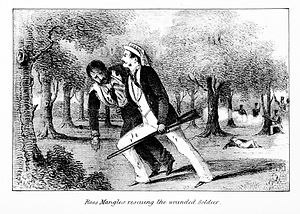
Of the VCs awarded in this desperate action, two were given to civilian volunteers – Ross Mangles and Mr McDonell, the very men who had come down with Tayler from Patna to be a part of what should have been a victorious force. The third was given to Private Dennis Dempsey of the 10th Regiment of Foot. Meanwhile, the siege of Arrah continued, and there did not seem any way to raise it. However, no one reckoned with Vincent Eyre.
 Mutiny Reflections
Fascinating. I must come back to read at leisure. My family lived in India for two centuries. Since the mid-1700’s to mid 20th century. My little sister and I were the last born there. On the Pakistan side, after the partition. Most of my ancestors were indigo planters. My great-grandfather worked for Scindia in Gwalior, after the Mutiny.
Thanks for your posts. I will be back.
Brian
LikeLike
Thank you Brian!
I have a few posts about Gwalior and Scindia though it isn’t quite finished – I hope you find it interesting.
That is fascinating about your family! If there is anything you would like to share to my site in regards to your family, that would be thrilling. The site started originally to examine the people of the Indian Mutiny, it has however morphed into something rather larger than I expected. I try to find my way back to the original intent when I can; there is just so much history!
Indigo features quite often in the history of the Indian Mutiny. The planters were men made of quite stern stuff! They deserve a history of their own. I just finished reading the history of indigo factories in Bihar, very fascinating.
Thank you again and I hope you continue to find my writing interesting!
LikeLiked by 1 person
Pleasure Eva. My great-grandmother was a Goutière. A family of Indigo planters near Calcutta. One of her nieces was Chritine Weston, née Goutière, born in India. She later became an American writer. Two of her novels, Indigo, and The Hoopoe are based on her childhood memories. I have all her books because though a generation “older”, she and her siblings were contemporaries of my father’s. Books might be available on Amazon though.
My father wrote a quite extensive family history, but it is inFrench. As strange as it may sound, we are French. I’ve been slowly translating the history into English, but I haven’t reached the India part yet. I will let you know.
And I will definitely come back to your Gwalior and Scindia posts and others…
🙏🏻
LikeLike
That is fascinating! Out of curiousity, I quickly searched Goutière in FIBIS (Families In British India Society) and I came up with quite a few names in the basic search, Births, Deaths and Marriages in Azimghar, Gorrackpur, Dinapore and Benares, Beoree Factory Gorruckpore, Chandernagore, Lucknow, Kanpur, Unao…basically all over northern India and and Indian Army Reserve Officer, serving in 1918 in the
2-69th Punjabis, Delhi who had previously served with the 4th Dragoon Guards, Jan-Mar 1916. FIBIS records are most 19th and early 20th century. It is wonderful to find a family with French roots in India – it is not a widely researched and deserves more attention!
LikeLiked by 1 person
Fascinating back. Thanks for the tip about FIBIS. My father did his research in the 70’s and 80’s. No Internet then. All written sources.
The French roots come from the French “counters” in India that we kept after Dupleix “lost” India to the Brits… Our “Indian” roots go back to Chandernagor. My Goutière great-gradnmother married a French Gentleman named Henri-Felix Onraet. The one who worked for Scindia. He was “Sarsubar”, chief of police or something like that. (I think the English liked to have “Europeans at key positions with the Indian princes after the Mutiny. His son Franck Onraet was later “head of hunts” for Scindia. He appears on several photos with the Prince of Wales (Later George V) on a tiger hunt.
The Onraets go back to Chandernagor where arrived during the French Revolution and married a Marie-Rose de Solminhac de Chaunes whose father, I believe, was Captain of the port of Pondichéry… (Can’t remember the current name of the city…)
I will definitely look up FIBIS. Thank you.
LikeLike
Very interesting! The British liked having their people in princely courts even before the mutiny, they were called Residents. In the case of Scindia of Gwalior, they were also European officers present in the Gwalior Contingent and often Europeans, many French for that matter were found to be in the employ of princely states as private officers. There is even a case of some beheadings for refusing to fight against the British in the Maharatta Wars.
Another family who were in the employ of the Oudh court for generations were the Orr family, the last being Alexander Orr. Their father and grandfather had been employed in various positions in the Oudh court, from the military to librarians until the annexation in 1856.
Keeping Europeans in the princely courts carried on in a greater or lesser degree until independence in 1947 and the posts were coveted for many reasons, besides being an ideal jumping board for higher political positions.
All this information from you is really making me more and more curious about the French in India. There were in all 5 French colonies in India Pondicherry, Karaikal in Tamil Nadu and Yanaon in Andhra Pradesh on the Coromandel Coast, Mahe in Kerala on the Malabar Coast and Chandernagore in West Bengal. A wealth of history to be explored!
If you like I can look through my books and see if I have anything more detailed regarding Scindia’s court, indigo factories and French India?
LikeLiked by 1 person
Beheadings? Hmmm. Those were dangerous times. I know my father wrote about the mutiny based on books and other sources he had access to.
I will see wether there is any reference to Mr. Orr in his writings.
My great-grandfather, Henry-Felix Onraet and all his family survived the Mutiny because they lived around Calcutta maybe? Again I have to look.
Henry-Felix was Scindia’s “sarsubar” whatever that means. I understand he fought and defeated the Dacoïts in Gwalior.
And yes, there were 5 counters in India. A lot of history to explore. Interestingly, in the case of my family they remained French. Signing up the children at Chandernagor every few years. Though the last generation had double nationality. (And were bilingual). My great-uncle René Onraët was born in Agra and eventually moved to Singapore, where he became Chief of Special Branch before WWII.
If you have time, and documents on Scindia, that would be lovely. There were many photos of the court in the family but the last cousin who had them died and I don’t know where those pictures are. What a loss.
I need to gather some material to send you.
I shall. In due time.
‘Best
Brian
LikeLike
I have found some traces of the Onraet family in Bihar as well – it was a district well known for indigo and for opium; I don’t know if Narainpore factory which was in or around Bhagalpur and was the abode of a P.T. Onraet in 1837 would be familiar? According to the history of the Bihar Indigo factories, there were some 300 people in Bihar directly involved with indigo in 1857 so it was fairly full of planters and their families.
Besides the occaisional panic Calcutta remained untouched by the mutiny directly and Chandernagore does not feature in any particular way unless one includes the dealings of one Mr La Font who was looking for a way to gain support of Nana Sahib of Kanpur infamy to help him overthrow the British! Nothing came of that, especially when the French realised that the overthrow of the British would very likely mean their own demise shortly after. In Calcutta the French merchants were among the first to send their offer of arming volunteers and putting them at the disposal of Canning’s goverment. They and all the others (Americans, Germans, Armenians. Italians..) were refused until Canning had no choice but to finally to accept their offers.
I also found an puzzling entry in FIBIS which reads: P. Onraet, 1797, District of Residence: Zillah of Nuddea, Place of Residence: Neemtollah, Employment: Iindigo Planter, Year Arrive India:1797, Authority to reside: Captured in a Ship. At the time of the entry he had been in the district 1 year. I am not sure what the captured in a ship is all about!
https://fibis.ourarchives.online/bin/aps_detail.php?id=930568
I even found an Onraet in my old home of Dhaka, Bangladesh. When I return to India next year, I shall certainly keep an eye out for all the surnames on your family tree when I go through the graveyards on my rather long list of places to visit!
I will send what I an about Gwalior as soon as I can. Best wishes, Eva
LikeLike
Hi Eva, thank you so much for spending the time.
P.T. Onraet would be Pierre-Thomas, my great-great grandfather. I will check next week my father’s notes on him. I seem to remember very little is known about him.
And P. Onraet was his father. He’s the one who sailed to India from France during the French Revolution. Though according to our records, he arrived in 1794… I’ll look your link up. “Captured in a ship”. The story my grandmother told was that they were two brothers who were set prisonners by the English on a pontoon, if you remember those demasted ships the English used on the Channel during the Napoleonic wars. But my parents’ research sort of contradicted that family story. Maybe he sailed on a French ship to Chandernagor and was captured on arrival? I know there was frequent squabble between the English and the French at Chandernagor, so maybe it was one of those.
And aas for an Onraet in Dacca it’s possible. My great-grandfather had several brothers. One ran a steamer on the Hooglie. The others I don’t know. One may possibly have “moved” to Dacca. (That was the old spelling of Dhaka, right? I get confused with Mumbay, Kolkatta and others…)
Cheers
Brian
LikeLiked by 1 person
You are most welcome! I find family stories fascinating and sometimes I can get quite stuck in histories. Yours is very interesting, and I am sure there is so much to find out. FIBIS is a good place to start. All the data is transribed by volunteers, I still do a bit on there from time to time and the people there are very helpful especially when it comes to deeper research. I have never used this site: http://www.archivesnationales.culture.gouv.fr/anom/fr/ but apparently it has a searchable section on French overseas territories.
LikeLiked by 1 person
Volunteers? You don’t say? Maybe that’s why 1794 came out as 1797? I have to check my father’s sources…
And you volunteer too? Compliments.
I’ll check your link to the Archives in “Frog”.
LikeLike
Just been there. As a typical public French site it might be a bit complicated… I need to spend a little time finding my way around. Thanks for the tip anyway.
have a great week… 🙏🏻
LikeLike
Just went to your link. That Fibis is quite amazing. My parents would have been delighted to have such tools at hand. Thanks for the tip.
LikeLiked by 1 person