Kunwar Singh
Instead of enjoying a peaceful retirement in 1857, at his jungle retreat of Jagdispur, the 80-year-old Rajput chief, Kunwar Singh, was fighting the Revenue Board of Bengal. While the nominal ruler over vast estates, the revenue system, but lately introduced, had secured nothing but his downfall. He was, in effect, a ruined man — his estates had been placed in liquidation to pay his debts, for which he barely scraped enough together to pay the interest. He had undertaken steps, early in the year, to secure a loan of 20 lakhs to save his estates; but the Revenue Board, with the worst timing known to man, decided against Kunwar Singh, throwing his case to the dust and suddenly demanded he produce the money within a month: should he fail to do, his estates would be sequestered, knowing full well the chief would never be able to raise the complete sum. Kunwar Singh had lived large, but it was a little too large for the revenue board. Kunwar Singh was also the master of his own ruin. His yearly income was assessed as less than 3 lakh rupees, but his debts sang to that of 37 lakh. His creditors in Benares, Arrah and Patna were pressing him for their dues out of his mortgaged villages, and yet, he still asked Peshwa Binayal Rao and the Benares bankers for a loan of 13 lakhs to make good some of his debt and save his estates.
“His anxieties could be gauged by going through his various petitions to the Board of Revenue, William Tayler, the Commissioner of Patna and Halliday, the Governor of Bengal for saving him from drowning. All these petitions, had they been given prior to 10th May 1857, would not raise any doubts. But his famous petition was made on 25th June 1857, when Delhi, Cawnpore, and Lucknow were in a blaze…”
William Tayler at Patna had been a good friend of Kunwar Singh, took up his case with the board, protesting and appealing against their decision, but to no avail. Mr. Halliday, all the way in Calcutta, was not a man who enjoyed listening, and he certainly could not abide Tayler, no matter how sound Tayler’s words were. The government in Calcutta was not in the habit of admitting wrongdoing, and their short-sightedness made a rebel out of Kunwar Singh. Tayler, in June 1857, was still writing to the Government on Singh’s behalf,
“Many people have sent me letters, imputing disloyalty and disaffection of several Zemindars, especially Babu Kunwar Singh. My personal friendship for him, and the attachment he has always shown me, enable me confidently to contradict the report…” Again, on July 8th he wrote ; “Babu Kunwar Singh would. I am sure, do anything he could; but he has now no means. He has written to me several times to express this loyalty and sympathy.” As late as the 19th of July, Mr. Wake who had presided over the estates of Kunwar Singh, implored the government to rethink their decision, “…. I do not think he will ever openly oppose the Government as long as he thinks that Government will stand, but I do think that, should these districts be ever the scene of a serious outbreak, he may take it into his head that it is time to strike a blow for his own interests, and his feudal influence is such as to render him exceedingly dangerous in such an event.”
The only loan Kunwar Singh managed to raise was for 5 lakh, far below the 20 demanded by the revenue board, and that at a ruinous interest rate of 12% from the Benares bankers.
“Kunwar Singh at last made a bargain deal for his loyalty by praying the British Government, already in the predicament of defeat and collapse, for aiding and protecting him with a loan of 13 lacs, through which he hoped he would ‘be freed of his worries’, Kunwar Singh assured the already half-dead British Government he was the ‘well-wisher and servant of the Government and will pray for its prosperity.'”
From the start of the rebellion, Kunwar Singh was watching and waiting. On the 25th of June, when he made his final appeal, where he once again asked for a loan, from the government, though this time only to the tune of five lakhs, he was already aware that the government he had sworn loyalty to was on the brink of disaster and cognisant of the fact that no money would be forthcoming. He had, to some extent, agreed to the rebellion in June while Tayler and Wake were still writing on his behalf; on the 3rd of July, when Patna rose, he remained undecided. Kunwar Singh declined, on the grounds of his health, to meet Tayler in Patna, shrewdly surmising that Tayler probably intended to imprison him; though Tayler might have refuted such allegations, Kunwar Singh’s presence in the already tumultuous atmosphere of Patna may have left him with no choice in the matter. However, the movements of the Dinapore mutineers changed his circumstances, and as it was, he found the time was right to bring them under his standard, taking the lead at the siege of Arrah. Willingly or not, the rebellion was Kunwar Singh’s last chance to restore his prestige, settle his score with the EICo and free himself from the irksome yoke of debt.
What, however, made Kunwar Singh such a force to be feared? It was not his military prowess, the defeat at Arrah, where he had failed to secure a house manned by engineers and 50 Sikhs; he could not claim the sole wreath for defeating Dunbar, that was as much down to the cleverness of the sepoys and their leaders with Kunwar Singh’s support, compounded by Dunbar’s failure. Kunwar Singh was dangerous because, essentially, Bihar was dangerous.
The geographical situation of Bihar throws a light on this.
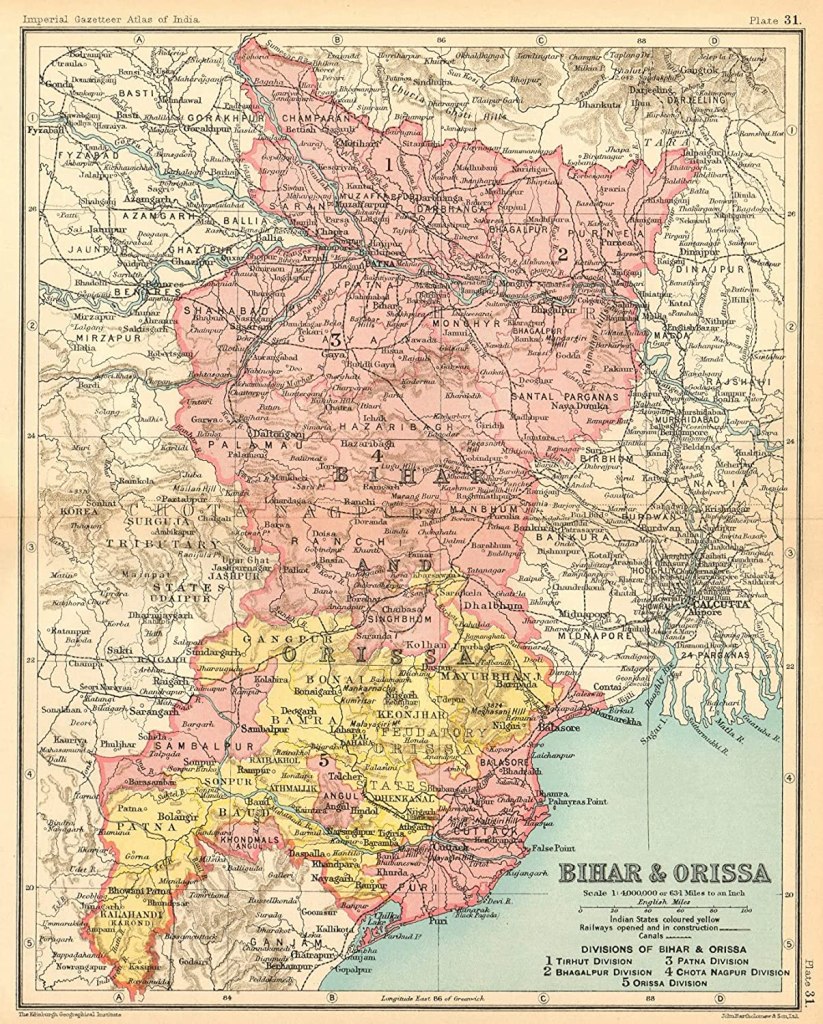
The Grand Trunk Road and the steamers plying on the Ganges were two lifelines left for the British in communication with the rest of India from Calcutta. To access Awadh, the troops still had to bypass Bihar. Bihar was also a financial lifeline for the British regarding their vast opium depots in the state, especially in Patna. A general uprising in Bihar would have squeezed them out of a sizeable income, destroyed their means of communication with NE Provinces and Oudh and hindered troops from Madras and Bombay from realising the road route to the north. Bihar, in the throes of rebellion, would have severely hindered smooth deployment from Calcutta, forcing movements through a longer and labourious route through Orrisa, Rajputana and Central India. As such, Kunwar Singh was in a position to block the Grand Trunk Road, retain the opium revenue for his own army and wreak havoc on even the best-laid plans of every general the British threw into the fight.
When Dunbar was defeated on the 30th of July, Kunwar Singh was viewed as the natural leader of the rebellion in Bihar, both by the Indians and the British. There were further revolts in Doranda, Bhagalpur and Chittagong, riding on Dunbar’s defeat, and these forces made their march to Bihar to join Kunwar Singh’s banner at Shahabad. It was thus imperative to put an end to his presumptions before he could consolidate his forces.
 Mutiny Reflections
Beautiful post! I didn’t know anything about it.
LikeLiked by 1 person