“Two facts may be deduced from the story of these operations – first, that the besiegers of the house at Arrah were neither cowards nor bunglers, and the next that it was uncommonly lucky for us that Coer Singh was not forty years younger.” (George Trevellyan, The Competition Wallah)
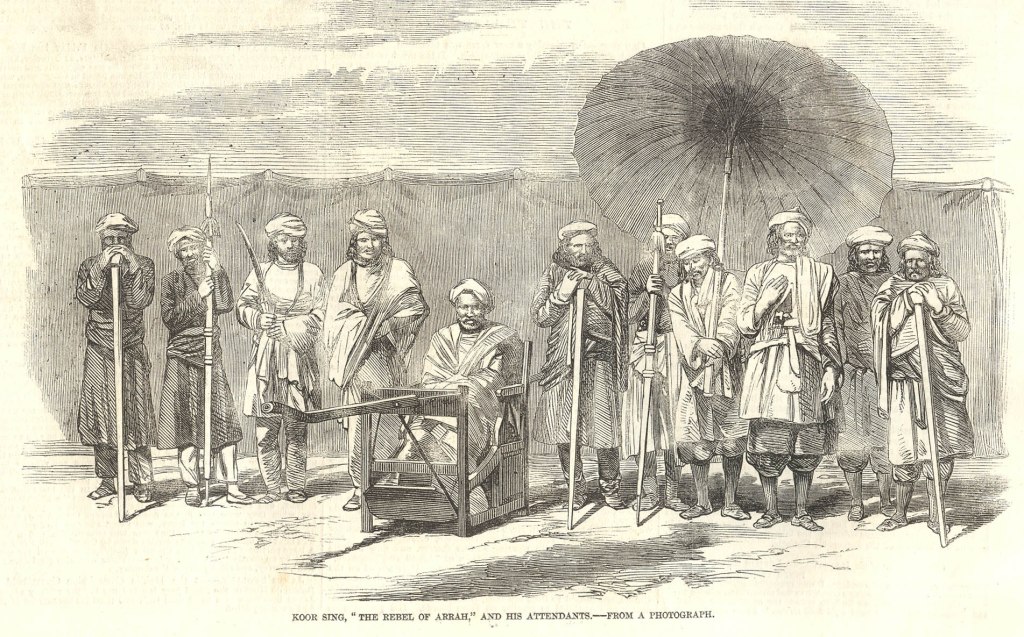
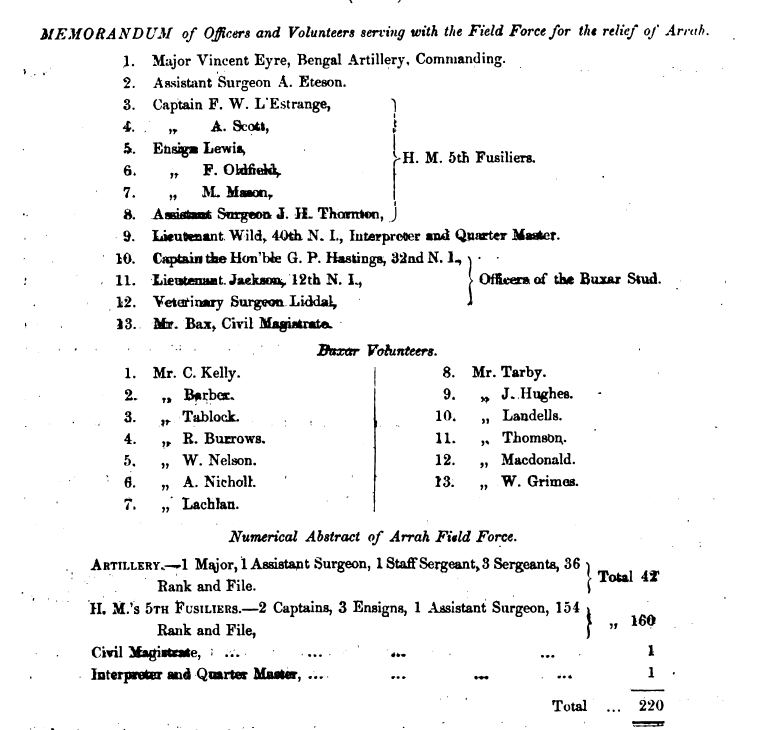
On the 3rd of August, Major Vincent Eyre broke the Siege of Arrah. He had managed what the officials at Dinapore had considered impossible, a swift but deliberate blow against a force that vastly outnumbered his. For their part, following the final bayonet charge, the rebels did not wait to see what else Eyre had up his sleeve — they broke rank and retreated in complete disorder and panic, leaving behind what they could not carry as they fled from Arrah. They had been a force numbering no less than 3000 men along with Kunwar Singh’s irregulars, but Eyre had set them to task, and now they were on the retreat; many to their homes but others followed in the wake of Kunwar Singh, to his stronghold at Jagdispur.
Major Eyre, meanwhile, was not hot on the trail of the retreating rebels. He was in Arrah. As his troops had marched in from the north side of the town, they had not yet seen the 104 naked bodies of soldiers of Dunbar’s ill-fated expedition, hanging from the branches of the tamarind trees that lined the other approach to Arrah. Their bodies had been retrieved from the battle site and unceremoniously strung up. But these were not hidden from sight for long.
Eyre now became judge, jury, and executioner, and Arrah was taken to task. He held a drumhead court-martial, at which he presided as president, taking precedence over the judge and magistrates who sat with him. Townspeople came forward to testify against any rebel who had not been swift to evade arrest, and they were promptly hanged or “in effect, strangled, in the gardens of the Arrah house. The request made in most instances simply was that they might be allowed to adjust the rope themselves.” On the 4th of August alone, seven sepoys were hung, among them an old man, who,
“…while awaiting his turn on the gallows, and witnessing the painful struggles of a man dying in the air,
opening his Kummerbund, took out all his property of three rupees and said calmly, ‘This is my will! I give one rupee for prayers for my soul, one I leave for charitable purposes, and the third I bequeath to the man who hangs me.’ ”
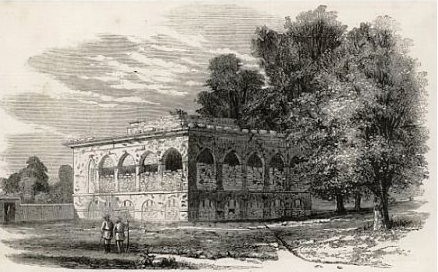
Over the next days, Eyre endeavoured to restore order. He disarmed the native population of Arrah and the surrounding area and, upon intelligence received, took a detachment out to search a village that was said to have taken a leading part in plundering the European residences. He found nothing in the houses, but the tanks were found to be full of stolen property. Eyre promptly ordered the village destroyed but spared the inhabitants. “An example or two of this sort,” he wrote, “seems necessary as a warning for the future.”
He then turned his attentions to Kunwar Singh.
“Koor Sing, who had been proclaimed Rajah, or King, of Arrah, has fled to his Fort at Jugdeespoor, about twelve miles south-west of this, and has probably taken some hundreds of Sepoys with him for its defence. It is only to be approached through several miles of dense jungle, and its capture might require a larger force than mine is at present, but of this I cannot judge without correct information, as to the actual strength of the position and garrison. It is of course highly desirable that he should be followed up and punished otherwise he will return to Arrah, when the Force is removed, and will become the “de facto” ruler. If, therefore, this part of the country is to be kept by us, he must be crushed, and my force strengthened whenever troops can be spared.” (Despatch from Major V. Eyre to Major Lydiard, Assistant Adjutant General, Dinapore Division, dated Camp Arrah, 4th August 1857).
 Mutiny Reflections