Heads Full of Murder and Mutiny
Around noon, Pritchard, his duties done for the day, received a visit from the munshi or translator of his regiment, a Muslim named Meer Wakar Ali. He told Pritchard he had passed several sepoys in the bazaar, all very excited, saying the grain merchants were in leaguer with the government to break their caste by mixing bone dust in the flour. Pritchard reported it to his Colonel, who had given any interest in Pritchard’s report and would have told the Brigadier. However, Shuldman simply said if he brought it to the Brigadier’s notice, he would have to give proof, and unless Pritchard could provide it, there was no point in disturbing the Brigadier.
Not one to give up, Pritchard took his concerns to the Brigadier-Major. He promised to take up the issue with the Brigadier himself the next day, and that was all Pritchard could get. Shortly after lunch, Pritchard, the Brigadier, Colonel, Brigadier- Major and indeed all the Europeans were startled by the report of a cannon. Whereas one shot might have been considered unusual, the second one which followed it shortly after was decidedly worrying. Pritchard hurried out of his compound to a vacant space which was immediately to the rear of the sepoy lines. The first thing he saw was a crowd of day labourers running as fast as they could away from the lines. At the same time –
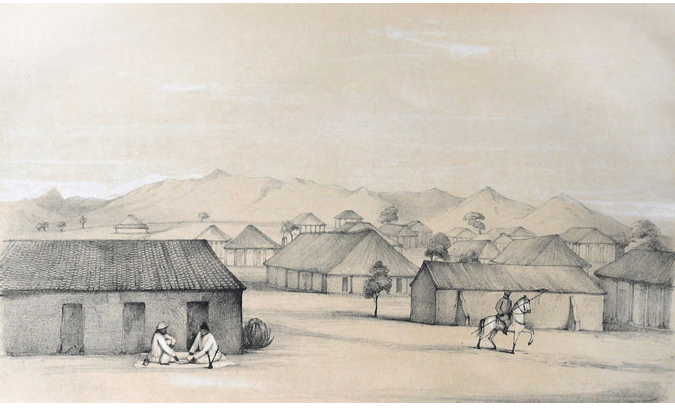
“… there arose the sound of many voices, a murmur, or buzz, as if a thousand men or more were all engaged in chattering…” Astonishingly, Pritchard returned to his house and told his wife there was nothing to be alarmed about. He then went back to the gate. As he approached, a man named Gopal Singh came running up – he simply said there was nothing the matter. A few sepoys of the 30th had rushed the guns but had been met by a party of the light company of the 15th and been driven away. Pritchard had scarcely digested this highly improbable story when Captain Timbrell, the officer commanding the artillery, galloped up furiously towards the house.
Pritchard called out, ” What’s the matter?” Timbrell answered, ” Those rascals of the 30th have taken my guns; I am off to turn out the cavalry.”
As no one had mentioned the 15th BNI, Pritchard saw no cause for concern; his regiment was not in open mutiny. Pritchard ordered his charger saddled and called on his wife to go across the road to the house of an officer of the Lancers. It had been presumed that should there be an uprising, the cavalry would be the least likely to join in; thus, their lines were certain to be safe. Without a moment’s hesitation, Mrs. Pritchard put on her hat and, followed by her ayah, crossed the compound to the other house. The buggy and horse would follow as soon as they were ready. “I had little time for thought, the hubbub outside was increasing momentarily, and the servants were rushing frantically to the compound wall, upon which they climbed to look over. The whole station was alive, and the very air seemed full of excitement, horses neighing, men shouting, children crying, and that everlasting buzz from the lines, growing louder every instant. The effect was perfectly indescribable. It was totally unlike anything I ever experienced before. One’s excitement is wound up pretty high on the occasion of a general action, but this was something totally different...all seemed confusion, hurry, anxiety, and wild excitement.“
Amid the growing chaos, the tailor, who had just been finishing up some sewing for Mrs. Pritchard, calmly folded the cloth. He looked at Pritchard and asked for orders. He was told to make up his bundle and leave. Pritchard quickly put on his uniform and grabbed his sword. He was the last to leave the house – as he rode out of the gate, the servants who were looking out over the wall, the tailor among them, beseeched him to stay – if he went to the parade ground, he would be killed. “Never mind,” said Pritchard as he rode away, “it is in the hands of God.”
As the parade ground was beyond the Sepoy Lines, the first men he saw were the rearguard, standing accoutred and looking suitably confused. Pritchard called out that the 30th had mutinied, and it was now a chance for the 15th to show them what they could do. As many sepoys were leaving their huts and running to the parade ground, Pritchard called out to them, waving his hands about – “they must have thought me mad, their heads being full of murder and mutiny…”
Arriving on the parade ground, Pritchard found his Colonel and two other officers on horseback, looking grave. The sepoys were crowding towards the bell of arms, some in uniform, others only in their red coats and, instead of trousers, in dhotis. Pritchard saw they were assembled in “tolerable order” as on a regular parade, and he ordered the column to form lines at right angles to the lines on the light company, which was done. In the background came the repeated sound of the guns booming, but no one could tell at what they were firing. The plan was for the 15th to advance a short distance and charge the guns. Convinced this was the best plan, Pritchard rode to the front of the grenadier company and called on them to do their duty as the brave and loyal soldiers he knew they were. As the cavalry, he knew, had been called out by Timbrell, he expected any moment to see them, in their French grey jackets and lances blazing in the sun, to emerge from between the buildings onto the parade ground – they would have charged the mutineers by now. However, as Pritchard waited, it became clear the cavalry was not coming.
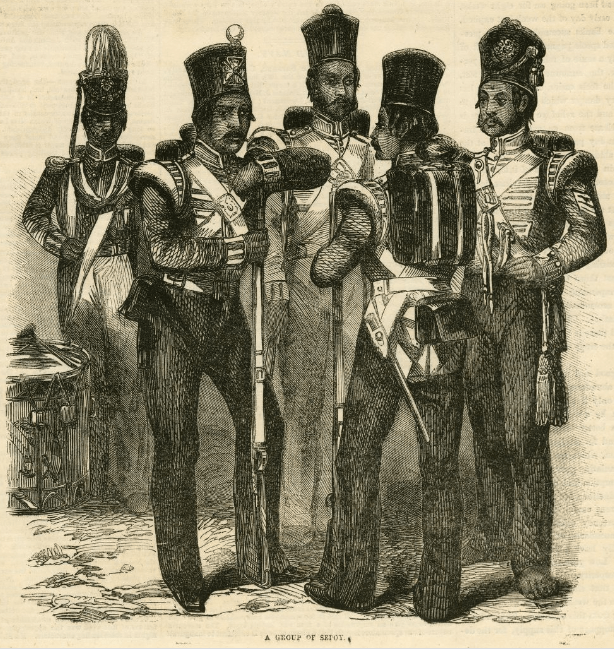
Pritchard lined the light company to the front and ordered them to skirmish. They followed the command, opening out into extended order from the left and then halted. Pritchard thought they were waiting for the cavalry to act first, but after a few moments, the Colonel called out to the officer in charge of the light company, “Why don’t you advance?” “Because the men won’t go,” came the reply. The bugle sounded for the light company to close on its left, and again, they obeyed. The grenadiers, in the meantime were ordered to the front and to extend. Again, the order was followed, but the men refused to advance. The flank companies were then ordered to proceed to the lines and advance in a column – they went to the designated spot but once again, like the others, stopped short. Gumbheer Singh, despite all his urging, could not get the men to move – for his pains, he was threatened by the men with execution if he did not stop issuing orders. Meanwhile, the Colonel rode up to each company in succession and ordered them to advance, but no one was listening – the 15th BNI was, to Pritchard’s horror, in open mutiny.
As for the cavalry, who no one had doubted, they had refused to act. They had half-heartedly charged the guns but drew up short, allowing themselves to be driven back by the artillery. They sat and watched as men flocked, under their noses, to the artillery park. The cavalry was then formed in the rear of the artillery lines and ordered to charge in squadrons. They charged, but as soon as they were within a few feet of the guns, went threes about and “allowed their officers to go on if they pleased.” Several did, with terrible consequences – Major Spottiswood was mortally wounded, Cornet Newbury was cut to pieces among the guns, while Lieutenants Lock and Hardy barely made it back alive, both badly wounded. Spottiswood was taken to his house, where he died shortly after.
As for the 15th, the Colonel ordered them back into the former position – again they obeyed but proceeded to sit down in the ranks. They complained it was hot and they were feeling very thirsty – they asked permission to go and get a drink of water at the nearby reservoir. Pritchard and the others managed to prevent them from taking their arms, but they could do nothing to stop them from leaving. When it became clear as to “the depth to which their treachery, ingratitude, and villainy could go,” the officers left the parade ground.
The only ones who did not need any convincing in regard to villainy were the ladies of the Nasirabad Cantonment. They had quietly packed a few things and, in their buggies, had left an hour earlier in the direction of Ajmer. Pritchard ordered his syce to return to the house, pack up as much as he could in a bundle and follow the fugitives.
Meanwhile, as the sun was setting over the station, the signal gun was fired, and to Pritchard’s surprise, the road was suddenly flooded by a band of fifty or more fakirs – from where they came, no one knew, and the time to ask had gone. They proceeded down the ranks, carrying brass lotas of water and a quantity of bhang – which they proceeded to distribute to the sepoys. As it was fairly common for sepoys to consume bhang in large doses before a fight, making them “regardless of consequences, and capable of undergoing any amount of fatigue or exertion under its intensely stimulating and exciting effects“, Pritchard realised the time for reasoning was over. “It has the power of transforming men into demons, giving them all the energy of madmen with all the recklessness of the drunkard. They began to talk or mutter incessantly, and evince the utmost disrespect for their officers by every means short of open and defiant insubordination.” The Brigadier issued orders for all the officers to leave, having been told by the Colonel of how things stood now.
Pritchard beckoned to the only two men he thought would remain true to their salt – Gumbheer Singh and Bucktuwar Singh. He asked the former how many men he thought would remain faithful, at which the man only looked at him in astonishment – he had been as surprised by events as Pritchard had, and although he believed there might be one or two, he soundly responded that no one should be trusted. Pritchard repeated his question to Bucktuwar Singh, who responded that he would go and ask. His answer was enough for the officer.
“I looked at Gumbheer Sing and smiled; it was evident he had no intention of proving stanch. About this time, a musket shot or two were fired at us by some man from among the mutineers at the guns, who came to the front and took deliberate aim; the ball passed harmlessly over our heads. The Colonel, at last, intimated his desire to leave, but wished if possible to save the colours of the regiment.”
Nothing would come of the noble idea. The Colonel asked the officer commanding the grenadier company to find volunteers to save the Colours – the whole company stepped forward. Once again, an elaborate charade was enacted, and they obeyed the order to form up, but when the Colonel called, “Quick March!” they stood as if rooted to the spot. Irritated, the Colonel asked them why they had volunteered if they were not willing to move. The men replied, under their breaths, if they marched, the cavalry would cut them up. Suddenly, from the centre of the column, Pritchard saw a movement – a sepoy snatched the Colours from the hand of the man who held them and ran off towards the mutineers. A moment later, a native officer named Tokey Ram, who held the other Colour, followed, and several others joined him, in single file, running.
I stood up in my stirrups and pointed at them, exclaiming in Hindostanee, ‘ Look at the treacherous villains;’ but the words were scarcely out of my lips when another movement took place—every musket was raised and levelled at us, and crack, crack, went the reports; ping, ping, sang the balls as they flew round our ears, heads, and bodies; in short, we were under as heavy and as good a file firing as ever it had been my lot to witness either with blank or ball cartridge, on the parade-ground or on the field of battle. I turned to P and said,’ Come along, we had better go now,’ and we both set spurs to our horses and galloped off as hard as we could. After riding a short distance while bullets were whistling by our ears, and knocking up the dust all around us in front and behind so that it seemed a perfect miracle we were not riddled with as many holes in our bodies as a sieve, we reached the road that flanked the right of the cavalry lines.
P. called out, ‘Left shoulder forward;’ we turned our horses round and, being undercover, began to rein in our steeds. We reached the top of the road at the rear of the lines, where the cavalry were drawn up awaiting the issue of events, but P.’s horse could go no further; he had been struck in the abdomen but had carried his master bravely out of danger, and there fell.”
As for the Colonel, he came up almost immediately after, his horse shot in three places, but its rider was unhurt. One after another and in pairs came the sergeants and the other officers, each with their own miraculous escapes. One had decided to go to the lines but was fired at by the sentries at the end of each row of huts;
“…till, just as he reached the last, he bethought himself of ordering the men to desist from shooting at him; he called out and made a sign not to fire, and they obeyed. Another rode between the bells of arms and the lines and was fired at by three Sepoys from each building. What the men could have been doing there, it is impossible to say, but there they were, with muskets loaded, and when this officer rode by for his life, took aim deliberately, and all missed.
Another officer, as gallant and brave a man as ever breathed, who afterwards met his death in a melancholy way, having been murdered in the streets of Lucknow, Lieutenant Thackwell, was in charge of a guard of about thirty men over the magazine. When the behaviour of the regiment upon parade rendered it apparent that we should be obliged to leave, an officer, Ensign C., rode off to tell Thackwell to leave also, lest he should remain at his post, which he would be unwilling to desert without orders. C rode up and, not knowing exactly what to tell Thackwell, called out to him that the Colonel wanted him and that he was to come away. Just then, the firing began upon parade. Thackwell had no idea what it was all about, but the men of his guard had, for no sooner did they hear it than they all levelled their muskets at this solitary British officer and fired; they missed. Thackwell, by that time, was mounted, but before riding off, levelled an old-fashioned six-barrelled revolver he had with him (that was never known, I believe, to go off in its life). The coward at whom he levelled this innocent weapon of war actually threw down the musket with which he had the instant before, in common with thirty of his comrades, endeavoured to murder their victim, raised his hands in an attitude of prayer, and begged to be spared! “
Thackwell went to the parade ground, still unaware that a mutiny had happened. As soon as he arrived, he saw the sepoys were firing their muskets at something, but he did not know it was at the retreating officers. Suddenly realising Thackwell’s presence, the guns all turned on him – he rode straight to the front for some hundred yards, wheeled right and rode off as fast as his horse could carry him towards the cavalry parade ground, shots being fired from each successive company he passed. The only injury he had was to his scabbard, which had been carried away by a musket ball.
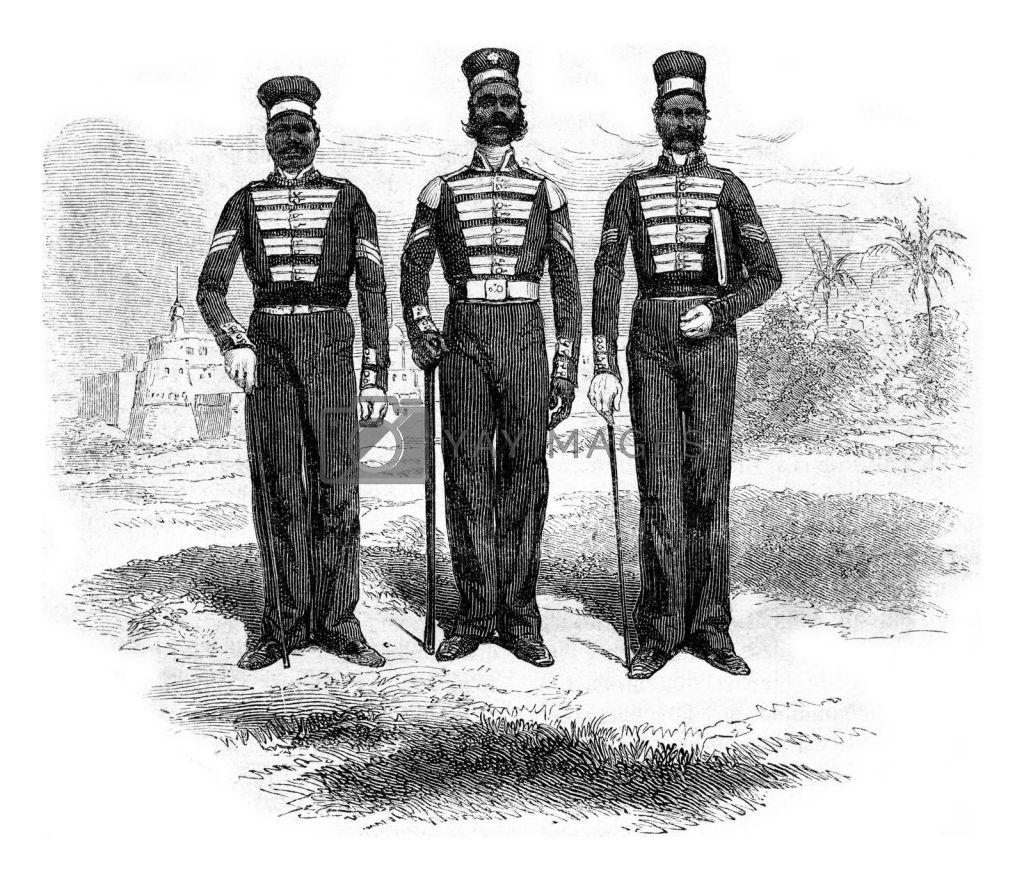
Those who had escaped from the parade ground now met at the rear of the Lancer’s lines – the cavalry was drawn up in columns, mounted but doing nothing, while their officers milled about in small groups on horseback. The Brigadier, his arm in a sling, astride a camel, sat in the growing dusk, unsure what to do next. To Pritchard’s surprise, the Lancer to whom he had entrusted his wife ran up to him, saying their wives were safe but still nearby. While the party sat, with no one issuing orders or doing anything meaningful at all, the thatched roof of the little church burst into flames.
It signalled the end of rule as anyone knew it, and in its place would come chaos. Bungalow after bungalow was set alight, and all around them, “the yells and shouts of the mutineers grew louder and louder as their ranks were swelled by Sepoys and camp-followers and blackguards of every description, who revelled in wanton mischief, plunder, and incendiarism.”
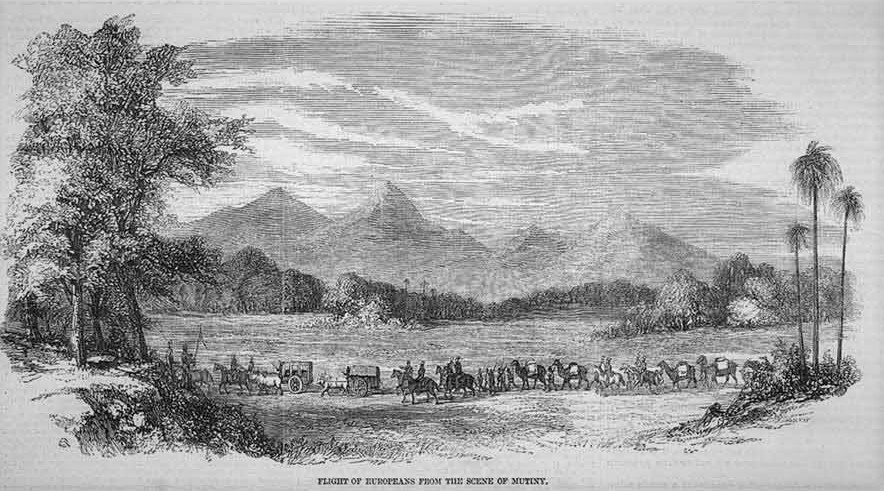
While the senior most officers argued whether they should make for Ajmer or Beawar, Pritchard decided he would go and find the ladies. With the help of a bystander, he rode off towards the countryside which started a few hundred yards from the cavalry lines – when he emerged on the plain he saw, to his surprise, nearly the whole of the non-combatant population of the station – men, women and children, some on foot, others in any conveyance possible, some carrying a bundle, others burdened with as much of their household as they had managed to save. They were scattered in a long, straggling line which appeared to have neither an end nor a beginning, but they were making, as Pritchard could see, for a scrap of jungle that ran along the foot of the nearby hills. Somewhere in this mass, he found his and the Lancer’s wife. There seemed little point to return to Nasirabad- indeed, several officers had by now joined their families and were heading off towards Ajmer.
The cantonment was first sacked and then burned. Two officers had remained behind – Captain Fenwick of the 30th stayed at the quarter-guard with his men out of a misguided sense of duty. The sepoys had behaved the same as those of the 15th – they had offered their officers no violence but simply told them they had better go, and they, except Fenwick, left. The 15th continuously sent emissaries to the lines of the 30th, first asking and then threatening to join them – when the last message said if they did not come forthwith, the 15th would turn the guns on them. Fenwick, to the exasperation of his men, who did not want to kill him, begged him to leave. Seeing reason would not work, they said they would resort to force, at which Fenwick finally consented to go. They sent four sepoys and an NCO to see him safely to the end of the cantonment, after which he was left to his own devices. He was left alone to wander across the plain and make his way as best he could to the jungle.
After the work of plundering had died down, the ill-gotten gains were brought to the parade ground, where a council of war was sitting, debating what to do next. As soon as the 30th joined the remaining mutineers, a Brigadier, a Commandant of the Corps, Adjutants and other staff were elected and presumed to take order of the chaos. Their attempts were fruitless; there was too much revelry in destruction, and no one listened to them. All they succeeded in doing was placing a gun at the head of the bazaar and telling the terrified inhabitants that if they did not submit to having their homes plundered, the artillery would open fire. The munshi who would report this to Pritchard was forced to remain in the city the rest of the night – when an opportunity came, he ran away, following in Pritchard’s wake. The only other man who stayed behind was in command of an artillery battery – he had stayed in the lines, but while trying the keep his men under control, the mutiny swept over him, and he could no longer flee. His men protected him through the night and the following day until he was able to get away.
On the 29th of May, the fugitives turned up Beawar; others had made their way to Ajmer instead – regardless of where they had chosen to go, Nasirabad was at least briefly lost. No sooner had they recovered from their shock, the news of the mutiny at Neemuch told in terse words, the station, “had gone.” It was the 3rd of June.
Killed and wounded at Nasirabad
Captain H. Spottiswoode, 1st Light Cavalry – killed whilst charging the guns
Cornet R. W. Newberry, 1st Light Cavalry, killed whilst charging the guns
Lieutenant and Adjutant F. A. E. Lock, 1st Light Cavalry, was wounded whilst charging the guns
Sources:
Chick, Noah Alfred. Annals of the Indian Rebellion. Calcutta: Sanders, Cones, and Co., 1859.
Cochrane, J., comp. Narrative of the Indian Mutinies of 1857, Compiled for the Madras Military Male Orphan Asylum. Madras: Military Male Orphan Asylum Press, 1858.
Intelligence Branch, comp. The Revolt in Central India 1857-59. Simla: Government Monotype Press, 1908.
Malleson, G. B. History of the Indian Mutiny, 1857-1858, Commencing from the Close of the Second Volume of Sir John Kaye’s History of the Sepoy War. Vol. III (1889). London: Wm. H. Allen & Co.
Prichard, Iltudus Thomas. The Mutinies in Rajpootana: A Personal Narrative. London: John W. Parker and Son, 1860.
Showers, Charles Lionel. A Missing Chapter of the Indian Mutiny. London: Longmans, Green, and Co., 1888.
Rajputana (Agency). The Rajputana Gazetteer. Vol. 1. Calcutta: Office of the Superintendent of Government Printing, 1879
 Mutiny Reflections