The Reverend’s Children
As it was at the time in India, not all of the Reverend David Brown’s children survived to adulthood, but those that did, did surprisingly well for themselves.
Jane Grant (1792–1821)
James Cowley (1797–1854)
Charles Philip (1798-1884)
George Francis (1802-1871)
Hannah Elizabeth (1800-1863)
Frances Cowley, died in Calcutta, aged 18 (1806-1824) — possibly Frances returned to India at some point and was residing with relatives. She lies buried in the South Park Street Cemetery, in Calcutta.
Ann Frushard (1804–1892) — married the merchant, Matthew Gisborne (Gisborne & Co., merchants in Calcutta), the son of Thomas Gisborne, the Anglican priest and poet, who fought for the abolition of slavery.
Lydia Martyn, (1807-1883) – married in 1826 to John Carysfort Proby, cleric and son of
Baptist John Proby
Sarah Robinson, the youngest daughter (1812- death unknown)
The Browns and the Birds
The only surviving child from the reverend’s first marriage, Jane Grant, had married in India in 1810 to one Robert Mertins (or Merttins) Bird, (the Birds were another prolific EICo family) who was responsible for the far-reaching Mahalwari Tax Reform. She died at Gorrackpore in 1821, while her husband was serving there as Judge and Magistrate.
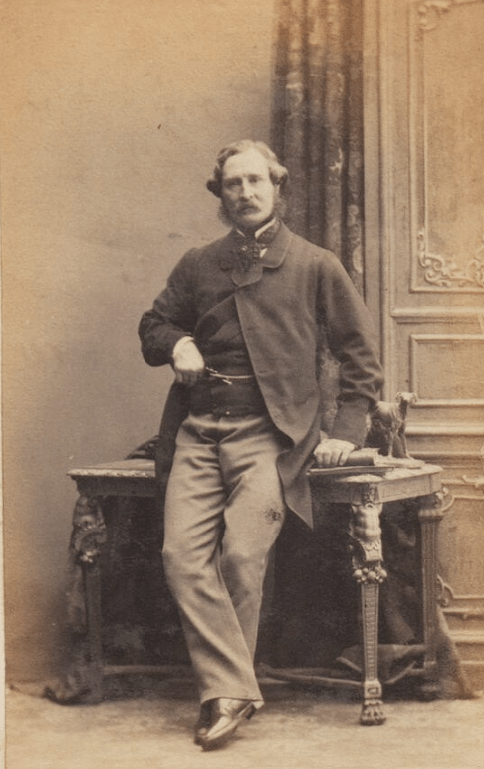
Their first son was none other than Robert Wilberforce Bird, who wrote the very critical, “Dacoitee in Excelsis or the Spoilation of Oude,” initially using the name of Samuel Lucas. The work, however, was republished with Bird’s name in 1857.
He served as Assistant Resident to Colonel Sleeman in Lucknow from 1844, but Bird was hardly an ordinary civil servant. Disgusted by the obvious treacherous behaviour of the EICo in Awadh, Bird retired from the service (with the rank of major, and his pension intact) in 1856 and joined the camp of the soon-to-be deposed Nawab, Wajid Ali Shah. https://www.cse.iitk.ac.in/users/amit/books/bird-1856-dacoitee-in-excelsis.html
Nor was this the only connection to the Birds, who had a rather worrying habit of marrying their cousins, and it is good to see a bit of the Browns creeping into the lineage.
The youngest of the reverend’s daughters, Sarah Robinson, married, in 1831 George Mertins Bird, (the brother of Robert Mertins) another EICo official who died a very early death at just 27, in Bulandshahr just four years after their marriage. It was his first appointment for the EICo, as Assistant Magistrate. Sarah’s fate is unknown but it is presumed she returned to England. Their son, George, drowned while fording the river Walran in the district of Nelson, New Zealand, in 1855, aged 23.
Another daughter, named Hannah Elizabeth, was the wife of none other than William Wilberforce Bird. Bird served as Deputy-Governor of the Bengal Presidency during Ellenborough’s reign as Governor, and then went on to replace Ellenborough as Governor-General of India until Sir Henry Hardinge arrived in India in 1844. He would hardly have been popular with the Reverend David Brown, as William Bird, while a supporter of secular education, believed wholeheartedly that a Christian approach to the subject would eventually lead to “catastrophes of a very serious description.”
The Browns as Civil Servants of the East India Company
James Cowley, the eldest of Brown’s sons, arrived in India in 1817, starting his career as a writer in the civil employ of the EICo, in Calcutta. He worked his way up diligently to the position of Civil and Sessions Judge of Nuddea (1842) but his career was cut off by his untimely death at Calcutta in January 1854. His wife , Matilda Chinnery (whom he married in 1821) bore him seven children.
Charles Philip fared better than his elder brother and made a name for himself as a scholar and linguist. Having trained at Haileybury, Charles found a position in the EICo, not in Bengal, but in Madras, in 1817. He was initially educated by his father and had more than a decent grasp of languages, with proficiency in Hebrew, Latin, Greek, Persian, Arabic, Syrian, French, Italian, Sanskrit and Hindustani under his belt. He swiftly added Persian but his language of choice was Telegu after the order of Thomas Munro, Governor of Madras, mandated that every civil officer should learn a local language. Studying diligently under Velagapudi Kodandarama Panthulu, Brown passed his examinations in 1820. His subsequent career reads like a novel.
Judge of Masulipatam; Persian and Telugu Translator to Government: Post Master General, Madras Member of the Council of Education: early made a special study of Telugu and became a great scholar: compiled a Telugu-English and English-Telugu Dictionary, 1845-53, and Grammar, 1840, and translated the Bible into Telugu: published Chronological Tables and various works in Telugu: wrote on that language and other subjects in the Madras Journal of Literature: retired, 1855: Honorary Professor of Telugu in London University: on the Council of the R.A.S: died 1884. (Dictionary of Indian Biography, Buckland).
“Became a great scholar” is something of an understatement. Charles wrote no less than 14 books about and in Telugu and sponsored a further eight, besides writing numerous articles and at least twelve more books which were published after his death. His name lives on as Andhrabhashoddhaaraka, saviour of Telegu and all this, because as a young man he had found his initial training in Telegu irritating with, an “insufficient grammar,” “two worthless native books of exercise,” “no dictionary,” and “tutors who spoke English but had few notions of grammar.” Finding Telugu literature was dying out; the flame was flickering in the socket“ he spent the next 30 years reviving it. There is much more to be read on this fascinating man: https://web.archive.org/web/20051130012458/http://www.engr.mun.ca/~adluri/telugu/modern/people/cpbrown1.html
https://web.archive.org/web/20050909124140/http://www.engr.mun.ca/~adluri/telugu/modern/people/cpbrown2.html
The youngest son, George Francis, did not show the same drive as his older sibling but he nevertheless excelled at his career in the EICo, taking up his position as writer in 1821 in Calcutta after completing his stint at the East India College (He had been an able scholar, taking home prizes in Mathematics, Drawing and Persian). Promotion was swift and by 1823 he was Assistant to the Magistrate and Collector of Allahabad. In 1831 he was Magistrate and Collector of Jaunpore and took a somewhat ambivalent interest in the affairs of Awadh.
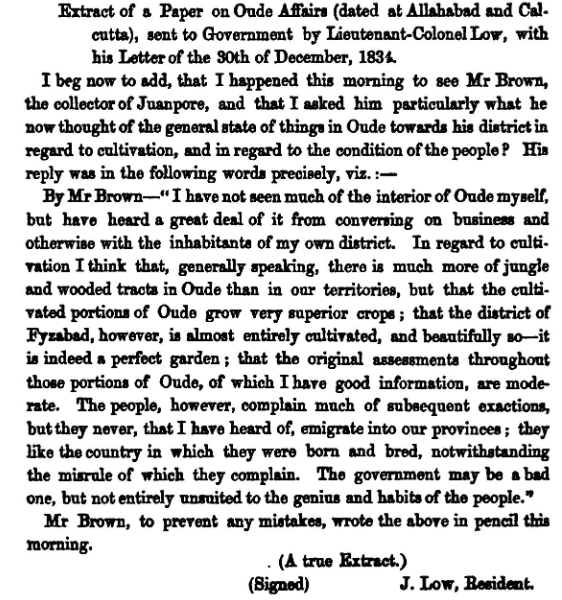
(From: Memoirs and Correspondence of Major General Sir William Nott, G.C.B. Vol II)
A year later, for the sake of his health, Brown resorted to a long sea voyage and sailed to the Cape, a journey which lasted 18 months – he returned to India in 1837 and should have joined as Magistrate and Collector at Suheswan in the Budaon District but he never joined, choosing instead to take an appointment as the Member of the Local Committee of Instruction at Bhagalpur where he would eventually serve as Commissioner. It is little surprise he chose Bhagalpur; being in Bihar, it was closer to his first home in Serampore, than the dusty station of Suhewan and he would have felt more at ease in familiar surroundings, doubtlessly speaking the language and well attuned to the habits of the state. However, as history would show, he might have been better off somewhere else.
Before his troubles began, George was busy, not just as a commissioner but invested himself heavily in building a church in Bhagalpur, which with “indefatigable zeal, energy and perseverance,” he not only “handsomely” subscribed to its building, but made numerous appeals to friends all across India for funds and then “drew the plan, collected the materials, superintended the workmen and in the short space of sixteen months” had “completed the body and nearly finished the tower.”
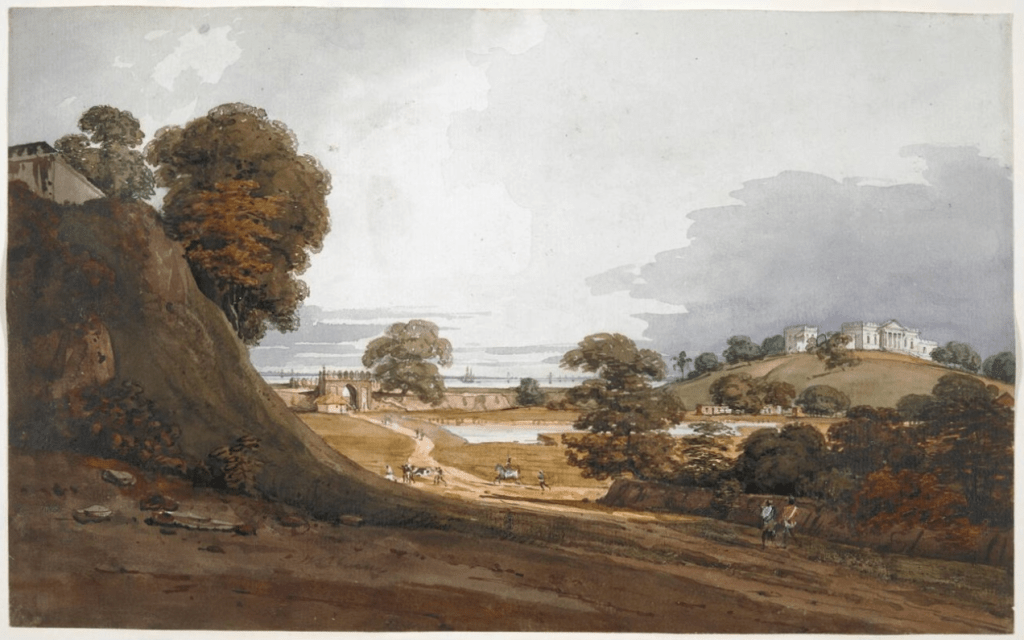
George’s trouble was not however with Bhagalpur he and his wife were raising their growing family; now with 5 children, it was somewhere else altogether, with the Santhals. The tribesmen, were frustrated by decades of oppression by money lenders, tax collectors, the opposition of settlers and traders who were encroaching on their lands and the British settlers with their obnoxious indigo factories. Real trouble did not start until 1854 when the plans for the new railway were made official – this would be a further encroachment into Santal land and brought with it not just an imbalance in their way of life but the “unwarrantable conduct” of the railwaymen who grossly insulted their women and refused to pay the Santal workers. Under the leadership of the four brothers, Kanhu, Sidhu, Chand and Bhairab, the population broke into open rebellion and after attacking the local market, where they made short work of the traders and moneylenders, killed a policeman and then turned their attention to the railway and attacked the workers. No one could quite understand what had gotten into the industrious and generally jovial Santals. Major F.W. Burroughs was sent out of Bhagalpur to deal with the insurrection but to everyone’s surprise, Burroughs was thrashed, with 6 officers and 25 soldiers dead. It was by no means conventional warfare, as Burroughs reported, they were “shot not only with hand-bows but with bows which they used with their feet, sitting on the ground to pull them, and fought also with a kind of battle-axe.”
Snapped out of his calm life of building churches in Bhagalpur, George Francis realised the uprising had “assumed all the characteristics of a rebellion” and suddenly started issuing proclaimations, which called for the killing of rebels caught bearing arms, offering rewards for information and capture of their leaders, and even went so far as to tell the soldiers they could “take all the measures considered necessary for the extirpation of the rebels’ but asked them to refrain killing women and children, saying the British Government did not wage war on the helpless. He then declared martial law.
This last effort on his part raised eyebrows in Calcutta. The government declared Brown’s actions illegal, his proclaimations null and void and martial law unneccesary. Brown however, was not going to take the bolshy behaviour of Calcutta lying down. Instead he wrote to his friend, General Lloyd at Dinapore and asked him for troops and then to directly to Frederick Halliday, Governor of Bengal,
“It appears that the Santhals are led on and incited to acts of oppression by the gowallahs (milkmen), telis (oilmen), and other castes, who supply them with intelligence, beat their drums, direct their proceedings, and act as their spies. These people, as well as the lohars (blacksmiths) who make their arrows and axes, ought to meet with condign punishment, and be speedily included in any procla- mation which government may see t to issue against the rebels.”
Sensibly, Halliday believed Brown was overreacting but created a special committee under A.C. Bidwell – “Commissioner for the Suppression of the Santal Insurrection” – but asked Bidwell to err on the side of caution and deal leniantly with the Santals. Bidwell was by no means to burn villages and to offer pardons to anyone who surrendered. The Santals in the meantime had gathered a substantial army of some 30’000 but while large in numbers they never had a chance.
The railway company, eager to continue their work pressured Halliday who finally submitted and allowed them to recruit their own force – 50 men armed with muskets – to protect the ongoing work and workers and in November 1855, after Calcutta had had a long think about the situation, martial law was once again declared and the Santals were forced into battle, when 14’000 soldiers were sent to put down the rebellion.
It was hardly a fair fight and many of the officers were disgusted by what they saw. The medal for the campaign was more often thrown away rather than worn for as Major Jervis wrote,
“It was not war, it was execution. We had orders to go out wherever we saw the smoke of a village rising above the jungle . . . As long as their national drums beat, the whole party would stand, and allow themselves to be shot down. Their arrows often killed our men, and so we had to fire on them as long as they stood . . . There was not a Sepoy in the war who did not feel ashamed of himself. The prisoners were for the most part wounded men.They upbraided us with fighting against them . . . They were the most truthful set of men I ever met; brave to infatuation. A lieutenant of mine had once to shoot down seventy-five men before their drums ceased, and the party fell back.”
After thousands of Santhals had been killed and the finger-pointing regarding this wholesale slaughter subsided it was subsequently found the Santhals had been right all along and it was the administration that was at fault after all. As for Brown, he retired and handed the reigns of the commissionership of Bhagalpur to George Yule and went home to England. He joined the Royal Institution and died peaceably in Surrey in 1871.
 Mutiny Reflections
The photograph of Harriette Wilberforce Bird suggests she was determined.
LikeLiked by 1 person
It is always interesting to find photographs of people we write about. Although I have not done much about the Birds as yet, there is so much more to discover and explore. She came from very out-spoken people, I wonder what her life would have been, had she and Peploe been allowed to have a future.
LikeLike