1st Battalion, 24th Foot
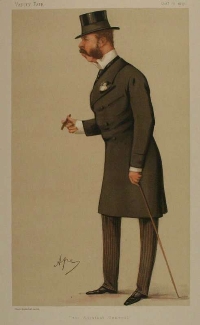
“Adjutant General”. Carlo Pellegrini – Published in Vanity Fair, 20 October 1877
Colonel Charles Henry Ellice — dangerously wounded in the neck, leg, and right shoulder. He was shot through the neck and right shoulder, the bullet coming out close to the spine, another bullet lodged in his leg. Ellice was first reported as killed in action, but this was later revised as he survived his injuries.
Ellice was born in 1823 in Florence, Italy, the second son of General Robert Ellice and his wife, Eliza Courtney.
Following his education at Sandhurst, Charles Henry was commissioned into the Coldstream Guards in 1839. He served in Canada and became a lieutenant and captain in 1845. He then exchanged into HM’s 82nd in 1846, but quickly followed in his father’s footsteps with an exchange into HM’s 24th in the same year. Furthermore, he served as ADC to his father at Malta between 1848 and 1849, thus missing the 2nd Anglo-Sikh War. Promoted major in 1849 and lieutenant colonel in 1851, he gained the rank of colonel in 1851.
He was appointed Companion of the Order of the Bath in 1858, the same year in which he was given the command of the 2nd Battalion of the 24th, whom he raised. After numerous postings, Ellice became Quartermaster General to the Forces in 1871 and in 1876, Adjutant-General to the Forces. He finally retired in 1887 and died the following year.
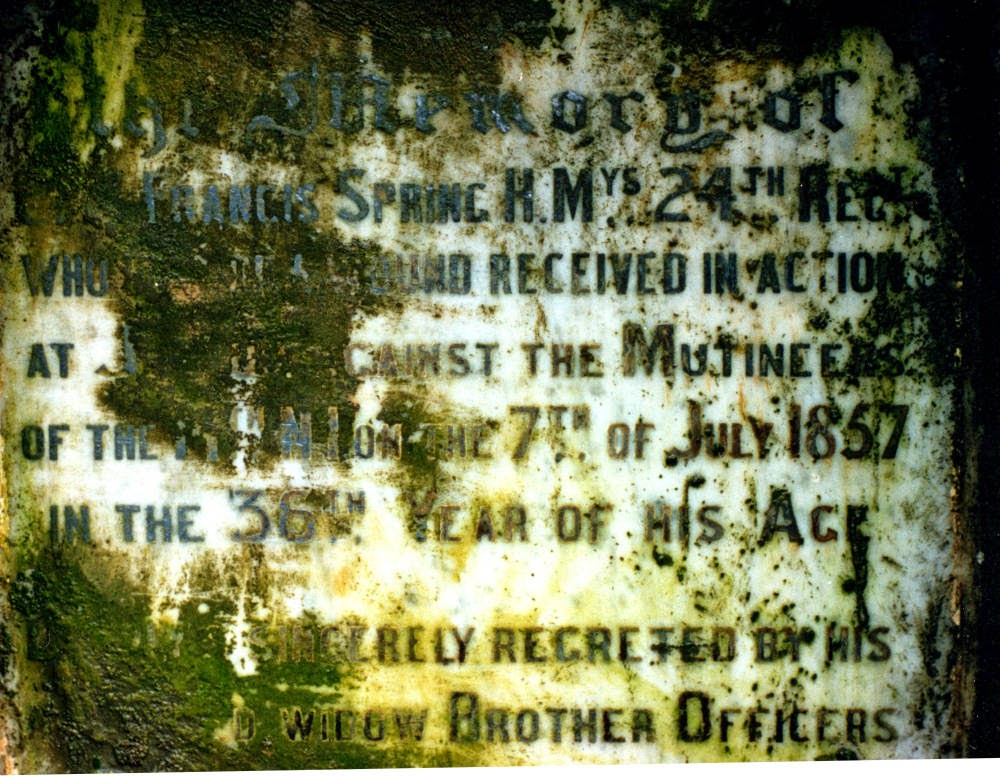
Captain Francis Spring — killed in action — 7th July 1857
Aged 36. Son of Lieut-Colonel William Spring (57th Foot). Joined the army in 1840. Husband of Sara Day.
Buried at Jhelum Cemetery — “Sacred to the memory of Capt. Francis Spring H.M.’s 24th Regt. who died of a wound recd. in action at Jhelum against the mutineers of the 14th N.I. on the 7th July 1857 in the 36th year of his age. Deeply and sincerely regretted by his afflicted widow, brother officers and others who knew him.”
The Historical Records of the 24th note the following:
Lieutenant, 24th Regiment, 22nd April 1842; captain, 14th January 1849.
As a small note, Spring was not in India during the 2nd Anglo-Sikh War, as he was at the depot in Chatham.
His son, Captain W.E.D. Spring of the 1st Battalion, 24th Regiment, served in the Kaffir War of 1878 and died in 1886.
Captain Spring had been at Roorkee at the start of the mutiny — on the 29th of June, he left the station with Richard Baird Smith and Captain Robertson, both bound for Delhi. Spring, however, went to rejoin his regiment in the Punjab. On the very morning he arrived at Jhelum, he lost his life in the ensuing battle.
Lieutenants
Burns, Samuel John James— slightly wounded
Ensign, 24th Regiment, 11th May 1848; lieutenant, 1862; captain, 21st February 1862. Died in Dublin, in 1865. (Historical Records of the 24th)
Chichester, Edmund Prideaux— severely wounded in the arm. Retired from the service as Captain, 7th Dragoon Guards. Died in 1869. After his death, his widow, Ellen Louisa Fairlie, remarried Major George Cecil Gooch. Chichester does not feature in the rolls of officers in the Historical Records of the 24th, likely as he left the regiment in 1857. He is, however, listed in Tavender’s Casualty Roll with the 24th.
According to the London Gazette for October 1857, we have the following citation:
7th Dragoon Guards, Lieutenant E. Prideaux Chichester, from the 24th Foot, to be Lieutenant, without purchase. Dated 17th September 1857.
And again:
Bulletins and Other State Intelligence for the Year 1863, Part 1 January to June:
War Office Pall Mall, 16th January 1863
7th Dragoon Guards Cornet Edward Goldsmith to be Lieutenant, by purchase, vice Edmund Prideaux Chichester, promoted. Dated 30th December 1862
Streatfield, Robert Champion— severely wounded in both legs. Right leg amputated. Afterwards, Colonel Robert Champion Streatfield, Chief Paymaster, Home District. Died at Canterbury on the 8th of August 1891, aged 56. He was born in 1836, in East Ham, Essex, the son of William and Harriet Jane Streatfield.
Ensign, 24th Regiment, 1853; became lieutenant paymaster, 8th June 1858; honorary major, 12th August 1868; honorary lieutenant-colonel, 1st April 1878; honorary colonel, 1st April 1886. (Historical Records of the 24th)
Sergeants
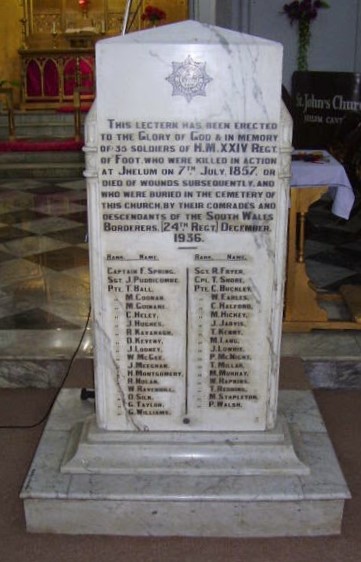
Fryer, Richard — killed in action
Riddicomb, Joseph — killed in action
Corporals
Ryan, John — wounded
Ryan, Thomas — slightly wounded
Shore, Thomas — killed in action
Drummer Hugh McDermid — dangerously wounded. Died of wounds, 14th of September 1857
Privates
Alexander, William — dangerously wounded by a musket ball, “…which struck the outer side
of the right calcaneum, passed through this bone, and made its exit on the inner side. On September 26th, 1857, an incision was made on the posterior part of the os calcis, and necrosed portions of bone were removed, saving the attachment of the tendo -Achillis. August 2nd, 1858.-Wounds healed,
but cannot bear his weight on the heel. 3rd.- Invalided.”
Appilan, James — dangerously wounded. Died of wounds the same day
Austin, Thomas — dangerously wounded. Died of wounds to same day
Ball, Thomas — killed in action
Brown, Richard— dangerously wounded. Died of wounds to same day
Brunsden, John — dangerously wounded. Died of wounds to same day
Buckley, Cornelius — dangerously wounded. Died of wounds to same day
Coonan, Martin — killed in action
Cooper, John — wounded
Earles, William — wounded
Elliott, John — wounded
Farrell, Patrick — wounded
Finn, James — wounded
Fitzgerald, David — wounded
Foley, George — wounded
Ford, Patrick — wounded
Gardner, Duncan — wounded
Garvey, Michael — wounded
Griman, Michael — killed in action
Guinnane, Michael — killed in action
Halford, Charles — killed in action
Halloran, John — wounded
Hardy, George — wounded
Harper, Joseph — dangerously wounded. Died of wounds to same day wounded
Harris, William — wounded
Hatton, Peter — wounded
Healey, Charles — killed in action
Healey, J.F. — wounded
Hickey, Michael — killed in action
Horder, Charles H. — dangerously wounded
Houracan, John (alias Gummings) — wounded
Hughes, John — dangerously wounded. Died of wounds 14th of July 1857
Hughes, Terence — wounded
Jarvis, John — killed in action
Kenny, Thomas — killed in action
Keveney, Dominic — killed in action
Lang, Michael — dangerously wounded. Died of wounds on the 19th of July 1857
Looney, John — killed in action
Lowrie, John — killed in action
McDonald, John — killed in action
McGee, William — killed in action
McKnight, Patrick — killed in action
McMahon, Patrick — wounded
Manners, James — wounded
Meeghan, John — dangerously wounded. Died of wounds on the 17th of July 1857
Miller, Thomas — killed in action
Molyneux, Henry — wounded
Moore, James — wounded by a musket ball “…which entered the left groin, about two inches below
Poupart’s ligament, and about two and a half inches external to the femoral artery, and passed out an inch and a half behind, and a little below the great trochanter, injuring the bone. Fragments of bone have continued at various times to come away.”
By November 1859, “The upper part of the thigh and buttock have now become much consolidated; and although a sinus in the buttock remains open and leads to a fragment of dead bone, which is not yet loose (although the wound was inflicted in July 1857), the parts are in a quiescent state, and the man, having been fitted with a high-heeled boot, is able to get about with facility by the help of a stick, and is now in good health and free from the ague from which he formerly suffered so severely.”
Mullins, George — wounded.
Nolan, Robert — killed in action
O’Here, Daniel — wounded
Rafferty, John — wounded
Rapkins, William — killed in action
Ravenhill, William — killed in action
Redding, Thomas — killed in action
Silk, Owen — killed in action
Smithy, John — wounded
Stapleton, Martin — killed in action
Sullivan, Patrick — wounded
Taylor, George — dangerously wounded. Died of wounds on the 20th of July 1857
Thompson, James — wounded
Walsh, Patrick — killed in action
West, Henry — wounded
Wheal, Samuel John — wounded
Wilbourne, James — wounded
Williams, George — killed in action
Bengal horse artillery, 3rd brigade
Lieutenant Charles Henry Cookes — slightly wounded:
Born in 1829, Charles Henry Cookes joined the army in 1844. He retired as Major-General and died in Eginswell in 1892, aged just 63. (London Gazette, August 1877 — Lieutenant-Colonel Charles Henry Cookes, Royal (late Bengal) Artillery. Dated 1st August 1877)
3rd Brigade, 1st Troop
Corporals
Ross, William — severely wounded in the calf
Turner, John — slightly wounded
Gunners
Brown, Richard — slightly wounded
Campbell, George — dangerously wounded. Died of wounds on the 19th of July 1857
Connolly, William — severely wounded in the right leg
Igo, John — severely wounded in the right thigh
McCarthy, Charles — severely wounded in the left leg
Monaghan, Patrick — compound fracture of the lower jaw
Northover, John T. — killed in action
Tayler, Frederick — severely wounded in the left elbow by a musket ball
Sources:
Cave-Browne, J. The Punjab and Delhi in 1857. Vol. 2. Edinburgh: William Blackwood and Sons, 1861.
Cooper, Frederic. The Crisis in the Punjab: From the 10th of May until the Fall of Delhi. London: Smith, Elder and Co., 1858.
Paton, George, Farquhar Glennie, William Penn Symons, and H. B. Moffat, eds. Historical Records of the 24th Regiment from Its Formation in 1689. London: Simpkin, Marshall, Hamilton, Kent & Co., 1892.
Punjab Government. Mutiny Reports: Reports on Events in the Cis-Sutlej Division. Vol. 8, Part 1 of Selections from the Punjab Government Records. Lahore: Punjab Government Press, 1911.
“Supplement to the London Gazette, May 19, 1858.” The London Gazette, no. 22141, May 19, 1858.
Tavender, I. T. The Casualty Roll for the Indian Mutiny, 1857–1859. London: J. B. Hayward, 1983.
Williamson, George. Military Surgery. London: John Churchill and Sons, 1863.
Links:
For Captain Chichester:
https://www.thepeerage.com/p47109.htm#c471081.1
https://www.thegazette.co.uk/London/issue/22052/page/3454/data.pdf
 Mutiny Reflections