26th Regiment Bengal Native Infantry – Poel Ka Paltan
Raised in 1797 as the 1st Battalion, 13th Regiment of Bengal Native Infantry, following the 1796 reoganisation
In 1824, the 1st Battalion became the 26th Regiment of Bengal Native Infantry, under Major A. Owen.
Battle Honours: Arracan;Caubal; Moodkee;Ferozeshur; Subraon
The 13th of May 1857
The 26th Regiment of Bengal Native Infantry had a distinguished history. They had fought well and bravely for 60 years, winning honours for their Colours in their battles, from Burma to the Punjab, the honourable regiment had taken its salt to heart. They had served well.
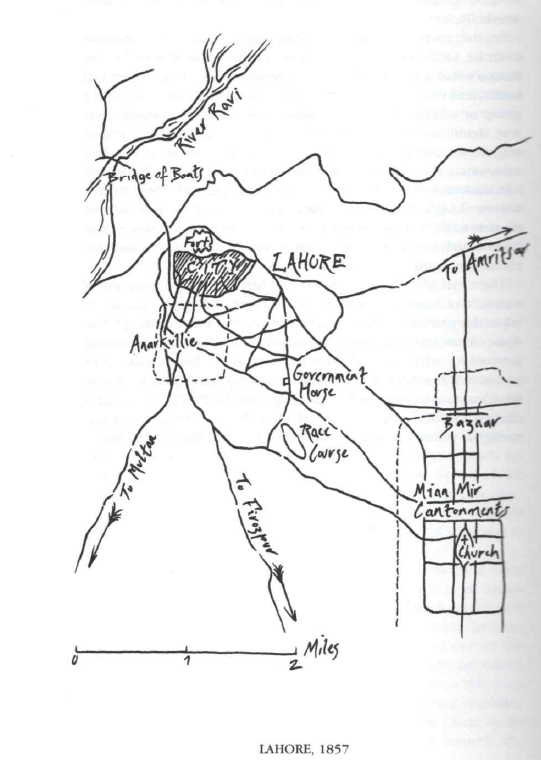
On the 13th of May 1857, the 26th Regiment, along with the 16th BNI, the 49th BNI and the 8th Regiment of Light Cavalry had been disarmed at Mian Mir. Acting on information received by a Sikh NCO in the Police Corps that the regiments planned to mutiny the following morning, the station commander, Brigadier Corbett, ordered their disarming. The news from Meerut was still fresh – whether a conspiracy was at hand or not, Corbett was not taking any chances. Long before dawn, three companies of the H.M.’s 81st fell in and were marched off to Lahore Fort under Colonel Smith. At four o’clock in the morning, the remainder of the regiment fell in and were ordered to ‘loosen their ammunition.’ Leaving the barrack guards doubled, six companies, twenty-four files each, started for the parade ground and were formed up in contiguous columns.
“This morning, the Horse Artillery drew up their formidable lines of black muzzles pointing on to the grand parade, cantonment at their back. The 81st, only 6 companies, drew up behind the guns, the 16th, 26th, 49th and 8th Cavalry, in continguous columns facing this line (about 350 or 400 yards off).
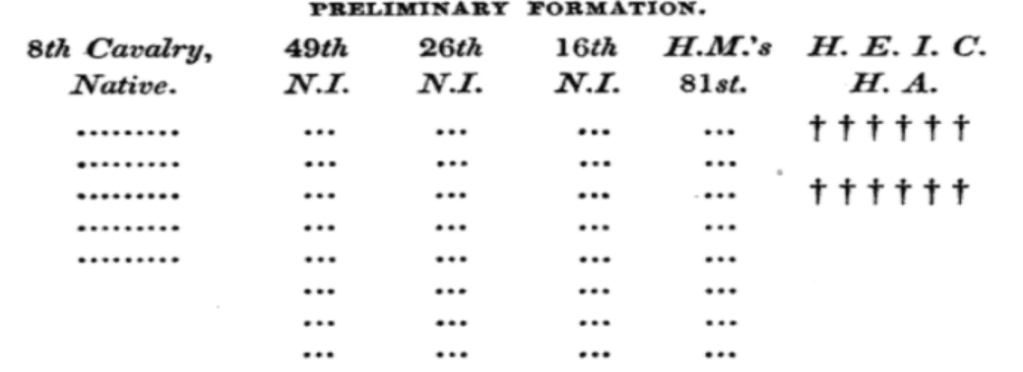
Brigadier Corbett then directed to be read out the Governor-General’s directive regarding the disbanding of the 34th at Barrackpore; as colonel of the 16th, Corbett started off by addressing the his own men. He complimented them for their brave service, for their distinguished reputation and “intimated dimly the step which it was his painful duty not to adopt.” He then ordered to native regiments to change from front to rear, “by the wheel of sub-divisions round the center” – in the mean time, the European artillery were loading as they moved; and the the 81st formed a line facing the native regiments.
Starting with the 16th,
“Order the 16th to pile arms.”
“Grenadiers, shoulder arms.” Done.
Ground arms.” Done.
“Pile arms.” Done.
“Stand from your arms…Right about face…Quick march.”
And so it was with each successive regiment, the cavalry dropping their swords and backed out of them, the carts came, the arms were piled and taken away. Before the morning was over, all 2000 muskets and 500 swords of four regiments were piled into carts, and the men were marched back to their barracks. Not a single shot was fired. While the parade was happening in Mian Mir, three companies of the 81st had moved into Lahore Fort itself, where they swiftly disarmed the half-battalion of sepoys garrisoned there.
The next day, on the 14th of May, a portion of the 16th BNI deserted; on the 3rd of June, the 8th Cavalry was deprived of their horses; but as Arthur Moffatt Lang pointed out, the regiments were “very cut up” about the disarming, and declared to the officers they would have willingly given up their arms at their own parades, “but they were very much hurt at the loaded guns and the Europeans being drawn up against them.”
Even with the regiments disarmed, the station was hardly quiet. Alarms, albeit false, were frequent, the officers of the native infantry regiments were under orders to quell any disturbance that occurred in their lines – 14 men of the 49th had set up Captain Larkins’ house as a possible place of defence, while all around them, the sepoys were in “an awful fright of us and we of them apparently; it does seem skittles: the sepoys will presently be goaded by sheer anxiety and fright to end the suspense by running amuck.” Yet Lang reasoned, they would “such fools as to rise with lathis and tulwars.”
The 30th of July 1857
Major Robert Spencer of the 26th Regiment had taken the disarming badly. Although only in temporary command while Lieutenant-Colonel Evans was on sick leave, he never for a moment thought his men could be mutineers. He had spent his entire 28-year career with the 26th, had fought with them in the First Afghan and Second Sikh Wars; to him, if any regiment was deserving of honour, it was his men. Spencer, as such, shunned European company, having, in the terms of the day, long since “gone native.” Ever since his beloved regiment had been thus shamed, Spencer was rarely seen away from his men, and when he was, he no longer held his head high. Their disgrace fell keenly on a man whose life had been for his regiment.
So it is hardly surprising when, on the 30th of July, and what seemed like yet another commotion in the lines, the sounds of yelling and shouting plain to hear, it was Spencer who proceeded to the lines of the 26th, unarmed. He went forward and tried to reason with the men, but they were beyond all that. Unaware, Spencer was attacked from behind, and with one blow from a hatchet to his head, he fell to the ground. Sergeant-Major John Potter, who had accompanied Spencer, ran forward to try and save the major but to no avail – he was set upon and likewise with blows from lathis and hatchets, brought to the ground. The Havildar Major and Pay Havildar had tried to intervene on behalf of the wounded and dying men but to no avail, and they, along with some others, were quickly brought to count by those very tulwars and sticks Lang had been so disdainful of.
Lieutenant Montagu White of the same regiment was riding to the lines when the men called out to him – the Major, they said, had been murdered by some Sikhs. White could see the bodies on the ground and would have dismounted had not a voice called out for him to fly. Without a moment’s thought, he galloped off, and a blow intended for him hit his horse instead. With all speed, White rode to the artillery lines to give the alarm.
It is, however, not clear what actually happened.
With the other disarmed regiments, there had been a plot brewing in Mean Mir. It was later supposed that “among themselves had they had decided one regiment should start to draw off theEuropean troops of the garrison in pursuit”, leaving the cantonments open for the other three to plunder or murder at will. The 26th had been quietly preparing for the past two days, disposing of their property; however, things did not go as well as planned. From subsequent statements, it was ascertained that a sepoy of the 26th, named Prakash Singh, had rushed out of his hut armed with his sword and shouting to his comrades to “rise and kill the Feringees, “ had set his sights on Major Spencer as soon as he appeared in the lines. Perhaps no one really liked Spencer as much as he believed they did, or maybe he was just at the wrong place and the wrong time. Such actions, as we have seen before, are infectious. Spencer was murdered, and those who witnessed the callous crime became victims themselves – the sepoys knew very well that such actions would not be taken lightly by an already jittery station commander, much less by the authorities of the Punjab. Their only choice then was flight. While the plan likely was not supported by the whole regiment, the rest were swept up in the oncoming panic.
Some of the men broke off into parties and went towards their officers’ bungalows only to find them empty- the officers were all at the mess-house. Then, a body of sepoys rushed to the house of Reverend F. Farrer, who lived in the lines of the 26th, but he managed to spring into his buggy and ride off, driving out one gate as the sepoys barged through the other. Some of the men imprudently made their way to the lines of the Sikh levies, who were not up for any nonsense. They opened fire on the oncoming sepoys, who ran back to their parade ground. Those that could then fled the station by 11 in the morning under the clouds of a severe duststorm. The folly of a few had now sealed the fate of the many.
A reason for their sudden mutiny could be given in the way the corps had been handled in the months after the humiliation on the parade ground. A segment of the regiment consisting of 140 Bhojpur Brahmins from Bihar were seperated from the Oudh men on the suggestion of Mr Mcleod with the view “of giving this class a chance of showing whether they might not be less ill-effected that the general mass” – this measure was adopted in all three regiments and they were the only men who did not mutiny on the 30th of July. However, the measure itself had caused considerable alarm within the 26th. The military authorities, on Montgomery’s suggestion, had also planned to separate the three regiments, sending one to Shekoopoor, one to Shahderah and keeping only one in Mian Mir. The arrangement was so far in the planning that it was circulated in the orderly books and was even known to the men of all three regiments. At the last moment, however, at Lawrence’s behest, the idea was quashed, as he considered it too dangerous for the officers who would have to accompany their regiments. He further felt that any advantage there might be in separating the regiments would be counterbalanced by the fact that at the said stations, there was no one to keep an eye on them. However, the 26th would not have been affected by this – they were the regiment chosen to remain at Mian Mir. All that could be finally ascertained was that it most likely all four regiments had intended to desert together at the sound of the noonday gun, but the murder of Major Spencer and the other three officers had “deranged the scheme.” As it was, the 26th were on their own.
The Flight of the 26th Regiment
By the time White arrived in the artillery lines to raise the alarm and a pursuit could be organised, the sepoys had disappeared. A search of some four miles was made, but no trace could be found of them, so the detachment returned to the cantonments. In the meantime, but not before two in the afternoon, word arrived at Anarkali of the uprising, prompting the Judicial Commissioner, the Commissioner of Lahore, and finally, John Lawrence himself to proceed to Mian Mir. As the pursuit had been given up and no one could say in which direction the sepoys had fled, Lawrence dispatched three parties of Mounted Police towards Amritsar, Hurreekee Ghat and Kussoor, the routes towards the River Sutlej. The largest body under a Sikh Sardar arrived at the ghat in just over six hours, a distance of 45 miles.

In addition to sending out the Mounted Police missives were circulated in every direction with offers of rewards for the capture or “destruction of the mutineers.” It was just a matter of time before someone would find them and the news was quick in coming. On the 31st of July it was clear the 26th had not fled south as anticipated. They were spotted by a watchman from a village who ran across some stragglers. He quickly informed the tehsildar of Dadiyan, south west of Ajnala. The sepoys would not find any friends here.
The tehsildar, with a small body of police and a “swarm” of sturdy villagers armed with sickles met the 26th at the ghat. It was hardly a fair fight. By the time Frederick Cooper arrived on the scene at 4pm with 90 horsemen, having received word that the 26th were now in his territory, he found,
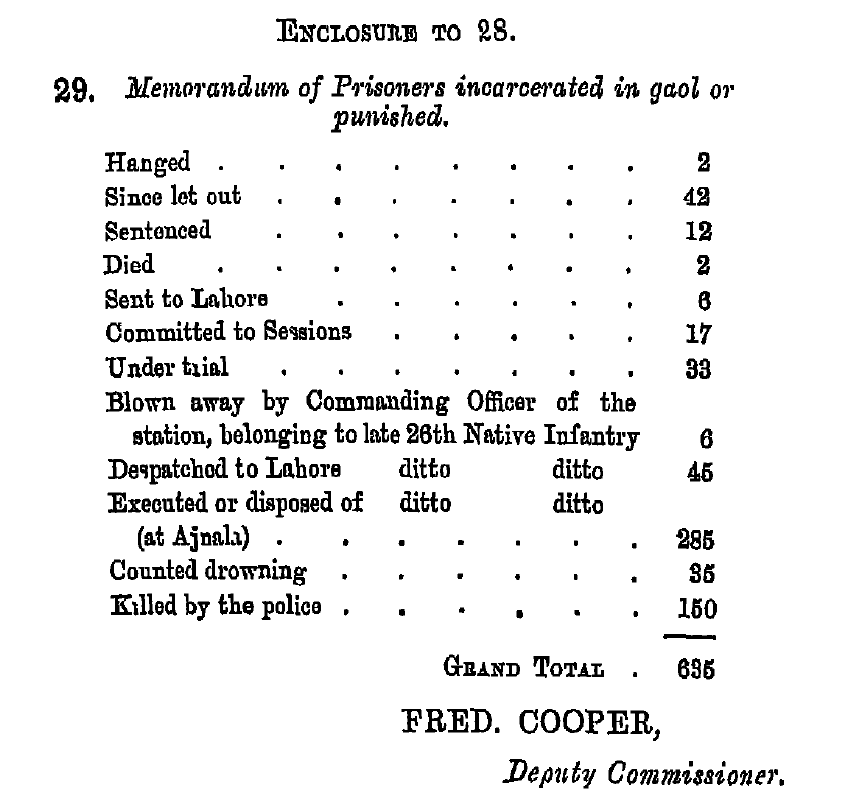
“…a great struggle had taken place: the gore, the marks of the trampling of hundreds of feet, and the broken banks of the river, which augmented with the late rains was sweeping in vast volume, all testified to it. Some 150 had been shot, mobbed backwards towards the river, and drowned inevitably, too weakened and famished after their forty miles flight to battle with the flood. The main body had fled upwards and swum over on pieces of wood, or floated on to an island about a mile off from the shore…”
And from here, the story takes a sinister turn.
Enter Frederick Henry Cooper
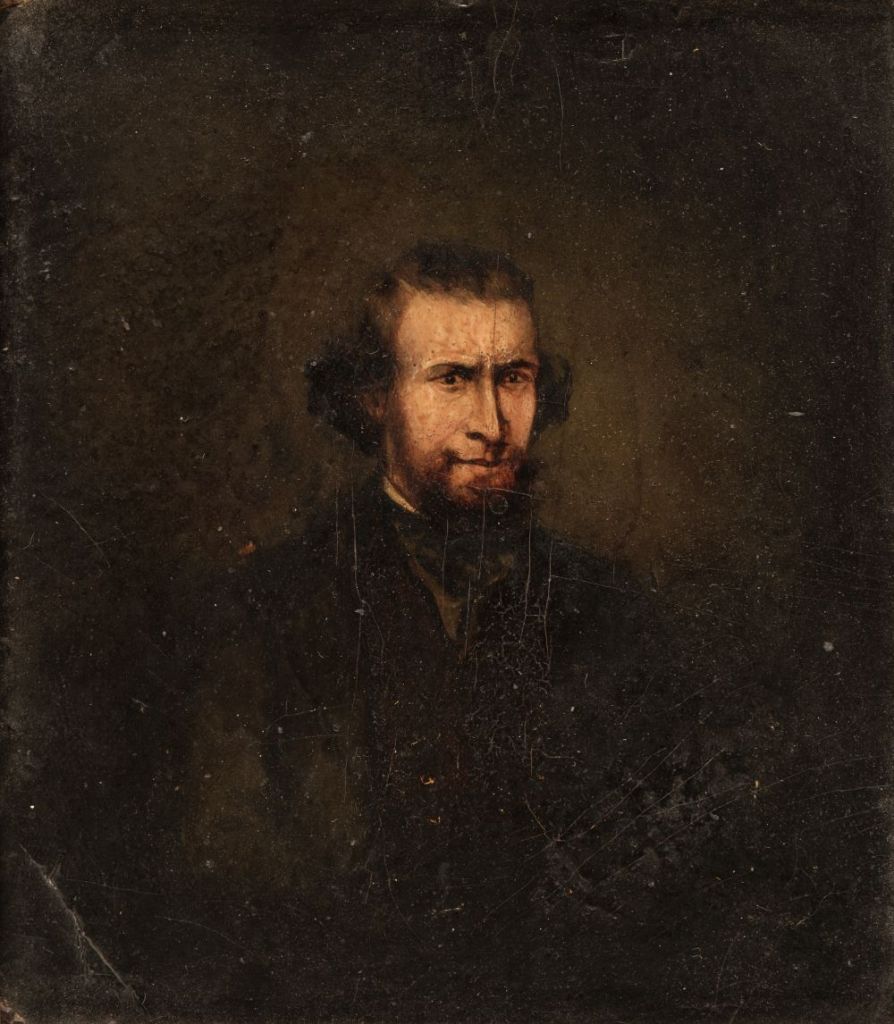
Born in 1827 to Allan Cooper, the “…perpetual curate of St. Mark’s, North Audley Street,” his elder brother, Allan followed a more steady route of employment as an ordained deacon and then a priest, Frederick went to Haileybury College. By 1847, he was in India, a writer for the EICo in Bengal and ten years later, at the age of 31, Deputy Commissioner of Amritsar. It was not a good sign for the 26th NI that the man who had taken it upon himself to bring them to justice had allowed his zealous Christianity to marr his better judgment. In the light of the times, Cooper was not unusual in his beliefs and with his upbringing, it is hardly surprising, being the son of a curate. However, it is the actions that make a man, and if Cooper is remembered for anything, it is for his shameful treatment of the 26th BNI.
Cooper found the 26th huddled on the island in the middle of the river, “famished and footsore” – they were unarmed and had no means of escape. It was not Trimmu Ghat. Instead of an old brass gun, the best weapons the men still had in their possession were hatchets and knives. In their pitiful plight, it is hardly surprising that they believed Cooper’s words. His words were as follows:
“There were but two boats, both rickety and the boatmen unskilled. The presence of a good number of Hindoostanees among the sowars might lead to embarrassment and “accidental” escapes. The point was first how to cross this large body to the mainland if they allowed themselves to be captured at all (after the model of the fox, the geese, and the peck of oats). This was not to be done under two or three trips, without leaving two-thirds of the mutineers on the island, under too scanty a protection, and able to escape, whilst the first batch was being conveyed to the main bank; nor also without launching the first batch, when they did arrive, into the jaws of the Hindoostanee party, who in the first trip were to be left ostensibly “ to take care of the horses” on the mainland. From the desperate conflict which had already taken place, a considerable struggle was anticipated before these plans could be brought into operation.”
The island was a “long, inhospitable patch of grass…with a rising tide,” and as the first boat with 30 sowars aboard reached it, the men of the 26th “with joined palms crowded down to the shore on the approach of the boats, one side of which bristled with about sixty muskets, besides sundry revolvers and pistols, their long shadows were flung far athwart the gleaming waters. In utter despair, forty or fifty dashed into the stream and disappeared, rose at a distance, and were borne away into the increasing gloom.
Some thirty or forty sowars with matchlocks (subsequently discovered to be of very precarious value) jumped into the shallow water and invested the lower side of the island, and being seen on the point of taking pot-shots at the heads of the swimmers, orders were given “not to fire.” This accidental instruction produced an instantaneous effect on the mutineers. They evidently were possessed of a sudden and insane idea that they were going to be tried by court-martial after some luxurious refreshment. In consequence which sixty-six stalwart sepoys submitted to be bound by a single man deputed for the purpose from the boats and stacked like slaves in a hold into one of the two boats emptied for the purpose. Leaving some forty armed sowars on the island, and feeling certain that after the peaceful submission of the first batch (or peck of oats) the rest -would follow suit and suit, orders were given to push off.”
As they stepped off the boats, they were immediately tied, their decorations and necklaces were cut off and cast aside, and under a guard of police and some Sikh sowars, they made their last journey on their doomed flight, the final six miles to the police station at Ajnala. Even when the last party was ferried over from the island, not a man had tried to escape or put up any fight at all. Some only begged that their women and children be spared from retribution. What they believed, however, was at the mercy of the government, but unfortunately for them, the government at Ajnala on that day was Frederick Cooper, unfettered and free to act as he saw fit, far away from any peering eyes of commissioners and judicial commissioners. He had already made up his mind that the men would die.
“It was near midnight before all were safely lodged in the police station. A drizzling rain coming on prevented the commencement of the execution, so a rest until daybreak was announced. Before dawn, another batch of sixty-six was brought in, and as the police station was then nearly full, they were ushered into a large round tower or bastion.”
Cooper’s only quandary appeared to be whether he should hang them or shoot them. Prepared for any such event, he ordered rope to be sent from Amritsar in case there were only a few to hang as “trees being scarce” and he further ordered a reserve party of 50 Sikh levies to proceed to Ajnala, to form a firing party, “in case the numbers demanding wholesale execution”. The levies met Cooper halfway between Ajnala and the river as he was marching his 282 doomed prisoners of all ranks to the police station. The camp followers who had taken flight with the regiment were left “to be taken care of by the villagers.”
This narrative is Cooper’s own. In his belief of the absolute righteousness of his actions, he committed the deed to words in a book entitled “The Crisis in the Punjab,” published in 1858. He does not seek to justify his acts but to glorify them. There is no consideration of a trial, not even a drumhead court-martial; no appearance or attempt is made to ascertain the guilt or innocence of the men in his custody, nor can he resist the insufferable need to gloat. Cooper states he had neither carriage nor escort to bring the men to Amritsar or rightly to Lahore, where they could expect a trial; Nicholson’s Moveable Column was a hundred miles away – here in Ajnala, and without the approval of any known authority, Cooper orchestrated the execution of a regiment.
It must be remembered that this was hardly a well-organised regiment anymore, if it was a regiment at all. They were unarmed in hostile territory surrounded by Sikhs and villagers who would hardly claim them as brothers; they had no support and no means of escape. Cooper makes no mention of them being fed much less given any water; in this deplorable state, while the risk might have existed of a possible escape, weakened men bound with ropes could have been marched 26 miles to Amritsar. Had they tried to escape, they would have died fighting. The other argument for not bringing them to Amritsar was the state of the station – the sepoys there might have organised a rescue of their brethren; the 59th NI had been disarmed and, more recently, the left wing of the 9th Light Cavalry. The station had precious few troops, and the addition of another 282 men, provided they all survived the march, was a burden Cooper did not want hanging on his shoulders. Lahore was still further, but with the recent mutiny and the volatile nature of the situation in Mian Mir, it was hardly a better choice. He fervently believed that “Had the 26th N. I. escaped, or even had their punishment been less terrible and instantaneous, the whole of the disarmed regiments would of a certainty have followed their example, and consequences, which it was fruitless now to speculate upon, but easy enough to conjecture, might have ensued. Their extermination probably saved the lives of thousands.”
Instead of seeking advice or even considering any other options, Cooper allowed himself to be master of a situation that was of his own doing. He had taken them prisoner on the false pretences of a trial, a vague promise given with a false heart, and he was going to make sure no one would hear their side of the story. On the morning of the 1st of August, taking advantage of the “great Mahomedan sacrificial festival of the Bukra Eed,” Cooper sent the Muslim horsemen back to Amritsar, ostentatiously to allow them to celebrate their festival – the real truth, however was, that Cooper was singularly unsure of where their loyalties lay.
In the growing light of the day, he placed sentries around the town to keep off the “egress of sight-seers.” He then summoned the officials of Ajnala, and they “were made aware of the character of the spectacle they were about to witness.” Ten by ten, the sepoys were called. Their names were duly noted, after which they “were pinioned, linked together, and marched to execution; a firing party being in readiness.” After the first 150 had thus been executed, a small break was called; one of the firing party had “swooned away.” By the time Cooper arrived, the only men left were those he had locked overnight in the bastion. Cooper ordered them to be brought forward, but was informed they refused to come out.
“Expecting a rush and resistance, preparations were made against escape, but little expectation was entertained of the real and awful fate which had fallen on the remainder of the mutineers: they had anticipated, by a few short hours, their doom. The doors were opened, and, behold they were nearly all dead!” Forty-five of the 66 imprisoned the night before were “dead from fright, exhaustion, fatigue, heat, and partial suffocation,” – the bastion had but two small windows that no one had taken care to open.
Only one sepoy was spared – too badly wounded to “suffer the agony of being taken to the scene of execution,” he was sent back to Lahore. Like a fury in a forgotten passage of some testament, Cooper gloated that close to the execution ground stood a disused well “and its presence furnished a convenient solution as to the one remaining difficulty which was of sanitary consideration — the disposal of the corpses of the dishonoured soldiers.” Their bodies were thrown, ten at a time as they fell, into the well by the village sweepers. Because he was not quite finished with self-aggrandisement, Cooper declared,
“A tumulus has been erected over the grave (already called moofsidgar, or rebels’ hole, by the people of the vicinity), and it can be seen from a great distance; as it is on the high road, travellers ask and ponder over the tale! Hereafter, the “ rebels’ grave‘ ”‘ will be imprinted in tall capitals over the masonry in Persian, Goormookhi, and English.”
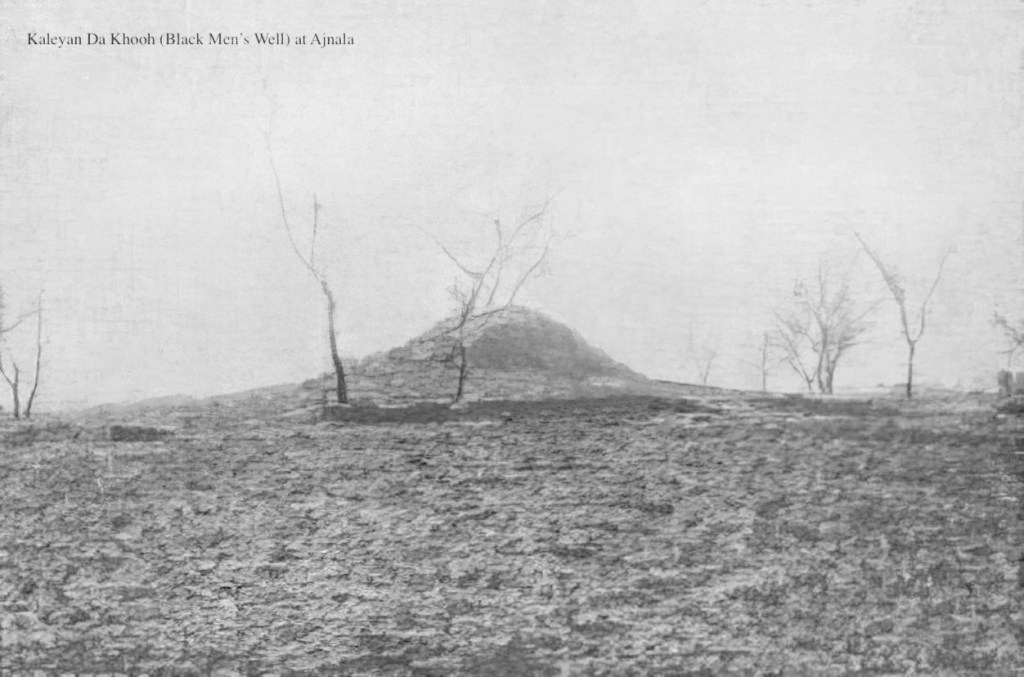
The well was filled with charcoal and lime, covered by a mound of dirt, bricked up and left eventually to fall into the realms of lore.
Within 48 hours of their attempted mutiny at Mian Mir, the 26th Regiment of Bengal Native Infantry had ceased to exist. Over the next weeks, the remainder who had not been at the River Ravi would be hunted – the arrangements of Naesmyth and Taylor frustrated their attempts to cross the river; villagers turned them in and Major Jackson of the 2nd Irregulars captured 40 of them after killing and wounded several in an encounter in a swamp. Some fled to Madhopore, where they were rounded up by the civilians Messrs. Garbett and Hanna. By the 7th of August, it was reported that “The men of the 26th Native Infantry who were not in the first instance destroyed must now have all been killed. One party who was attacked by Major Jackson of the 2nd Irregular Cavalry and three sowars, not far from Gordaspoor, fought desperately, wounded that officer and killed one of his men. Some 24 mutineers have been sent to Lahore.”
In all, 45 men would meet their fate at Lahore – not to languish in jail or face hanging; they would be blown from guns.
As for the 16th, 49th and 8th Light Cavalry – following the flight of the 26th, police were placed around the Mian Mir cantonment and on the 4th of August the disarmed regiments were taken from their lines and put into tents within range of the guns that had been drawn up in front of the HM’s 81st’ barracks. Their lines were searched, and the lines of the 26th were razed to the ground.
Repercussions
After the praise he received the length and breadth of Punjab and, indeed, India, Cooper must have been feeling their words vindicated his actions. After all, when his superiors commended him and could find no fault in Mr. Cooper, he felt smug enough to write his book.
Yet Mr. Cooper, instead of getting the praise he believed he deserved, the parliament back in England took a dim view of the deputy commissioner. In 1859, the words he had written were deemed worrying enough that whole sections of his book were entered into records by Mr Charles Gilpin, a Quaker MP for Northhampton who stated, “One such atrocity as this would do more to excite burning hatred to our power and to our faith, everything multiplied a hundredfold, than the missionaries could eradicate in the next century.” Another was less demure in his words:
“Sir F. Currie, late Deputy Chairman of the Board of Directors and now a member of the Council of India, spoke of this act as a ‘cruel massacre.’ He never heard of Mr. Cooper’s name until his book was put into his hands. He now took his leave of him, recommending him before he left India to build a pyramid of human skulls in imitation of Tamerlane, and then, remembering his constant reference to Providence and his inclination to ascribe such events to Providence, he would no doubt inscribe upon the ghastly structure Non nobis Domine. He could not believe that the approval of Sir John Lawrence…had been given to Mr Cooper with a knowledge of all the facts of the case…”
Another MP sincerely hoped Cooper would be diagnosed as suffering from insanity and was “…ashamed of being an Englishman and being obliged to own himself this man’s countryman.”
Yet, it was the words of a distinguished Polish officer who had written to Gilpin that perhaps struck a higher cord: “The execution of the 26th, as detailed by Mr. Cooper, is truly such a cannibal affair that I am relieved it is not a military man who commanded the massacre. Such a deed would stain the escutcheon of any civilized army in the world with indelible disgrace. Taking the facts upon the perpetrator’s own showing, the wholesale murder was wholly unnecessary, inhuman and unjustifiable. I say this as a military man.”
Cooper falls out of history, but his bloody deed remains one of the most atrocious acts committed by a civilian – condemnation fell on his shoulders like water. Expecting that his actions might irk a few, he called them “mock philanthropists” in his book even before the Gilpin took his outrage to parliament; undeservedly, Cooper still received a CB shortly before he died in 1869.
The Well
The well at Ajnala remained all but forgotten, a story told by townsfolk, a name half-remembered for a place no longer found. Cooper’s book was one of the facets that led to its rediscovery and the excavation of the bones found in its depths. This story, however, belongs to the present; we must continue on in the past.
Sources:
Blomfield, David, ed. Lahore to Lucknow: The Indian Mutiny Journal of Arthur Moffat Lang. London: Leo Cooper, 1992.
Cave-Browne, J. The Punjab and Delhi in 1857. Vol. 2. Edinburgh: William Blackwood and Sons, 1861.
Chick, Noah Alfred. Annals of the Indian Rebellion. Calcutta: Sanders, Cones, and Co., 1859.
Cooper, Frederick. The Crisis in the Punjab: From the 10th of May until the Fall of Delhi. London: Smith, Elder and Co., 1858.
Gimlette, G. H. D. A Postscript to the Records of the Indian Mutiny. London: H. F. & G. Witherby, 1927.
Hansard’s Parliamentary Debates. 3rd series. Vol. 153, Second and Last Volume of the Session 1859. London: Cornelius Buck, 1859.
Kaye, John William. A History of the Sepoy War in India, 1857–1858. Vol. 2. London: W. H. Allen & Co., 1880.
Papers Relating to the Mutiny in the Punjab in 1857. London: Printed by Order of the House of Commons, 1859.
Punjab Government. Mutiny Reports: Reports on Events in the Cis-Sutlej Division. Vol. 8, Part 1 of Selections from the Punjab Government Records. Lahore: Punjab Government Press, 1911.
Links:
https://kclpure.kcl.ac.uk/ws/portalfiles/portal/167504207/The_Ajnala_Massacre_of_CONDOS_Accepted21December2021_GOLD_VoR_CC_BY_.pdf
https://theses.gla.ac.uk/1742/1/2001davidphd.pdf
https://collections.westminster.org.uk/index.php/cooper-frederick-henry-1826-1869
FIBIS
Ajnala Well
https://theprint.in/science/armed-with-dna-scientists-find-1857-war-link-to-skeletons-discovered-in-punjab-well-in-2014/935320/
http://www.anthropology.uw.edu.pl/10/bne-10-06.pdf
http://www.archeolog-home.com/pages/content/ajnala-inde-a-matter-of-martyrs.html
 Mutiny Reflections