On arriving at the Ravi, Captain Bourchier was rightly feeling nervous. His artillerymen had been in Sialkote, friends and comrades of the very men they were now being asked to fire upon. Would they now stand, or would they turn against their salt? No suspicion had attached itself to the artillery, but he took the precaution to warn the European gunners. In reply, the Farrier-Sergeant replied,
“If they only attempt to run, sir, we’ll cut their heads off.” Trimmu Ghat would prove whether Bourchier’s fear was justified or not.
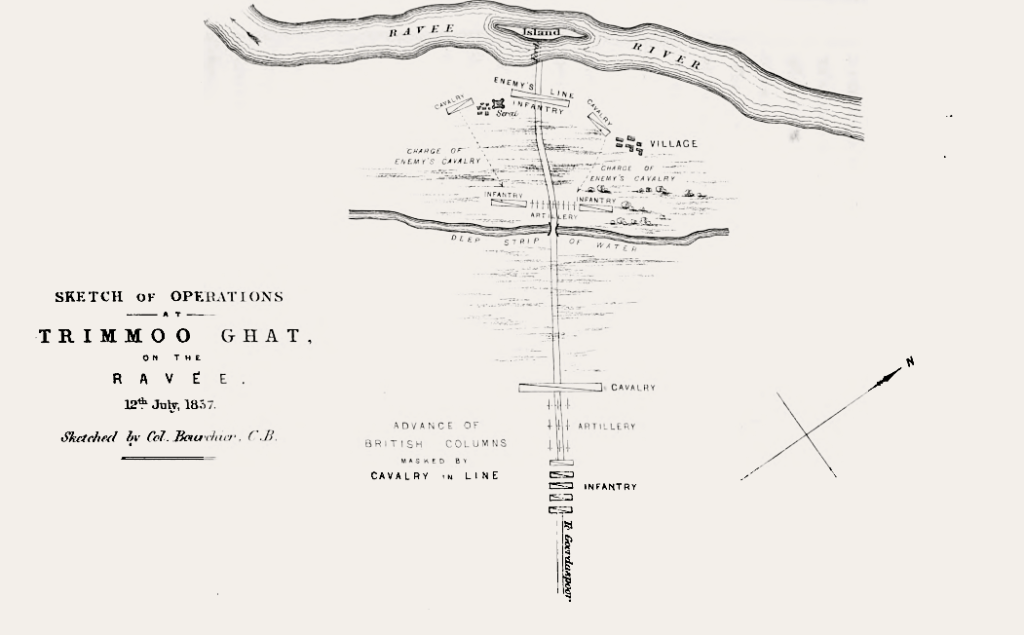
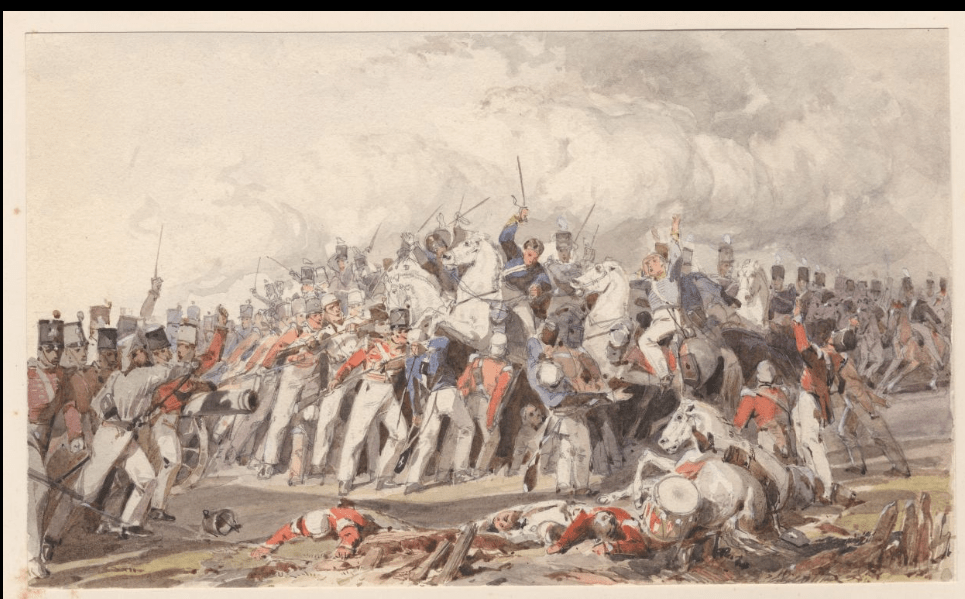
They found the Sialkote Brigade drawn up in line, dressed in their regimental uniforms, with their Colours flying. Nicholson ordered the Movable Column to advance. Nicholson delivered his attack simultaneously in two lines. The first line was formed by 300 men of the 52nd, marching in loose order on either flank of Bourchier’s three guns, while the remaining 6 guns of Dawe’s troop guarded the outer flanks of the regiment. The remainder of the 52nd and the companies of the Punjab Infantry formed a second line. The mutineers had chosen their ground well — in their front was a long but narrow strip of water over which there was only one bridge, and their flanks were protected by villages. Hardly was the artillery over the bridge, protected by some Punjab levies, when down came the 9th Cavalry on their flanks, well before the 52nd could be formed to receive them, and rode straight at the gunners and drivers of Dawes’ troop, cutting them up, left and right. “In five minutes the scene was changed not a trooper of the 9th Cavalry who charged the guns left the batteries alive The infantry formed on our flanks, and a well-directed pounding of grape and shrapnel, from nine guns, aided by the rifles of the infantry, soon told its tale.”
Nicholson had ordered the troops to hold their fire until they were within 300 yards of the rebel line, and then both rifles and guns were to open fire together. “At about that distance, however, the mutineers led off with continuous file-firing, which at closer quarters might have been deadly enough. We lost no time in replying, and for about ten minutes, they stood up very well indeed against the great odds opposed to them, many of them advancing boldly up to the very guns. Meanwhile, the cavalry had made several rushes in detached parties on our flanks and rear but had always been repulsed by the file-firing of our infantry.”
While this was going on, the rebels skirmished from the right to within 30 yards of the leftmost gun but were immediately charged and bayoneted by the left subdivision of the 52nd. The front was soon cleared, and firing from the guns and rifles recommenced and soon sent the Sialkote Brigade into retreat. As the main body retired, they were covered by their flank subdivisions, “who behaved admirably, and were destroyed while covering the retreat.” On recrossing the river, many of them drowned in the turbulent waters; others tossed their arms aside and fled to the neighbouring villages — Nicholson did not have cavalry to speak of and his Sikh sowars were as done up by the sun and the march as the Europeans; their horses could hardly be brought to canter to the river bank, much less give chase.
The Sialkote Brigade had consisted of 800 infantry and 300 cavalry, of which 120 were left dead on the ground before half an hour was up. Those who had not fled took up their position with one 12-pounder on an island in the river Ravi. Meanwhile, the Movable Column quickly took possession of the baggage and stores that the Brigade had had to leave behind. While they were occupied with securing it, the iron gun, which “with immense labour, they had dragged with them, and posted on an island, 1,100 yards from the main bank,” opened fire. As the evening was coming on, it was deemed impossible to cross the river to meet them; a few rounds were fired at the men manning the gun, which caused them to fall back.
The Punjab Infantry under Lieutenant Boswell were detailed to guard the ford and protect the captured property; the rest of the Column returned to Gurdaspur. So ended the first day. It was long after dark when they had trudged the 10 miles to camp — a sergeant of the 52nd died of exhaustion by Bourchier’s side—the artillery carried as many as they could on their limbers, but still the day had proved too much for 4 men who died of heat apoplexy on the march back. On arrival, Bourchier’s servant brought him a bottle of much-needed beer — as Bourchier poured out a tumbler, a sergeant of the 52nd passed him, turned and stared at the captain with his beer with such a look of miserable exhaustion, Bourchier offered him the tumbler. The man drank it down in one gulp and only said, “God bless you, sir,” before moving on.
“The audacity with which the Sepoys and Sowars attacked on this occasion was not repeated in any subsequent action. Colonel Campbell, just before leaving Sealkote, had clothed the 52nd in Karkee-rung (khaki-colour), a native cloth of grey colour, and it is supposed that this very useful and novel dress deceived the enemy as to the character of the troops opposed to them.” As for the 52nd with their novel uniform, it was the first time they had been in action for some 40 years, “…much interest was felt by the officers and men to show that the glorious character earned for the regiment by their predecessors should be maintained in their hands. The result was that thrice their own numbers were attacked, in a position chosen by the enemy, after the 52nd had suffered from long marching and were completely routed and driven across the river. It is not the province of this Record to criticize field operations, but it may be remarked that the peculiar disposition of artillery and riflemen in line was not due to the officer in command of the 52nd.”
So ended the first day at Trimmu Ghat. Bourchier slept in the knowledge that not one of his artillerymen had deserted and had all done their duty without question.
The 13th of July was spent in camp as Nicholson waited for reports. He knew the Sialkote Brigade could not get very far; he had foiled their plans to march on Gurdaspur, and they could not recross the river without being seen. Captain Adams — Assistant Commissioner of Gurdaspur went off to collect information at Trimmu Ghat, and reports soon came in from both him and Boswell. Some mutineers had attempted to recross the river during the night from the island; while a number of them drowned, others were captured by the waiting police. The rest, however, were still on the island. The only choice Nicholson had left open to them was to fight.
In the afternoon of the 14th, the Column marched back to the river, encamping just out of range of the battery on the island. There, they waited while boats were procured, with some difficulty, to cross the river. By the evening of the 15th, 2 ferries were secured from higher up on the river — Naesmyth had done his job so well, these were the only two left intact. As it was too late to cross, the day drew to a close, and the final operations would commence on the 16th of July.
At daybreak on the 16th everything was ready. Two of Dawes’ Horse Artillery guns were mounted on elephants ready to be crossed, should they be needed, by the ford. Bourchier’s battery was placed out in the open, a ruse to draw attention away from the infantry that was being ferried across the river to the southernmost point of the island, where they would be amply covered from the rebel pickets by thick brushwood. Bourchier in the meantime, continued “blazing away” at the old 12-pounder, well hidden by tall grass and a hastily erected earthwork. The gunners were still returning fire as the 52nd moved forward, skirmishers in front. Nicholson in the meantime, with his staff officers and a small escort, rode ahead, reconnoitring the rebel position.
From the river bank, Bourchier watched as suddenly, “Troopers galloped about the assembly was sounded over and over again, and the gun was slewed round to arrest the progress o the line…” They had realised too late that their island retreat was under attack. The gun had been elevated to throw a shot at Bourchier at 1200 hundred yards and the men working it could not get the rusty screw of the old gun adjusted at such short notice — the shot they aimed at the advancing 52nd flew harmlessly over their heads. Nicholson led the charge on the battery himself, and his sword “crashed down…upon the shoulder of the man who worked the gun, and clove him literally in two.” Within a few minutes, the battery fell silent and not one of the gunners escaped with his life – they died defending their guns to the last. The rest ran to the head of the islands and quickly took to the river. Many of them drowned while others found refuge on sandbanks and smaller islands. Many of those who made it to land were caught by Naesmyths’ police or shortly after given up by villagers.
“The majority of the fugitives made for the upper part of the Doab. The hills were the only route by which they could hope to elude the vigilant search which was now instituted, and every villager well understood the value of a mutineer. Some wandered up the right bank of the Ravi and became entangled in the dense jungle and swamps of the “Narot Talooqua” and were eventually hunted down by the police or the zemindars; others attempted to conceal them selves in the brushwood which lines the river’s bank or on the islands in its bed, and either met a similar fate or perished in attempting the passage of the Ravi; some contrived to escape to the Jummoo territory, where it is believed the majority were apprehended and either made over to justice or stripped of all and left to wander penniless outcasts beyond the limit of British territory. Some few attempted, by assuming the guise of faqueers, boldly to escape across the Beas or, pending more fortunate times, to exist as mendicants and to fraternise with faqueers of the country, &c.; but in this too they were foiled, for their speech betrayed them, and the bonds of caste and superstition failed to protect them from the animosity of a race who detested them, and who were now tempted by pecuniary reward, and thus from the doom they so richly merited.”
The punishment for mutiny, wrote Nicholson, is death. Any rebels that had been caught while Nicholson was still in Gurdaspur were executed; the helpless camp followers who had fled from the island with the sepoys were flogged. 141 men of the Sialkote Brigade were handed over by the Kardar of Jusrota of Jummu to Lieutenant McMahon and his levies on the frontier some weeks after the battle – they were executed on the orders of Captain Andrews. Reynell Taylor reported that in his district, fugitive sepoys from the Sialkote Brigade were caught by the ghat guards at the river crossings, and he believed only three or four actually reached the river at all. Twenty sepoys, three horses and 60 camp followers were captured in his district alone –
“Of the first one was of the 9th Cavalry, one Ramzan, Quartermaster-Havildar, who I have been informed by an officer of the corps burnt the Kutcherry at Sealkot and was prominent in releasing the prisoners, and was made a Brigadier for his services. This man was executed at Noorpoor. 17 were men of the 46th,—1 havildar and 16 sepoys. 6 of these were executed at Noorpoor and 10 were forwarded to Jullunder…” The Raja of Chumba captured a further 32 and sent them to Kangra to meet their fate.
It was estimated, of the 1000-strong infantry and 200 cavalry of the Sialkote Brigade, 759 of them were either killed during the battle of Trimmu Ghat or subsequently executed. None of the men of the 46th reached Delhi, and their once proud regiment was wiped off the lists. They and the 9th Cavalry had valiantly fought their last battle at Trimmu Ghat.
Returns for the Movable Column
52nd Regiment of Foot
Lieutenant C.J.R. Troup – wounded
Colour Sergeant William Sayer – wounded
Corporal James Fair – severely wounded
Sergeants
Forbes, William – dangerously wounded
Hughes, William – severely wounded
Jakeman, David – killed in action
Sheward, John – slightly wounded
Privates
Buck, Robert – severely wounded
Connolly, Thomas – severely wounded
Cross, James – dangerously wounded. Died of wounds.
Evans, George – slightly wounded
Goodrum, George – slightly wounded
Hewitt, James – severely wounded “…by a musket ball, which entered on the anterior aspect of the upper third of the left thigh, and fractured the femur; the ball was cut out in the lower part of the gluteus muscles six weeks after . July 20th, 1858. – Wound healed; the fractured ends of the bones overlap; the leg is now an inch and a half shorter than the other, and he cannot put his heel to the ground. It is a good cure, and he still retains a very useful limb; no pieces of bone came away ; long splint used. 22nd .— Invalided
Holgate, Henry – wounded
Horwood, Stephen – dangerously wounded
Johnson, John – wounded
McGenniss, Henry – slightly wounded
McNamara, Thomas – wounded
Madden, Peter – slightly wounded
Murren, Lewis – severely wounded
Neill, John – killed in action
Nicholas, George – dangerously wounded. Died of wounds
Parkins, John – slightly wounded
Percy, Edward – severely wounded
Bengal Horse Artillery
1st Brigade, 2nd Troop
Corporal Edward Covenay – killed in action
Gunners
Clarke, Joseph – killed in action
Corrigan, Andrew – killed in action
1st Brigade, 3rd Troop
Sergeant George Beveridge – wounded
Gunners
Barron, Thomas – wounded
Brabson, James – dangerously wounded. Died of wounds
Case, Henry – severely wounded
Clarke, Joseph – killed in action
Craig, Robert – shot in the hand while on sentry duty
Doyle, Maurice – thigh fractured by a gun wheel
Kean, Henry – wounded
Lyons, James – wounded
Morison, Angus – wounded
Sources:
Bourchier, George. Eight Months’ Campaign against the Bengal Sepoy Army, during the Mutiny of 1857. London: Smith, Elder and Co., 1858.
Cave-Browne, J. The Punjab and Delhi in 1857. Vol. 2. Edinburgh: William Blackwood and Sons, 1861.
Gimlette, G. H. D. A Postscript to the Records of the Indian Mutiny. London: H. F. & G. Witherby, 1927.
Kaye, John William. A History of the Sepoy War in India, 1857–1858. Vol. 2. London: W. H. Allen & Co., 1880.
Moorsom, W. S., ed. Historical Record of the Fifty-Second Regiment (Oxfordshire Light Infantry) from the Year 1755 to the Year 1858. London: Richard Bentley, 1860.
Papers Relating to the Mutiny in the Punjab in 1857. London: Printed by Order of the House of Commons, 1859.
Punjab Government. Mutiny Reports: Reports on Events in the Cis-Sutlej Division. Vol. 8, Part 1 of Selections from the Punjab Government Records. Lahore: Punjab Government Press, 1911.
Tavender, I. T. The Casualty Roll for the Indian Mutiny, 1857–1859. London: J. B. Hayward, 1983.
Trotter, Lionel J. The Life of John Nicholson: Soldier and Administrator. London: John Murray, 1904.
Williamson, George. Military Surgery. London: John Churchill and Sons, 1863.
 Mutiny Reflections