The Siege Continues
Ten days into the siege, Thomson described the scene as such:
“Tattered in clothing, begrimed with dirt, emaciated in countenance, were all without exception; faces that had been beautiful were now chiselled with deep furrows; haggard despair seated itself where there had been a month before only smiles. Some were sinking into the settled vacancy of look which marked insanity. The old, babbling with confirmed imbecility, and the young raving in no few cases with wild mania, while only the strongest retained the calmness demanded by the occasion.”
Ill-equipped, in ruined barracks under the tortures of the June sun, the garrison fought as best it could against overwhelming odds. A rumour that the British had surrounded the entrenchment with buried gunpowder might have deterred the troops of the Nana from attacking directly. Because the British fought so well and so doggedly, it might also have been difficult to tell how well-armed and how many were there. Their only option was to do their duty and, as fate would have it, die trying. Thomson, who would spend most of the siege at the outposts, wrote,
“Our position behind these unroofed walls was one of intense suffering, in consequence of the unmitigated heat of the sun by day, and the almost perpetual surprises to which we were liable by night. My sixteen men consisted in the first instance of Ensign Henderson, of the 56th Native Infantry, five or six of the Madras Fusiliers, two platelayers from the railway works, and some men of the 84th Regiment. This first instalment was soon disabled. The Madras Fusiliers were armed with the Enfield rifle, and consequently, they had to bear the brunt of the attack they were all shot at their posts several of the 84th also fell; but, in consequence of the importance of the position, as soon as a loss in my little corps was reported, Captain Moore sent me over a reinforcement from the intrenchment. Sometimes a civilian, sometimes a soldier came. The orders given us were, not to surrender with our lives, and we did our best to obey them…”
If Thomson’s position was terrible, in the barracks where the women and children were was worse. There was little shelter left from the heat as wall after wall crumbled and the roofs began to give way. Every corner was a shelter for a family, and as each room became untenable, they would rush to another, vying for any little space that afforded them some shelter. Many women and children were killed outright by shot and shell, and others were buried under heaps of masonry and debris. Their bodies were dragged outside and dumped on the veranda, awaiting their interment at night in a dry well. There was neither time nor space to bury them; the ground was too hard for shovels, and no man could be spared for the duty. After the first day of shelling, the women and children fell into a despondent silence, only broken by the groans of the wounded and the dying. As for the well which provided the garrison with water, it shortly became the most contested spot in the entrenchment. Unprotected and open to fire from the insurgents, it took a brave man to haul up the precious liquid some 70 feet below ground. As soon as the creaking of the tackle rang out, even in the dead of night, the artillery would open fire – and the privates who had volunteered for the duty would be sent scurrying back to safety. They charged now as much as 10 shillings for a bucket, not that their earnings would be of any use. The continuous shot and shell poured onto the well soon tore away the wood and the brickwork of the well, and when the tackle was smashed, the only option left was to draw the water up overhand. Mr MacKillop of the Bengal Civil Service, who confessed he was not a fighting man, volunteered for this dangerous task. He managed to hold his post for a week when a shot in the thigh disabled him, and as he lay dying from the effects, he begged that the last bucket he had filled be given to the lady who had asked for it.


In the batteries, work continued undaunted.
Untiring, Lieutenant Ashe could be seen leaping up, spyglass in hand, checking to see where each of his shots had landed, after every shot, unaware of the missiles flying around his head. Eight out of ten pieces in the entrenchment were 9-pounders, and the supply of ball was quickly used up. The artillery officers found themselves reduced to using shot which was a size too small, limiting their accuracy. As contests go, this was quickly uneven. The insurgents had 18 and 24-pounders and as much ammunition as they could possibly want. For the entrenchment, there was nothing for it but to resort to creativity.
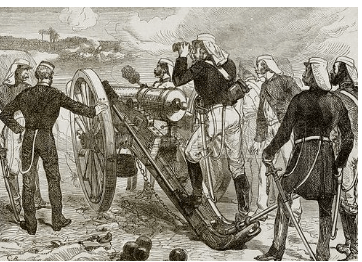
A particularly loathsome small cannon had been brought up by the insurgents to one of the unfinished barracks and behind the safety of the walls, plied a murderous trade on the entrenchment. Lieutenant Delafossie had tried to dislodge it with 6-pounders but to no avail. He was, however, not a man defeated by circumstance. Loading the gun with three balls and with grapeshot to fill in the chinks, he told everyone to stand well back. He fired the gun and watched for the results. The shot smashed through the unfinished barrack, destroyed the small gun and sent the remaining sepoys flying. At least one side was momentarily silenced until the next attack.
By the end of the first week, 59 artillerymen would be killed or wounded at their posts. Most of the officers were dead; Major Prout was dead from sunstroke, and Captain Kempland, who had never been able to stand the heat, lay on the floor of the barrack, utterly prostrated. Lieutenant Eckford, while sitting on the veranda, was caught full in the chest by a round shot, while Lieutenant Dempster was shot dead at his post. Lieutenant Martin received a shot in the lungs. Martin had arrived in Cawnpore two days before the outbreak, and Thomson overheard him say, as he looked at a pile of shells, ” I should like to see some practice with these things…” Wishes can be granted most unexpectedly. As each man fell, a volunteer was sent in his place – instead of well-trained gunners, the posts were increasingly relying on bandsmen, opium agents and telegraph clerks.
The guns, too, had suffered. The howitzer was knocked off its carriage, while one cannon lost its entire muzzle. Others had their sides beaten in and their vents blown out, while most of them were so damaged that the canister could not be driven home. The women gave up their stockings to the artillery, who, after tapping the canisters, “charged these with the contents of the shot-cases — a species of cartridge probably never heard of before. It was a poor subterfuge, but by that time, we were driven to every expedient that invention, sharpened by dire necessity, could bring into play.”
As the siege wore on, the remaining guns were withdrawn under whatever cover was remaining, loaded with grapeshot and reserved in case the insurgents tried an all-out assault. Things would only get worse.
On the 13th of June, the hospital barrack was set on fire. The thatch had only been imperfectly covered by tiles, and the work was never completed – fate would have it that an incendiary, either a carcase or a shell filled with burning material, settled on the roof and within seconds, the thatch burst into flames. Every attempt was made to remove the injured from the flames, but for others, it was too late.
“…it was about 5 p.m., and that evening was one of unspeakable distress and trial, for all the
wounded and sick were in it, also the families of the Soldiers and Drummers; the fire took on the South side of it, and the breeze being very strong, the flames spread out so quickly, that it was a hard matter to remove the women and children, who were all in great confusion; so that the helpless, wounded and sick could not be removed, and were all burnt down to ashes (about forty or upwards in number.) The whole of the medicines, also there, shared the same fate; all that the doctors could save was a box or two of surgical instruments and a small chest of medicines so that after that was expended, the sick could get no medicine. It was perfectly impracticable to save any of the wounded or the medicines, in consequence of the insurgents collecting in very large bodies in the adjacent compounds and buildings, with their muskets and swords, ready every moment to pounce down upon us, and the men were compelled to keep their places under the walls of the entrenchment, and could not lend a helping hand to those in the Barracks.”
Taking advantage of the confusion in the entrenchment, the insurgents decided to attack. Advancing in hundreds in the direction of Ashe’s Battery to storm it, they were caught off-guard when sixty yards from the guns, Ashe opened fire with grapeshot. He had seen them all along.
Simultaneously, the men shouldered their guns, one after the other, already loaded and discharged them into the midst of the insurgents, leaving a hundred corpses on the ground and the rebels fleeing back to their lines. It was a half-hour of hell. While the assault was thus being thwarted, at the burning barrack, Lieutenant Ward of the 56th was trying to remove the wounded from the blaze. It was his misfortune to fall over and run his own sword through his leg. Injured as he was, Ward struggled back to his feet and carried on with his work, and then he would return to his post and fight on. He would die on the boats at Satichaura Ghat.
With the barrack gone, the women and children were forced out into the trenches. For the next 12 days, they would cower in holes hastily scraped out of the dirt; sometimes, a piece of canvas was stretched over their heads, but as soon as it was seen, the insurgents lost no time in directing their fire at it. A group of soldiers’ wives huddled together in the trench at Whiting’s Battery received a mortar shell in their midst, which killed seven of them outright. Somewhere in this misery lay Mrs Darby, the wife of an assistant surgeon who had been ordered to Lucknow before the siege. Too advanced in her pregnancy to accompany her husband, she would give birth in the entrenchment only to die, with her baby, in the boats. Dr Darby would be dead before the evacuation of Lucknow was completed.
The deaths continued.
Lieutenant Jervis, of the engineers who loathed to run, was seen calmly walking across the open between the barracks and Whiting’s Battery in a perfect hail of bullets, while his friends called out, “Run, Jervis!” he continued his casual pace only to receive a bullet through the heart. Major Lindsay received wood splinters in his face as round shot smashed through a door – blinded and in terrible agony, he died three days later. His wife followed shortly after. Mr Heberden, one of the intrepid railwaymen, took over when Mackillop died, while handing some ladies buckets full of water, a charge of grapeshot entered the barracks, and one shot passed through both his hips. He survived long enough to die at Satichaura Ghat.
Yet, the fighting went on.
Captain Moore, seemingly undaunted, decided at least some of the guns could be silenced. Gathering together a party of volunteers, Moore sallied out at midnight, first towards the burnt-out church where the party spiked three guns. Using the cover of darkness, they moved on towards the mess house, where they surprised a group of sleeping insurgents, bayonetting them as they lay. Two guns were spiked, and a third was blown up. They then returned, triumphant, to the entrenchment. Their rewards were brief – the next day, the rebels brought up fresh guns, and the cannonade continued unabated. However, men driven by the will to live are capable of the extraordinary.
When the carriage of a cannon in the north-western battery was accidentally ignited, the wood was so dry that it quickly turned into a furious blaze which threatened the nearby powder magazine. It was Lieutenant Delafosse who, stretched out on his back under the gun, pulled down the burning splinters all the while under the concentrated fire of the insurgents. Two privates quickly came to his aid, carrying buckets of water, and with their help, he managed to extinguish the conflagration; all the while, 18 and 24 round shot flying past them, six per minute. Meanwhile, Mr Jacobi, a coachmaker by trade, spotted what he believed was a live shell, landing on the magazine roof. Clambering up, he grabbed the object, which was, in fact, a fireball shot by the insurgents, and threw it over the breastwork.
Page 3/5
 Mutiny Reflections
The cavalry cadet named Mainwaring was Cornet Charles Mainwaring of the 6th Bengal Light Cavalry. I wrote about his death in the massacre by the river at Cawnpore in https://anneyoungau.wordpress.com/2023/04/11/i-is-for-indian-mutiny/
Charles Mainwaring is remembered on a tablet in All Souls Church, Cawnpore.
LikeLiked by 1 person
I have added your site information to the Cawnpore posts and am currently in the process of fixing the casualty lists. It is a rather long and laborious task but hopefully I can get it finished this week.
LikeLike
Hi there Darth Sahib. Thankyou for your kindly comments. I have made a third trip to India since my last comment and produced a documentary of sorts, that I hope will help heal. Filmed in Lucknow and Kanpur mostly. I will go back again for sure as I have much unfinished business connected with my dear family who perished in Cawnpore, especially Bibighar. I will try to add the link below, but if I can't, please search Youtube and type \”India Sepahi Rising 1857 Remembering Cawnpore\” The film is short on narrative during the first 20 minutes because I needed ananimity , but the narrative should help explain in book form the second half. Namaste and God bless then, Mark Ji. New Zealand.
LikeLike
I found myself reading about the history of colonialism in India and could not believe that such an atrocity was committed. I don't know how the people that committed such an act justified it morally, or how they were able to continue with their lives afterward. It is a scary thought to imagine that people are capable of this. My family comes from India and although I live in North America, I am so very sorry for the barbaric murder of the innocent women and children, which should never have happened. Although this event is reprehensible by today's standards, I'm certain that even back then, most individuals would have been totally against such brutality (including my ancestors). I hope that we can all collectively learn from these past mistakes, in the hopes that such things never happen again.
LikeLiked by 1 person
For a certainty Anil; this I know for sure having travelled twice to India in the last 4 years and with my Father also born in Allahabad, actually my family trace 4 generations in UP. The kindness, gentleness and respect I have found in my travels from Ahmedabad to Kangra in the north, Agra, across to Lucknow and right down to Calcutta is simply wonderful. The world that was during the 19th century, with a different kind of normal than that of today, is history and would seem very foreign to you and me I am sure and if we were to travel back to that time. Namaskar – Mark
LikeLike
Very sorry to read this horryfic truth.this is not Indian culture
LikeLike
Well done Eva. I have just read your work on Cawnpore and you have meticulously covered nearly every aspect of that terrible drama during June and July of 1857. Your references are impeccable and beyond any questioning and there is nothing more that I might add. If anyone wants to make contact, I will leave my email if that's okay and would happily correspond, as I have already with a number of descendents of Cawnpore families. mark@gafelk.co.nz Kind thanks Eva for adding my family connection too, is truly appreciated and an honour. Respectfully yours – Mark Probett (New Zealand)
LikeLike