The Siege of Wheeler’s Entrenchment
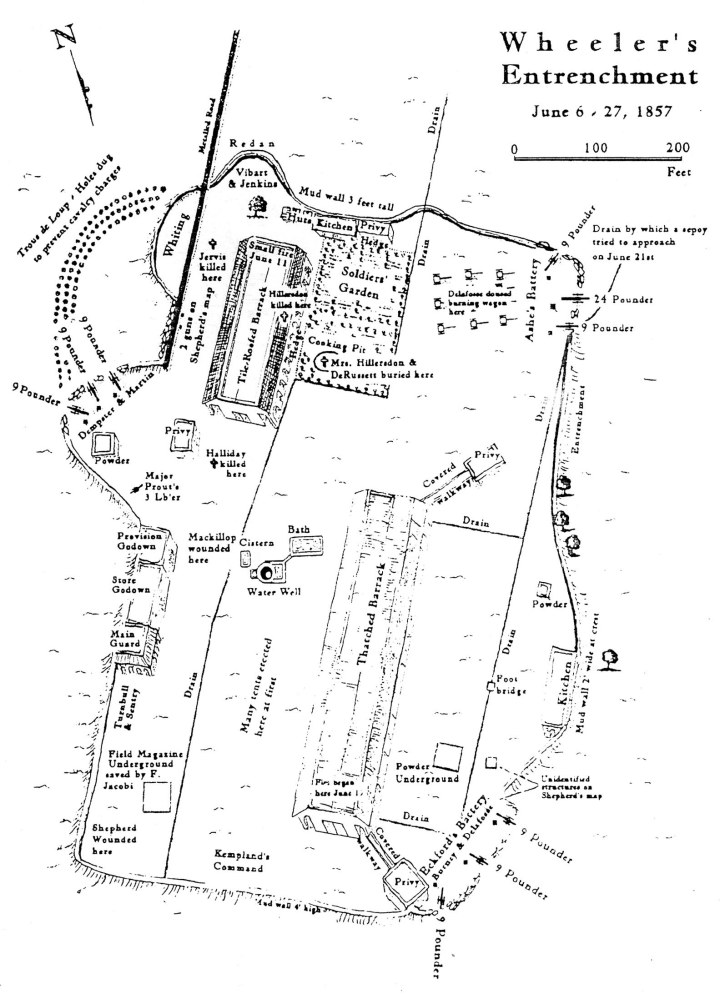
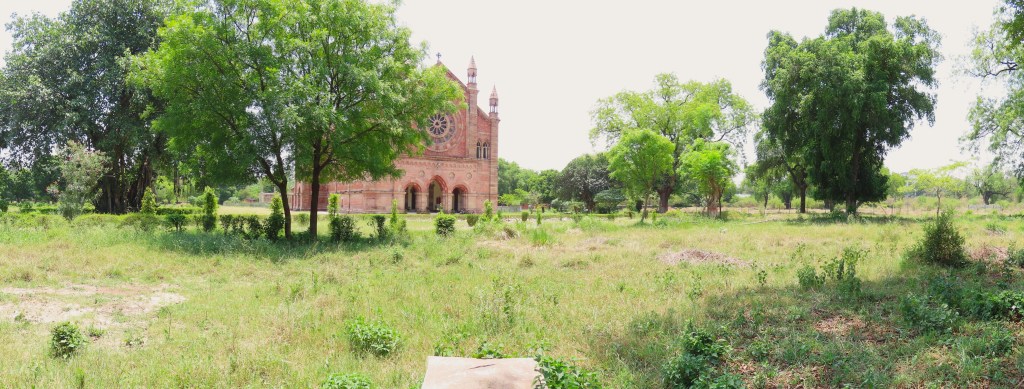
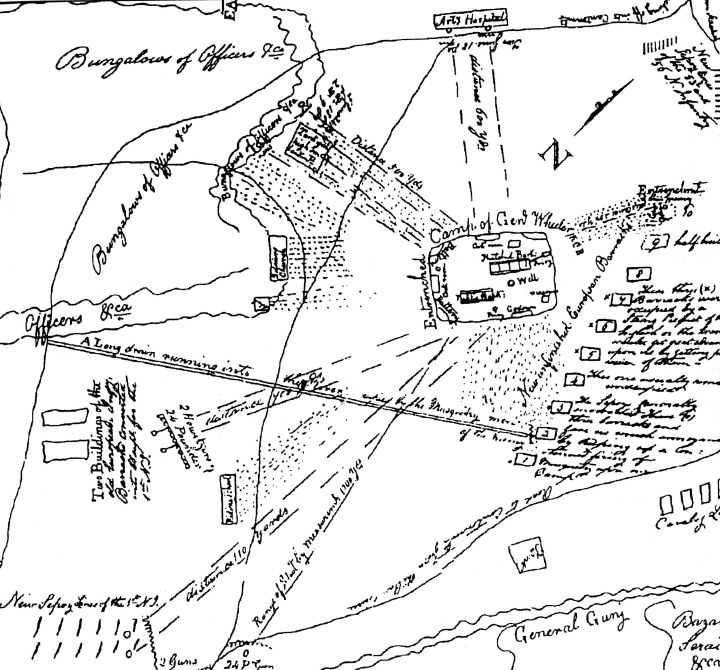
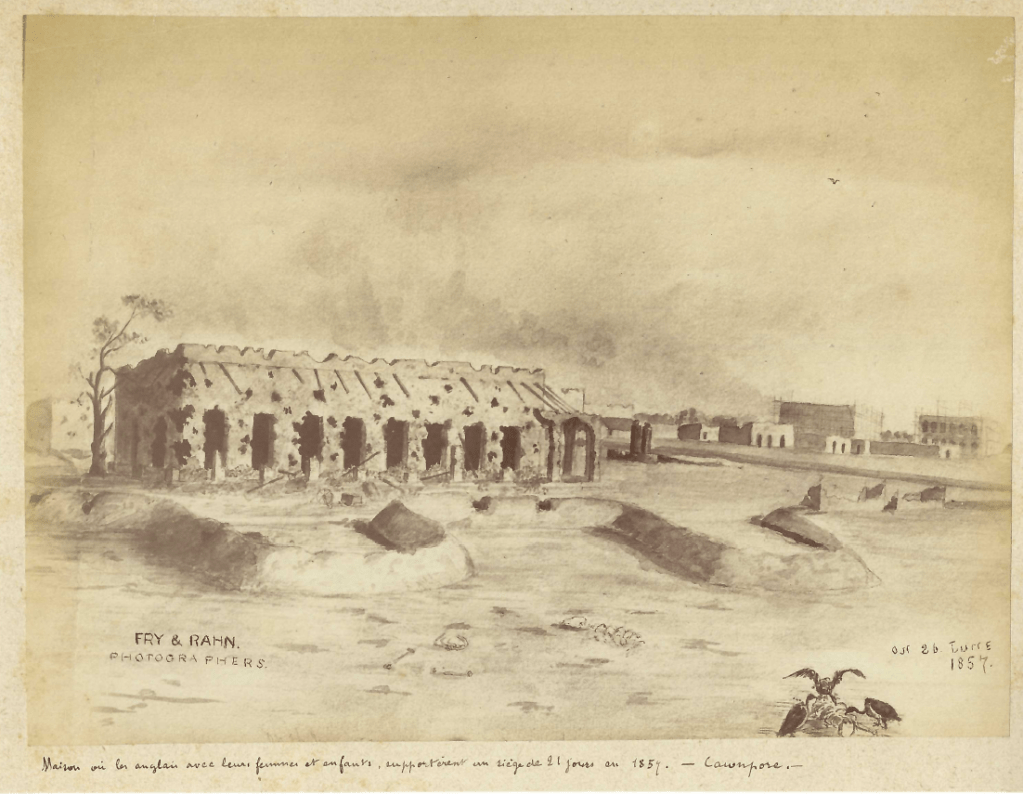
At 10:30 am, the first shot, from a nine-pounder fired from the empty 1st BNI lines, struck the crest of the mud wall and glided unhindered into the smaller of the two barracks. The British were as ready as they could be. The entrenchment, some nine acres in size, was constructed around the two hospital barracks between St. John’s Church and the new but unfinished European lines. Although practical for the reinforcements to reach, it was also frightfully exposed to the rebel fire. However, Wheeler had done what he thought best.
On the north, Major Vibart, assisted by Jenkins, commanded the Redan Battery, while to the north-east, Lieutenant Ashe of the Oudh Irregular Artillery commanded the 24-pounder and the two nine-pounders, assisted by Lieutenant Sotheby. Captain Kempland of the 56th commanded the south of the entrenchment while Lieutenant Eckford led the south-eastern battery with three nine-pounders. At his side stood Lieutenant Burney of the Artillery and Lieutenant Delafosse of the 53rd. The main guard – for the entire area from south to west – was held by Lieutenant Turnbull of the 13th BNI, while on the west, Lieutenant Demptster, assisted by Lieutenant Martin, commanded three n9-pounders and flanking this was a small three-pounder under Major Prout of the 56th. To the northwest, Captain Whiting commanded.
“At each of the batteries, infantry were posted fifteen paces apart, under the cover of the mud wall, four feet in height: this service was shared by combatants and non-combatants alike, without any relief; each man had at least three loaded muskets by his side, with bayonet fixed in case of assault; but in most instances, our trained men had as many as seven, and even eight muskets each.” (Thomson). The batteries, however, were neither masked nor fortified, which left the men unprotected and open to the direct fire of the rebels who, in their turn, had positioned themselves at every conceivable angle of the entrenchment.
Some women and children were outside the barracks when the first cannonball made its mark. With screams of terror, they gathered up their children and ran into the barracks. The walls shook, covering them with plaster and loosened bricks, while the doors and window frames exploded in splinters around them. The bugle sounded, and all the men rushed to their posts. Outside in the west battery, the first victim fell – Gunner McGuire killed by a round shot. He and the others had watched as it bounded towards him, but transfixed to the spot, he never moved out of the way. His body was covered with a blanket and left where he fell until nightfall.
The first day was an artillery duel – the rebels had not as yet positioned their guns with complete accuracy and were still moving them around; some were placed behind the Riding School and tested for distance, and others were brought up closer to the walls. Their every shot was answered from the entrenchment, a din so deafening it was heard 50 miles away at Fatehpur. Standing on the veranda of his house and looking into the distance, John Sherer and the other officers saw “a purple haze, and a sound of guns was distinctly heard. The firing had been going on since mid-day…and every now and then the deep rumble of heavy ordnance came rolling over the fields…” Then they settled down for lunch, unaware that they were listening to the guns smashing Wheeler’s entrenchment to bits.
The rebels had other work to attend to. They burned down the bungalows to the east of the entrenchment and continued solidifying their position – although they could have attacked the entrenchment through sheer force of numbers, they did not take the opportunity; feeling perhaps, like Nana Sahib, was watching from a safe distance, that the artillery would do the work for them. By nightfall, however, as they settled down to their evening meal, it must have been something of a surprise all around that the British were still holding out behind their small mud walls.
In the entrenchment, no one felt much like eating. The women and children whose terrified screaming could be heard throughout the day had all fallen into a numbed silence; fathers, relieved from duty, tried to comfort their families, the doctors continued to hurriedly patch up the wounded, while the dead were buried under the cover of darkness. The only well with all the water the garrison had stood in the centre of the entrenchment. The rebels had not commenced their sniper fire as yet, but when they did, the well would be their target. Jonah Shepherd was quick to refill the large earthenware vessels he had been opportune enough to bring into the entrenchment with him; at least for a few days, while the vessels remained unbroken, there would be enough water for his family. After the second day, while water carriers still plied their trade in the entrenchment, a skinful of water cost 5 rupees and a bucket, 1 rupee. Almost all the servants deserted in the first week, leaving the garrison to fetch their own water. The insurgents only stopped their firing for some 2 hours at dusk, allowing anyone who dared to venture to the well and help themselves.
The next day, the Soldier’s Church – St. John’s Chapel – was set on fire.
“I could not help thinking,” wrote Jonah Shepherd, ” how heavy the hand of God was upon us thus to bring this judgement upon us – no only did He will that we should be besieged so fearfully from all sides without a hope of escape, but also permitted our persecutors to set fire to the house of God before our very faces…and that on the Sabbath day.”
The very same evening. Shepherd would be shot in the back. Luckily, it was a spent shot and had had to go through several layers of clothing before penetrating the body to a depth of 1 inch, but he nevertheless had to see a surgeon in the thatched barrack. While seated on a chair, he watched as the doctors busily performed operations on the wounded. One man of the artillery particularly attracted Shepherd’s attention – he was sitting shirtless on a stool, his left arm shot off to a little above the elbow, the remains of his “shattered flesh” hanging down. Amputation was his only option.
Within the first four days, several casualties occurred – irreplaceably so.
Mr. Gee was killed by round shot; Major Sir George Parker died of sun-stroke as did Colonel Williams of the 56th; the schoolmaster Mr Gill “while leaning against the wall of the Guard-Room, had his skull fractured from around shot hitting the outside of the building and endured for several days intense pain; “Mrs. Reid (the bazaar-sergeant’s wife) and Mrs. O’Brien (of the Cawnpore Collector’s Office) both succumbed to apoplexy. The Jack brothers did not fare well and were both laid up at the same time, the brigadier from sunstroke and his brother with a broken leg. They would both die “within a week of the siege.”
After the first night, sleep was impossible – the incessant firing during the day would be followed by the endless musketry fire at night –
“Awaiting the assault that we supposed to be impending, not a man closed his eyes in sleep, and throughout the whole siege, snatches of troubled slumber under cover of the wall, was all the relief the combatants could obtain. The ping-ping of rifle bullets would break short dreams of home or of approaching relief, pleasant visions made horrible by waking to the state of things around; and if it were so with men of mature years, sustained by the fullness of physical strength, how much more terrific were the nights passed inside those barracks by our women and children! As often as the shout of our sentinels was heard, each half-hour sounding the “ All’s well,” the spot from which the voice proceeded became the centre for hundreds of bullets. At different degrees of distance, from fifty to four hundred yards and more, they hovered about during the hours of darkness, always measuring the range by daylight, and then pouring in from under the cover of adjacent buildings or ruins of buildings, the fire of their artillery, or rather of our artillery turned against us.”
However, Thomson further recalled, “The execution committed by the twenty-four-pounders they had was terrific, though they were not always a match for the devices we adopted to divert their aim. When we wanted to create a diversion, we used to pile up some of the muskets behind the mud wall, and mount them with hats and shakos, and then allow the sepoys to expend their powder on these dummies, while we went elsewhere.”
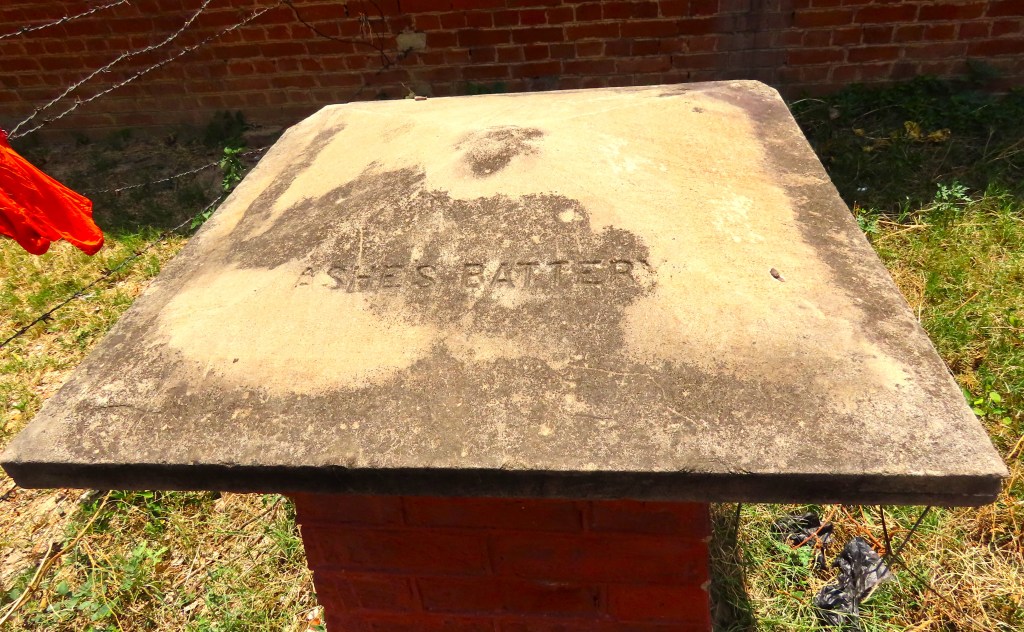
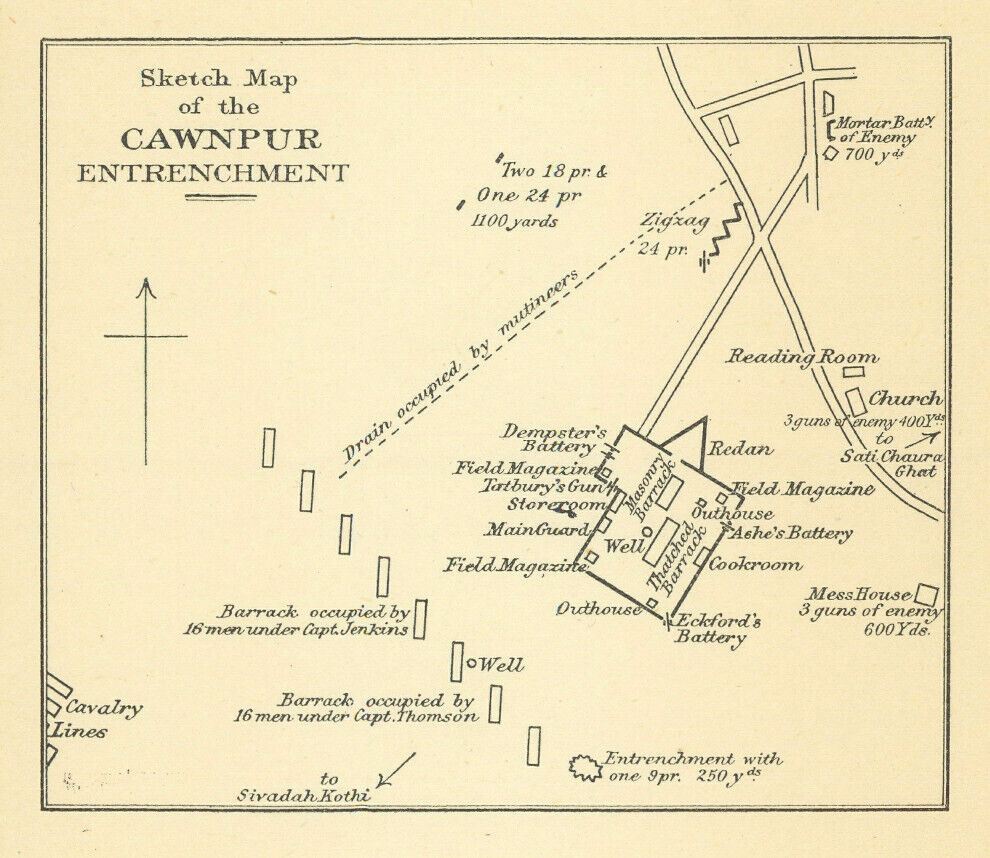
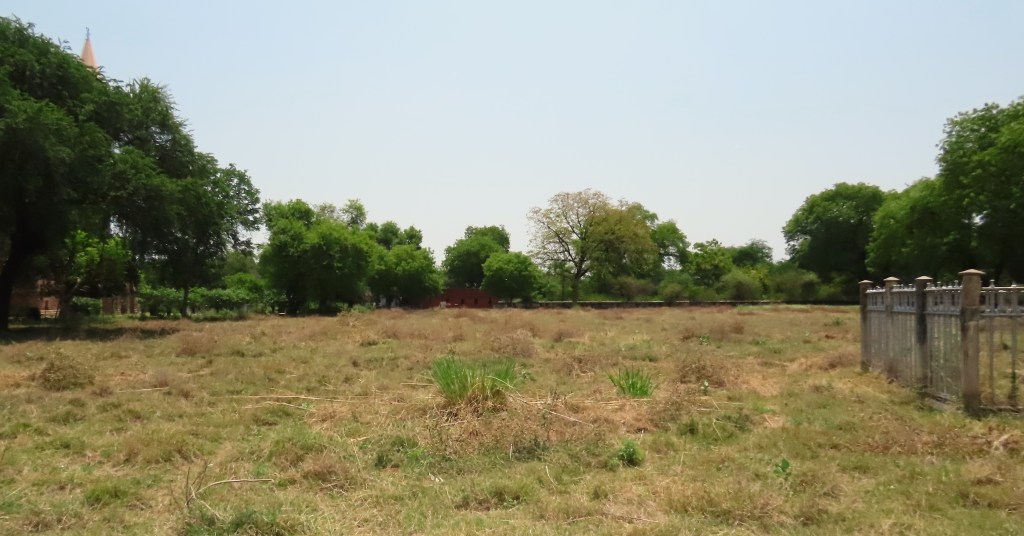
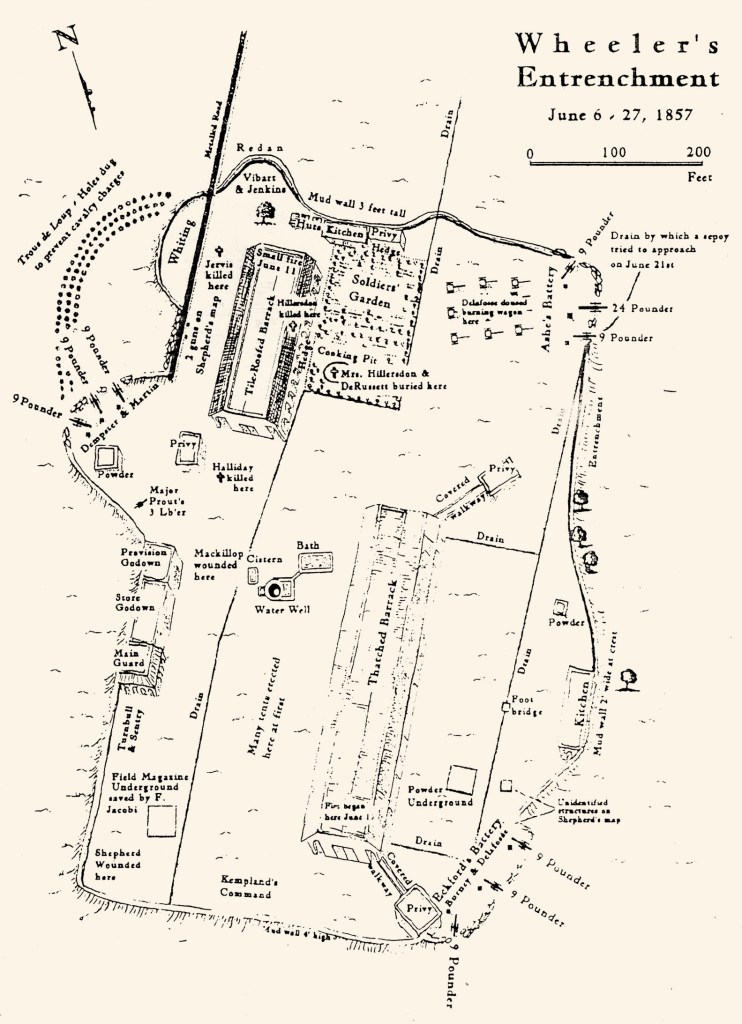
In the course of the first week, the insurgents had completed placing their guns around the entrenchment. They also took possession of all the nearby bungalows, keeping themselves safe behind the compound walls, while the burnt-out church, being so close to the entrenchment, provided them with yet another position from which to harass the garrison, along with the unfinished barracks; however, they did not reckon with the vigilance and particular bravery of one officer – Captain Moore of the 32nd.
With his arm in a sling from a broken collar bone and a revolver in his belt, Captain Moore made sure, for as long as he was alive, the insurgents would not gain a foothold in the entrenchment. Placing scouts with spy-glasses on top of the closest of the three unfinished barracks, just outside the entrenchment walls, thus ensuring any move by the insurgents was not only seen but thwarted with accuracy by the artillery. When all else failed, and Moore found the small picquet of railway engineers he had placed in one of these outposts was in serious danger of being overrun, Moore would gather together some volunteers and rout the insurgents from their hiding places. However, without the railwaymen, holding the outpost would have been impossible. They held the out picket at barrack No. 4 for three days without any help from Moore or anyone else at first – it was their “sharp sight and accurate and accurate knowledge of distances acquired in surveying, had made these gentlemen invaluable as marksmen..”
The unfinished barracks would have been a welcome addition to the entrenchment, but Wheeler had left them out of his plan. Built of brick and each about 200 feet in length, and numbered 7 in all, with 8 and 9 barely past the initial stages of construction.
The walls of No. 1 were seven feet high, No. 2 was nearing completion and had walls some 40 feet high, with No. 3 following closely in height, while No. 4 had a temporary roof. The remaining barracks were no more than seven feet high – none of them had floors laid in them, and the ground surrounding them was covered in piles of bricks and various building debris. The railwaymen had been placed in No. 4 and had to contend with hundreds of insurgents “creeping up…behind the cover of these walls…” So thick was the firing and so hard-pressed the little picquet that Wheeler found himself ordering that their position be strengthened by the military. Captain Jenkins of the 2nd Cavalry was put in charge of the volunteer force, but they numbered only 16 men. Pushed back, the insurgents contented themselves with occupying barrack No. 1 – but their new neighbour, in barrack No.2 (only 200 yards from the entrenchment), was Lieutenant Glanville of the 2nd Bengal Fusiliers with a further detachment of 16 men. Glanville was shortly after seriously wounded, but the post was not lost. Captain Elmes of the 1st BNI took his place, and then, when his presence was required elsewhere, Captain Mowbray Thomson relieved him.
“Our greatest apprehensions were always excited when they ceased to fire, as this was invariably the prelude to a coming attack. Then, we seventeen men had to hold that barrack No. 2 against a black swarm compassing us about like bees, and had it not been for their most surprising cowardice in attack, we could not have held the place for four and twenty hours.’ In order to keep us as fully acquainted as possible with their movements, I had a crow’s nest constructed twenty feet from the ground; it was made of some of the building materials lying about the place. By turns of an hour each, my men were posted up there and through a loophole could overlook the movements of our troublesome neighbours and telegraph to us beneath. As soon as any intruder quitted barrack No. l, the signalman fired at him. One of our party, Lieutenant Stirling, spent many hours in this elevated post, and as he was most expert with his rifle, it is quite impossible to conjecture the results in the number of sepoys brought down by his gun.“
To keep these outposts supplied with ammunition, volunteers had to be sent across the entrenchment to the field magazines. They had to run the gauntlet, fired on continuously by the insurgents in Barrack No. 1.
“It was no trifle, under any circumstances, to hop, skip, and jump to the covering place at half the distance in the open, but the ammunition bearers were exposed to conditions that any insurance company would write down as doubly hazardous. There was no difficulty, however, in obtaining the services of men willing to undertake the perilous but necessary duty. Two men of the picket, who acted as cooks, performed this dangerous journey daily when they went for our miserable dole of food, and in consequence of undergoing this hazard continually, these cooks were exempt from all night duty. If ever men deserved the Victoria Cross, these poor fellows did; nor were they the only ones of our garrison who in all probability would have earned this distinction, so dear to the soldier of modern times.”
The main duty at the outposts was to ensure the insurgents never managed to gain more than a temporary foothold in any of the unfinished barracks, and try they did. Hundreds, sometimes thousands, would gather and form up as if they were intending to launch an assault. Their bugles would sound the advance, but they never moved past the safety of barrack No. 1 or No. 5,
“..from the windows of these barracks, they could pepper away upon our walls, yelling defiance, abusing us in the most hellish language, brandishing their swords, and striking up a war dance. Some of these fanatics, under the influence of infuriating doses of bhang, would come out into the open and perform, but at the inevitable cost of life. Our combined pickets always swept through these barracks once, and sometimes twice a day, in chase of the foe. They scarcely ever stood for a hand-to-hand fight, but heaps of them were left dead as the result of these sallies. As soon as we had expelled them from their covert, the musketry and artillery of the intrenched party played upon them furiously, and this process inspired them with a wholesome terror of approaching us.”
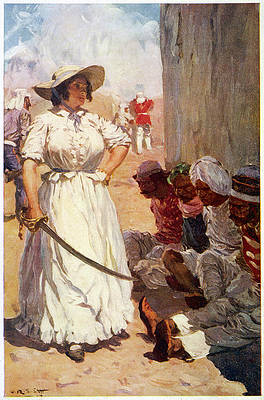
Occasionally on these sorties prisoners were made but these were inevitably released or escaped. At one point 11 were kept in the main guard under the watchful eye of Mrs. Bridget Widdowson, the wife of a private of the 32nd who volunteered for the duty. Armed only with a sword, she performed her duty admirably – but as soon as she was relieved, the prisoners managed to escape.
Page 2/5
 Mutiny Reflections
The cavalry cadet named Mainwaring was Cornet Charles Mainwaring of the 6th Bengal Light Cavalry. I wrote about his death in the massacre by the river at Cawnpore in https://anneyoungau.wordpress.com/2023/04/11/i-is-for-indian-mutiny/
Charles Mainwaring is remembered on a tablet in All Souls Church, Cawnpore.
LikeLiked by 1 person
I have added your site information to the Cawnpore posts and am currently in the process of fixing the casualty lists. It is a rather long and laborious task but hopefully I can get it finished this week.
LikeLike
Hi there Darth Sahib. Thankyou for your kindly comments. I have made a third trip to India since my last comment and produced a documentary of sorts, that I hope will help heal. Filmed in Lucknow and Kanpur mostly. I will go back again for sure as I have much unfinished business connected with my dear family who perished in Cawnpore, especially Bibighar. I will try to add the link below, but if I can't, please search Youtube and type \”India Sepahi Rising 1857 Remembering Cawnpore\” The film is short on narrative during the first 20 minutes because I needed ananimity , but the narrative should help explain in book form the second half. Namaste and God bless then, Mark Ji. New Zealand.
LikeLike
I found myself reading about the history of colonialism in India and could not believe that such an atrocity was committed. I don't know how the people that committed such an act justified it morally, or how they were able to continue with their lives afterward. It is a scary thought to imagine that people are capable of this. My family comes from India and although I live in North America, I am so very sorry for the barbaric murder of the innocent women and children, which should never have happened. Although this event is reprehensible by today's standards, I'm certain that even back then, most individuals would have been totally against such brutality (including my ancestors). I hope that we can all collectively learn from these past mistakes, in the hopes that such things never happen again.
LikeLiked by 1 person
For a certainty Anil; this I know for sure having travelled twice to India in the last 4 years and with my Father also born in Allahabad, actually my family trace 4 generations in UP. The kindness, gentleness and respect I have found in my travels from Ahmedabad to Kangra in the north, Agra, across to Lucknow and right down to Calcutta is simply wonderful. The world that was during the 19th century, with a different kind of normal than that of today, is history and would seem very foreign to you and me I am sure and if we were to travel back to that time. Namaskar – Mark
LikeLike
Very sorry to read this horryfic truth.this is not Indian culture
LikeLike
Well done Eva. I have just read your work on Cawnpore and you have meticulously covered nearly every aspect of that terrible drama during June and July of 1857. Your references are impeccable and beyond any questioning and there is nothing more that I might add. If anyone wants to make contact, I will leave my email if that's okay and would happily correspond, as I have already with a number of descendents of Cawnpore families. mark@gafelk.co.nz Kind thanks Eva for adding my family connection too, is truly appreciated and an honour. Respectfully yours – Mark Probett (New Zealand)
LikeLike