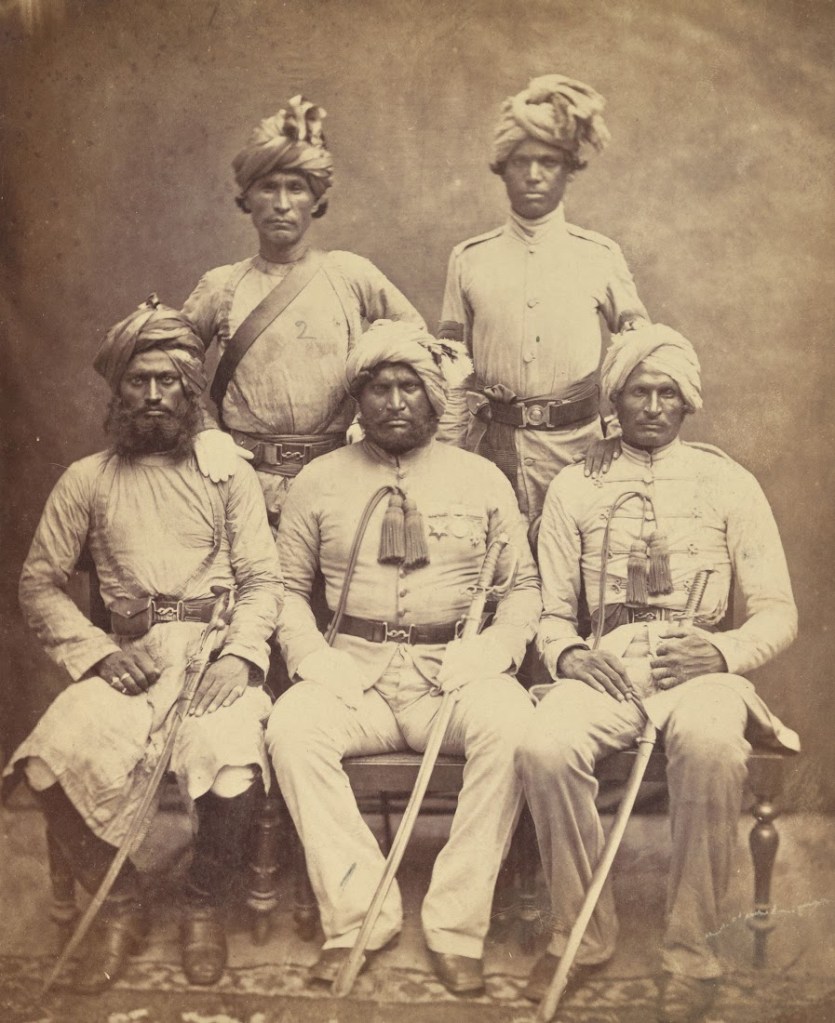
At 1.30 in the morning on the 5th of June, 3 shots rang out over Cawnpore. The 2nd Cavalry, finding they could not convince the Infantry regiments to join them, were determined to have their uprising. The elderly Risaldar-Major, Bhawani Singh, shocked at the behaviour of his men, strode forward, sword in hand, determined to protect the colours and treasure. Alone, he held them back, but his position was hopeless. He was found the next day lying in a pool of blood, alive but severely wounded.
The men rose in a body and, with a great shout, mounted their horses. From their lines, they came, some with their minds bent on sedition, to loot and burn and plunder. The men of the 53rd and 56th BNI were awoken by the shots. Their European officers were quick to the mark – sleeping in tents and in the quarter guard meant they were close at hand. While most of the men kept to their lines, some of the 56th panicked and ran off to the city. Meanwhile, the 2nd Cavalry continued their uprising.
“ Some ran to set alight the house, the English riding-master; some to make a bonfire of the horse-litter; others to secure the treasure-chest and the colours.” They made their way to the Commissariat cattle yard and stole all 36 of the Government elephants and then set fire to the Cattle Sergeant’s bungalow. The cavalry then drew up on the high road. A bugle sounded, and two horsemen left the ranks and rode to the lines of the 1st BNI. In a loud voice, one of them cried out, “Our Risaldar-Major sends his compliments to the Risaldar-Major of the First and wishes to know the reason for this delay, as the cavalry is drawn up on the road.” Unbeknownst to the men of the 1st, the self-same Risaldar-Major had made no such compliment; he was lying senseless on the floor of the quarter-guard.
It was short work persuading the men, mostly young recruits, to join them. In a body, they began to load their muskets and settle their cross-belts and hastily pack up what valuables they had.
Colonel Ewart ran out of the Quarter Guard, followed by the other officers and cried out, “My children! My children! This is not your usual conduct! Do not do so great a wickedness!”
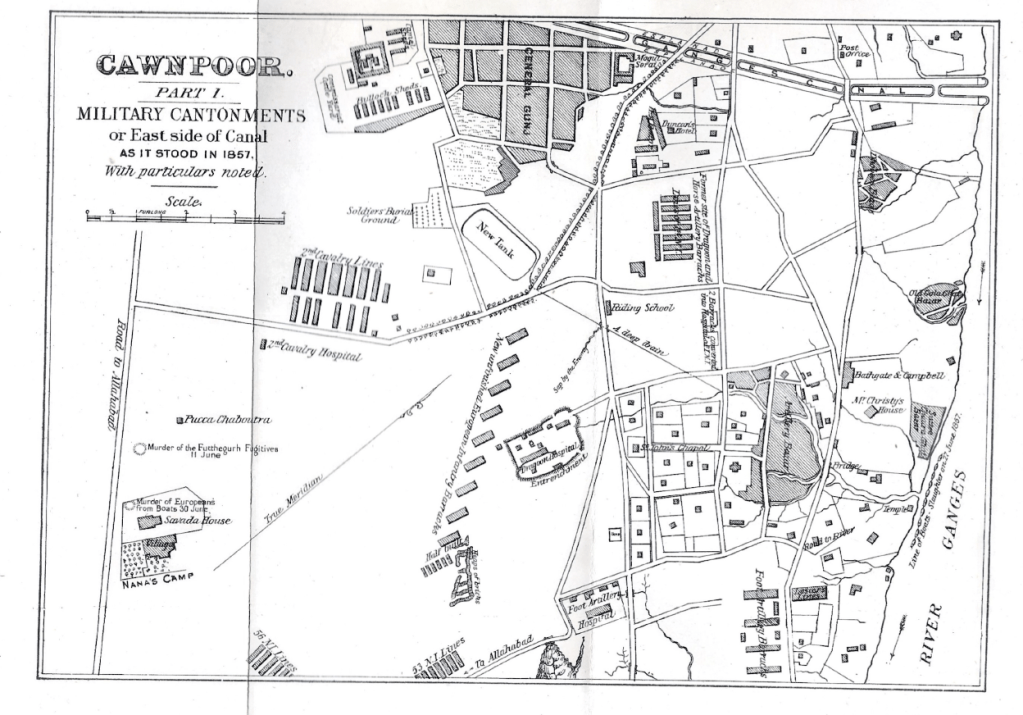
The men turned and looked at him. Time for remonstrance was over – they begged him and the others to leave them. Ewart harangued and then begged, but it was all for nothing. He and the others were forced to leave their regiment and make their way, as best they could, to the entrenchment. Their men at least kept their last promise. They would not kill their officers. Not today, at least. The corps left its lines and followed the Cavalry. They marched towards Nawabganj in the northwest of Cawnpore towards the Magazine and the Treasury.
In the lines of the 53rd and 56th BNI, the adjutants got their men together on the parade ground and kept them under arms through the rest of the night and well into the following morning. Then, realising the cavalry regiments were well and truly gone, the colonel of the 56th marched his men to the lines of the 2nd and collected the horses and arms they had, in their haste, left behind. He then dismissed his men to their lines. Following the example of the colonel, the major of the 53rd likewise ordered his men to step down. They could return to their lines, remove their uniforms and cook their well-deserved breakfasts.
However, he summoned all the commissioned and non-commissioned native officers to follow him to the entrenchment, satisfied, somewhat injudiciously, that he could leave his regiment alone without a single native officer in sight. They were, for the most part, untainted by mutiny; had the major left them in the lines, perhaps the 53rd could have been kept to their salt. Mischief was swift. As soon as the officers were gone, a trooper of the 2nd Cavalry rode in among the men of the 56th. He had a message for them from the company of the 53rd posted at the treasury.
The 53rd would not allow anyone to take the treasure, he said, until the 56th had taken its fair share. For five men of the 56th, it seemed like an opportunity they at least did not want to miss. Stealing through the neighbouring lines, they were soon seen talking eagerly with a native sergeant and a private of the light company. Whatever they said had the desired effect. Suddenly, the two men shouted, “Glory be to the great God! Men! Prepare for action!” and a rush was made to the quarter guard. While one broke open the treasure chest, another grabbed the colours. The native officer on duty stood his ground, but overwhelmed by numbers, he was forced to stand aside.
“In an instant, all was uproar, terror and confusion. The sergeant of the fourth company burst into tears and ran to fetch the Adjutant: the sepoys of the 56th and light companies flung on their coats, loaded their muskets and crammed their girdles with the regimental rupees; while the remainder of the corps came of their own accord on to the parade ground with the intention of placing themselves under the command of their officers.”
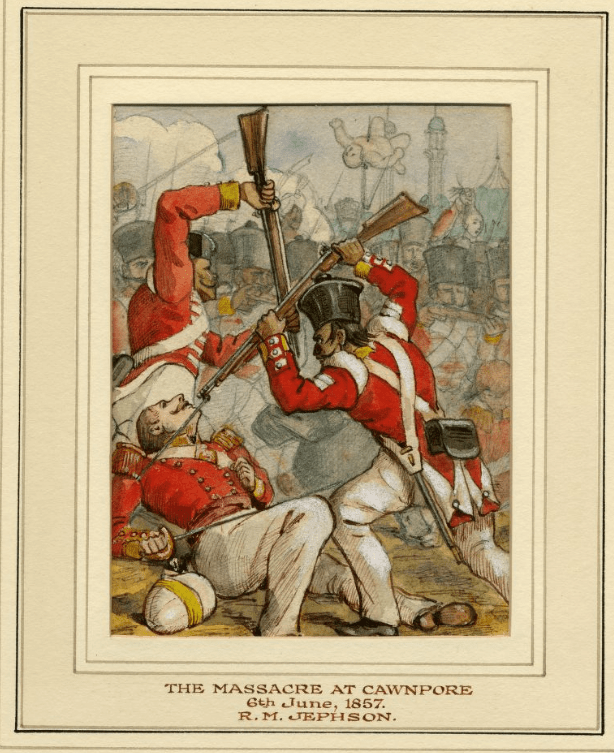
Over in the entrenchment, the European artillery, unable to determine friend from foe, only saw men running. With something akin to ill-timed energy, Sir Hugh Wheeler ordered the guns of Ashe’s battery to open fire. The men, in their shock, stood their ground as another two rounds flew in their direction – unable to understand why their commander had chosen such a “cruel and uncourteous method” to inform them their services were no longer needed. The third round proved too much even for the most loyal. To save themselves, they broke and fled. Many of them ran down the high road, not stopping until they reached Nawabganj. Others, not convinced Wheeler meant to kill them, hid in a ravine until the firing stopped and “it should please Sir Hugh to allow them to within gun-shot of their own officers.” It was a sad end for the 53rd BNI.
The mutiny of the 56th is simply told by one of their own, a commissioned officer named Khuda Bux.
“I was sleeping in my house between twelve and one A.M. when Hossain a Bux, Havildar, Grenadier Company, came and u awoke me, and said, ‘What? Are you not awake? There is a row in the cavalry lines, three reports of a pistol, and the Quartermaster Sergeant’s bungalow is on fire.’
I was astonished and ordered the regiment to turn out and went to give information to the Adjutant. He came out of his tent and went with me to parade and asked if the regiment was ready. I said, ‘Yes, it is ready. ’ He said, ‘Where is it?’ I said, ‘In front of the bells of arms.’ He ordered them to form up in front of the quarter-guard. I formed them up and made them ready. I received orders that if any cavalryman came, he was instantly to be shot. In this way, we passed the night with our officers. No one took off his uniform. The cavalry, having mutinied, went away to Delhi.
In the morning, the Adjutant ordered us to take off our uniforms and eat our dinners. Then the guards were placed, and we took off our uniforms.
The colonel came to us and asked what Naick was on duty at the elephant sheds, as the cavalry and First Native Infantry wanted four elephants, which were under a guard of a Naick and four sepoys of the regiment, and he was greatly pleased they had refused to give them up, and that he was so content with the Naick that he should make him a Havildar. I said it was Gunga Deen, Naick, First Company.
The First Regiment mutinied like the cavalry and went away. After this, the Colonel said, ‘Bhowany Singh, Soubahdar, has been wounded by these mutineers. I will go and see him.’
I and Annundeedeen, Havildar Major, went with the Colonel to the Cavalry Hospital and saw Bhowany Singh, who was wounded. The Colonel was very much pleased with him. The Colonel then went to his bungalow, and I and Aimundeedeen went to our lines, and, having taken off our uniforms, began to smoke; when Chain Singh, Havildar, came and said, ‘Jemmadar, the regiment is turning out.’ I asked by whose orders and why. He said, ‘I don’t know.’ I went outside and saw that the Havildar was dreadfully frightened and was buttoning his coat.
I went with him to my company and saw some of the men in the tent packing up their clothes and others throwing them away. I asked them what was the matter and why they were getting ready? They said, ‘The Fifty-third regiment is getting ready, and so are we.’ I said, ‘Your regiment is the Fifty-sixth; what have you to do with the Fifty-third? It would be better for you first to shoot me and then to do what you like afterwards.’ Many of the men said, ‘You are our senior officer; we will not kill you. Come with us.’ I said, ‘Very well; 1 will get ready and come with you.’ I went out of the tent very slowly for about a hundred yards, and then ran as fast as I could to the entrenchment, and told the Colonel and Adjutant that the regiment had mutinied. They said, ‘Come with us, and we will see.’ I said, ‘Oh, gentlemen, all, the regiment has mutinied, and are your enemies. It is not right for you to go to them.‘”
While Khuda Bux had been searching for his colonel, a round shot fired from the entrenchment at the 53rd rolled into the lines of the 56th. Taking fright, Gunga Rai, a sepoy of “an excitable and suspicious temperament”, shouted to the others, “We are all going to be killed!” and took off running down the road to Nawabgunge with his equally terrified comrades following.
Now that the worst appeared to be over, the officers left the entrenchment to gather up the remaining men of their regiments. Some went around the lines, searching in the huts. The regimental bugler was called for – with his aid, eighty sepoys “whose sense of duty had been stronger than their fear of English nine-pounders” were brought out of the ravine where they had hidden. For the rest of the day, the men were put to work bringing into the entrenchment anything of use that could be found in the now abandoned lines. They also collected up the property of the Christian drummers and bandsmen who had been allowed at the 11th hour, with their families, to enter the entrenchment. Besides the native officers who had been called into the entrenchment earlier, 150 sepoys threw in their lot with the British – had Wheeler not caused Ashe’s battery to open fire, what would the story of Cawnpore have been with nearly two loyal regiments at hand?
At Nawabganj, the rebels gathered. To Delhi was the cry, to Delhi to serve the king. However, fate had another plan. It came to the attention that the Nana Sahib was nearby, watching and waiting. A deputation of officers determined to hold an audience with him determined he would ride at their head to Delhi. The meeting went better than they expected. The Nana laid a hand on each of their heads and swore his fidelity to their cause, and he would lead them to Delhi. But first, there was some work left to do in Cawnpore.
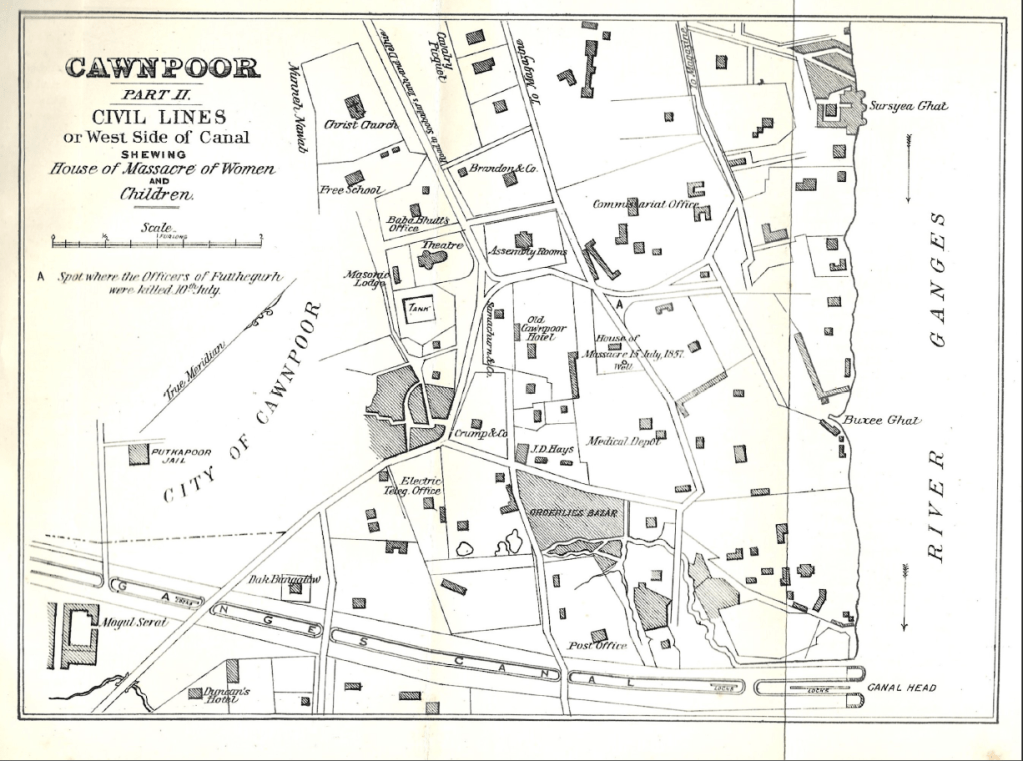
The officers returned to their men with the news, and in a body, they moved off, not on the road to Delhi but to the Treasury. The keeper of the keys did not put up resistance – he quickly handed over his charge, the doors were opened, and the treasure was distributed to the four regiments. Then, because there was still plunder to be had, they turned their sights to the town. Some opened the jail and released the prisoners, others set fire to the Magistrate’s office and the Courthouse, but not before they had piled Records, both civil and criminal, into a pyre and set them alight, like a bonfire. Some cut the cables of the Bridge of Boats, leaving the boats floating free along the river; others, determined to help themselves to a bit of plunder, ransacked all the European houses at the station’s west end before setting them alight.
They did not miss visiting the Magazine either – it stood whole and complete, packed with munitions and accoutrements of all kinds; the sepoy guard here had prevented the Europeans from blowing it up, and now it was open for the taking. Down by the canal, they found thirty boatloads of shot and shell that no one had had the time to offload – what with the contents of the magazine, they had enough gunpowder, cartridges and percussion caps to last them not just to Delhi but for an entire campaign.
They also had their first victim.
Mr Murphy, overseer of the railways, had left the entrenchment in the morning to conduct some business – it must have been of a pressing sort for him to have disobeyed orders; unhappily, he was in his house at the railway line when the regiments moved through Cawnpore. His servants, who saw them first, raised the alarm, and Murphy hastily ordered his horse, determined now to return to the entrenchment. It was to no avail – he received two shots in the back and one in the head. His stiffened corpse was brought to the entrenchment at two in the afternoon, to be the only person buried in a coffin, as one was found in the hospital. He would soon be joined by Mrs Wade, who died shortly after of fever, to be the only two people buried in the entrenchment.
The regiments now moved out.
“They packed their more valuable booty about their persons; filled a long caravan of carts with their property and set forth on their adventurous journey; and after a very easy afternoon’s march, halted at Kullianpore, the first stage on the Delhi road.”
Waiting for them, once again, was the Nana Sahib. What arguments he used are unknown, but it was clear he was no longer willing to go to Delhi, where he would be subordinate to the king at best; he could stay in Cawnpore and be a king instead. However, his most pressing problem was the Entrenchment. Offering rewards and glory, he induced the men of the four regiments to return and lay siege to General Wheeler instead.
In the Entrenchment
Whether General Wheeler had any misgivings about the entrenchment, he kept these to himself, but his sentiments as to its viability were not shared by some of his officers. Lieutenant Cortland Angelo took one look at the fortifications and swiftly packed his pregnant wife and their daughters on one of the last boats to Calcutta on the 28th of May. Another man, who had managed to keep the mutiny at his back, arrived in Cawnpore the day before the outbreak and, seeing what was in store for the Europeans, determined to push on. He packed up his family and, securing a boat, managed to escape the fate in store for the others.
Back in May, when Wheeler ordered the officer’s families into the entrenchment, many of the men had tried to persuade their wives to leave, arguing they would be safer anywhere else. However, the ladies stoutly refused to go – as long as General Wheeler did not send off his family, they too would stay. They would share their husbands’ fates, come what may.
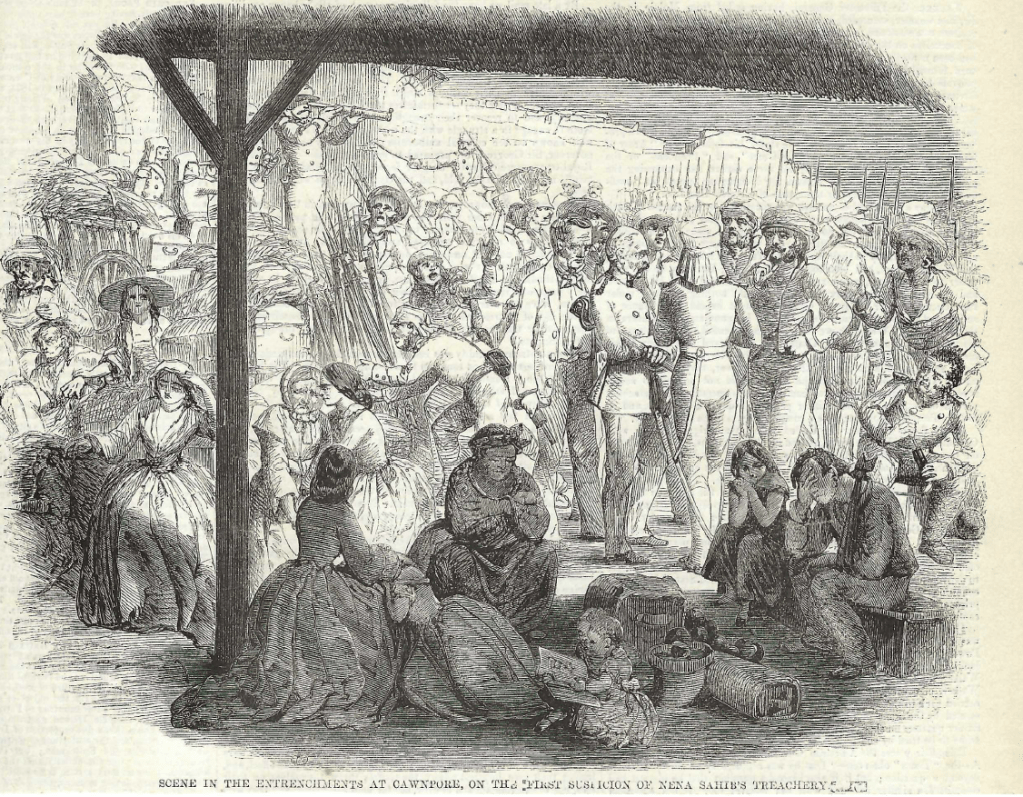
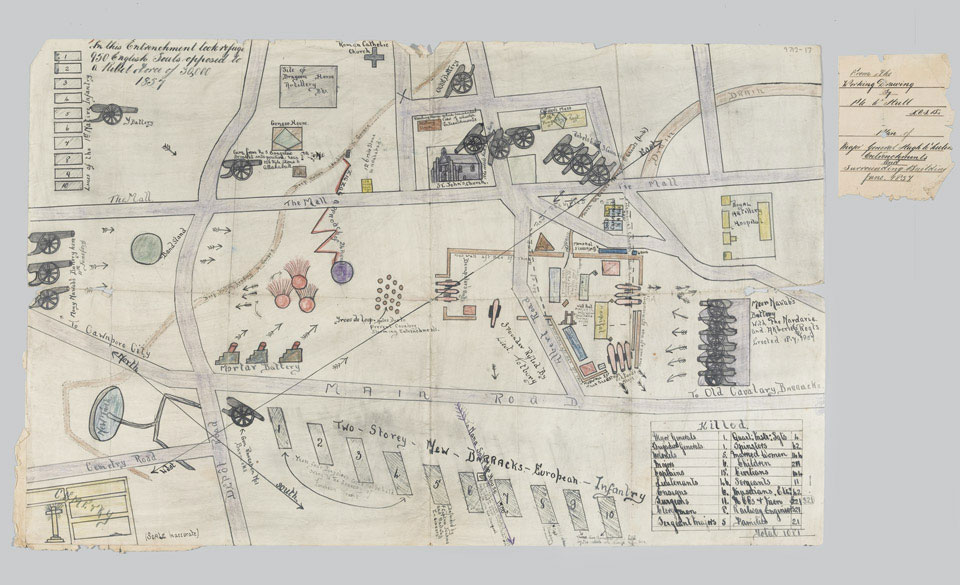
The ladies and children of the officers had been living, since the 21st of May, in the old dragoon hospital, which was laid out on a dusty patch of land, some nine acres in size, at the south end of Cawnpore. The two barracks were single-storied, of which one was thatched, and both had a flat-roofed arcade of apartments surrounded by sloping verandahs made of beams and strong masonry. The walls were some 2 feet thick, and surrounding them were several outbuildings. Around the barracks, a trench was hastily dug to form a parapet from the earth thrown up during the digging. The work had started on the 25th of May, in the hottest time of the year, when the earth is little more than dust and ground as hard as rock. The soil was neither beaten down nor watered to make it solid, leaving the parapet neither bulletproof nor very high, measuring no more than 4 feet in all. At the crest, sandbags were placed to allow the sentries access. Embrasures were constructed for the guns, but these likewise were scarcely protected, while the barracks themselves had nothing but their bare walls. On the thatched roof tiles were quickly laid to prevent any accidental incendiarism, but on the 6th of June, a small patch was still not finished, leaving the thatch exposed. In the middle of the compound stood the only useable well in the entrenchment.
Around the entrenchment, the guns were placed; three stood on the north-east side overlooking the lines, and three on the south to cover the plain that separated the cantonments from the city. A small three-pound cannon, which would be left wanting during the siege for lack of conical shell and could only be used for grape. It was positioned to command the unfinished barracks that were still being constructed. With the arrival of Lieutenant Ashe and a half-battery from Lucknow consisting of two nine-pounders and one 24-pound howitzer, the full compliment of artillery was completed – ten guns in all. Ammunition was plentiful, and the field magazines boasted of 2000 pounds of powder along with ample amounts of ball cartridge and round shot.
Wheeler had chosen his position not so much to withstand a siege but to hold out until the expected reinforcements arrived. The entrenchment was easier to access than the Magazine for any forces determined to come by road. Some had already arrived – the advanced force of 15 Madras Fusiliers and 60 men of the 84th Regiment of Foot. So confident of his position, Wheeler had returned to Lucknow 55 men of the 32nd, but as a precaution, he had retained Lieutenant Ashe. That Wheeler would have had time to provision and establish the Magazine as a place of defence is without a doubt. However, the guards had objected to the very idea of anyone tampering with the building, much less occupying it and, as it turned out, blowing it up; not wanting to cause fire when there was barely a spark, Wheeler had let the idea go for the sake of the sentiments of the guards. The building was made of solid masonry, with high walls and was protected by the river on one side. There was ample space to house the families, and what with the munitions in place, Wheeler might have held out long enough for the reinforcements to arrive. However, Wheeler was not expecting a siege.
Provisions too were laid in – but only for 25 days – and Wheeler ordered dal, ghee, salt rice, tea, sugar, rum, malt liquor, and hermetically sealed provisions. The messes had also sent in their stocks; not siege fare, but no one was expecting a siege. Tinned salmon, truffles, jam and hams were some of the offerings and a plentiful supply of beer, champagne, wine and brandy. That the local provisioners had cheated Wheeler appears to have escaped him; the lentils were mostly gram used for horses and flour.
So it came as something of a shock when, on the 6th of June, he received a politely worded note from the Nana Sahib, written in the hand of Azimullah Khan, that hostilities would commence the next day at 10.00 am.
Sources:
Kaye, John William. A History of the Sepoy Revolt. Vol. 2. London: Longmans, Green, and Co., 1896.
Shepherd, W. J. A Personal Narrative of the Outbreak and Massacre at Cawnpore. Lucknow: Methodist Episcopal Church Press, 1879.
Thomson, Mowbray. The Story of Cawnpore. London: Richard Bentley, 1859.
Trevelyan, G. O. Cawnpore. London: Macmillan and Co., 1866.
 Mutiny Reflections
Quite an information. Thanks.
LikeLiked by 1 person