Lieutenant Henry Marsham Havelock, ADC to Sir Henry Havelock, 10th Regiment of Foot
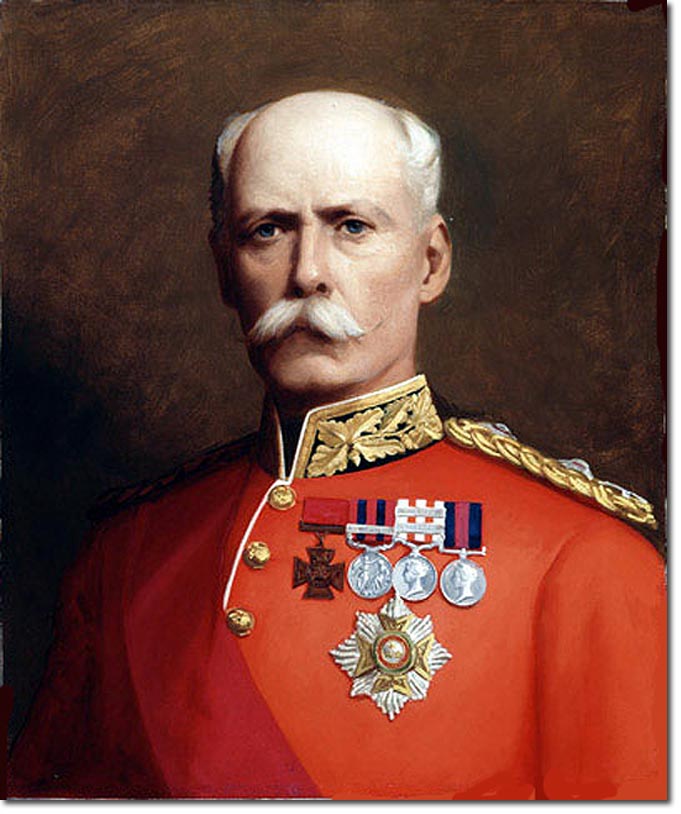
Born on the 6th of August 1830 at Chinsurah to Lieutenant Henry Havelock and his wife Hannah née Marsham, young Henry, or Harry as he was called, was commissioned as an ensign at the age of 15 with the 39th Regiment. He became a lieutenant by purchase with the 86th but transferred to the 10th Regiment as Adjutant. In 1857, his father took him in his employ as an aide to his staff for the Persian War – he retained the position until his father’s death at Alambagh in November 1857.
He received his Victoria Cross for a singular act of daring on the 16th of July, 1857 during the Battle of Aherwa, otherwise known as the First Battle of Cawnpore. It is interesting to note that Havelock himself would call his actions that day “highly irregular” as they were done without orders, but considering, “the irregular conduct of the other officers,” he felt his action was worthy of a Victoria Cross.
What actually happened depends very much on who is recalling the event.
Towards the end of the battle, the forces of the Nana Sahib had pulled back to a position which was well served by a 24-pounder which was worked with devastating effect against Sir Henry’s men. It was however the last barrier between Sir Henry and the taking of Cawnpore – the gun needed to be, by all means, captured.
The 64th and the 78th were taking cover after their rough fight to push the mutineers back – but Havelock called for one last charge. He gave the honour to the 64th and their commander Major Thomas Stirling. Stirling at this point was on foot – his horse had been rendered unrideable by a shot bursting close to it. Apparently, it had been an excitable beast to begin with – the day before it was barely controllable and had tried to bite other horses. However, we must bear in mind, that this is young Henry Havelock’s telling. While he had fended off the horse t with his sword to prevent it from attacking his own mount in what appeared to be something of a near-death situation, Sherer recalled it somewhat differently.
“Now it so happened that Major Stirling had bought a particularly misguided and undisciplined pony; and the day after he crossed the Pandoo Naddi I saw this animal advancing on its hind legs, determined to bite some other horse, if possible. Everybody got out of the way, and I remember the younger Havelock, in joke, drew his sword to defend his own steed.”
As such, Stirling found he could not ride the animal into battle and “with the intention of sending it to the devil, dismounted.”
So we will now let Henry continue and return to the battle.
Ultimately, the 64th did charge the gun and Harry Havelock was at their head but his account of things leaves one with little doubt as to why the 64th were irritated when they read his VC citation.
“Eager to go ahead of the Highlanders, the 64th had got a little in advance of their front lines when all at once shrapnel shell from the 24-pounder in their front struck their No. 5 Company, burst and knocked over six men…At this, someone shouted that they were to lie down. They got into confusion. Many broke their ranks and ran back into the village for shelter, and it looked as if they were going to break into a general rout…I rode up, dismounted and the men out of the village by abuse and entreaties. I then got them to lie down in the front line. There the wounded men were left groaning a few paces in advance of the line; and Major Stirling, the commander, instead of sending a few men to remove them, kept beckoning and calling out to me, in the presence of his regiment, “For God’s sake, get some help for these poor fellows…”
I at last went over and quietly spoke to him about it, and he off his whining and the men were removed as I suggested. I had noticed earlier in the day that his nerves were badly shaken and now the thing was critical enough without his making it worse. And I confess that I thought it was all up with me…”
Havelock admits he was “absolutely sick with apprehension” and hoped he would never find himself in such a situation again.
“Just then the General rode bareheaded to the front…He pulled up with his back to the fire and smiling, he said clearly and calmly, “The longer you look at it men, the less you will like it. We must silence those noisy guns. Rise up! The brigade will extend in skirmishing order to the left, in battalion echelon from the left.”
Harry Havelock leapt to his feet, shouting, “Get up, men, and take those damned guns!” He then rode on the right flank of the advancing 64th but their officers had dismounted and were advancing on foot – in Harry’s estimation, to “be less exposed” but as such, were hardly visible to the men they were leading.
He continues, firstly referring to Stirling’s brute of a horse, and then says, “But it doesn’t explain the Major’s allowing his subordinates to dismount. And worst of all, he was merely grazed on the left shoulder and immediately went to the rear. I then asked each of the three other officers to take his place; but they all declined, saying it was not their duty to do so. This was poppycock, of course, and they knew it; but there was no time to argue the matter; so I rode forward at once and led the regiment myself, shaming and ridiculing them into steadiness over those twelve hundred yards of level ground, with the enemy blazing shot and shell into us the whole way…“
John Sherer noted,
“There was the briefest space, during which, by a pure accident, the leader was not in front of his regiment. “Come on, then, with me,” cried the A.D.C, who happened in that second to ride up. I believe it to be true and it is agreeable because it puts everything right. The 64th needs no eulogy from anybody. Stirling was romantically brave, as his death, a little later, amply showed; while “young Harry” was well worthy of the honours he won, and which he has since increased in other fields of action.”
The telegram sent to Sir James Outram is certainly less exhilarating to read than the account left by young Havelock but it was undoubtedly problematic.
“In the combat at Cawnpore, Lieutenant Havelock was my Aide-de-camp. The 64th Regiment had been much under artillery fire, from which it had severely suffered. The whole of the infantry were lying down in line, when, perceiving that the enemy had brought out the last reserved gun, a 24-pounder, and were rallying round it, I called up the regiment to rise and advance. Without any other word from me, Lieutenant Havelock placed himself on his horse, in front of the centre of the 64th, opposite the muzzle of the gun. Major Stirling, commanding the regiment, was in front, dismounted, but the Lieutenant continued to move steadily on in front of the regiment at a foot pace, on his horse. The gun discharged shot until the troops were within a short distance when they fired grape. In went the corps, led by the Lieutenant, who still steered steadily on the gun’s muzzle until it was mastered by a rush of the 64th.”
(Extract of a telegram from the late Major General Sir Henry Havelock to the Commander-in-Chief in India, dated Cawnpore, August 18th, 1857. No. 22083. The London Gazette. 15 January 1858. p. 178)
“Young Harry” was recommended for the Victoria Cross by his father – and there in lay the crux. To waylay even the merest hint of nepotism, Sir Henry waited to have the recommendation approved by Sir James Outram and wrote what was essentially a disclaimer.
“On this spontaneous statement of the Major General (Sir Henry Havelock), the Brigadier General (Sir James Outram) consents to award the Cross to this officer, which, if originating from himself, might from the near relationship Lieutenant Havelock bears to him, assume the appearance of undue partiality.”
This did little to smooth the ruffled feathers of the 64th – the citation, when it reached India, infuriated them and particularly their officers, who felt it reflected quite poorly on them. In their turn, they took up the situation with Sir Colin Campbell who was by no means an advocate for the Victoria Cross. The letter of the officers was duly forwarded to the Adjutant General with Campbell’s own comments on the situation.
“This instance is one of many in which, since the institution of the Victoria Cross, advantage has been taken by young aide-de-camp and other staff officers to place themselves in prominent situations for the purpose of attracting attention. To them, life is of little value compared with the gain of public honour, but they do not reflect, and the Generals to whom they belong do not reflect, on the cruel injustice done to gallant officers, who, besides the excitement of the moment of action, have all the responsibility attendant on the situation. By such despatches as the one above alluded to, it is made to appear to the world that a regiment would prove wanting in courage except for an accidental circumstance; such a reflection is galling to British soldiers, indeed it is most intolerable, and the fact is remembered against it by all other corps in Her Majesty’s service. Soldiers feel these things keenly. I would, therefore, again beg leave to dwell on the injustice sometimes done by General officers when they give public preference to those attached to them over the officers who are charged with the most difficult and responsible duties.”
That said, there is little doubt Harry Havelock was a brave man even if his recollections of events, told with such brutal honesty from his point of view, irritated those around him. However, the charge of nepotism (it must not be forgotten Sir Henry had fought alongside Outram in Persia, and as such, Harry Havelock was well known to Sir James) could perhaps be levied against the father and as Sir Colin pointed out, ADCs had little business charging about, it should not deter from the fact, had Harry not won the VC for Cawnpore, there would have been countless other situations in which he would have earned it. One such situation was on Charbagh Bridge on the 25th of September, which has already been recounted at some length in the first part of The Fight for Lucknow.
During the advance, Harry was shot and injured in the elbow. He spent a gruelling night in a doolie and would be brought to the Residency by the forceful nature that was James Ward. Following Lucknow, and recovered from his wound, Harry Havelock would continue campaigning, eventually even commanding the fabled cavalry known as Hodson’s Horse. In 1858 he had exchanged into the 18th Royal Irish Regiment as captain – by the end of the mutiny, at the age of 30, he was Brevet Lieutenant Colonel Havelock. He received his VC from Queen Victoria on the 8th of June 1859; he also succeeded the baronetcy bestowed on his father shortly before his death and an act of Parliament secured him and his widowed mother an annual pension of £1000. He would then take up the road to war again serving in New Zealand, Canada and Dublin, Ireland, before trying his hand as a war correspondence for which he took leave, to cover not just the Franco-Prussian War of 1870 but the Russo-Turkish War of 1877. Ill health forced his retirement in 1881 but the Anglo-Eygptian War of 1882 had him scrambling for a staff position, even going so far as making his way to the Ismaelia to the British Headquarters, as he “could not resist coming here to see the fun!” His wife in the meantime believed he was on the Riviera.
On the private front, he was certainly never wanting for occupation – he had become Member of Parliament for Sunderland 1874-81 and SE Durham 1885-92 and inherited Blackwell Grange, the former property of his cousin, Robert Allen (as required by his cousin’s will, Havelock changed his name to Havelock-Allen in 1880) – however it would appear war was what Havelock truly desired.
Sir Garnet Wolseley refused Havelock a role on the staff, privately writing to his wife.
“Havelock is still here as mad as ever; I received a letter from him yesterday, begging to have it sent home as a request to be re-employed, etc., etc., in his usual strain. I am extremely sorry for him, and I feel for him very much, but still feel that can never be employed again; he is not sane enough to argue with.”
The rejection for this role was not the end of Havelock’s endeavours to be employed again and he found his way to the Battle of Tel-el-Kebir following the Highland Brigade and charging the Egyptian defences armed with nothing but a riding crop.
In 1895, he was appointed Colonel of his old regiment (the Royal Irish) and took it upon himself to return to India to personally investigate the charges laid by Major-General Yeatman-Bigg that the 2nd Battalion was unfit for duty, which had led them to be recalled from the Tirah campaign. While in India however, he could not resist attaching himself to Sir Wiliam Lockhart’s punitive expedition to the Khyber Pass. His reputation preceded him, and Havelock promised Lockhart he would run no unnecessary risks and remain with his escort. Habits it would seem died hard in his heart for Havelock constantly did exactly what he promised not to do – he rode out ahead of his escort. On the 30th of December 1897, he was reported missing. His body was later found, shot dead by an Afridi sniper. He was taken back to Rawalpindi and buried, where his remains continue to rest today.
As for the Royal Irish, after General Lockhart saw them at Havelock’s funeral he not only reinstated them but sent them back on active service.
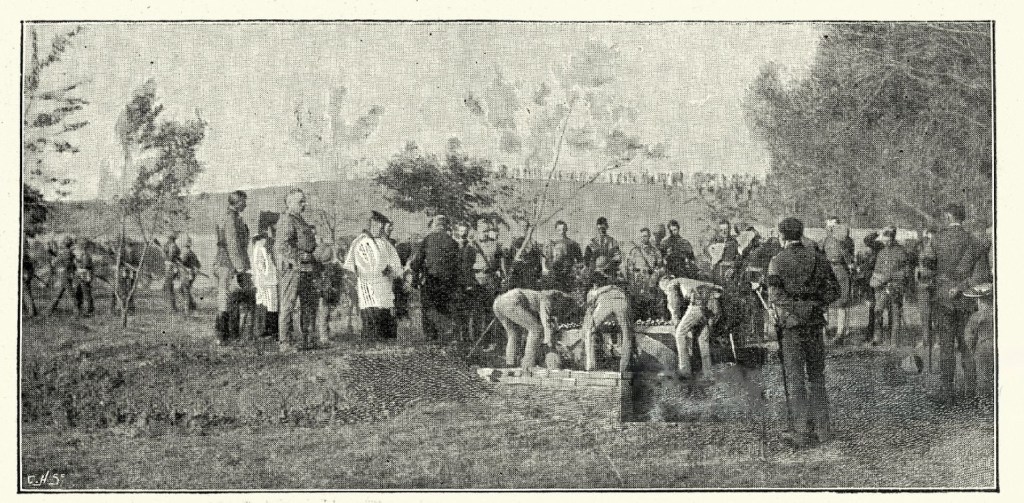
The Funeral of Sir Henry Havelock-Allen
In the final instalment of this series, we will ponder over the reluctance of Francis Cornwallis Maude to put himself up for a VC, look at the daring of Surgeon Jee, reunite with Hellfire Jack and meet the rest of the men who so justly deserve to have their names written in history.
Sources:
Bartlett, D. W. The Heroes of the Indian Rebellion. Columbus, OH: Follett, Foster and Co., 1859.
Best, Brian. The Victoria Crosses That Saved an Empire: The Story of the Mutiny VCs. Barnsley: Frontline Books, 2016.
Cromb, James. The Highland Brigade: Its Battles and Its Heroes. Edited by David L. Cromb. Stirling: Eneas Mackay, 1902.
Delavoye, Alex. M. Records of the 90th Regiment (Perthshire Light Infantry), with Roll of Officers from 1795 to 1880. London: Richardson & Co., 1880.
Malleson, G. B., ed. Kaye’s and Malleson’s History of the Indian Mutiny of 1857–58. Vol. 3. London: W.H. Allen & Co., 1889.
Parry, D. H. Britain’s Roll of Glory; or, The Victoria Cross: Its Heroes and Their Deeds. London: Cassell and Co., 1898.
Raikes, G. A. Roll of the Officers of the York and Lancaster Regiment. Vol. 1, The First Battalion (Formerly 65th Foot). London: Richard Bentley & Son, 1885.
Stewart, Rupert, comp. The Book of the Victoria Cross. London: Hugh Rees, Ltd., 1916.
The Register of the Victoria Cross. Cheltenham: This England Books, 1981.
Wilkins, Philip Aveling. The History of the Victoria Cross: Being an Account of the 520 Acts of Bravery for which the Decoration Has Been Awarded, and Portraits of 392 Recipients. London: Archibald Constable & Co., 1904.
Wylly, H. C. Neill’s “Blue Caps.” Vol. 2, 1826–1914. London: Gale & Polden, 1923.
Links:
https://vcgca.org/
https://www.nam.ac.uk/
https://www.memorialstovalour.co.uk/
https://victoriacrossonline.co.uk/
https://kilcullenbridge.blogspot.com/2007/01/abraham-boulger-vc.html
https://www.moth.org.za/
http://cameronians.org/victoriacross/
https://wardsendcemetery.wordpress.com/lieutenant-george-lambert-vc/
https://www.geni.com/people/Lieut-Colonel-Joseph-Crowe-VC/6000000011961004618
 Mutiny Reflections