Lieutenant Joseph Petrus Hendrik Crowe, 78th Regiment of Foot
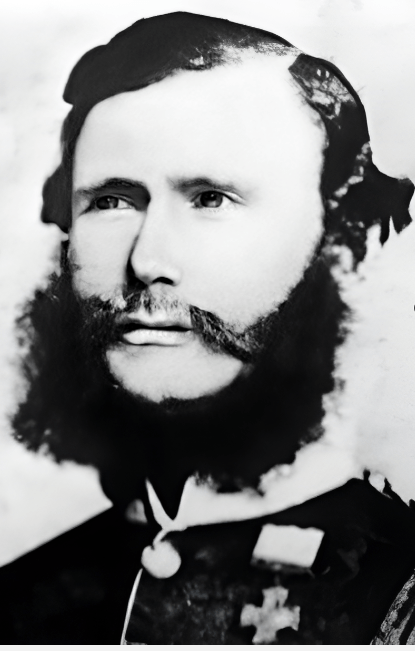
The second South African to win a Victoria Cross, Joseph Crowe was born on the 26th of January, 1826 at Vermaak’s Military Post, Uitenhage, Cape Province. He was the 5th of seven children born to Lieutenant Joseph Crowe of Ireland, late of the 60th Regiment of Foot and Classina Magdalena Vermaak. Classina was the daughter of a farmer at Vermaak’s Military Post. In 1827, his father bought a house in Uitenhage, where Joseph would spend his formative years. He attended school, with his brother Thomas under the rather watchful eye of one James Rose Innes, a notable educationist from Scotland. While 2 of Innes’ sons would later become notable men of government in South Africa, Joseph Crowe, who would probably have been one of their playmates, joined the army.
Although it is not certain how he joined the 78th Highlanders, Joseph likely served in the local levies or Provisional Companies which were attached to British regiments, notably the 72nd, 75th and 78th Highlanders. He received an ensignship in the 78th on the 27th of October 1846. He left Uitenhage for India in February 1847. In 1850 he was promoted to the rank of lieutenant.
Promotion in the army of the time was slow and unless a scourge or a war wiped out several officers, the only other option besides the inevitable rise by seniority, was to purchase it. A frustrated Joseph Crowe wrote to his father, asking him for a loan for just such a purchase – it would have been a startling sum at the time, although it was only the difference between his existing rank and that of the one he wished to obtain, his father wrote back, “Promotion cometh neither from the east nor the west . . . but from the Lord Thy God.”
In other words, “No.”
It was just as well. Lieutenant Joseph Crowe suddenly found himself embroiled in the Persian Campaign, for which he received the Persian Medal with one clasp, and in 1857, he and the 78th were marching with Havelock to Cawnpore.
Like Abraham Boulger, Lieutenant Crowe would fight his way through all of Havelock’s battles, but it was the third battle of Bushiratganj on the 12th of August where Crowe made his mark on history. Amid the carnage, strode Joseph, right through the entrance of a chowk, or village outside Bushiratganj in which the rebels were making their stand.
“Here a redoubt was strongly occupied by the enemy, whence they were firing rapidly on our men. Preparations were made to carry the place by storm, there being no guns at hand to attack it with, and night was coming. Every minute men were falling killed or wounded. All being ready for a charge, with marksmen playing on the place to keep down the fire, the word was given, ‘go’. The gallant Highlanders dashed forward, each man trying to be ‘first in’. The race was won by Lieutenant Crowe, who outstripped all and, being followed by his men, in less than a minute the place was captured and the enemy scattered or slain.”
It was however by no means a “done deal” as to who would receive the Victoria Cross. Upon returning to Cawnpore, Havelock wrote the following Order of the Day:
“The exertions of the troops in the combat of yesterday deserve the highest praise the Brigadier can bestow. In this, our eighth fight, the conduct of the artillery was admirable. The Fusiliers and the Highlanders were, as usual, distinguished. The Highlanders, without firing a shot, rushed with a cheer upon the enemy’s redoubt, carried it, and captured two of the three guns with which it was armed. If Colonel Hamilton can ascertain the officer, non-commissioned officer, or soldier, who first entered this work, the Brigadier will recommend him for the Victoria Cross.”
Colonel Hamilton was faced with choosing between Lieutenant Crowe and Lieutenant Campbell who had raced Crowe to the breastwork. Both men appeared to have reached it at the same time but it was Crowe who climbed over the wall first and dashed straight into the rebels. In the fight that followed, Crowe lost the tip of his small finger to a stroke from a tulwar.
Fate finally, would be the great decider – the next day, Lieutenant Campbell was struck down with cholera and died four days later, thus making Hamilton’s decision rather easy – the distinction was given to Lieutenant Crowe. The citation in the Gazette was very short.
“For being the first to enter the redoubt at Bourzekee Chowkee’, the entrenched village in front of the Busherut-gunge, on the 12th of August.” (Telegram from the late Major General Sir Henry Havelock to the Commander-in-Chief in India, dated, Cawnpore, 18th August, 1857. No. 22083″. The London Gazette. 15 January 1858. p. 178)
Back in South Africa, no one had heard of Joseph’s achievement. Three months after the citation appeared in the Gazette, a chance visit from the Bishop of Grahamstown to Uitenhage brought the news hope to his family. His father noted in his diary,
“The Bishop of Grahamstown visited Uitenhage, held Divine Service and Confirmation and administered the Sacrament, after which the Bishop came up to me and enquired if I had heard from my son in India. I said, ‘No, my Lord, not for some time . . . when he says ‘I have good news for you. He has got the Victoria Cross and has been promoted to the rank of captain for his bravery in India.’ I thanked his Lordship for his good news which was entirely unexpected . . . the Bishop on his way to Grahamstown called on my children at Quagga Flat and told them the news of their brother so that the Bishop was first to tell us.”
As for Joseph, the war waged on. He fought his way through the mutiny, receiving the Lucknow Medal with 2 clasps, a year’s service for Lucknow and a long-awaited captaincy, not in the 78th but in the 10th Regiment of Foot to which he had transferred in 1858. By December 1859, Crowe was promoted to Brevet Major and following further service in India, he finally found himself, with his regiment, in South Africa. Joseph Crowe had been away for 13 years.
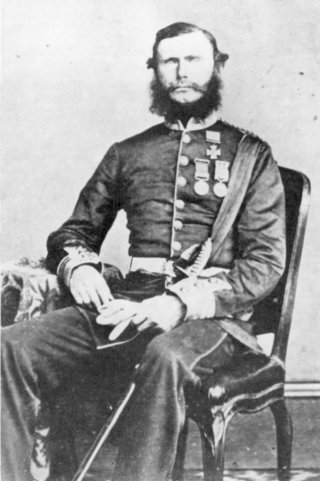
For the next four years, Joseph remained at home, commanding the 10th for in Port Elizabeth for a few months in 1862 before their transfer to Fort Beaufort, where they remained until 1864. Then it was back to India for the 10th Regiment, with further stints in China, Japan, Malaya and Singapore, including the Perak Campaign. In 1876 it was Lieutenant Colonel Crowe, commanding the 1st Battalion who sailed for England. He had retired from the army in January due to ill-health and while residing with his niece in Upper Norwood, Crowe died of lung congestion in April, apparently brought on by snipe shooting in the bogs of Ireland. He was due to have returned to South Africa the same year.
His grave at Norwood Cemetery would eventually fall into disrepair, lost in the weeds and undergrowth – 100 years after he received his VC a relative of his applied to have Joseph’s remains transferred to South Africa, but it would take another 20 years before his bones were finally resting in home soil. To welcome him back, a military service was held in Uitenhage at the Anglican church and the Post Office “issued a First Day Cover on February 5, 1977, to commemorate Joseph’s reinternment.”The original gravestone at Norwood sadly vanished.
It was not the last move for Lieutenant Colonel Crowe. In 2019, he embarked on his last journey, from the M.O.T.H. Garden of Remembrance in Uitenhage which was due for re-development and he was reinterred at the Heroes Acre Jubilieey Cemetery following a burial ceremony coordinated by veterans of the Memorable Order of Tin Hats (M.O.T.H) – several South African newspapers had carried an obituary notice of the upcoming internment and reburial- the ceremony took place on the 24th of August 2019.
Unfortunately, his medals and Victoria Cross were lost in a house fire in 1880 at his sister’s farm in Rondebosch. This included his Victoria Cross.
Medals of Lieutenant Colonel Joseph Crowe:
- Indian Mutiny Medal ( 1857-58 )
- 2 clasps:
- “Defence of Lucknow” – “Lucknow”
- Indian General Service Medal ( 1854-95 )
- 1 clasp:
- “Persia”
 Mutiny Reflections