Lieutenant William Rennie, 90th Regiment of Foot
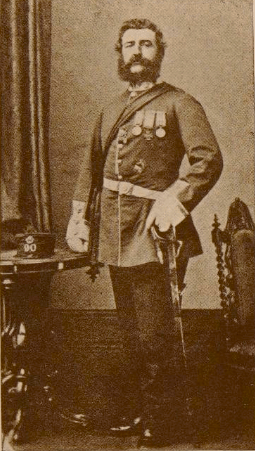
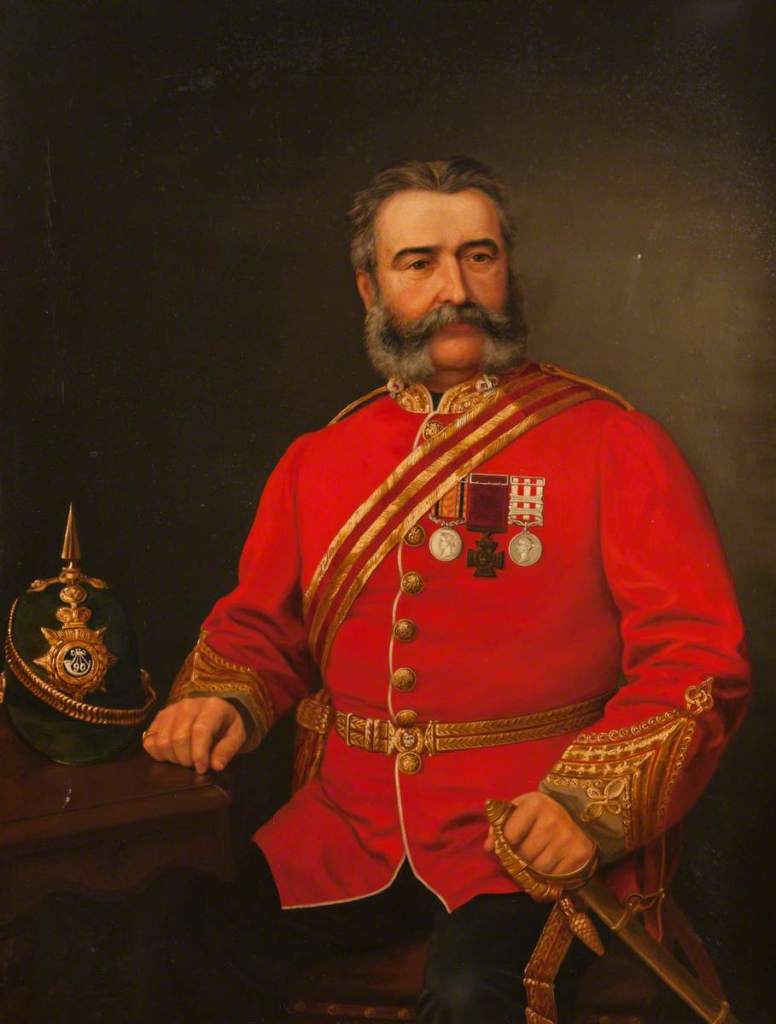
Born on the 1st of November 1821 in Elgin, William Rennie spent his boyhood on the estates of the Duke of Sutherland whom his father served as gamekeeper. William joined the 73rd Perthshire Regiment in 1846 and served in South Africa in the 6th and 8th Frontier Wars from 1846 to 1847 and again from 1850 to 1853. Rennie was promoted to ensign for gallantry and lieutenant in 1855 and transferred to the 90th Regiment of Foot. Relegated for the China Expedition, the 90th was diverted to India – it was an interesting state of affairs. The regiment had only been a week in Portsmouth following their arrival in England in February 1857, when they were initially ordered to India -this was quickly rescinded and the regiment was thence ordered to proceed to China instead. At the beginning of April, they embarked (Lieutenant Rennie was one of their numbers) but only made it as far as the straits of Sundra. They were crossed by a vessel bearing dispatches – the regiment was to proceed with all haste to Calcutta. They finally reached their destination on the 21st of July. They were quickly pushed up country and made a brief stop in Berhampore on the 2nd of August to quell a mutiny of the 63rd NI and the 11th Irregular Cavalry before joining Outram on his march to Cawnpore. They then advanced towards Lucknow.
Although they met with little opposition on their route of march, on the 21st of September the division was stopped shortly before Mangalwar by 6 guns, carefully positioned by the rebels to strafe the oncoming force. Maude, Olpherts and Eyre replied and shelled the rebel position until Havelock considered they had been sufficiently impressed that he could let his men loose.
“We moved forward from the road in oblique line for the purpose of turning the right flank of the insurgents, whose batteries had meantime opened, and were directed chiefly upon our heavy guns
drawn by elephants, killing some of the detachment escorting them. The sagacious animals displayed their usual caution, at once turning back, and could not be induced to drag on the guns, to which bullocks were then attached, to obviate this difficulty. Beyond this our line experienced but little resistance, and sweeping onward, with the 90th Light Infantry on its left, in dashing style, soon cleared the plantation and village; the hasty retreat of the rebels being simultaneous with our advance.” (North)
In the rush for the guns, Lieutenant Rennie ran ahead of the skirmishers and attacked the gunners, at first, with his fists – the audacity and surprise of the attack caused enough confusion in the lines of the gunners they were no longer in the mood to fight. With Rennie and the 90th creating havoc in their lines, the rebels gave up dragging off one of their guns (they were apparently prevented from doing so by Rennie himself) and fled instead. They joined the rest of their numbers and were pursued across the plain by Barrow and the Volunteer Cavalry.
This was Rennie’s first citation for the VC. He would receive a second on the 25th of September after the taking of Charbagh Bridge.
“After crossing the bridge, the 90th was ordered by General Havelock to take two guns which were posted at the end of a narrow lane on the right of the column. Two companies, under Captains Wade and Magenis, left the road and entered the defile, which was swept by the fire from the guns and by the musketry of the enemy, who filled the houses on either side. Led by Colonel Campbell (whose life was saved by his prayer-book, in which a bullet lodged), and accompanied by Colonel Purnell and Lieutenant and Adjutant Rennie, the 90th men dashed forward, and after a brief but desperate struggle captured the guns, up to which Ensigns Gordon and Chute carried the colours. The prize was not obtained, however, without serious loss, for Lieutenant Moultrie and Colour-Sergeants Sanderson and Cole were mortally wounded, and Lieutenant Knight and many others were put hors de combat. As soon as the guns were in our possession, Captain Olpherts, R.A., now Lieut. -General Olpherts, V.C., C.B., who had accompanied the advance, went back and brought up some limbers, removing the guns—on which he scratched with his sword the number of the 90th Regiment—under a heavy fire from the loopholed houses.”
As it was, Rennie reached the guns first and forced the gunners to give up their battery. Havelock, who had observed Rennie at Mangalwar and now saw his actions at Lucknow commented, “To do once was bravery. To do it twice was madness.” Thus Rennie received his VC.
“For conspicuous gallantry in the advance upon Lucknow, under the late Major-General Havelock, on the 21st of September, 1857, in having charged the enemy’s guns in advance of the skirmishers of the 90th Light Infantry, under a heavy musketry fire, and prevented them dragging off one gun, which was consequently captured. For conspicuous gallantry at Lucknow on the 25th of September, 1857, in having charged in advance of the 90th column, in the face of a heavy fire of grape, and forced the enemy to abandon their guns.” (“No. 22212”. The London Gazette. 24 December 1858. p. 5518)
The 24th of December, 1858, was incidentally the same day that 3 other VC winners of the same regiment- Major John Guise, Sergeant Samuel Hill and Private Patrick Graham – were gazetted.
Rennie managed to get through the mutiny unscathed and was promoted to captain in 1863 and returned to Scotland with his regiment in 1869. Promoted to major in 1873 and retiring with lieutenant-colonelcy in 1874, William Rennie died at Elgin, Moray on the 22nd of August 1896. The Cameronians Regimental Museum purchased his medals at Sotheby’s for the princely sum of £1700.- in 1969 and remain to this day at their museum.
At Mangalwar, another man received the Victoria Cross but in circumstances quite different to those of Lieutenant Rennie.
Sergeant Patrick Mahoney, 1st Madras Fusiliers
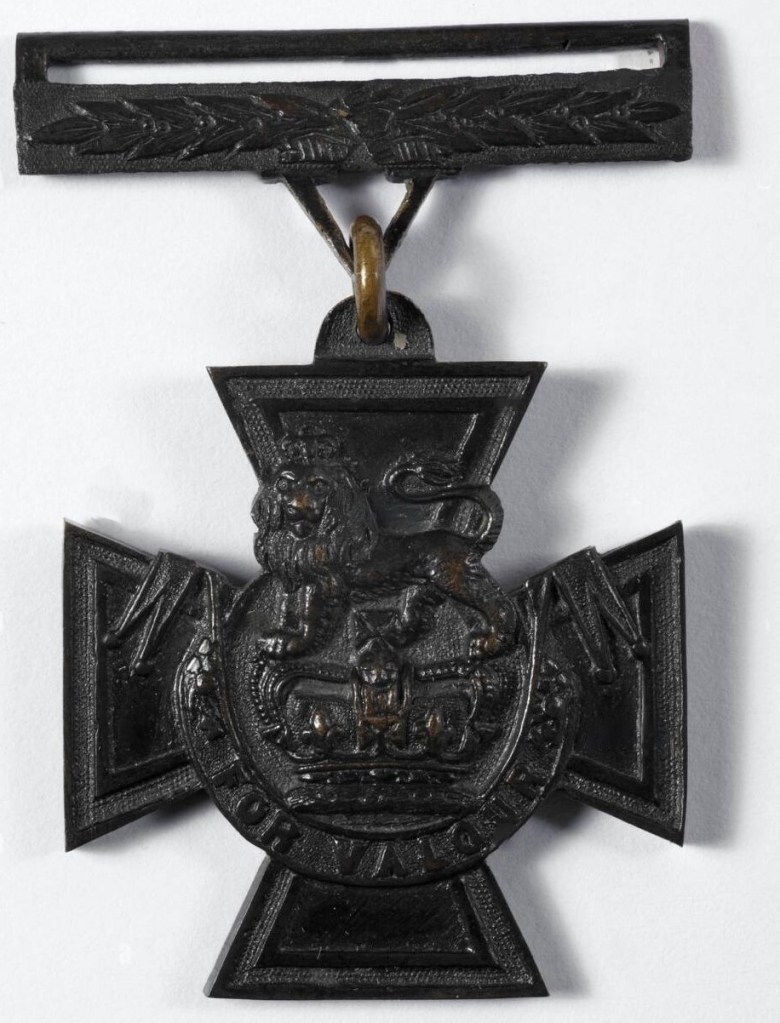
Serjt. Patrick Mahoney.1st Madras Fusiliers.21 Sept.1857.
Born in 1827 at Waterford, Patrick Mahoney enlisted in the EICo army and joined the 1st Madras Fusiliers where he attained the rank of sergeant. His knowledge of horses must have impressed Lousada Barrow enough, for Mahoney would swiftly find himself as a volunteer with Barrow’s Volunteer Cavalry. As such, during the attack on Mangalwar, acting Sergeant Major Mahoney was astride his steed, belting across the plain in pursuit of the rebels, Outram pounding heads with his cane and Napier breaking his sword over the head of another- amid this hectic ride, Mahoney sped after three men who appeared to be carrying Colours. In the ensuing tussle which ended in the deaths of the three mutineers, Mahoney lost two fingers, sliced off by a tulwar, but he grimly held onto the Colours. He had severed at the wrist, the hand of the Indian officer who was carrying it – the prize turned out to be the Colours of the 1st Bengal Native Infantry, who had mutinied at Cawnpore. Bleeding as he was, Mahoney then insisted on riding another charge, refusing steadfastly to get off his horse – he eventually did, though most unwillingly, after he fainted from loss of blood.
“For distinguished gallantry (whilst doing duty with the Volunteer Cavalry) in aiding in the capture of the Regimental Colour of the 1st Regiment Native Infantry, at Mungulwar, on the 21st of September, 1857.” (Extract from Field Force Orders of the late Major-General Havelock, dated 17 October 1857. “No. 22154”. The London Gazette. 18 June 1858. p. 2957)
Unfortunately, Patrick Mahoney would never wear his medal, nor indeed see his name in the Gazette – on the 30th of October, 1857, he was killed in action in Lucknow. As no one appeared to be aware that Mahoney was dead, and Havelock had already mentioned him in the Field Orders, a medal was minted for him. It is held today by the Oriental and India Office Collection at The British Library in London.
Had he lived Patrick would have worn the Indian Mutiny Medal with 1 clasp, “Defence of Lucknow.”
Corporal Robert Grant, 5th Fusiliers
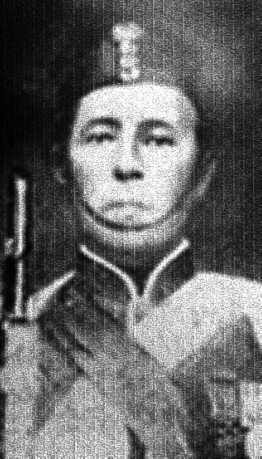
Born in Harrogate in 1837, 17 year old joined the 5th Fusiliers in 1854. Now at 20, Grant found himself in front of the Alambagh on the 23rd of September. The force had fought its way across to what was once a palatial retreat, a garden paradise, for the wife of the Nawab of Oudh – now it was filled with mutineers and the road was barred by their cannon.
Needless to say, events regarding this VC are rather confusing. Grant was awarded for actions on the 24th of September, which occurred outside the Alambagh itself.
The force had bivouacked near the Alambagh, taking a day of rest, such as it was. Corporal Grant and Private E. Deveney were part of the reconnoitring party – Lieutenant Brown – sent out to ascertain what the enemy was up to – as such, they set forth from Alambagh, in skirmishing order, only to find out very quickly the rebels were indeed very close by. They brought their cannon into play as they closed in on the small party – in their retreat, Deveney’s leg was blown off by a cannonball. Grant, realising Deveney was not with them, turned and ran back. He found him lying on the ground, still alive and unable to move. Calling to Lieutenant Brown, Grant tried to pick up Deveney – only when Brown and the others came up, were they able to carry the wounded private back to the Alambagh. Despite their brave efforts, Deveney died.
“For conspicuous devotion at Alumbagh, on the 24th September, 1857, in proceeding under a heavy and galling fire to save the life of Private E. Deveney, whose leg had been shot away, and eventually carrying him safe into camp, with the assistance of the late Lieutenant Brown, and some comrades.” (No. 22396″. The London Gazette. 19 June 1860. p. 2316). The citation however was initially made out to Sargeant Robert Ewart – this was subsequently corrected on the 12th of October, 1860. (No. 22434, P. 3679)
Grant would be promoted to sergeant after the mutiny and received his VC from Lady Hersey at Fort William in Calcutta on the 12th of December, 1860. When he finally left the army, Grant joined the Metropolitan Police, where he served as a constable until he died in 1867 from tuberculosis. He was buried in a pauper’s grave in Highgate Cemetery. In 2008 a headstone was unveiled by Sir Iain Blair (then Commissioner of the Metropolitan Police) on the site of Grant’s grave. Members of Grant’s family and Colonel Simon Marr of the Royal Regiment of Fusiliers were present, as was Grant’s VC – it was brought to the ceremony from its home in the Royal Northumberland Fusiliers Museum in Alnwick Castle. Interestingly enough, there are discrepancies regarding Grant’s death year – while everyone can agree he died at the age of 30, some sites (and books, including the Register of the Victoria Cross, 1981) still commemorate his death as November 1874, while the stone on his grave states March 1867.
The last Victoria Cross in this set should rightly have been the first as it was awarded for actions at Cawnpore, however, since it requires a much more detailed explanation, it has been relegated to the end, to prevent it from overshadowing the other men in this post.
 Mutiny Reflections