Private James Hollowell, 78th Regiment of Foot
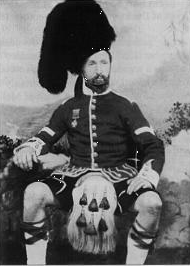
Born in Lambeth in 1825, the son of a carpenter, James Hollowell joined the 78th Highlanders and served with the regiment in the Anglo-Persian War. Although his career to this point was not anything more spectacular than that of the other men in his regiment, Hollowell had already gained a reputation for being a crack shot. He was just the man Surgeon Home needed on the 26th of September. His conduct was described as admirable, his demeanour fearless and his talent to encourage others, by now, nearly all wounded and some desperately so, was faultless. Hollowell was not going to give an inch of ground and neither was Surgeon Home.
After shooting the man in the red cummerbund, the attackers fell back. The men broke through the plaster that blocked the window and through it, crawled into the outer room. From the doorway, they saw the road was empty and silent. Strewn across it, however, were the bodies of the soldiers Home and the others had been unable to save and their heads had been cut off. After a quarter of an hour of this eery silence, one of the men remarked he could hear a dull, rolling noise and believed their attackers were returning – with a gun.
Home saw men pushing a “screen on wheels” towards them and it was soon pushed up against the door (marked B on the plan). The men hastily retreated back to the other room as the insurgents clambered up on the roof, scraped through the plaster and began throwing lighted straw down into the house. The smoke soon became intolerable and a new horror was about to commence.
“Thus situated, we knew not what to do. Numerous plans were suggested and abandoned. At last, we raised the three most helpless among the wounded, and dragging them after us, rushed from the back-door C, which led into the square. We had only about ten yards to run, when we got into the shed on the north side of the square. Here we found some dead and dying sepoys. In making this passage, Lieatenaut Swanston of the 78th, received a second wound, of which he died and one of the wounded men was again wounded. We were now, including myself, six men capable of using arms, and four more of the wounded men capable of standing sentry. One end of this arched shed had a passage broken into it, and we were suddenly roused by two shots fired at us through this. After this, we put one man to guard this entrance; and his presence there was enough to keep the assailants off. The fire of the enemy at this moment recommenced upon us through the doorways and numerous loopholes in the walls. From our first position in the house at the archway, we had in a great measure protected the doolies; but now the enemy were able to come through the archway, and reaching the doolies, commenced massacring the wounded. We were powerless to prevent this. The enemy crept up to them along the sheds, keeping tie curtains of the doolies between us and them, and thus we did not see them actually doing this deed of butchery. They used swords. Had we seen them, however, we could have done nothing. One wounded officer, Lieutenant Knight of the 90th Regt., was lying in a doolie. A sowar came up and was about to kill him, Knight sprung out of the other side of the doolie, and had instantly fifty shots fired at him, two of which struck him in the leg, making three wounds; but despite of his wounds, he succeeded in distancing his pursuers who followed after him, and he joined the rearguard, shot through the legs in three places.”
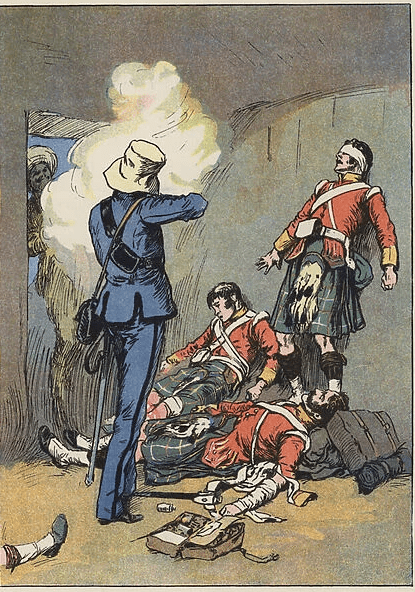
Up on the roof, their attackers now began shooting at the men in the house from above. Home and the others broke through a mud wall and found themselves in a courtyard. To their luck, they found two pots of water, a small salvation after being nearly burned alive.
“The wounded with us were calling out to us to shoot them, for we heard the cries of the poor wretches across the square, who were being inhumanly butchered. About thirty yards from the courtyard was the rear of a large building. Myself and another man crept forward cautiously and noiselessly to this wall. We found about eight feet from the ground an arched opening. Climbing on his shoulders, I managed to get inside this building, and found a spacious courtyard looking into a garden, and as I thought a place to which we had been directed by Providence for our defence and preservation. The walls were thick, the doorways few. I advanced a few feet into this building but dared go no further. I beckoned to the rest to come, but there being some hesitation, we were discovered by the sepoys on the roof, and fired upon. We now retreated back again into the first shed where the enemy had pierced the roof, carrying with us the water.“
Night was fast approaching and the surviving men made their preparations. Nine were told off in three reliefs to allow for three sentries and they all stayed close to the door.
“It soon became dark, and the scene baffles description. Here we were in the shed. Lying near us were dead men of the enemy, a dead horse shot that morning, — dead and living huddled together; and our own wounded, some of them delirious. The enemy on the roof over our heads, pacing backwards and forwards, their footfall being distinctly audible, and enemies all round us. All hope of relief had long left us, and we were merely, as we thought, clinging together in desperation. The intolerable thirst and the overstrained excitement of the whole day began about this time to overpower me, and I should not have cared at some moments to have been put out of Bospense by death. Again the hope of life would return. The enemy now set fire to several of the doolies. We heard the moans of the unhappy dying men within them, but dared not communicate to one another that the horrid sounds had reached us.”
Providentially, the attackers had ceased firing on the shed – Home found they had barely seven rounds for six men left and of the wounded he was the only one of the party unscathed. They spent the night, in fitful sleep, hungry, thirsty and exhausted, starting up at the slightest noise. Halfway through the endless night, they heard the sound of heavy firing and a rush of feet over their heads.
“We now felt certain that our situation was known, and that the firing proceeded from a party sent to our relief. To describe the revulsion of feeling is impossible. We raised a cry of ‘ Europeans! ‘ ‘Europeans! ‘ and then united to give one loud cheer, and shouted with all our might, ‘Charge them !’ ‘Charge them!’ ‘Keep on your right!’ ” The firing suddenly ceased. After waiting a few minutes, we gave ourselves up to despair. A little after, rousing ourselves, we consulted as to what we should do. I proposed to the men, either to force our way back to the rear guard or forward to the Residency. They agreed. But on creeping forward under shadow of the building, I found a large fire burning in the archway, and great numbers of men clustered about it. Escape that way was utterly impossible. Whilst by the way by which we had come, we had to rush through the men who had just successfully repelled our own soldiers. To escape, and carry away three wounded was hopeless. We resigned ourselves completely to our fate. A little after daybreak, we were roused by distant firing. This time it had no effect upon us. It, however, approached nearer and nearer, when Ryan, suddenly jumping up, shouted, ‘Oh boys! them’s our own chaps!’ We then all jumped up, and united in a cheer, and kept shouting to keep on their right. At the same time we fired at the loopholes, from which the enemy were firing. In about three minutes we saw Captain Moorsom appear at the entrance hole of the shed, and beckoning to him he entered, and then by his admirable arrangements we were all brought off safely, and soon after reached the palace with the rear guard of the 90th Regt.”
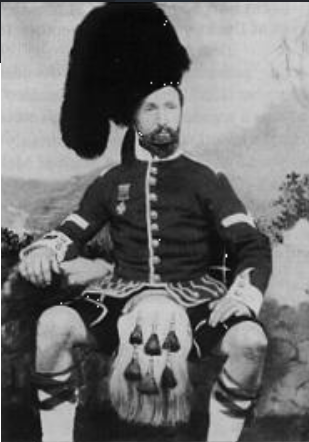
Private Hollowell survived the ordeal and for his actions received the VC and a promotion to Lance Corporal. He continued to serve with the 78th for the remainder of the mutiny and returned home with his regiment in 1859. At the age of 37, and declaring his profession proudly as “V.C.” on the marriage register in 1862, James married Sara Whicher in Whitechapel, London. As for James, he would be given the sobriquet, “Hollowell of the Deadly Rifle,” by his comrades in the Corps of Commissionaires – a charitable organisation that provided employment for ex-servicemen. James had worked intermittently as a labourer since leaving the army with his £10 per annum annuity for his VC, intact. However, with the Corps of Commissionaires he was able to find work as a watchman and James, “a square-built, upright man in a policeman’s uniform on the breast of which are many medals and a Victoria Cross” could be found keeping order outside E. Moses and Son, Gentleman’s Outfitters, of New Oxford Street, London. Besides the VC, James wore the India General Service Medal with one clasp for Persia, the India Mutiny Medal with two clasps – “Defence of Lucknow” for the relief under Havelock, and “Lucknow” for the recapture of the city under Sir Colin Campbell.
James died in 1876 and was buried in an unmarked grave in the Corps of Commissionaires plot at Brookwood Cemetery, Surrey. In 2000 his regiment put up a permanent memorial to him, in the form of a CWGC pattern headstone which today can be found at Brookwood Cemetery. Of his three sons, only one, James, would follow his father’s footsteps into the military, serving with the Royal Artillery. He died in Nova Scotia in 1895.
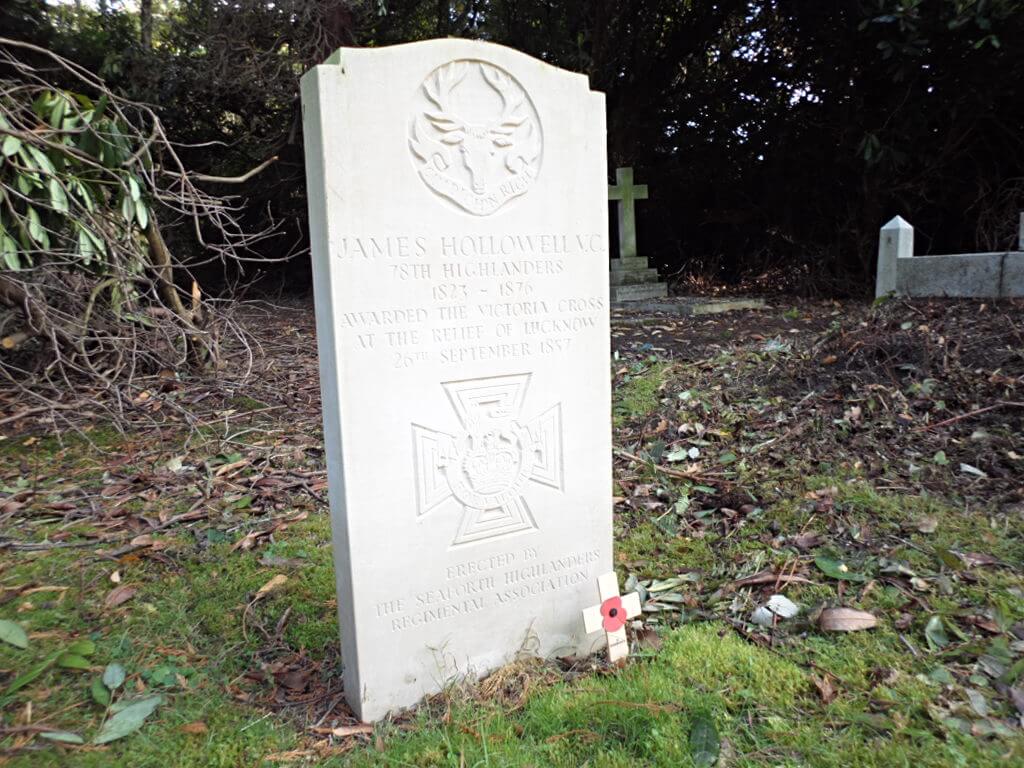
” A party, on the 26th of September, 1857, was shut up and besieged in a house in the city of Lucknow, by the rebel sepoys. Private James Hollowell, one of the party, behaved, throughout the day, in the most admirable manner; he directed, encouraged, and led the others, exposing himself fearlessly, and by his talent in persuading and cheering, prevailed on nine dispirited men to make a successful defence, in a burning house, with the enemy, firing through four windows. “(Extract from Divisional Orders of Major-General Sir James Outram, G.C.B., dated 14th October, 1857. No, 22154, The London Gazette of 18 June 1858, p. 2958)
His VC is held by the Highlanders Regiment Museum in Inverness, Scotland.
The final recipient of the VC for this band of distinguished men is none other than Sir Anthony Dickson Home, the vivid narrator of the events of the 26th of September.
 Mutiny Reflections