Private Peter McManus, 5th Fusiliers
There is very little known about Private Peter McManus. He was born in Ireland in Tynan, County Armagh in 1829. He joined the 5th Fusiliers as a private and would later be raised to the rank of sergeant, but his life, like so many others, was short. In April 1859 he died of smallpox in Allahabad and was buried in an unmarked grave, along with other victims of the dreaded disease. His VC citation, made by Outram would be forever linked to that of the next VC winner, Private John Ryan.
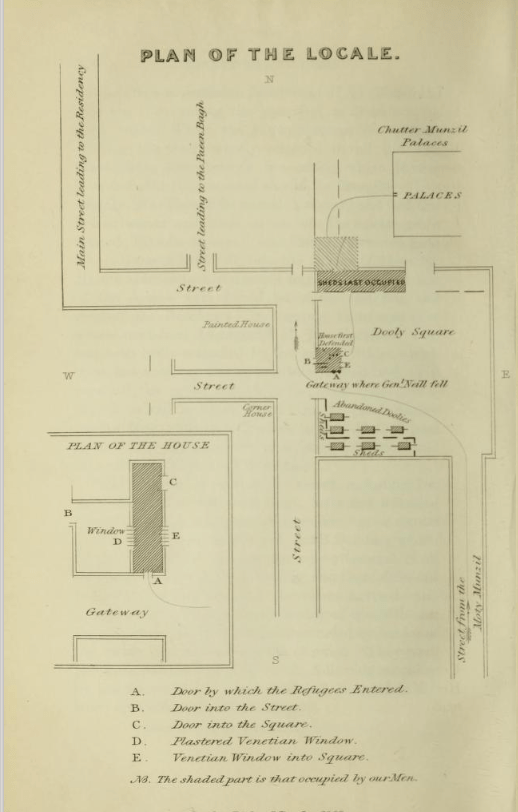
“They now got a great accession to their numbers, and the noise they made was fearful. They kept reviling us; and, indeed, we were so close, that continually words passed between them and Captain Becher. The assailants kept pressing continually closer and were then not more than twenty yards from us. They kept on saying, ” Why do you not come out into the street?” and their leader called on his men to rush on us, saying that there were but three of us in the house. To undeceive them, we gave a loud cheer, wounded and all joining. We barricaded the doorway partly with lumber, which we found in the house, partly with sandbags, to obtain which we stripped the dead natives close about the door of their waistcloths. The bodies of these natives about the doorway also offered an impediment to their making a rush upon us. From their position at this time, the mutineers could fire freely on our doolies in the square.
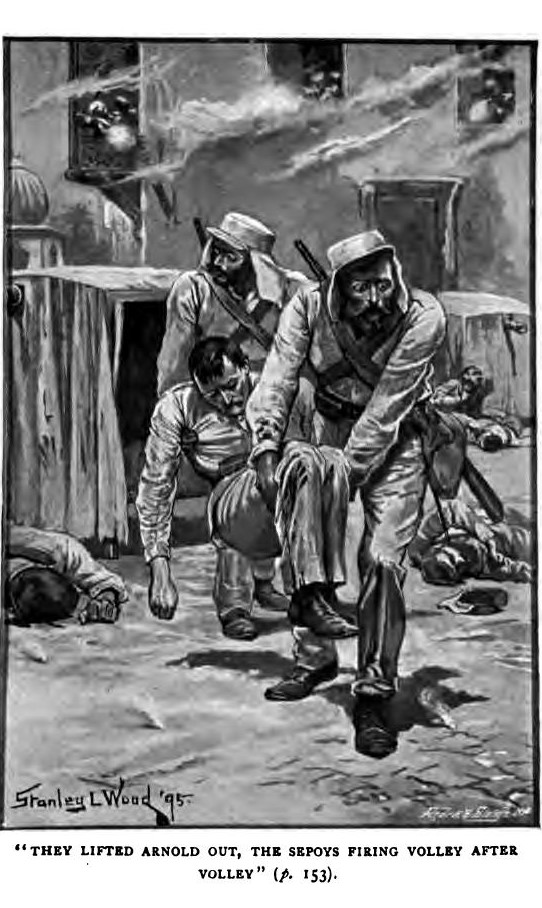
“One of our number, Private Ryan, Madras Fusiliers, was in a sad way about the fate of Captain Arnold, of his regiment, who was lying wounded in one of the doolies near. He called for a volunteer to assist him in removing the wounded officer. Private McManus, 5th Fusiliers, instantly came forward, though wounded in the foot. We removed our barricade, and the two rushed across the gateway, through the terrible musketry fire, and into the square, when they tried to lift the doolie, but found it beyond their strength. They then took Captain Arnold out of the doolie and carried him through the same heavy fire into the house. The ground was torn by musket balls about them, but they effected their return in safety, though Captain Arnold received a second wound through the thigh, while in their arms. A wounded soldier was also brought in, in this way, and he also, poor fellow, received two mortal wounds while being carried in; the men who carried them miraculously escaping.”
Private John Ryan, Madras Fusiliers
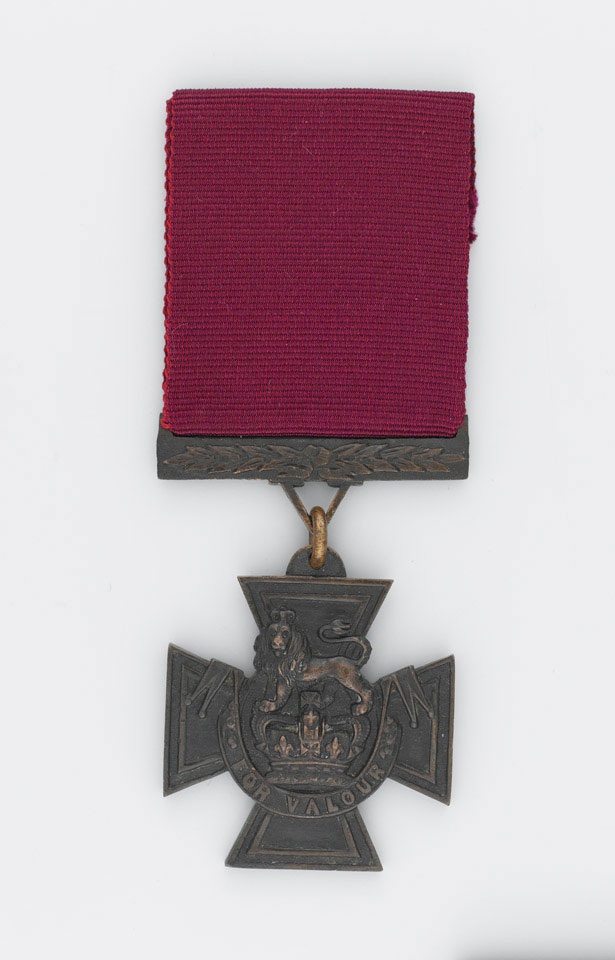
Like McManus, John Ryan hailed from Ireland and was born in Kilkenny in 1823. He was a man of some masterful bravery for shortly after, during the blockade of the Residency when Outram was trying to clear the Cawnpore Road, Ryan once again distinguished himself. Refusing to leave behind a sergeant of his regiment during a sortie, he requisitioned the aid of Lieutenant Dale and returned to pick up the wounded man. Together, they carried him back to the Residency – had he not already received his VC for the event on the 26th of September, Dale noted, this act would certainly have secured it for him.
Private Ryan would be raised in rank to sergeant and died the following year, killed in the retaking of Lucknow in March.
“A party, on the 26th of September, 1857, was shut up and besieged in a house in the city of Lucknow, by the rebel sepoys…Private McManus in conjunction with Private John Ryan, rushed into the street, and took Captain Arnold, of the 1st Madras Fusiliers, out of a dooly, and brought him into the house in spite of a heavy fire, in which Captain Arnold was again wounded. In addition to the above act, Private Ryan distinguished himself throughout the day by his intrepidity and especially devoted himself to rescuing the wounded in the neighbourhood from being massacred. He was most anxious to visit every dooly’. (Extract from Divisional Orders of Major-General Sir James Outram. G.C.B., dated 11 October 1857. No. 22154. The London Gazette. 18 June 1858. p. 2958.)
Captain Arnold unfortunately did not survive the ordeal and died later in the Residency following the amputation of his leg.
“Our situation at this time seemed to ourselves far from desperate: we thought that, by holding out for an hour or two, we were sure to be relieved by the rear guard when it marched up to the Residency. In fact, we were expecting them every moment. We, therefore, kept up a very steady fire from the doorway, and from the window that looked into the square. An hour passed away, and three of our men had received wounds which disabled them from firing.
“The conduct of Private Hollowell, of the 78th, was most splendid: cheering the men, keeping up their courage, and doing everything to prevent them giving way, himself all the time firing most steadily, and constantly with effect. At length, he killed their leader. The assailants, it must be explained, showed themselves only at intervals, when they would come forward as if resolved to make a rush; but Hollowell always manned to Idll one at this critical moment, which stopped them. At length he, as above said, killed their leader. He was quite an old man, dressed in white, with a red “cummerbund,” and armed with sword and shield. Soon after this, the noise in the street quite ceased. An occasional shot was fired at us, but the street seemed to have been deserted. Just before the leader fell, the assailants stealthily pushed the door open at B, f and fired into us through the plastered Venetian window at D; but, most providentially, without effect. Stationing myself at that window, and looking through the hole blown through it by the musket shot, I was enabled to shoot with my revolver, through the body, a man who came to repeat the fire. He staggered and fell dead in the doorway. At the same time, Hollowell shot another man endeavouring to drag this one away.“
 Mutiny Reflections