Private Henry Ward, 78th Regiment of Foot
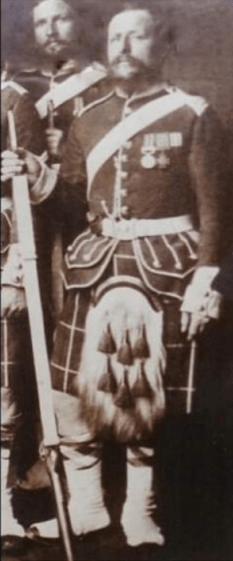
Instructed to remain behind with the rearguard of the 78th, Ward spent the night, with the other men of his regiment guarding the heavy guns, holding the ground in the Moti Manzil and guarding the wounded, helpless in their doolies. Ward stood over Harry Havelock for the whole night, tending him as best he could, but there was little anyone could do; Havelock’s arm was shattered at the elbow. In the morning, when it became clear the party was to move off, Ward organised four doolie bearers to carry Havelock and set off.
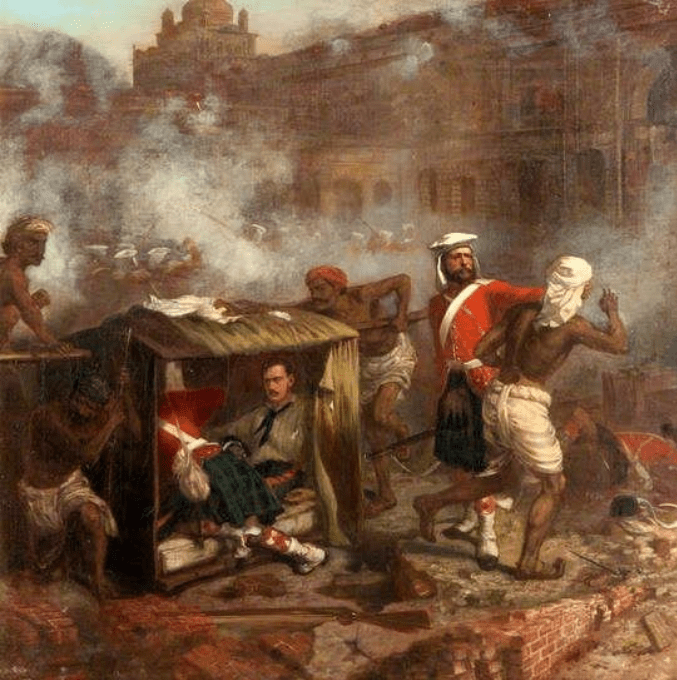
Under the heavy fire of the rebels, Ward quickly stopped the doolie – a private of the escort, one Thomas Pilkington, of Ward’s own regiment, fell, badly wounded. Ward picked the man up off the ground and placed him in the same doolie as Havelock. The doolie bearers, already terrified were more so harrassed with the double load but Ward was not having it. Through his “example and exertions” he contrived to keep the men moving, at the point of the bayonet. What the other exertions might have been, we can well imagine. Needless to say, Ward remained by the side of the doolie and arrived at the Residency with his charges.
Born into a working-class family in Harleston, Norfolk, Henry Ward was the eldest son of James and Mary Reeve, in June 1823. His options in life were limited – bricklaying, labouring or, as Ward chose, the army. In 1841, his father died, leaving the family destitute and living as paupers in the Depwade Workhouse. While his three siblings and his mother continued to live in the workhouse, Henry had lodgings in a fish merchant’s house and worked as an agricultural labourer. He was 18 years old. Perhaps inspired by his uncle, John who had once been in the army himself, Henry joined the 78th Regiment of Foot on the 31st of March, 1845. While his uncle would appear to regret his action and become one of the 6 privates to desert from the “Suffolk Regiment of Fencible Cavalry”, Henry and his cousin, John’s son, took their oath rather more earnestly.
How a Norfolk man ended up in a Highland Regiment, however, is another tale. Their numbers decimated by cholera, the regiment was allowed to recruit nationwide and Henry doubtlessly would have seen them marching up through Norfolk in their striking uniforms and pipes playing. Perhaps it was the encouragement he needed. He started his career in Scotland but swiftly he followed his regiment abroad – to Aden, India, Persia and back to India; of the 21 years he served in the 78th, Henry spent 14 of those away from home. He was discharged in 1865 in Dublin, and the notes read,
“21 years and 16 days service during which period he served 14 years in the East Indies. His discharge is proposed in consequence of his own request to go out pension having completed 21 years’ service.
Character appears very good. He is in possession of five good conduct badges he earned in the Persian Campaign of 1857 medal. Also served in India during the Mutiny of 1857 & 1858. Medal with two clasps. Also, in possession of the Victoria Cross. His name was never entered in the Rat. Defaulters book. He was never tried by a court martial.
He was slightly wounded in the left foot on the 25th Sept 1857″
Sir James Outram recommended Ward for the VC and he received the cross in 1858, without any presentation.
For his valiant conduct on the 26th of September, the grateful Havelock appointed Ward his Batman and he remained in his service as a personal servant for some years to come. Ward retired with the rank of quartermaster sergeant.
Following his retirement from army life, Ward resided briefly in Aldershot where he married a Scottish woman and in the brief time left to him, had two daughters with her. He took up employment as a railwayman firstly in Inverness but transferred suddenly to Malvern in Worcestershire. Ward died barely 2 years after leaving the army and on the 12th of September, 1867, he succumbed to heart disease. He was buried in a pauper’s grave. His widow returned to Scotland and Havelock, hearing of his batman’s sad fate rushed to pay for a handsome stone for Ward’s grave. His Victoria Cross is displayed at the Regimental Museum of Queens Own Highlanders in Fort George, Inverness-shire, Scotland.
“”For his gallant and devoted conduct in having on the night of the 25th, and morning of the 26th of September, 1857, remained by the dooly of Captain H. M. Havelock, 10th Regiment, Deputy Assistant-Adjutant-General, Field Force, who was severely wounded, and on the morning of the 26th of September, escorted that Officer and Private Thomas Pilkington, 78th Highlanders, who was also wounded and had taken refuge in the same dooly, through a very heavy crossfire of ordnance and musketry. This soldier remained by the side of the dooly, and by his example and exertions kept the dooly bearers from dropping their double load, throughout the heavy fire, with the same steadiness as if on parade, thus saving the lives of both, and bringing them in safety to the Baillie Guard.” (Extract from Divisional Orders of Major-General Sir James Outram, G.C.B., dated 27th October 1857 – No. 22154 The London Gazette. 18 June 1858. p. 2958.)
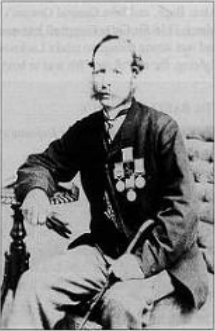
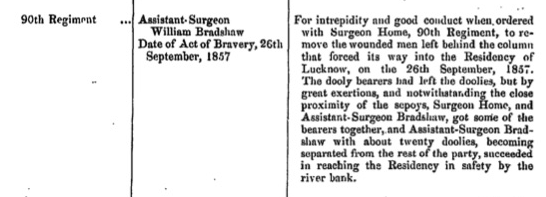
Like Ward, William Bradshaw did not survive the army long enough to leave behind anything in the way of a long personal history. He was recommended for the VC on the 18th of June, 1858 but unlike Ward, he received his award from the Queen on the 8th of June, 1859 at Buckingham Palace. Bradshaw retired from the army and returned to Ireland but he died at the age of 31 on the 9th of March 1861 in Thurles.
As for John Bensley Thornhill, he received a sobering epitaph from Lieutenant T. James, Assistant-Commissary General of the Lucknow Garrison:
“Poor dear old Bensley Thornhill received a mortal wound, performing a daring action that would have got him the Victoria Cross had he lived. He went out and rescued his wife’s cousin. General Havelock’s eldest son, who was lying wounded in a doolie, almost in the hands of the enemy, when that force reinforced us. He lost his arm and left temple in the murderous fire which he exposed himself to. Watson and I laid him in his last resting place.”
He lingered on, desperately injured, his arm amputated, until the 12th of October when death put an end to his sufferings. He was buried in the Residency Cemetery, where his grieving widow, only 18 years old, placed a stone over his grave and that of their little daughter who died during the siege. The inscription, while it lasted, read:
‘—Sacred to the memory of John Bensley Thornhill, Bengal Civil Service, born May 7th, 1832, died from wounds received during the siege of Lucknow, October 12th, 1857. Also of Mary Charlotte Bensley Thornhill, infant daughter of John Bensley and Mary Thornhill, died September 1st, 1857, aged six days.
The Lord gave and the Lord hath taken away; blessed be the name of the Lord.‘
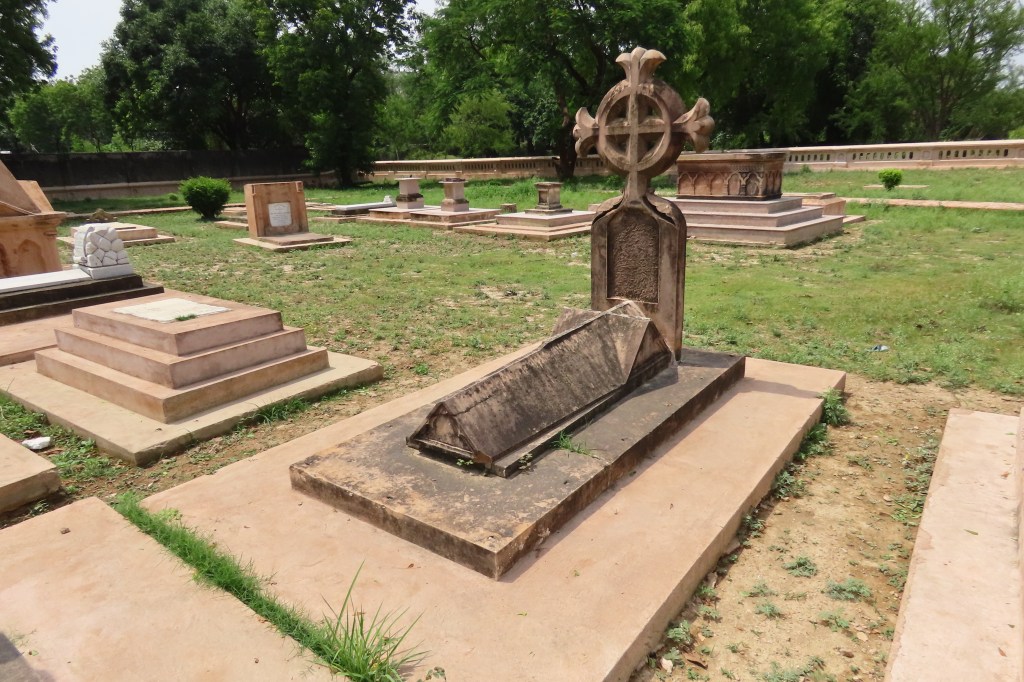
He was the son of John Bensley Thornhill, who first served in the EICO’s China and then in the Bengal Civil Service. He was born in Macao in 1830 and educated at Harrow and Haileybury before following in the footsteps of his father and brothers, into the service of the East India Company. In all 6 Bensley Thornhills and 2 of their nephews served in the mutiny and all of them, not only in the same province but as members of the Civil Service. Three would be killed in 1857 – at Sitapur, Cawnpore and Lucknow.
His widow, the sweet Mary, eventually remarried in 1869 to Captain Joseph Samuel Hudson.
We will now return to the events at Dooly Square and Surgeon Home continues his narrative.
“Our position at this time was the following: — Between thirty and forty doolies were scattered in the street, in the square, and in the sheds on either side; the bearers who remained unwounded were dispersed and hiding everywhere. Dismounted troopers of the enemy were entering the square, armed with swords, and three sides of it were surrounded by the enemy’s musketeers and riflemen, pouring into us a deadly fire. I did not like to leave the doolies, and remained, though the case appeared desperate.
” Seeing presently some stragglers of the escort, I joined myself to them, and we entered an open doorway, in a house which formed the right side of the archway. There were present, including myself, nine sound men, two wounded officers, Captain Andrew Becher, of the 40th N. I., and Swanston, 78th, and three wounded men: total, fourteen. At this time we were completely cut off. This was about ten o’clock. The mutineers having discovered where we were, were flocking round, and kept up a constant fire upon the doorway. The only thing which checked them was the intrepidity of Private McManus, of the 5th Fusiliers, who kept outside the doorway, sheltering himself behind a pillar, and managing to screen himself under that slight cover, from which he kept op, for half an hour, a constant fire on the assailants. He killed numbers of them; and the fear of his intrepidity was so great, that he had at last often only to raise his piece to cause all the enemy to stoop, and leave their loopholes.”
 Mutiny Reflections