Najafgarh
Ridge Force, Commander Brigadier General John Nicholson.
Cavalry
HM 9th Lancers. Capt. Henry Sarel, No. 3 Sqn only. (100). Guides Cavalry. Capt. Charles Sanford, 3rd BLC. 1 x sqn. (120).Mooltanee Horse. Lt. J. B. Lind, 24th BNI. Sikh Irregulars. (80). Note: Capt. Sarel had overall command of the cavalry.
Infantry
HM 61st Regiment – Lt-Col. Henry Rainey. (320).1st Bengal Fusiliers – Maj. George Jacob. (280).1st Punjaub Infantry (Coke’s Rifles) – Lt. Wm. Lumsden. (400). 2nd (Green’s) Punjaub Infantry. – Capt. George Green. (300). Composite Rear-guard and Reserve Battalion – Capt. Alexander Gordon. 100 men each from HM 61st, 1st Bengal Fusiliers and 2nd Punjaub Infantry.(300).
Artillery
Tombs’ Troop, 2nd Tp/1st Bde., Bengal Horse Artillery – Maj. Harry Tombs. 4 x 6-pdrs.
Remmington’s Troop, 1st Tp/1st Bde., Bengal Horse Artillery – Capt. Frederick Remmington. 5 x 6-pdrs, 1 x 12-pdr howitzer.
Blunt’s Troop, 2nd Tp/3rd Bde., Bengal Horse Artillery – Capt. Charles Blunt. 5 x 9-pdrs, 1 x 12/24-pdr howitzer.
Engineers, Sappers & Miners.
Lt. Maximilian Geneste – Detachment only. (30).
Baggage Guard
2nd Punjaub Cavalry – Lt. Charles Nicholson. 1 x sqn. (80).
Mooltanee Horse – Lt. Caulfield. Sikh Irregulars. (120).
The Rebel Force:
Comd: General Bakht Khan
Total Force:
7,000 Infantry, 1,000 cavalry and 13 guns. Note that Nicholson’s attack fell primarily on the Neemuch Brigade. Much of the Rohilkhund Brigade failed to support its sister formation in any meaningful way.
Neemuch Brigade.
1st Bengal Light Cavalry; one wing only. Kotah Contingent Cavalry (4 x tps).72nd Bengal Native Infantry, 7th Infantry Gwalior Contingent, Kotah Contingent Infantry.4th Tp/1st Bde., Bengal Horse Artillery.
Rohilkhand Brigade.
8th Bengal Irregular Cavalry.18th, 28th, 29th and 69th Bengal Native Infantry. No. 6 Coy/8th Bn., with No 15 Light Field Battery, Bengal Artillery.
Other Cavalry.
13th Bengal Irregular Cavalry (elements only).14th Bengal Irregular Cavalry.
Other Artillery.
No. 3 Coy/7th Bn., with No. 5 Light Field Battery, Bengal Artillery.
Total Ordnance.
1 x 24-pdr howitzer, 2 x 12-pdr howitzers, 2 x 9-pdrs, 4 x 6-pdrs and 4 x small calibre brass guns (2 x 4-pdr, 2 x 3-pdr). The likelihood is that the 6-pdrs and perhaps one or two of the 12-pdr howitzers were fielded by the horse artillery troop of the Neemuch Brigade. The other distribution of guns is impossible even to guess at.
The news of the siege train making its way slowly from Ferozepore towards Delhi seemed like the perfect opportunity for the rebels to crush the British on the Ridge. Their objective was to take the siege train before it arrived in Delhi. For Bakht Khan, he could repair his somewhat diminished image if he could win a decisive victory over the now very irritating Europeans on the Ridge, and he intended to do so. From the Ridge, the British watched as the mutineers poured out of the city, no less than 9000 in number, with 18 guns. At daybreak the following morning, Nicholson was dispatched to follow them and force them into battle.
His force consisted of 2000 infantry and cavalry with sixteen horse artillery guns. As they left the Ridge, the rain was pouring down in torrents; by the time they reached the open country, the roads had turned into quagmires, and the land around them resembled a lake. Before reaching their first halt, only nine miles from camp, the artillery was already forced to put their shoulder to their guns, dragging, pushing and pulling their way through two swamps.
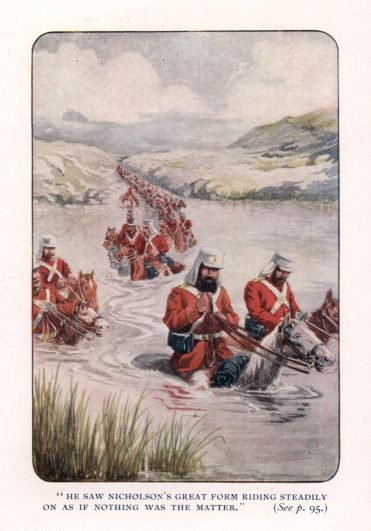
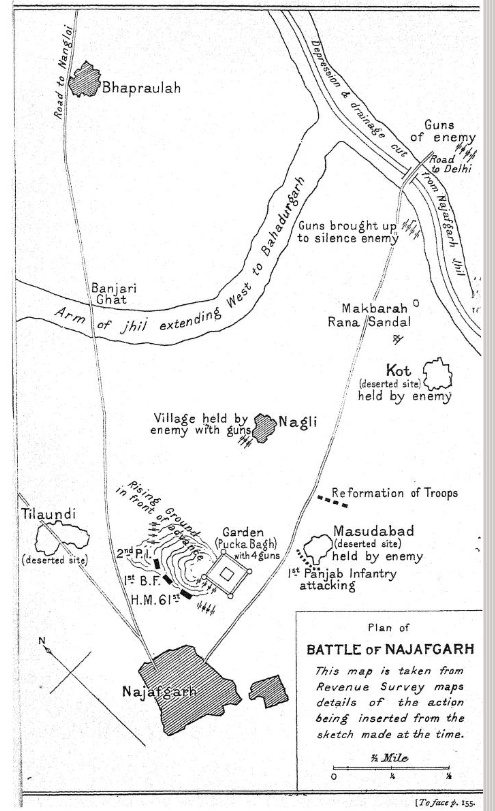
At Nangloi, Nicholson received intelligence of the movement of the enemy, and after a brief rest, he pushed his men on towards Najafgarh. Reaching shortly after 4 pm, they found the enemy occupying a position some three-quarters of a mile long, stretching from the bridge over the canal to Najafgarh town itself. Leaving the baggage behind under the guard of Multani Horse and a detachment of the 2nd Punjab Cavalry, Nicholson crossed a ford which passed in front of the rebel lines.
The strongest position held by the rebels was an old walled garden or serai in which they had planted four guns while a further nine were established between the garden and the bridge. Within an hour, Nicholson’s men had crossed the ford, and he engaged the enemy. His plan was as follows:
“The serai being the first and chief point to be gained, in front of it were drawn up the European portion of the force, the 1st Bengal Fusiliers in the centre, HM’s 61st on the right, with Green’s Rifles on the left, some 800 men in all; Tomb’s and Remmington’s guns were on a slight ridge in advance, with the Guides in skirmishing order to keep down the enemy’s fire. The village of Nujuffghur beyond the serai, on our right, was consigned to Lumsden with Rifles (Coke’s), that on the left, which seemed more strongly occupied, was made over to Captain Blunt with four guns and a small detachment of cavalry, to watch till the infantry should be available for an attack.”
The reserve was composed of Blunt’s two remaining guns and the rest of the Mooltanees under Lieut. Lind. Nicholson advanced to the front of the line, whom he ordered to lie down, and thus addressed them;
“Men of the 61st, remember what Sir Colin Campbell said at Chillianwallah, and you have heard he said the same to his gallant Highland Brigade at the Alma: I have the same request to make of you and the men of the 1st Fusiliers. Hold your fire till within 20 yards or 30 yards; then fire and charge, and the serai is yours.”
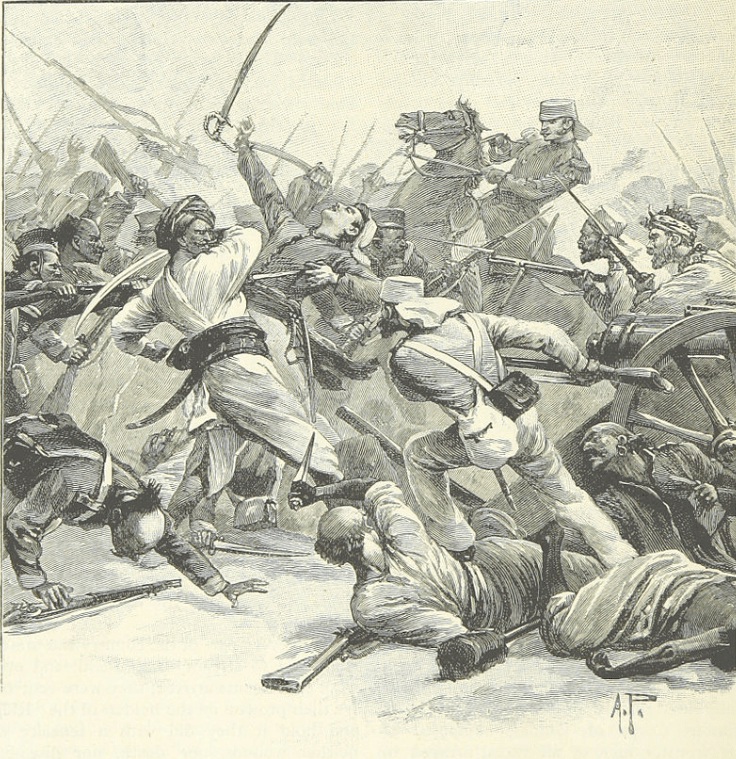
Opening up briskly with artillery fire and forcing the rebel left centre, Nicholson gave the order for the main line to rise and advance. The men came on relentlessly, holding their fire as ordered until within 20 yards of the walls, when the order came to charge. Storming the serai, they carried the guns and then swept down the line of rebels towards the bridge. Under the cannonade and the determined onslaught of Nicholson’s men, the rebels fled in confusion, running leaderless towards the bridge into the open country on the other side, pursued relentlessly by Nicholson’s troops. In an action that lasted less than an hour, Nicholson had routed an army of 9000 men and captured 13 of their guns. Meanwhile, the 1st Punjab Infantry cleared out the town of Najafgarh, while the 1st Punjab Rifles were sent to deal with stragglers who were hiding in a nearby village. Here, at least, the rebels put up a sound resistance, forcing the Rifles back, their commandant shot dead, and a party of the 61st Foot was sent in to help. Even with the additional support, they could not clear the village; however, during the night, the rebels decided themselves to leave.
In their flight, the rebels only managed to save two of their guns. They left behind all their baggage, which included, oddly enough, an English buggy and a quantity of ladies’ dresses. Seventeen tumbrils of ammunition had to be abandoned for lack of transportation; the powder was blown up. The rest of the supplies, which could not be carried away, were burned. Nicholson then ordered the Najafgarh Bridge destroyed, and on the evening of the 26th, he marched his men back to Delhi. His casualties were two officers and twenty-three men killed, two officers and sixty-eight men wounded, and sixteen horses killed and four wounded.
Perhaps the outcome would have been different if the Rohilkhand Brigade had joined the Neemuch Brigade in the fight -as it was, they were a few miles in the rear and either unwilling or unable to move forward. It was a damning loss for the rebels, and worse was yet to come.
Sources:
Anson, Brevet Major O. H. G. S. With H.M. 9th Lancers During the Indian Mutiny. Edited by Harcourt S. Anson. London: W. H. Allen & Co., 1896.
Barter, Richard. The Siege of Delhi: Mutiny Memories of an Old Officer. London: The Folio Society, 1984.
Cave-Browne, Rev. J. The Punjab and Delhi in 1857. Vol. 2. Edinburgh: William Blackwood and Sons, 1861; repr., London: Forgotten Books, 1911.
Fanshawe, H. C. Delhi Past and Present. London: John Murray, 1902.
Griffiths, Charles John. A Narrative of the Siege of Delhi: With an Account of the Mutiny at Ferozepore in 1857. Edited by Henry John Yonge. London: John Murray, 1910.
Handcock, Major-General A. G. The Siege of Delhi in 1857: A Short Account. Allahabad: Pioneer Press, 1897.
Hibbert, Christopher. The Great Mutiny: India 1857. London: Allen Lane, 1978; repr., New York: Viking Press, 1980.
Holmes, T. Rice. A History of the Indian Mutiny. 5th ed. London: Macmillan and Co., 1904.
Ireland, W. W. History of the Siege of Delhi by an Officer Who Served There. Edinburgh: Adam and Charles Black, 1861.
Leasor, James. The Red Fort: An Account of the Siege of Delhi. London: Werner Laurie, 1956.
Malleson, Colonel G. B. The Indian Mutiny of 1857. London: Seeley and Co., 1891.
Nigam, N. K. Delhi in 1857. Delhi: S. Chand, 1957.
Norman, General Sir Henry Wylie, and Mrs. Keith Young, eds. Delhi-1857: The Siege, Assault, and Capture as Given in the Diary and Correspondence of the Late Colonel Keith Young. London: W. and R. Chambers, 1902.
Roberts, Field Marshal Lord. Forty-One Years in India: From Subaltern to Commander-in-Chief. Vol. 1. London: Richard Bentley and Son, 1897.
Sedgwick, Captain F. R. The Indian Mutiny of 1857: A Sketch of the Principal Military Events. London: Foster Groom & Co., 1909; repr., 1919.
Vibart, Colonel H. M. Richard Baird Smith: The Leader of the Delhi Heroes in 1857. Westminster: Archibald Constable and Co., 1897; repr., 1907.
Wilberforce, Reginald G. An Unrecorded Chapter of the Indian Mutiny. London: John Murray, 1894.
 Mutiny Reflections