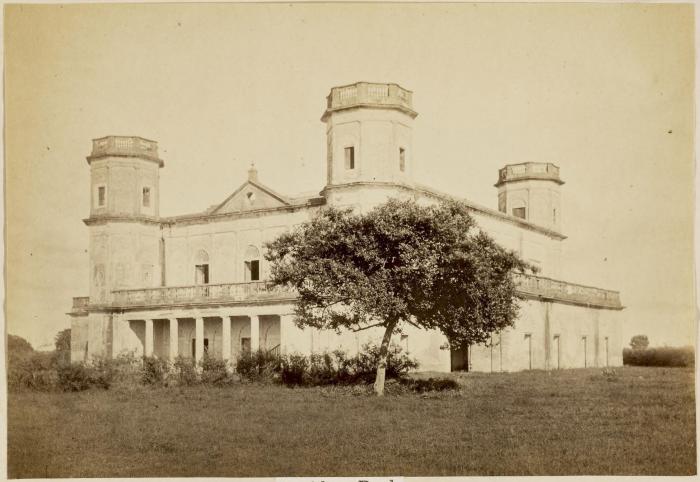
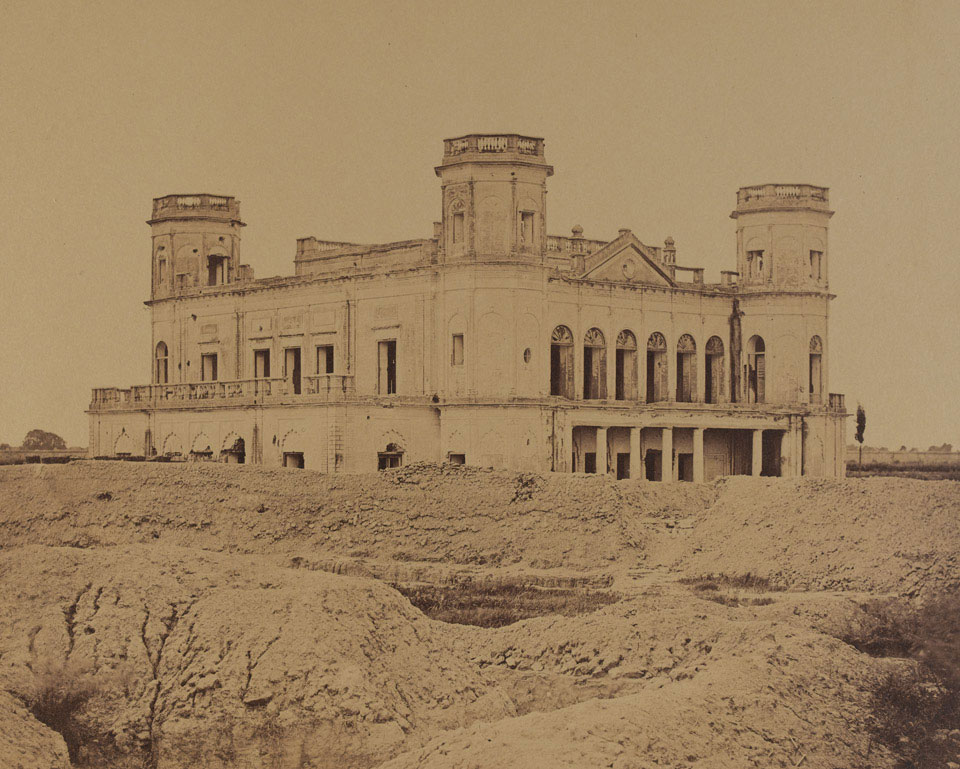
On the 25th of September, as Havelock and Outram advanced towards the Lucknow Residency, they left behind, at the Alambagh, a nominal force under the command of Major Colin McIntyre of the 78th, to defend and uphold the position until they could return. The sick and wounded from the advance, the hospital stores, along with the food and ammunition reserves and all the baggage would remain at the Alambagh. The 300 men left at McIntyre’s disposal were footsore and tired – of these, only 250 were fit for duty; however, they would be called on to fight – not for the three days that Havelock had calculated it would take him to relieve the Residency, but for the next 2 months.
Major McIntyre was ordered by Outram to hold the Alambagh, come what will. Unless he deemed his position beyond hope, he could, in this event, retire on Cawnpore, however, McIntyre was not a man to walk away from a fight. The position was well fortified, they had 2 heavy guns at their disposal, two nine-pounders and several guns captured from the rebels. They also had ammunition in abundance and good, clean water; their only problem was provisions and this only what they had brought with them from Cawnpore.
Three days after Outram and Havelock had reached the Residency, Outram was finally able to pen a few lines to McIntyre – it was impractical, at this point, to open communications between the Residency and the Alambagh, “on account of the band of rebels swarming in the rear.” McIntyre was to make the best of the situation as he could, and Outram advised, should the Alambagh be attacked, McIntyre should be able to hold his own as“The only damage they can do to you is by firing long shots into the garden, but I trust the four guns left with you will soon silence such fire.” By the 6th of October, Outram had abandoned any designs on withdrawing any portion of his force from the Residency, and wrote again to McIntyre, reporting the current situation and instructing him to make friends with a Bhowani Deen, a pensioner who was known to him and a supporter of the British, who had shown his willingness to provide the Alambagh with provision,
“Arrange with him to introduce what he gets in such as make it appear that you looted his carts in pa.- sing near your post. Otherwise, you would get no second supply. He might be instructed to bring his carts into the vicinity of ’Alam-bagh, when you would creep out and rush upon him with a cheer, and pretend to plunder, taking him and the banians with him (to whom the grain belongs) prisoners, and, when out of observation, paying them most liberally, m hard cash, from the public treasury, five rupees for every rupee’s worth of supplies, and sending them off again with the carts after dark, with instructions to repeat the experiment. It: is obviously necessary to arrange it so that our friends must appear victims.“
While McIntyre was arranging this rather elaborate ruse, back in Cawnpore Brigadier Nicholas Wilson (64th Foot) too had been equally active. The same day Outram’s note reached McIntyre, a party of 270 Europeans, with 2 guns as an escort for the hastily arranged Commissariat stores Wilson had gathered together, arrived in the Alambagh, under the command of Major Bingham of the 64th. By some oversight, no one in Cawnpore had thought to provide supplies for the Indians stationed at the Alambagh and they would have to continue shifting for themselves. Meanwhile, Wilson learned that all the bridges between the Alambagh and the Residency had been destroyed, the city was swarming with rebels and it was impossible to send anything further than the Alambagh – so the troops and the stores would remain for the time being with McIntyre and not be pushed forward to reinforce Outram, as originally intended. Wilson himself concurred that unless 1500 troops and 6 guns could be found, it was pointless sending small detachments towards the Residency – for now, everything and everyone would be gathered at the Alambagh.
On the 17th of October, Wilson received intelligence that the Delhi mutineers were marching on Bithur. They had been obliged to divide their force into detachments due to a scarcity of food, with each division marching ahead of the next – the first was expected in Shivrajpur the next day. The Nana, it was related, was trying to induce them to proceed with all haste to Bithur and secure it for him; in consequence, Wilson moved out with 600 infantry and 6 guns to intercept them.
On the evening of the 18th, Captain Bruce sent a message from Shivrajpur –
“We reached at three-thirty; drove the enemy right out of the place which was strong, with hardly any resistance and followed them up two miles and continued for a mile-and-a-half further with a few sowars, but they could not be overtaken. I suspect their nominal opposition was to cover their flight. Our casualties, seven or eight. No guns taken but some ordinance stores.”
One young man who happened to be at the action had a slightly more interesting account. Private Charles Wickins of the 90th Regiment was the eldest of 11 children, the son of a coppersmith from Summerstown, Wandsworth. Born in 1835, he had enlisted in the 90th in June 1854, in time to serve in Crimea, be wounded and return home invalided in 1855. In April 1857 he embarked on the HMS Transit, bound for China but after many mishaps, he finally arrived in Singapore on the Actaeon on the 25th of July. The stay was short – on the 30th his regiment boarded the Shannon and the Pearl, bound for Calcutta. By the 9th of October, he was in Cawnpore.
Curiously he mentions in his journal the expedition organised by Wilson on the 17th was secret – the men essentially had no idea where they were going or what they were about to do. they marched out of Cawnpore at 12pm and three miles outside the city, took their place atop waiting elephants. The next morning, at 10:30 the enemy was sighted in from of Shivrajpur. “…Captain Bruce, on informing the officer in command of the party, Colonel Wilson,” of the position of the enemy, he put his glass to his eye and looked in the direction for a few minutes, then turning to Captain Bruce he said, “Well I don’t see them. The troops will move on.”
Just as they commenced the advance, down came a round shot that killed two and wounded four of Wickins’ regiment. It was rapidly followed by another that knocked over 2 horses.
“We were all the time advancing in sections, when Major Barnston leaps out of his palanquin and, addressing Captain Guise,” said, “For God’s sake, take your men off the road and form line,” which
after some time was done.”
By now the artillery had unlimbered and commenced steady fire of shot and shell, “to inform them, the sepoys, that we would soon enter the village…” Twenty minutes later, after a swift charge, Wickins found himself in the village, with the rebels running out the other side of it – the troops gave chase for another 3 miles and then returned. 36 sepoys were taken prisoner, seven were hung and another 40 were found dead.
The next day Wilson moved his men on in pursuit, but the rebels had by now crossed the river and were out of reach. He then proceeded to burn some villages and take a few prisoners, en route to Bithur, where the men rested for the night. On the 20th, the small force was moving back to Cawnpore.
“We now thought that we were just entering on the campaign with the rebels, for the same night our baggage was packed up and taken to the entrenched camp. We were to proceed at once to Alam Bagh with a convoy of provisions and ammunition. 550 hackeries and we were to make the best of our way there, for the troops in the Alam Bagh fort were suffering for the want of provisions.”
The road thus cleared, on the 22nd of October, Wilson moved 500 infantry, 50 cavalry and 2 guns towards the Alambagh.
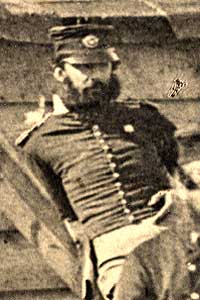
The night of the 22nd and the morning of the 23rd were occupied with transporting the column across the Ganges before following in Havelock’s footsteps. They met with no resistance until 7 miles from Alambagh when they were ambushed by the rebels who had been lying in wait with four six-pounder guns and opened up with no warning on the rear guard. With 2 companies covering the guns and only one company in the rear, the forward company was immediately turned and marched over 2 miles, to their assistance. By the time Wickins and the others arrived, the rebels had been dispersed and Captain J.C. Guise, who was in charge of the rearguard had been wounded by a sword cut to the hand. This was singularly unfortunate for Guise as he had previously lost his right arm seven years earlier in an accident. The march continued.
The convoy had barely proceeded a few more miles when the rebels again showed themselves, in considerable force to their right. The infantry opened fire with their Enfields, and “being well elevated, we made them move at a distance of 12 hundred yards.”
Just as the baggage arrived at the Alambagh, Major Barnston, who commanded the column, ordered a company of Madras Fusiliers and a company of the 90th to drive the rebels back as they were still harassing the rear – as soon as the companies advanced, the rebels fell back. The Fusiliers and the 90th advanced within 500 yards of Jellalabad Fort ( an old fort on the Alambagh road) and within 100 of a two-gun battery covered by tope of trees on the north side of the fort when the rebel cavalry began to close in on their flank – Barnston realising his men were tired, ordered them the retire instead of engaging, “at the same time cautioning the men to keep the enemy off their flank, which was admirably done with the Enfield rifle in use of the men.” As soon as they regained the road, however, they were ordered once again to the rear as the cavalry was now showing “a strong disposition” to resume attacking the baggage – a few volleys from the Enfields sent them flying.
“All this time not a hand’s turn was done towards getting the baggage into the fort, the troops merely looking out of their picquet houses upon us, evidently enjoying the scene in which we were engaged. We however got everything into the compound in safety with no thanks to anyone but ourselves and the good guidance of our much respected major who commanded us.”
Wickins now found himself regularly besieged in the Alambagh. With a few heavy guns in position, the rebels harassed the coolies and camp followers who were relegated to digging trenches and erecting batteries at all corners of the Alambagh. Meanwhile, rations were running low – the men were on half-rations, no one had thought to bring anything for the camp followers from Cawnpore and the elephants, bullocks, camels and horses were desperately short of fodder.
“One morning we sallied out for the purpose of covering our camp followers for the purpose of bringing in forage for the cattle. We suddenly came upon a body of the enemy and one gun. On our approach they unyoked the bullocks from the gun and yoked themselves at the gun and away they run [sic] with it. The gun was ours but for an order given by Major Mclntyre,29 who was in command at Alam Bagh. He had given an order to Major Barnston not to attack the enemy on any circumstances. Therefore the enemy were allowed to take their gun away unmolested to the utter astonishment of all parties. As we were returning after getting a sufficient amount of forage, the enemy came out in strong force and opened a heavy fire upon us, but their shot had no effect upon us. After this we never went out again …but the enemy had got the range of the compound to such an extent that they were daily killing horses, camels and bullocks and several natives were wounded.” Wickins would have to hold out until the 13th of November. Meanwhile, news arrived that Greathed and Grant were a short march from Cawnpore and behind them, was Sir Colin Campbell. Wilson continued to push stores onward to the Alambagh in preparation for what would be the final relief of Lucknow.
However, there were still many weeks to cross. Employing spies and heavily bought messengers, Outram remained in contact with McIntyre. While he had enough work as it was with defending the Residency and its outlying positions, Outram continued to send directives to McIntyre.
“Occupy the mosque in front of your gate by a small picket of Rifles, night and day; for if seized by the enemy they might harass you much thence. Burn all huts and cover within gunshot of your post. If you can spare time and followers to work, erect an earthen banquette inside your wall—at least at the most exposed spots, if not- all round—and some flanking defences round your towers, or in front of your curtains.”
Until the arrival of the Delhi column, McIntyre was further instructed to
“In addition to the ramp inside the wall, loopholes and a redoubt outside each corner curtain, you should make a ditch outside all round, commencing with the most exposed places, of course. A traverse should also be constructed, connecting the mosque with four squares. . . . Surround your corner towers with a rampart of sandbags.”
As soon as news of Bingham’s arrival reached Outram he instructed McIntyre to rid himself of all the elephants and camels at the Alambagh and send them, in one forced march “under guidance of an intelligent officer who knows the fords of the Bunnee River.” This unusual convoy was to start after dark and should keep a “sharp look-out” when passing Bunnee and Bashiratganj and make a detour if they encountered any problems. Until the departure was set, McIntyre was to prevent anyone from leaving the Alambagh for fear of traitors who could inform the rebels of the intended move. While this seems absurd in the light that it was a convoy of animals, Outram pointed out,
“But they must be well guarded, for the capture of our elephants would be an irreparable loss to us. One hundred riflemen at least should escort them, half of whom might be mounted on the elephants—the animals to be kept well together—as many Europeans as can be spared, who understand the native language (such as conductors &c,), to be sent with the party, to prevent misunderstanding between the soldiers and the mahouts (elephant drivers), and to guard against the latter taking their animals off the road on any pretext, lest they should walk off with them to the enemy.“
He also had some practical advice for McIntyre regarding provisioning his men:
“Be careful in not attempting forays beyond reach of your guns. It is most dangerous to weaken your position for ever so short a time, and you might fall into an ambuscade. If you cannot seize cattle in the field without exposing your men to risk of being cut of by cavalry, kill your cart bullocks (and sheep if you have them) for their subsistence, and supply something from your European stores to those natives whose caste will not allow them to eat meat.”
However, he just as swiftly admonished McIntyre for charging famine prices for flour,
“A camp follower who has made his way from Alum Bagh informs me that you charge the poor followers one rupee a seer for atta! I directed that the Mahomedan and meat-eating castes should be furnished with meat, by slaughtering the cart bullocks necessary to supply them, and that the castes who cannot eat meat should be furnished from the European supplies until bazaar supplies arrived from Cawnpore; but this did not warrant your charging famine prices for the articles so supplied, or charging one fraction beyond the price they cost at Cawnpore; so I trust I am misinformed.
The price you put on meat and biscuit is much too high for poor camp followers. An anna a seer is the utmost that should be charged; but the allowance, of course, to be limited in accordance with your means.”
McIntyre was to manage the Alambagh like any other garrison – for punishments, he could consult the articles of war and act accordingly but was to follow Outram’s directions – the plundering of stores was to be rewarded with 50 lashes from the Provost Marshal, if not caught red-handed but convicted regardless, the 50 lashes under sentence of the court-martial were to be given anyway. There was an even sterner punishment for traitors:
“The troops should be warned that the commanding officer has received my orders to direct the Provost Marshal to hang on the spot the next man found thus offending and that the order will be carried out without fail. The jemadar and mahout found communicating with the enemy should he tried by court-martial for rebellion, and if found guilty, hanged.”
While Outram could not directly message Cawnpore, he could contact the Alambagh, through messengers such as the wily Ungud and the fleet-footed Kanoji Lal he sent messages, the body of which was sometimes in French; important words were in Greek characters, and numbers in Roman capitals (while it was possible, that English might be read by at least a portion of the rebels, it was surmised they would probably be baffled by English words written in different languages), smuggled in bamboo sticks, which had been specially modified for this purpose with a small compartment concealed in the tube. The slip was rolled up, and put into a piece of quill about an inch long, with both ends sealed with wax. The missives were thus necessarily small, no larger than a few inches, and written out in the tiniest handwriting deemed readable. It must not be presumed Outram was fluent in Greek and on occasion was sent into a rage by the intricacies of the alphabet but he insisted on its use. He thus admonishes one officer: — ‘You ask me to write in the English character — so would the enemy wish me to do. As the only security against their understanding what we write in case our letters fall into their hands, the Greek character must be used.’ The use of these characters left the reader scrambling about looking for anyone who remembered enough of their education in classical languages to decipher what Outram wrote. Occasionally the messengers could bring papers and letters from the Alambagh concealed in bundles of grass. Even with these precautions, not all messages arrived at their destination and those that did were not necessarily in the order they were sent – often it was left up to the officer reading them to decide what exactly was wanted from him and to wait for what would be sent next. On occasion, the messengers were stopped and searched by the rebels; when such a missive was found, they were inevitably put to death. The bamboo stick was just one method of transmitting messages – one messenger concealed them in the bottom of his shoe, while another had concealed them directly on his person in a manner which is not fit for description!
In preparation for the arrival of the Delhi Column, news of which Outram received from the Alambagh where there was a reasonably open line of communication with Cawnpore even though the road was plagued by thieves, Outram devised an elaborate scheme of signalling for communicating with the Alambagh. The device alluded to is not a telegraph in the known sense, but a semaphore.
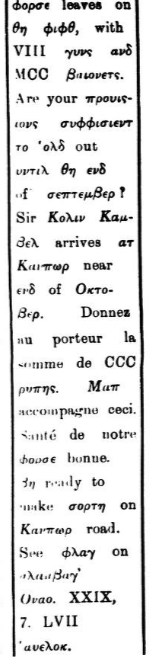
The message above was accompanied by a sketch map and a key to the semaphore. These had both been drawn out by Lieutenant Henry Moorsom of the 52nd Light Infantry, and D.A Q.M.G. to Havelock’s Force. It was under his direction that the semaphore was erected on the Residency roof, protected by sandbags. The device would be worked by the boys of the Martiniere. As soon as it was in place, Francis Maude ascended to the top of the tower and put himself to work with the semaphore. The key originally sent had fallen into enemy hands and the messenger killed, necessitating Moorsom to write another one and send it off again.
“We noticed, with some amusement, that the enemy, thinking they had the key in their hands, maintained complete neutrality, and did not fire a shot at us, although, in spite of the sandbags, our party presented a fair enough mark for musketry. The exact distance between the two semaphores was estimated by us to be exactly three miles, and we had a very powerful telescope, so that every movement was clearly visible. We laid our code on the coping of the parapet and began to send a message to the Alum Bagh. After some delay, we were delighted to see the arms of their semaphore in motion, and we, each of us in turn, noted the message which was sent.”
Unfortunately, the message the Residency received was utter nonsense and read MYYR.
“…and the following signals were equally mysterious. So again we had recourse to our own semaphore, and the Martiniere lads vied with one another in their alacrity in working the arms. A pause and the same cryptogram was revealed by the telescope.”
The next day it was ascertained by Maude that the workers of the Alambagh were in truth standing on opposite side to those of the Residency – in other words, they were reveresing the movements of the arms. “The meaning of this will be best understood if a person will move his right arm up and down, after the manner of a semaphore, and while doing so, turn to the right about; or, if the spectator will walk round to the other side of him. The position will of course then appear as though he were working with his left arm.” Moorsom agreed and quickly wrote out a new key.
The first four letters however did not appear to throw a better light on the matter and were read by Maude as “GOON” much to the laughter of the members of the Brigade Mess who were watching the spectacle with some delight.
“But the mirth was on our side a few seconds after, when another flash of intelligence enabled us to spell out,
GO—ON— WE— ARE— READY!“
Almost as soon as the first message was received from the Alambagh, the rebels realised their code was wrong and unleashed an unholy fire towards the Residency tower. However, as Maude, an artilleryman to the last, observed, “..the fire was only musketry, at over a hundred yards; the elevation being too great for their cannon.”
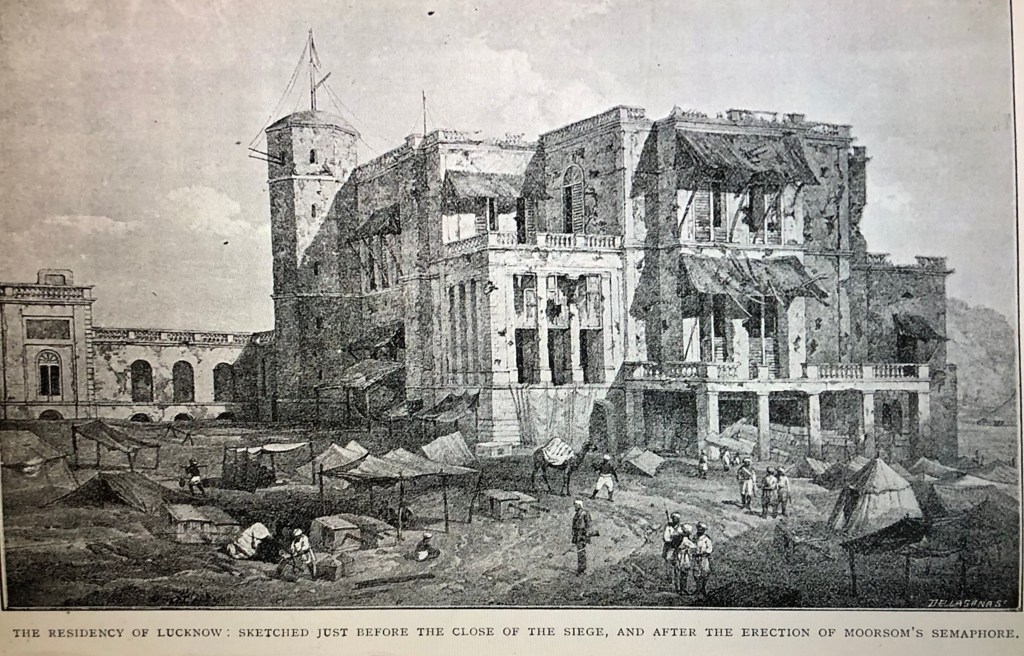
Outram was equally clear as to what he expected from the Alambagh signallers.
“I enclose a plan for telegraphic communication; your share of which Sibley will, I hope, be able to construct, as I know he is a great mechanic. Ours will, I hope, be ready in a couple of days, and you will be able to make it out from the top of your house. A second set of apparatus should be got ready to send with the relieving column, for the purpose of being placed on the top of the Martiniere.
The evening before the day on which we propose telegraphing to you, a bonfire will be lit on the highest point of our position (the Residency roof), to enable you to know exactly our whereabouts. A similar illumination on the top of the Alum Bagh will be proof to us that our signal has succeeded. We shall signal at twelve, noon, of each day, the time best suited; for the enemy annoy us least at this hour, and our signallers consequently will incur less danger. Even should our signals fail from your being too far from us, still do not delay in having two sets of telegraphic apparatus prepared; for so soon as we establish one set of apparatus at the Martiniere, and yours also is ready, the signals will be carried on without difficulty.
I have requested the officer commanding the relieving force to light a beacon fire on the top of the top of the Alum Bagh at 8 p.m., on the evening before advancing to Dil Khoosha. To prevent mistakes, a salvo of four or more guns should be fired twice. I have requested him to fire a similar salvo three times (five minutes interval) at 2 p.m. on the day of his arrival at Alum Bagh.”
Sources:
Anson, O. H. S. G. With H.M. 9th Lancers during the Indian Mutiny: The Letters of Brevet-Major O.H.S.G. Anson. Edited by Harcourt S. Anson. London: W. H. Allen & Co., 1896.
Bourchier, George. Eight Months Campaign against the Bengal Sepoy Army during the Mutiny of 1857. London: Smith, Elder, and Co., 1858.
Forbes, Archibald. Colin Campbell, Lord Clyde. London: Macmillan and Co., 1895.
Forrest, G. W. A History of the Indian Mutiny: Reviewed and Illustrated from Original Documents. Vol. 2. Edinburgh: William Blackwood and Sons, 1904.
Goldsmid, F. J. James Outram: A Biography. Vol. 2. London: Smith, Elder, & Co., 1880. (Note: While your notes state 1881, the two-volume first edition was officially published in 1880).
Gough, Hugh. Old Memories. Edinburgh: William Blackwood and Sons, 1897.
Grant, Hope. Incidents of the Sepoy War, 1857-58: Compiled from the Private Journals of General Sir Hope Grant. Edited by Henry Knollys. Edinburgh: William Blackwood and Sons, 1873.
Lee-Warner, William. Memoirs of Field Marshal Sir Henry Wylie Norman. London: Smith, Elder, & Co., 1908.
Malleson, G. B. Kaye and Malleson’s History of the Indian Mutiny of 1857–8. Cabinet ed. Vol. 6. London: Longmans, Green, and Co., 1891.
Maude, Francis Cornwallis. Memories of the Mutiny. Vol. 2. London: Remington & Co., 1894.
Ouvry, Henry Aimé. Cavalry Experiences and Leaves from my Journal. Lymington: Charles T. King, 1892.
Roberts, Frederick Sleigh. Forty-One Years in India: From Subaltern to Commander-in-Chief. London: Macmillan and Co., 1911.
Wickins, Peter, and Patrick Cadell. “The Indian Mutiny Journal of Private Charles Wickins of the 90th Light Infantry.” Journal of the Society for Army Historical Research 44, no. 179 (September 1966): 154–171. https://www.jstor.org/stable/44228848.
 Mutiny Reflections
Lucknow has that immense history behind it, thanks.
LikeLiked by 1 person