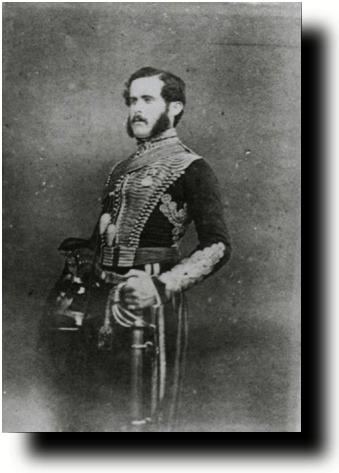
Sir Hope Grant
“We march at six to-morrow morning across the river. The report is that the rebels have abandoned Lucknow, and that we shall have only to walk into it. We must bring the brutes to bay somewhere or other. They fly before us so soon, that it will be very difficult to catch them in a cul-de-sac the only way we can make a terrible example of them. In taking up a position, the first thing they look to is a secure retreat. By patience and perseverance and good commissariat arrangements, we may eventually starve them into submission.” (HG Anson)
On the 30th of October, reinforced by 4 companies of the 93rd Highlanders and some infantry detachments, Hope Grant crossed the Ganges into Oudh. As Hodson’s Horse had displeased Grant for “sadly wanting in that alert smartness so dear to the heart of the energetic cavalry commander” when he visited one of their picquets, their native commander was savaged by Grant and Hugh Gough, their proud leader, received a “rubbing up” and was informed of “all the sins of my men, who never dreamt they were to blame, on my head,” and Grant passed an order that for their slovenly turnout, the “rabble” which he called Hodson’s Horse would remain on perpetual rearguard duty. When they left Cawnpore they were still occupying their place of punishment. Gough in his turn, was “naturally very disgusted” with his men and pitched into the native officers – penitent, the men they would do everything they could to restore honour to Hodson’s Horse.
If however one was to only read Henry Aimé Ouvry, one would imagine nothing at all out of the ordinary had happened on the march:
October 31st. Marched to Bushir Serai, fourteen mile & went with a party of one hundred 93rd Highlanders, one hundred Sikh Infantry and Watson’s Horse, to attack a village, but found that the body of the enemy who had occupied it had fled. I surrounded the village with the Cavalry, entered it and killed some fifty budmashes; lost one Sikh, who was shot. Started at 2.30, returned at 8, very hot.
The 31st of October brought them to Bunee Bridge where a telegram from Sir Colin Campbell was waiting – he had arrived in Cawnpore and would follow in their wake. For the next 2 days, Grant led his men on their way to Lucknow. Everything was for the moment as Anson had hoped – the enemy appeared to have scarpered.
Yet as was often told in these narratives, they had developed a knack for showing up when least expected but rarely by their own design. Gough and his men saw nothing of Ouvry’s fight – he and his men were looking after the safety of a long straggling line of camels and bullock carts – “a task very trying to one’s temper and patience, and the more so as one felt so utterly disgusted at being kept out of the good thing going on in front.” However, Hodson’s Horse would soon have more to do than harangue reluctant beasts of burden.
The rebel cavalry, numbering some 200 horsemen, intent on securing at least a share of some plunder, suddenly appeared on Gough’s left flank and made a dash towards the baggage carts. Captain Wheatcroft of the Carabiniers (who had but recently returned to India in the hope of rejoining his regiment but had found himself commanding the Military Train instead), ordered Gough to reconnoitre the rebel cavalry to deduce what they were up to. Gough went forward with 15 of his men and soon came in “full view of the enemy” who Gough observed consisted of mutinied Irregular Horse regiments. Realising that Gough was practically alone, “promptly came at us, and saluted us with a volley from their carabines, which, as they fired from horseback, was ill-directed and harmless.” Gough had just enough time to race back, and order up as many men of his regiment as he could gather together and with 40 men, charged the rebels with ” tremendous cheer” and soon got into the very thick of them. Although they were superior in numbers, the rebel cavalry broke and fled. Hodson’s Horse, in full gallop, pursued the rebels for some of the way, cutting up anyone they could reach. The men “were mad to retrieve their disgrace” and in Gough’s summation, behaved splendidly.
Meanwhile, Wheatcroft seeing Gough disappearing in the distance and knowing just how few men Gough could muster prepared to start off in his assistance, only to suddenly see Gough returning, his men full of victorious fervour and Gough proudly at their head. The report swiftly reached Hope Grant who “made amends” by admitting he had been mistaken in his estimation of Hodson’s Horse and added he rescinded his previous order – Hodson’s Horse would now have the post on advance-guard on the rest of the march to the Alambagh.
The march continued unhindered until the 2nd of November.
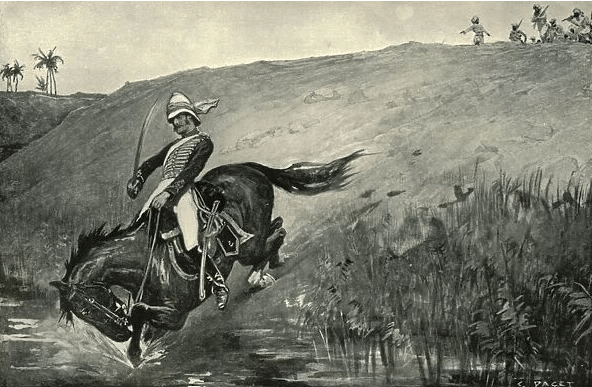
Hope Grant encamped his force on the 1st of November after fording the Bunnee River and the next day moved onwards towards the Alambagh. He duly sent lieutenants Frederick Roberts and Augustus Otway Mayne to mark out the camp in the open plain close to the village of Bhantira, which they had reconnoitred the day before. They met with no opposition but as the country people were proving to be rather hostile by cutting up any straying camp followers, the two men were particularly cautious to examine not just the village but the surrounding grounds. On the 2nd of November, Mayne and Roberts were once again sent forward and upon reaching the grounds, they sent back the escort to bring up the camp colourmen, satisfied the area was safe, and proceeded to talk to a few men that passed them on the road, pilgrims they said they were, on their way to Benares to bathe in the holy water of the Ganges. Suddenly a bullet whizzed over the officers’ heads, fired from the very direction they had just come from. Looking back, Roberts was surprised to see “a crowd of armed men at a distance of about three and four hundred yards,” who now cut them off from the main column. As soon as they realised they had been seen, the men advanced towards Mayne and Roberts, shouting and firing. The men, acquainted with the grounds from the day before knew there was an impassable jhil (marsh) on their right and another to their left front. This one was a little further off and they realised that if they rode hard enough they could get around the enemy’s flank before they could cut them off at that jhil to stop them.
“Accordingly, we put spurs to our horses and galloped as fast as they could carry us to our left; the enemy turned in the same direction, and made for a village we must pass, and which we could see was already occupied. The firing got hotter and more uncomfortable as we neared this village, the walls of which we skirted at our best possible pace. We cleared the village and hoped we had distanced the rebels when suddenly we came upon a deep nulla. Mayne got safely to the other side, but my horse stumbled and rolled over with me into the water at the bottom. In the fall my hand was slightly cut by my sword, which I had drawn, thinking we might have to fight for our lives; the blood flowed freely and made the reins so slippery when I tried to remount, that it was with considerable difficulty I got into the saddle. The enemy were already at the edge of the nulla, and preparing to fire, so there was no time to be lost. I struggled through the water and up the opposite bank, and ducking my head to avoid the shots, now coming thick and fast, galloped straight into some high cultivation in which Mayne had already sought shelter.
They managed eventually to reach the main column, where they found Hope Grant anxious – having heard the firing he had naturally expected the worst. “The dear old fellow evinced his satisfaction at our safe return by shaking each of us heartily by the hand, repeating over and over again in his quick, quaint way, ‘ Well, my boys, well, my boys, very glad to have you back! never thought to see you again.”
The column however continued to move forward and found themselves facing, not a well-disciplined rebel force but a “vast body of men” comprising of county people who were armed to the hilt and ready for fight. They however had not expected Grant and his column. Their intention had been to capture Mayne and Roberts but not take on the might of the Delhi Force – in one swift turn, they fled in every direction, disappearing with alacrity into the surrounding high grass and crops. Many however were cut up and killed. They left behind a 9-pounder brass gun but not before they had killed and wounded thirty of Grant’s men. Only later did Roberts come to understand that while the village had indeed been deserted the day before, during the night, the zamindars of the neighbourhood had gathered up as many men as they could, including the cavalry that attacked Hodson’s Horse and concealed them in the dark in the very places Roberts and Mayne and reconnoitred. The plan had been to fall upon Grant’s Column in the early morning but since Grant had not ordered the march at daybreak but at 7am instead, their plans had been rather disrupted and they had already given up on attacking Grant that day when into their midst stumbled Mayne and Roberts.
On the 3rd and 4th of November, the army remained at Banthira, all in anticipation of the arrival of Sir Colin Campbell. Anson grumbled, calling it being reduced to “Cossid post” – wait, watch and collect information but otherwise do nothing. Ouvry noted, in his usual laconic style,
“Camp near Lucknow. We are still halted at the same spot waiting for the Commander-in-Chief who has arrived at Cawnpore. Yesterday I went with a force to Alumbagh, about two miles from Lucknow, where a body of our troops are besieged — one squadron 9th Lancers, two Regiments Irregular Cavalry and a lot of Infantry with six guns. We threw in supplies and brought out the sick. The enemy tried to hinder us, but a few rounds from our guns made them all run. Our loss was nil…”
No 17 Battery was ordered to form part of a convoy to escort a long string of camels and carts loaded with ammunition and grain to the Alambagh. They arrived within half a mile of the position without encountering any resistance and it was decided the detachment would remain here while the stores were being deposited in the Alamabagh and provisions were made to evacuate the sick. Around mid-day a body of cavalry “menaced” their flanks while some light guns opened up on their right – the European guns opened and returned fire while the cavalry charged, scattering the rebels. Later on in the day, however, a truly bewildering incident took place that set the 9th Lancers in full flight, their pursuers victorious and the glorious Lancers defeated.
While in the Alambagh, Lieutenant Roberts, working inside the enclosure, heard “noise and commotion” some little distance off. Climbing up to the roof he watched with horror as troops flew in every direction – but there was no enemy in sight. Roberts quickly descended, mounted his horse and rode off to find out what could possibly be wrong to cause such a rout.
Ouvry had ridden ahead of the column with one squadron of the 9th Lancers and 2 guns. He positioned the guns in a small grove of trees, some 700 yards from the main road where the rest of the column remained, a few Infantrymen of the 93rd Highlanders stood about watching the proceedings. Now one of two things happened:
Bourchier claims it was officers, possessed with the “demon of mischief” who upon espying a large bees-nest hanging from a tree proceeded to throw clods of earth at it. When the method did not provoke the merriment the officers expected, a lance, presumably Evans’, was thrown with deadly accuracy directly into the centre of it. According to Ouvry, it was Evans alone, who went by the sobriquet “Bashi Bazook” who started it when he foolishly stuck his lance in the nest while riding under it.
“Cavalry and Artillery rushing back to the main column all mixed up and in the wildest confusion. Fawcett who commanded the squadron of Lancers, was thrown from his horse, and how I myself got out of the scrape I can hardly tell. My horse reared and plunged so that it was a considerable time before I could get him to move on at all. The Infantry stood to their arms not knowing what to make of it, while we galloped past, away into the plain. Such a rout was never seen, but nobody could see any enemy in pursuit…naturally, the bees attacked us with the utmost fury. Many are now laid up with swelled heads and eyes. I got punished about the head and ears and my clothes are full of stings…”
The Highlanders in their kilts and bonnets were noted to observe after the fracas was over, that their clothes were singularity unsuitable to treat with such an enemy and as Bourchier observed they had taken “more bees than they carried in their bonnets.”
The sick and wounded from the Alambagh were sent back to Cawnpore while the remaining force remained, thus encamped waiting for Sir Colin Campbell – on the 9th of November, on the plain outside Banthira, he finally arrived.
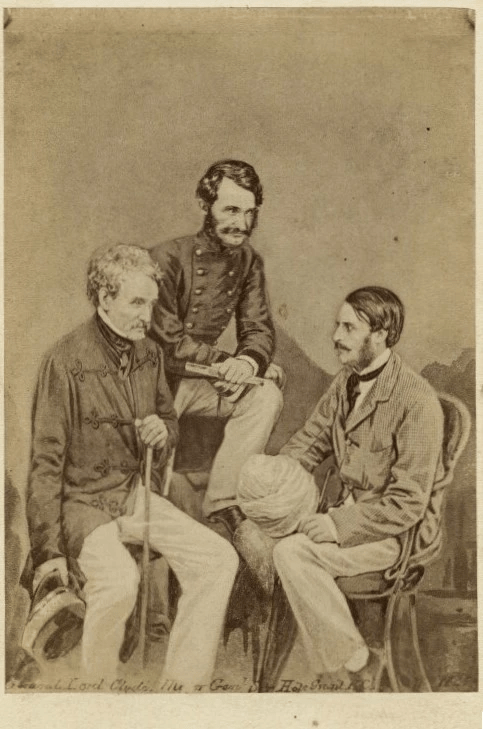
(Henry Hering albumen carte-de-visite, circa 1862)
To Campbell’s surprise, he was greeted the same evening by a most unlikely figure – the bedraggled, mud-spattered form of Henry Thomas Kavanagh and his trusty guide Kanoji Lal who had swum, run and sneaked their way through Lucknow to bring Sir Colin Campbell messages from Sir James Outram.
Outram surmised the rebels would be expecting Campbell to follow Havelock’s route and had subsequently destroyed the bridge over the canal and commenced extensive preparations in that direction. He thus recommended Campbell give Lucknow a wide berth and suggested the advance should be made via the Dilkusha and the Martiniere, and the canal could then be crossed by the bridge nearest the Gumti. As such, the right flank would be covered by the river, and any fire from the rebels would thus be from a considerable distance. While Campbell agreed to Outram’s plans he decided to abandon the bridge altogether and ford the canal nearer the river, thus keeping his force clear of the streets altogether.
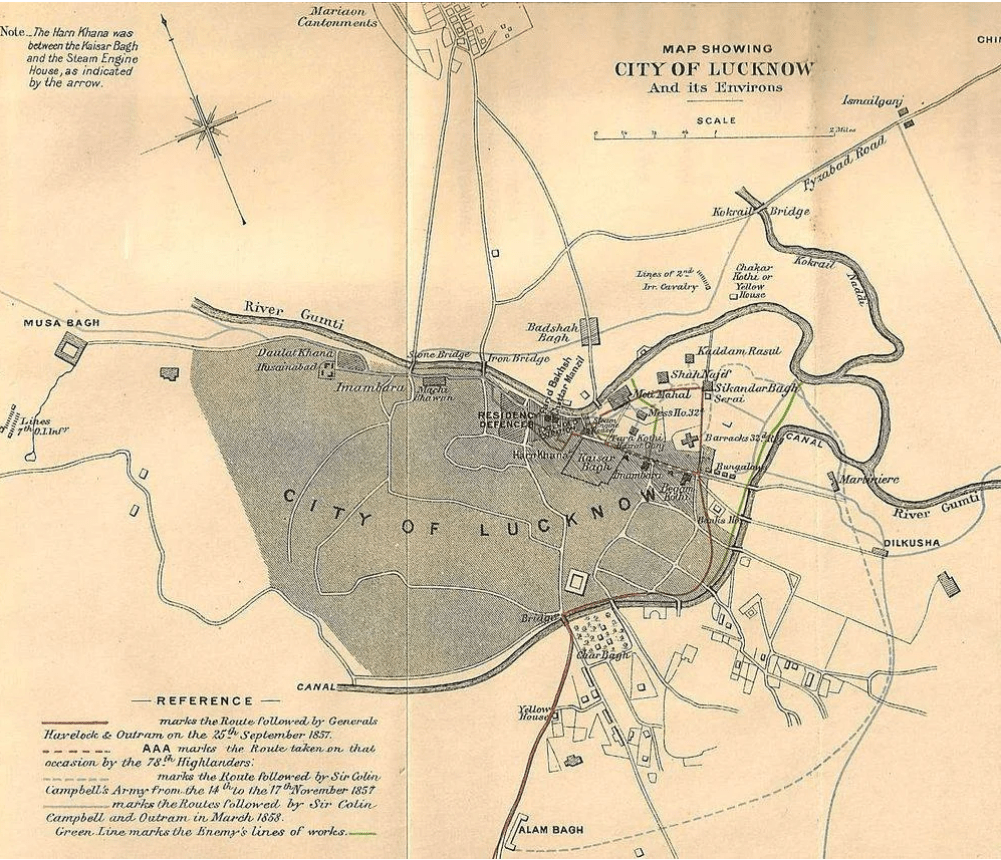
As for holding Lucknow, Campbell was under no delusions – he knew, with the force at his disposal he he could either reinforce the Residency and become as bogged down as Havelock had or evacuate the position and make his way back to Cawnpore, thus leaving Lucknow to its own devices until he could return on the offensive at a later time. His pressing concern was the Gwalior Contingent, said to be marching on Cawnpore – while he had left “Redan” Wyndham in charge, Campbell was eager to return to Cawnpore with all haste, rid himself of the cumbersome women and children and then be on his way to deal with the rebels. Lucknow would therefore have to be abandoned. A message wus sent swiftly to Outram informing him that Campbell would leave the Alambagh on the 13th; and if all went well,
“that he hoped to gain possession of the barracks and the Secundrabagh on the 14th; and on the 16th to carry out the women and children and the sick and wounded.” That was the plan, at any rate.
 Mutiny Reflections