The 15th of November
On the morning of the 15th, the captain of the 90th asked for a dozen volunteers to take on the duty of sharpshooters. Hardly had he finished his sentence, when 10 men stepped forward, among them Private Wickens. Ten minutes later he and the others found themselves on the river bank, “popping at the Pandies.” Peel’s Brigade was busy getting their guns into position on the road – they then opened up and sent a number of shot and shell across the canal into the city, strafing Bank’s House in the process. The rebels had loopholed every house and wall on their side of the river, and Wickens observed they had in their number some fine shots, “for they actually cut the grass close to our ears as we lay under the bank, watching an opportunity to fire.” As for the sailors, Bourchier wrote,
“The sailors on our right, with that universal talent they possess of turning their hands to anything, threw up a battery in front of their guns, and escaped with scarcely a casualty; while the artillerymen, less inclined to use the spade and pickaxe, had many men badly wounded. The conduct of the sailors was most amusing; a shot at a Tandy with a carbine, with but the slightest chance of success, was hailed with as great delight as a schoolboy’s first shot at a crow; and to be without one for any length of time was a real hardship. Their fun and good temper on all occasions made it quite delightful to serve near them; while to men who had been many years in India, there was a freshness in their ways, which brought the dear old country more to our hearts than anything else possibly could have done.
They were described by the natives who first saw them, as “little men four feet high, and four feet in the beam; always laughing and dragging about their own guns.” Although becoming slightly amphibious, the idiosyncrasies of their own profession were kept up to an amusing extent. They paraded (I beg pardon, mustered) not in front of the camp, like the regiments, or, like the artillery, near their guns, but in the officers’ lines astern; which they persisted was their quarter-deck. The boatswain piped all hands to grog..”
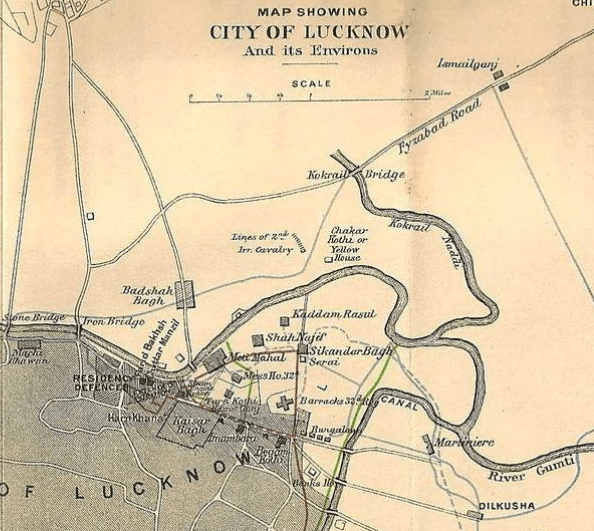
The whole of the 15th was spent preparing the advance. The Dilkusha was turned into a general depot for the sick, the wounded and for ordnance of every description. A hurried defence was thrown up around the building; a garrison left to defend it consisting of 5 field guns, half of the 9th Lancers, the Military Train, a squadron of the Punjab Cavalry and HM’s 8th Foot, all placed under the command of the Brigadier Little of the 9th Lancers.
Towards the afternoon, Campbell made a feint to divert the rebel’s attention from his actual line of advance. The left of the position at the Martiniere, he amassed the Artillery and ordered a constant mortar fire to be kept up, through the night, against the Begum’s Palace and the barracks. Then “to further strengthen the belief” that the operations would carried out to the left, some of the piquets stationed on the right were withdrawn, to force the rebels to show their hand. They quickly crossed the canal but were just as speedily driven off by the Madras Horse Artillery guns. From the west side of the Gumti River, the rebels opened fire with a 12-pounder howitzer. A shell, fortunately, a blind one, came spinning straight into Watson’s squadron that was drawn up under the bank of the Martiniere canal.
“…it struck a trooper’s saddle in front and must have lifted the man partly out of it, for it passed between his thigh and the horse, tearing the saddle to shreds and sending one piece of it high into the air. The horse was knocked down, but not hurt: the man’s thigh was only badly bruised, and he was able to ride again in a few days. One of Watson’s officers, Captain Cosserat, having examined the man and horse, came up and reported their condition to Watson, who, of course, was expecting to be told they were both dead, and added: ‘I think we had better not tell this story in England, for no one would believe it.‘”
As for Roberts he was kept hard at work throughout the 15th and had reserved a few hopes of having a quiet night when Campbell’s A.D.C. appeared and he wanted Roberts straight away at the Martiniere.
It turned out Campbell was dissatisfied with the reserve of small-arm ammunition and the only chance of getting anymore would be to send someone back to the Alambagh that very night to procure some more. He had little time left before the advance on the 16th and no troops to spare to send the next day so he asked Roberts if he could find his way to the Alambagh, and back, in the dark. Answering the affirmative, Campbell told Roberts to take whatever escort he thought necessary and proceed with haste for he needed to be back by daybreak. The advance was set for 6 a.m.
A bonfire had been lit on the roof of the Martiniere, signalling to Outram and Havelock that Campbell was ready to advance. Meanwhile, Captain Peel kept up a steady fire on the city.
With dusk rapidly approaching, Roberts sought out Hope Grant who advised him to take a troop of the 9th Lancers and some Native Cavalry – Roberts decided finally to only take Native troops, as they “moved more quietly” seeing their scabbards were made of wood and did not jingle like those of the Lancers which were of steel. He also felt that if they did come across any rebels, the Indian troopers were more likely to be able to take care of themselves. As such, Grant persisted that Roberts take at least some Europeans with him, as he would feel easier in his mind, knowing Roberts was out there with at least some of his countrymen. He finally decided on Younghusband and Hugh Gough.
Firstly Roberts warned the two officers their services were wanted and then rode over to the Dilkusha to Lieutenant Tod Brown that he would be taking his assistant and lastly arranged with the Commissariat officer for the use of camels on which Roberts would bring back the ammunition. Roberts had hoped to avail himself of a guide but he could not find the man he had explicitly wanted – he would now have to “hope for the best” and set off at 9 p.m., “accompanied by Younghusband, Hugh Gough, the unlucky Ordnance officer, two squadrons of cavalry and 150 camels.“
Their problems started as soon as they passed the Dilkusha. There was no road as such, only a track in the dirt and they could see nothing in the dark except a few lights of the rebel piquets uncomfortably close on the right. Roberts took out his compass and struck a match to read it – they were heading in the correct direction, but the compass, as Roberts writes, could not tell them where the ravines were located and they found themselves soon foundering in them, from one to the next, until they finally hit level ground. Unfortunately, they now found themselves even closer to the rebel picquets and could distinctly hear the men in them, talking. The party halted to allow the camels to catch up and then set off again. Every few minutes Roberts struck a match to check his compass and to look at the time – they were moving slowly, too slowly he feared to even reach the Alambagh before daybreak.
Finally, they passed the Jalalabad Fort. Roberts called up Gough, whose squadron had taken the front, and instructed him to remain where he was – rightly, Roberts was worried if they approached the Alambagh in force, they would be fired upon, in which case he was certain the camel drivers would run away, the camels would undoubtedly stampede and they might all be shot before anyone ascertained who they were. Roberts decided to go on alone.
The Alambagh proved to be a little further than Roberts had anticipated but suddenly out of the dark, the walls loomed before him and he could just make out a sentry pacing up and down – Roberts called to him and ordered him to ask the sergeant of the guard to bring the officer on duty. A somewhat surprised officer appeared but Roberts had no time for explanations. The night was already half gone and after explaining his objective as briefly as possible he begged him to have the ammunition boxes ready by the time he came back with the camels. Understanding the haste needed, Roberts rode back to Gough, secured the camels and by the time they were within sight again of the Alambagh, the boxes were ready.
By dawn the party arrived at the Dilkusha and by the time the ammunition had been handed over to the Ordnance department, it was already daylight. As Roberts rode up to the Martiniere, he was greeted by a half-dressed Colin Campbell, standing anxiously on the stairs, evidently very pleased to see the young officer. After many “kind and complimentary remarks,” Campbell told Roberts to go back to camp and get something to eat as quickly as possible- the advance would start as soon as the men had breakfasted. Roberts rode to the artillery camp and “refreshed the inner man with a steak cut off a gun bullock which had been killed by round shot on the 14th.”
On the 16th of November, 1857, the force under Sir Colin Campbell advanced to the relief of Lucknow. The heavy guns were withdrawn from the advanced picquets on the canal, as well as the detachments that had formed a part of Brigadier Hope’s Brigade – Brigadier Greathed’s Brigade, with Bourchier’s Battery were to remain at the Dilkusha until mid-day to guard the left flank, and then take their place as the rear-guard of the column. The 8th Foot would be left to guard the Dilkusha. Roberts and Gough both rode with the advance guard, consisting of Blunt’s Troop of Horse Artillery, a squadron of Hodson’s Horse and the wing of the 53rd. Close by came Hope’s and Russell’s brigades, followed up by Travers’ Heavy Battery, Peel’s Naval Brigade and Middleton’s Field Battery.
The final advance had begun.
Sources:
Bourchier, George. Eight Months Campaign against the Bengal Sepoy Army during the Mutiny of 1857. London: Smith, Elder, and Co., 1858.
Forbes, Archibald. Colin Campbell, Lord Clyde. London: Macmillan and Co., 1895.
Forrest, G. W. A History of the Indian Mutiny: Reviewed and Illustrated from Original Documents. Vol. 2. Edinburgh: William Blackwood and Sons, 1904.
Gough, Hugh. Old Memories. Edinburgh: William Blackwood and Sons, 1897.
Grant, Hope. Incidents of the Sepoy War, 1857-58: Compiled from the Private Journals of General Sir Hope Grant. Edited by Henry Knollys. Edinburgh: William Blackwood and Sons, 1873.
Lang, Arthur Moffat. The Diary and Letters of Arthur Moffat Lang, 1st Lieutenant, Bengal Engineers, India, 1857–1859. Edited by David Blomfield. London: Centre of South Asian Studies, University of Cambridge, 2010.
Roberts, Frederick Sleigh. Forty-One Years in India: From Subaltern to Commander-in-Chief. London: Macmillan and Co., 1911.
Wickins, Peter, and Patrick Cadell. “The Indian Mutiny Journal of Private Charles Wickins of the 90th Light Infantry.” Journal of the Society for Army Historical Research 44, no. 179 (September 1966): 154–171. https://www.jstor.org/stable/44228848.
 Mutiny Reflections