The Battle of Fatehpur
There had been a need for haste: Havelock, cautious to the last degree had sent out spies, to reconnoitre and bring back news of the rebel movements. Taking the various reports into consideration, Havelock was able to ascertain, with the help of his staff, especially his DAQMC, Colonel Tytler, that the rebels were advancing on Renaud’s position. Their objective was to take Allahabad and while aware of Renaud’s column, they were heartily in the dark about Havelock’s.
It was no use calling Renaud back, in case the move had a detrimental effect on his men: Havelock ordered him to halt immediately, set up camp and wait. The rebel army was no less than 3500 strong, mostly made up of well-trained sepoys from mutinied regiments, Nana Sahib’s personal levies and as many guns as they had chosen to take from Cawnpore. Without a moment’s hesitation, Havelock called his men to march.
Acting against the advice of the numerous surgeons who accompanied his force, that the men were tired, footsore and desperate for a rest, the tents were struck at 11pm and by midnight the force was on the move; they caught up with Renaud scarcely an hour later on the 12th of July and taking charge, Havelock ordered them to move off towards Khaga, five miles short of Fatehpur. The men could now rest – it was 7 in the morning, they had come far in the past few days, and no one wanted a fit army now more than Sir Henry Havelock. Sending Colonel Tytler out to reconnoitre and report back, the general allowed himself a moment’s repose. Around him, the men were setting up camp and preparing for their rest. Maude and his artillery had been left on the road that ran straight up the centre of Havelock’s camp, while the 78th and the cavalry pitched their tents on the right, and the 84th, 64th and the Sikhs on the left. No sooner had they settled down for their rest, that Havelock’s spies arrived in the camp.
The rebels, they said, had just arrived in Fatehpur and were encamping themselves on the other side of the town. As if to add emphasis to their report a 24-pounder shot came whizzing into Havelock’s camp and struck the ground barely 200 yards from where he was standing. It had been meant for Colonel Tytler, who, with the other men in the advance, was perceived by the rebels as being Renaud’s Column. Sure of a swift victory, they attacked.
In Havelock’s camp, the men leapt to their feet eager for orders. Maude formed his guns on the road protected by 100 Enfield Riflemen of the 64th. At the same time, the infantry detachment was thrown into line of quarter distant columns and advanced in support, covered by Enfield skirmishers, while the cavalry, bother volunteer and irregular, moved forward on the harder ground, on the flanks. Considering the insult to his camp, Havlock allowed, momentarily the rebels to continue their advance. Suddenly they stopped, surprised by the long range of the Enfield and as Maude was able to move his guns through the flanking swamps to deliver his opening salvo at point-blank range, the rebels had a change of heart. Within a few moments, they had abandoned three of their guns, and Havelock advanced. Major Renaud
“Major Renaud won a hillock on the right in good style and struggled on through the inundation. The 78th, in extension, kept up his communication with the centre; the 64th gave strength to the centre and left; while, on the left, the 84th and regiment of Ferozepore pressed back the enemy’s right. As Havelock moved forward, the enemy’s guns continued to fall into his hands, and then in succession, they were driven by skirmishers and columns from the garden enclosures, from a strong barricade on the road, and from the town wall, into and through, out of and beyond the town. They endeavoured to make a stand a mile in advance of it…At the same time, the mutineers of the 2d Light Cavalry made an effort to renew the combat by charging, with some success, our Irregular Horse, whose intentions throughout the fight were worse than doubtful. But again the guns and riflemen were, with great labour, pushed to the front. Their fire soon put the enemy to final and irretrievable flight…”
In his report to the Governor-General, Havelock simply stated he had attacked and totally defeated the rebels, captured 11 guns and scattered their forces, sending the fleeing back towards Cawnpore. To his family, he wrote otherwise,
“One of the prayers oft repeated throughout my life since my school days, has been answered, and I have lived to command in a successful action. I must refer you for the particulars to my despatch. I will here only say that I marched down upon this place yesterday morning, Sunday the 12th (battle of the Boyne) with harassed troops intending to attack the insurgents next day, but their fate led them on. Out they sallied and insulted my camp, whereupon I determined to try an immediate action. We fought, and I may say that in ten minutes the affair was decided, for in that short time our Enfield Rifles and cannon had taken all conceit of fight out of the mutineers. Amongst them was the 56th, the very regiment which I led on at Maharajpore. “I challenged them – ‘There’s some of you that have beheld me fighting, now try upon yourselves what you have seen in me.’“
In the Battle of Fatehpur, Havelock did not lose a single European and only 5 died of heat stroke. As for John Sherer, one-time collector at Fatehpur, he recalled telling his Indian assistant in June he was going on one month’s leave and now a month to the day, he was riding again through the dusty streets of Fatehpur, empty and deserted. He found and buried the bones of his friend, Judge Tucker who had refused to leave the station, and then rode away, turning his back on Fatehpur.
With the town quickly cleared of rebels, Havelock decided to make an example of the place and the town was given up to loot before being set on fire. As it was barely after noon, Havelock disarmed the Irregular Cavalry, who had acted with noted apathy during the battle, much to the horror of the commander, Charles Palliser – only 2 men chose to stay and they refused to let Palliser out of their sight.
Then Havelock called a day of rest.
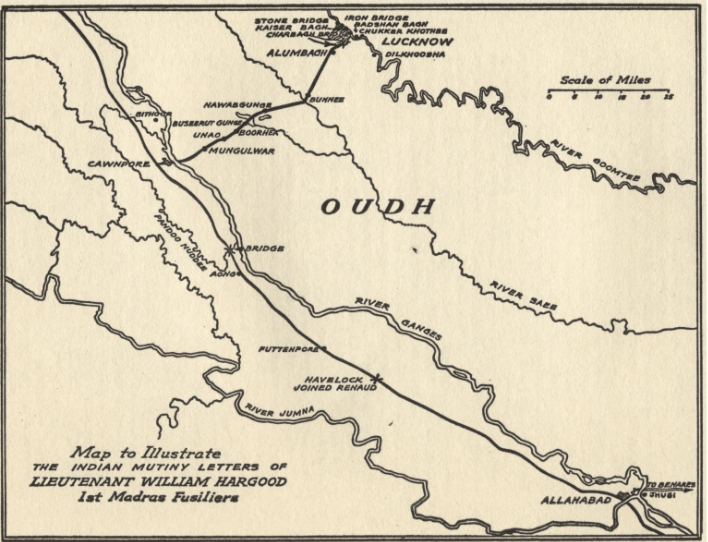
On the 14th of July, they would be marching again, each step bringing them closer to Cawnpore.
Sources:
Annand, A. McK. “The Indian Mutiny Letters of Lieutenant William Hargood, 1st Madras Fusiliers.” Journal of the Society for Army Historical Research 43, no. 176 (December 1965): 190–215. https://www.jstor.org/stable/44226401.
Bates, Crispin, and Marina Carter. Mutiny at the Margins: New Perspectives on the Indian Uprising of 1857. Vol. 7, Documents of the Indian Uprising. New Delhi: SAGE Publications, 2017.
Brock, William. A Biographical Sketch of Sir Henry Havelock, K.C.B. London: James Nisbet and Co., 1858.
Forrest, G. W. A History of the Indian Mutiny: Reviewed and Illustrated from Original Documents. Edinburgh: William Blackwood and Sons, 1904.
Groom, William Tate. With Havelock from Allahabad to Lucknow, 1857. Edited by Helen M. I. Groom. London: Sampson Low, Marston & Company, 1894.
Headley, J. T. The Life of General H. Havelock. New York: Charles Scribner, 1861.
Malleson, G. B., ed. Kaye’s and Malleson’s History of the Indian Mutiny of 1857–8. Vol. 2. London: Longmans, Green, and Co., 1892.
Marshman, John Clark. Memoirs of Major-General Sir Henry Havelock, K.C.B. London: Longman, Green, Longman, and Roberts, 1860.
Maude, Francis Cornwallis. Memories of the Mutiny. Vol. 1. London: Remington & Co., 1894.
My Journal, or What I Did and Saw Between the 9th June and 25th November, 1857: With an Account of General Havelock’s March from Allahabad to Lucknow. By a Volunteer. Calcutta: Baptist Mission Press, 1858. (Note: Often historically attributed to Lieutenant William Oliver Swanston).
Sherer, J. W. Havelock’s March on Cawnpore, 1857: A Civilian’s Notes. London: Thomas Nelson & Sons, 1910
Links:
puronokolkata.com
 Mutiny Reflections
Great as always, thanks.
LikeLiked by 1 person