Havelock Takes Command
Havelock assumed command of the expedition at Benares and inspected his troops. His first telegram to Sir Patrick Grant noted the singular lack of cavalry – without it, he could not expect to reconnoitre effectively, and he sought permission to raise a corps. This, however, would not be done until Havelock arrived in Allahabad.
The next problem Havelock set out to solve had its roots further afield – the 78th Highlanders had left India for the Persia Campaign in their woollen clothes, and when they returned, their dispatch to Calcutta had been so swift that there had been no thought given to the fact that wool was hardly the correct accoutrement for men expected to march in the heat of an Indian summer. Havelock strove to have them clothed in lighter dress, and native contractors were put to task to clothe the regiment. While their summer dress languished in the depots in Bombay and Calcutta was awash in clothes, Havelock would only be able to furnish half the men, leaving the rest to leave Allahabad in their woollen tunics. Then, giving instructions to the small body of Europeans who would be left behind at Benares, Havelock pushed on to Allahabad.
Neill, too, had been busy at Allahabad preparing for Havelock’s arrival. Although usurped from a position that he felt was rightfully his and merely by reason of seniority, Neill was determined, at least for now, to let Havelock have his way. When the general arrived, he found Neill, acting on instructions from Calcutta, had despatched a detachment of 800 men under Major Sydenham Renaud of the Madras Fusiliers, towards Cawnpore. It was a mixed force consisting of 400 Europeans, 300 Ferozepore Sikhs, 120 Native Irregular Cavalry and two 9-pounders. Renaud marched on the 30th of June, followed shortly after by 100 Europeans, sent by Havelock on the 3rd of July, in the only steamer available, up the Ganges to not only communicate with Renaud’s Column but also to cover their flank. Captain Spurgin commanded, and with him went 2 further guns and supplies for Cawnpore.
As for the cavalry, Grant acquiesced, and Havelock quickly put together an irregular cavalry unit, consisting of officers whose regiments had mutinied, of indigo planters up for a fight, shopkeepers whose businesses had been burned – in short, anyone who would join him. This new Volunteer Cavalry was put under the command of an experienced field officer – Captain Lusada Barrow of the Madras Light Cavalry. With them went a rather adventurous civil servant, named John Sherer, whom we have met in the trials of Fatehpur. He was without employment and without a station – determined to be useful, Sherer would march with Havelock. Only 18 men joined, among them ensigns who had never even had the chance to join their corps before they mutinied and had not been more than 18 months in the service of the Government. The next men to step forward were those of the railway whose employment, at least for now, was at a standstill – eight of them signed up for Barrow’s cavalry.
Renaud’s orders were to push onto Cawnpore and in the first 37 hours, he marched his men 40 miles. Lieutenant Hargood proudly wrote to his family he had marched the whole way, unlike several of the Fusiliers and men of the 84th, suffering from sore feet. Although the rain had flooded him out of his tent, Hargood was in excellent health and his spirits could not have been better.
On the 3rd of July, Lieutenant Chalmers of the 45th NI and one of the first men to have volunteered for the Barrow’s cavalry rode into Allahabad. It was 1 am, and the news he brought was grim. Renaud had sent him back to bring the news that Wheeler’s Garrison was gone. In the same afternoon, two spies arrived in Allahabad and confirmed Chalmer’s news. They had been sent by Sir Henry Lawrence to Cawnpore had witnessed the massacre at Satichaura Ghat and now carried the dismal intelligence to Allahabad. Sending the tidings to Sir Patrick Grant, Havelock wrote,
“ If the report, be correct, which there is too much reason to believe, we have lost Cawnpore, an important point on the great line of communication, and the place from which alone Lucknow can be succoured, for it would hardly be possible at this season of the year to operate on the crossroads. My duty is therefore to endeavour to retake Cawnpore, to the accomplishment of which I will bend every effort. I advance along the trunk road as I can unite 1400 British infantry to a battery of six well-equipped guns. Lawrence is confident of holding out for a month. Lieut. -Col. Neill, whose high qualities I cannot sufficiently praise, will follow with another column as soon as it can be organised, and this fort left in proper hands. I should have preferred to move the whole of the troops together, but the relief of Lucknow is an affair of time, and I cannot hazard its fall by waiting for the organisation of Neill’s column. We urgently want here more artillerymen, both for the equipment of field batteries and the defence of this place. I would also observe that, with every hope of ultimate success, it appears to me on the cards, that for some weeks or months, we might possess nothing within the Jumna but the forts of Agra, Allahabad and Chunar. I would therefore suggest that gunboats and armed steamers be sent up speedily to aid in keeping open the navigation of the Jumna and the Ganges. The arrival of the troops from China, and the complete success of Sir Henry Barnard, would speedily change the whole state of affairs. But we cannot fix a date for either of these events, and it seems reasonable to provide against the worst that may happen in the meantime.”
Lieutenant Chalmers was sent back to Renaud’s Column – they were to halt and wait for Havelock to join them. Entreating Renaud to keep a good lookout, he promised he would reinforce him within a day. Havelock had not reckoned with the Allahabad Commissariat when he had sent his message to Renaud – it would be another 3 days before he could leave the city; carriage, cattle and stores were unprocurable and had to be ordered from Benares. While waiting with as much patience he could muster, Havelock was joined by another small reinforcement of poorly-equipped 78th Highlanders, under Colonel Hamilton. To add to his irritation, Major Barrow in his zeal to organise his force, had requisitioned the best Government stud horses from Allahabad for the use of his men and for any recruits he might pick up en route. While the intention may have been noble, it left Captain Maude and the Royal Artillery with a pack of bullocks for their guns.
As for the men, there had been no time to season them to campaigning – while the 78th and 64th were seasoned soldiers, they had spent over a month cooped up in troop ships while the Madras Fusiliers boasted of 300 raw recruits who had never seen a days’ fighting, much less a prolonged campaign. When Havelock finally left Allahabad, he would also have a Colonel Neill to deal with.
Colonel Neill was not a man to take his position lightly and as such, had been shocked at his sudden demotion. While he had tried to provide Havelock with the support he sorely needed, Neill wrote to Calcutta behind Havelock’s back. The news of Cawnpore, he said, was not to be believed; it was probably a ruse by the enemy to force the British hand and prevent their march. Sir Patrick Grant took Neill’s word and in a return telegraph, requested Neill to order Renaud to push on with his detachment, contrary to Havelock’s orders. A Madras man himself, Renaud proceeded, albeit cautiously past his position at Lohanga, leaving Havelock little choice but to order forced marches to catch up with the major.
Major Renuad had been busy, but not in the way Havelock had expected. All along the route of the march were signs of his passing – burned villages and the grisly spectacle of bodies hung from trees in lieu of gibbets. While Renaud himself was not a cruel man, his actions were too much for his officers, who complained bitterly if the major insisted on this course of action, there would soon be no village left to supply the army. Havelock sternly warned Renaud to desist from indiscriminately burning villages and hang only with undeniable proof of mutiny – he did not need Havelock; his commander had been Colonel Neill, a man all too fond of Canning’s Act XIV, issued in June. The act had been interpreted broadly from the start and instead of being limited to the punishment of persons convicted of mutiny and sedition in the army, it also provided a clause extending that guilt to anyone thought to be harbouring such offenders whether they were under military jurisdiction or not. While Canning would eventually replace the act with another that restricted the powers of punishment, it came too late for the people who crossed Neill and Renaud’s path.
Renaud’s behaviour is unexplainable. While Neill believed he needed to resort to harsh means to restore order in Allahabad and Benares, Renaud had no such excuse. There were no mutineers on his course – nor was he likely in the first few days of his march to meet any. The news of Cawnpore did not reach him until he was well away from Allahabad; the only reason that can be given Renaud was eager to prove himself the Neill. Within 2days he had hung 42 men on the roadside, 12 of whom were facing the wrong direction when they were found by Havelock’s men. They were neither mutineers nor soldiers but frightened peasants who had most likely tried to run away from Renaud’s advance. Hunted down and hung for no other reason than being, in the estimation of the man from Madras, everyone in Bengal was a mutineer. While his commander, Colonel Neill would be called the Butcher of Allahabad, Renaud’s actions have gone mostly unnoticed.
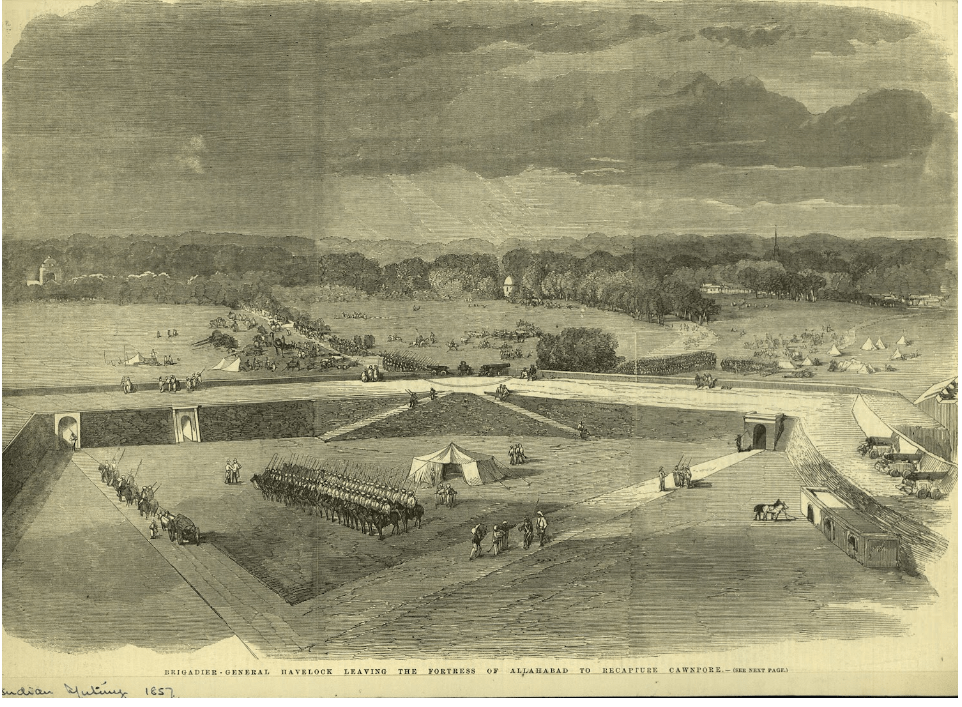
As for Havelock, he marched away from Allahabad on the 7th of July, at the head of 1137 Europeans, made up of the 5th Fusiliers, the 78th Highlanders, the 1st Madras Fusiliers and Maude’s Artillery. The intention now was to catch up with Renaud. For the next three days, however, he only marched the men short distances, through the pouring rain and avoiding when he could, the blazing sun; unaccustomed as they were to the heat, Havelock was determined to husband their strength for the work he knew would soon come. It happened sooner than he thought.
On the 11th of July, Havelock pushed his force on for 15 miles to Synee without their accustomed break for the noonday sun for spies had brought him some unnerving news.
 Mutiny Reflections
Great as always, thanks.
LikeLiked by 1 person