The Royal Artillery
Early in 1855, when the Crimean War was at its height, a battery of the Royal Artillery and a company of the 37th (Hampshire) Regiment were told off for duty in Ceylon. They sailed together aboard the troop ship Jullundur to Trincomalee, where for nearly two years, they engaged in little more than hunting expeditions in the surrounding jungles to help vary the boredom. Not a single unnecessary parade of drill was imposed, and while they kept to their uniforms, green for the Ceylon Rifles, blue for the gunners and red for the Hampshires, it was the only imposition on what was called their “lotus life” in the land of Ceylon. Among them was 2nd Captain F.C. Maude, commanding the battery of Royal Artillery. Together with his chums, many of whom would never see the end of 1857, Maude thoroughly enjoyed his life in Trincomalee. Towards the end of their stay on the charmed island, Maude was granted permission by his most indulgent commandant to take his battery on a picnic to Nilaveli, some 10 miles from their station. Unfortunately, one of their number had been imprudent enough to date an official letter from their little camp, but before anyone at Headquarters in Colombo could ask why the artillery had been shifted to Nilaveli, and pray, on whose orders, Maude and his men were on their way to Calcutta, neatly avoiding the inevitable whigging heading their way from higher places.
On the 6th of June 1857, the EICo frigate, the Semiramis, arrived at Back Bay in Trincomalee bringing the astonishing news of events in India. Within an hour, Maude had packed his traps and, along with the rest of the men told off for duty in India, was on his way to Calcutta. Sir Henry Ward would practically empty Ceylon of European troops and leave the fate of the island in the hands of the Malays serving in the Ceylon Rifle Regiment. While Ceylon was not disturbed by the mutiny, the inhabitants would still have 12 months of worry ahead of them.
On the 13th of June, Maude arrived in Calcutta. Captain Clutterbuck of the 37th was ordered to march his men without delay to Barrackpore, a distance of 16 miles. Unaccustomed to the heat, several of the men died of heat apoplexy on the march, and Clutterbuck, sent off in the wrong direction, without a guide, ended up marching them twice the distance. When he finally arrived in Barrackpore, the exhausted captain swiftly drank off a glass of cold water; to everyone’s surprise, he fell down, stone dead. It was not the start to the campaign the 37th had hoped for.
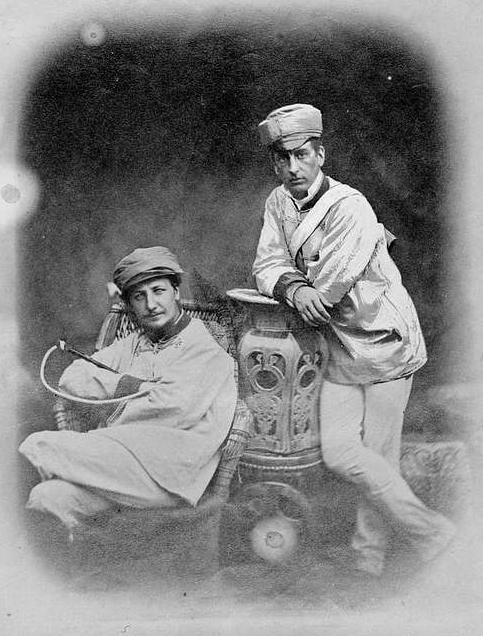
As for Maude, he was twiddling his thumbs in Calcutta – hot, uncomfortable and bored in the dirty casements in Fort William put at the disposal of his men. To alleviate the monotony of this less-than-acceptable existence, he ordered “standing gun drill” during the short time they were stuck. The only duty he was called for was the arrest of the King of Oudh at Garden Reach. On the 15th of June, Maude and every European capable of handling arms were marched out of the Fort and disposed around the royal residency, on the land side. Meanwhile, the Zenobia had slipped from her moorings at Calcutta and was now anchored off Garden Reach, her guns, double-shotted, were pointed at the palace. With no resistance to offer the King allowed himself to be brought from his bed to Fort William. The next day, panic Sunday broke out in Calcutta and Maude, from his place in the fort, watched as the people of the city rushed on board ships, crowded into Fort William and “did many other foolish things.” For Maude and his 58 gunners, the advent of Havelock’s arrival was a godsend.
Neill’s Blue Caps
Colonel Neill had preceded Havelock from Madras by some weeks. On the 17th of May one of his young officers, Lieutenant William Hargood, wrote to his parents. He had been awoken at 1am by some of his fellow officers to tell him the Colonel had ordered the regiment to embark without delay for Calcutta.
“Headquarters and No.1,7,8,9 and 10 Companies embarked the in the Zenobia on the 18th, the remaining five companies following on the next day in the John Wells under Captain Gelway – 917 NCOs and men in all. “ (Neill’s Blue Caps – Col. H.C. Wylly, Vol II pp 39/40)
Hargood arrived safely in Calcutta on the 26th and complained bitterly in a letter to his parents.
“…the heat was something fearful, and the ship was measured for only 350 men, we took onboard 450..” While the Left Wing had already been dispatched to Benares, on the 27th, a large party under a captain were sent the 135 miles by rail with the rest of the journey to be completed by bullock dak. Neill also swiftly dispatched 2 captains and another party of men by steamer on the 28th to Benares, while the rest would leave Calcutta the same night by rail, including 23-year-old William Hargood, in charge of 18 men.
“We get 135 miles by train, the remaining distance, upwards of 300 miles, we are carried by horse transit. I have received instructions to proceed as fast as possible and to travel night and day. I hope to accomplish my journey in under 4 days – it will be very delightful to be jolted for 4 days in a covered cart, with horses going at full gallop.”
A portion of the Queen’s 84th had left Calcutta by fast dak towards Benares on the 21st of May, but in small detachments numbering no more than 25 men at a time. Their progress was slow – before the monsoon, the rivers were too low for travel, and they had to proceed by bullock train – a cumbersome, organised train of wagons drawn by relays of bullocks, incapable of travelling more than 130 miles a day, but the stops to change bullocks were tiresome and the journey much delayed.
The rail line was barely 135 miles long, but it was still faster than marching, that is, if Neill could get a train. He had his first scrap with mutineers of a sort, but not the ones he expected, on the 25th of May.
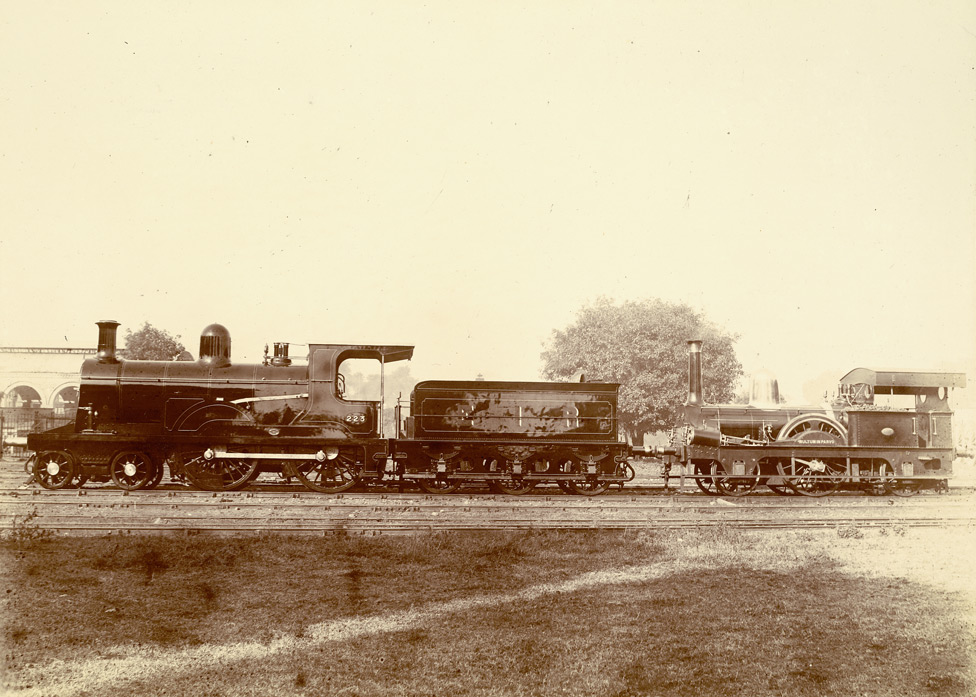
The locomotive on the left is the latest model of 1897, the year this picture was taken in the Jamalpur Railway Workshop, Eastern India
https://puronokolkata.com/2013/08/30/railway-1854-first-locomotive-in-india-on-its-first-line-from-howrah-to-hooghly/
“There is a landing place and jetty,” wrote Neill; “the train was to start at 8.30 p.m. My men were all on
board flats in the river, where they were cool and comfortable, and out of the way of mischief . When
a party of 100 men were intended to go by train, the flat on which they were was hauled into the
jetty. On the night on which the second party left, the flat was hauled in, but there was a squall, and consequent delay. The railway people on shore gave no assistance. As we neared the jetty a jackin’–
office station-master called out to me very insolently that I was late, and that the train would not wait for me a moment. He would send it off without me. A little altercation ensued. Our men were landed by their officers, and went making the best of their way up to the carriages. The fellow was still insolent, and threatened to start the train, so I put him under charge of a sergeant’s guard, with orders not to allow him to move until I gave permission. The other officials were equally threatening and impertinent. One gentleman told me I might command a regiment, but that I did not command them; they had authority there, and that he would start the train without my men. I then placed a guard over the engineer and stoker, got all my men safely into the train, and then released the railway people: off went the train, only ten minutes after time. … I told the gentlemen that their conduct was that of traitors and rebels, and fortunate it was for them that I had not to deal with them. The matter has been brought to the notice of Government. I have heard nothing more than that Lord Canning thinks I did what was right, and the railway people are now most painfully civil and polite.”
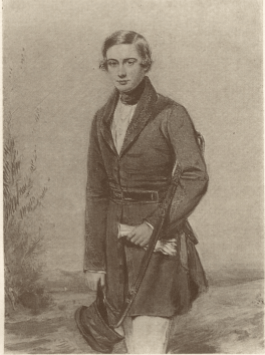
Hargood arrived in Benares on the 2nd of June, one day before Neill, and just in time for the mutiny of the 37th NI on the 4th.
For Lieutenant William Groom of the 1st Madras Fusiliers who left Calcutta on the 4th of June, the journey to Allahabad was less irritating. Arriving at the railhead in Raniganj,
“Renaud, Stephenson, Grant, Fraser and Spurgin went on in carriages immediately, Seton and I started on the same day at six o’clock in the evening, and ran 100 miles by twelve o’clock noon on the 6th.
We dined, and at four o’clock p.m. again started and caught up with the others at Sherghatti, where they had stopped by order, on account of the revolt in Benares. We, however, last night got a telegraph despatch,
*’ All clear, come on,” so we have run on to this place, and start for Benares at four o’clock p.m. We are all armed with guns, revolvers, etc., and keep a bright look-out. There are Sowars all along the road, so I think we can give a good account of ourselves.” There would be no time to rest – on the 9th of June, Groom arrived in Benares and the same night, with 100 men and two other officers was sent off to reinforce Allahabad. It took them three days of hard marching (or in Groom’s case, riding, after which he was unsure he would ever be able to sit properly again) to arrive at the city only to find they were not to be heroes on this occasion. The Allahabad Fort was secure, the civilians soon to be embarked on steamers to take them to Calcutta and all that was left was to wait for Havelock.
Captain Maude would finally leave Calcutta on the 18th of June. Having left his guns behind in Ceylon, Maude had been promised he should find not just horses but guns at Allahabad, sufficient for a Field Battery. He proceeded by rail to Raniganj and with some hope, travelled on by bullock dak. At the station, John Irvine was waiting for him, the newly appointed surgeon of the Royal Artillery. Then, with a company of the 78th Highlanders, under Captain George Henry Hunt, Maude and his men made their way, for the next 300 miles, by bullock cart.
The carts had neither springs nor seats – the floor was covered with a little hay, and to protect the men from the sun, heavy tarpaulins had been hung around the conveyance which could be rolled up, allowing at least for air. The marches would be forced but as Maude notes, the bullocks were incapable of moving more than 3 miles an hour and never more than 30 in a day even on good roads. Forced to halt when the day was the hottest to water and feed the bullocks, the journey was tediously slow and uncomfortable. Barely a day on their way, cholera made its appearance – six of Maude’s men died before they reached Benares and were buried on the roadside, their graves marked by a piece of tin.
While still 50 miles from Benares, they were overtaken by Havelock and two of his staff in horse dak carriages. Havelock immediately ordered Maude to abandon his escort of Highlanders, acquire as many carriages as he needed and follow him with all haste to Allahabad. As Havelock proceeded onwards, Maude was left with a baffling task.
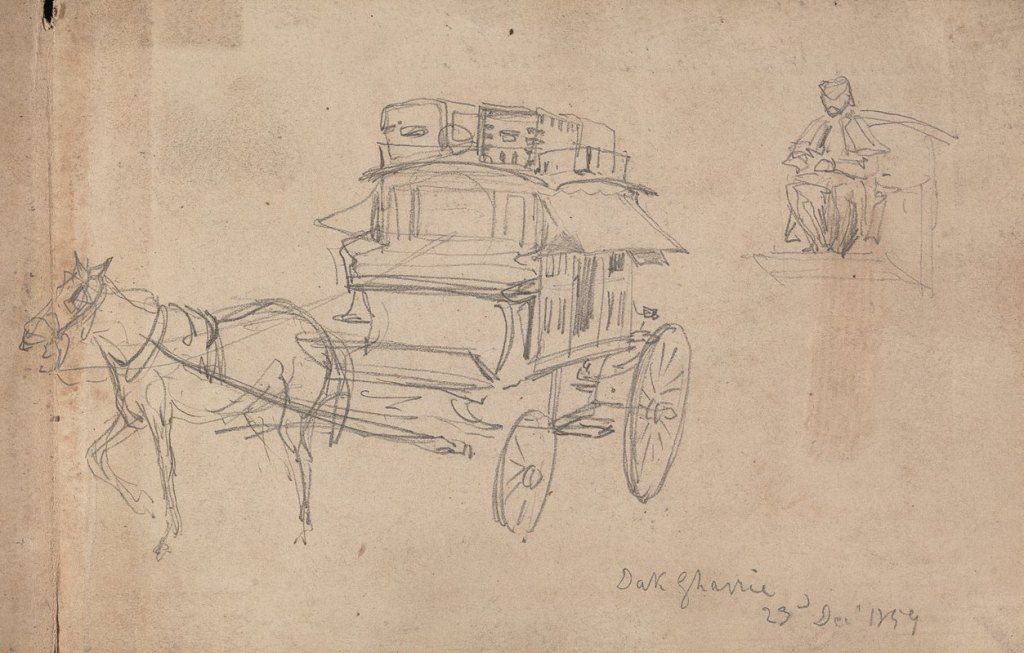
The dak agents, those that could be found at the posts along the road, had been infected with a mysterious ailment of their own; instead of providing carriages as required, they shuffled their feet and showed Maude any number that were suddenly without their lynch pins, or with only three wheels. Rapidly losing his good humour, Maude resorted to threats and finally to bribes – the wheels, pins and even horses suddenly materialised and the men could resume their journey.
As for Hunt and the Highlanders, left behind on the road, they would continue their wearisome march – Hunt would not see anything of the mutiny; he contracted cholera shortly after arriving in Benares and died aboard a steamer on the 28th of July.
Instead of the abundance of horses and guns Maude had believed were waiting for him at Allahabad, he found his battery would take to the field guns of the most antiquated pattern. As for everyone else, the 1st Madras Fusiliers were the only regiment supplied with Enfield Rifles; but they complained bitterly the ammunition often jammed and invariably when the fire was the hottest. Everyone else was left to make do with the sturdy, but unwieldy Brown Bess, which at least had a most effective bayonet at close quarters. As for Maude,
“We of the Artillery, used nothing but port-fires, priming powder, and smooth bore guns, Armstrong’s breach loaders not having yet reached India. In fact, even the rudimentary quill tubes were not procurable, until the smart troops from England joined us…”
Lieutenant Charles Crump of the Madras Artillery was soon after attached to Maude’s Battery. A man of much resource and enthusiasm, he proved invaluable to Maude in equipping the Royal Artillery. With horses impossible to procure, Crump organised bullocks to draw the guns and they soon put together a small six-gun battery, consisting of two 6-pounders, two 9 pounders and two 12-pounder howitzers; together with ammunition wagons, forage carts and the other paraphernalia needed to reasonably march an artillery battery into battle. However, he was still shorthanded. With only 51 left of his original compliment of 58, he petitioned Havelock for reinforcements, which were quickly provided in the form of 31 volunteers mostly from the 64th (North Staffordshire) Regiment who had been instructed in gunnery. Later a few men from the 84th joined the ranks –“…and after a few days drill with our gunners, took a great liking for the work, to say nothing of the small extra pay.”
On the 25th of June, unbeknownst to Havelock, Hugh Wheeler at Cawnpore surrendered to Nana Sahib. Havelock reached Benares three days later, on the 28th when the Cawnpore garrison had already been destroyed. The people Havelock was so anxious to save, were no more.
 Mutiny Reflections
Great as always, thanks.
LikeLiked by 1 person