The 12th of July, 1857 – Battle of Fatehpur
If one were to believe Major North, the Battle of Fatehpur had no casualties except himself, a private of the 78th Highlanders and a very angry bullock.
“A bullock lashed to fury by the pain of its wounds (it had been struck with a round shot) rushed from the town, and as it dashed violently against me, lifted me from the ground, and, striking at me, fortunately between its horns, flung me to some distance. A kind-hearted Highlander who, “with more chivalry than wisdom,” interposed to save me, was also bowled over in every acceptation of the term. The blow was ” stunning” yet, sustained by an impetuous impulse of volition, I was quickly on my feet, and dashed off at a double in pursuit of the enemy, as he bolted through the village, sending an occasional random shot at his relentless pursuers…I was the only person hurt at Futtehpore, with the exception of Butterworth, the Highlander who had attempted to save me. We both suffered from the same cause. My escape on this occasion I hope I may remember with thankfulness.“
While Major North claims that only he and Private Butterworth were wounded at Fatehpur, the returns list the following:
78th Highlanders
Privates
Fotheringham, David – severely wounded “…musket ball, in the right wrist-joint. The ball entered on the anterior surface and passed directly out on the posterior. Several small pieces of bone were taken
away at the time. The hand has been kept in a straight splint ever since, and he has now nearly lost the use of the fingers. The wrist joint is much enlarged; the aperture of entrance of ball is long since healed, that of exit still remains open; diseased bone can be felt. May 10th, 1858.-Diseased bone taken away by the gouge. June 2nd.- Invalided. General anchylosis of the carpal bones. Wound nearly healed; has the use of the fingers to some extent.”
Watson, James – killed in action
Bengal Engineers
Quartermaster Sergeant W. Cogan, (Sappers&Miners) -wounded
1st Madras Fusiliers
Although not killed in battle, this man is mentioned nevertheless:
Private Martin Maloney – shot himself dead at Futtehpore, 13/7/1857
The following privates died of sunstroke:
Patrick Casey
William Thorn
Peter McEvoy
John Helling
James Brown

13th Irregular Cavalry
Killed
1 Jemadar
1Sowar
Wounded
1 Duffadar
Missing
2 Duffadars
3rd Oudh Irregular Cavalry
Killed
1 Russeldar
1 Duffadar
2 Sowars
Wounded
1 Duffadar
1 Sowar
Missing
2 Sowars
Regiment of Ferozepore Sikhs
Wounded
1 Private
Many of the losses incurred on the march from Allahabad to Cawnpore were from sunstroke – men unaccustomed to the heat, the long marches and the unsuitable, cumbersome uniforms some were forced to wear. There had been little time to provide them with a change of raiment – it had been a cause of great concern for Sir Henry Havelock.
“The 78th Highlanders had left India for the Persian expedition in their woollen clothing, and arrived with no other dress in Calcutta; but no arrangements were made there to furnish them with garments suited to the month of July, although there was the complete establishment of the army clothing agent at the Presidency. Every exertion was therefore made by the General to supply them with a lighter dress, fitted to a march with the thermometer above 100°. Native contractors were set to work with all promptitude, but in spite of every exertion, many men were obliged to leave Allahabad in their woollen tunics; and the 78th Highlanders fought every battle in this campaign in that dress.” (‘Memoirs of Sir Henry Havelock’)
Sir Henry Havelock, himself always properly attired and correctly turned out, was scandalised by the outfits some of the officers took to wearing, particularly that of Eardley Maitland of the Royal Artillery, who, when he first saw him, was wearing “a well-fitting juste-au-corps suit, of a sap-green colour, and a soft drab felt wide-awake, which, although unmilitary in appearance, had done excellent service in the Ceylon jungle. On our arrival at Cawnpore, he was enabled to rig himself out in blue, with red stripes and facings, but the only cloth procurable was of that cerulean tint which the Artillery had discarded since the year 1844.” (F.C.Maude)
Maude too suffered from a lack of clothing, rigging himself out in a scarlet tunic, over which he wore his regulation white cartouche belt and black pouch, his leather strapped overalls and on his head a forage cap with a pugree. Unfortunately, his tunic caught fire at the Battle of Cawnpore, reducing him to wearing “nearly white” tussore silk coats. By the following spring, he noted that only one of his gunners had anything that looked like a uniform and that being a jacket procured from the kit of a dead Bengal Artilleryman.
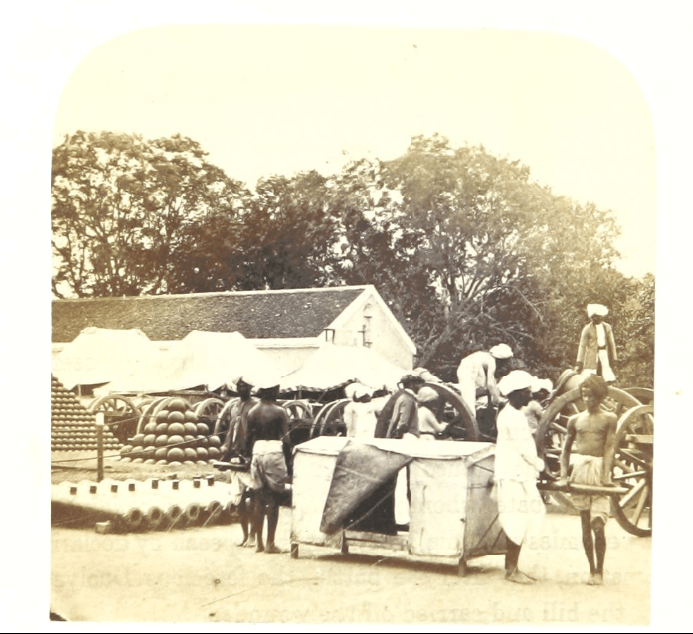
Cholera and dysentery would take a further toll on the force, ultimately forcing Havelock to abandon his attempt to gain Lucknow. Surgeon Home, who would win his VC at Lucknow, had a few words to say about the medical arrangements. Having served in Crimea, Home was no stranger to battlefields and had an admiration for the Indian system of doolie bearers.
” It has been claimed above that the ” sick transport ” of the Indian army is, for that country, supremely good. The system is theoretically weak, in the fact that its distribution in the field is not controlled from a centre and that its proportionate distribution to individual corps may lead to absence, or partial absence, where, from severe and disproportionate loss, it is most urgently needed; whilst, on the other hand, where loss has been light, corps may be encumbered with it. The answer to this is that, in practice, with very long experience, the existing system is found most favourable for the wounded, by its swift action clearing the field, placing the sufferers in what are in effect cots, screened from the sun’s heat and the night winds if there are such, capable also of being carried, for short or for long distances, with a minimum of discomfort. Unlike the waggon form of transport, which is apt to be useless unless made roads can be found for them to run on, the Indian doolie, slung on a bamboo pole and carried by men, with reliefs at intervals, can be taken anywhere, across rain-sodden fields where waggons would stick like stranded ships, up the side of a hill, or over rock-strewn ground quite impracticable for wheels. The doolie system never breaks down; no ” bearer parties ” are wanted with it—the doolie is carried up to them, not the wounded man to it; and what praise is too great for the hard-working, intrepid men who carry it, never grumbling at hardships, always ready for their work!
 Mutiny Reflections
Always a treat to read these informative ones, thanks.
LikeLiked by 1 person
Thank you! You are most welcome! I am glad you enjoyed reading the post!
LikeLiked by 1 person