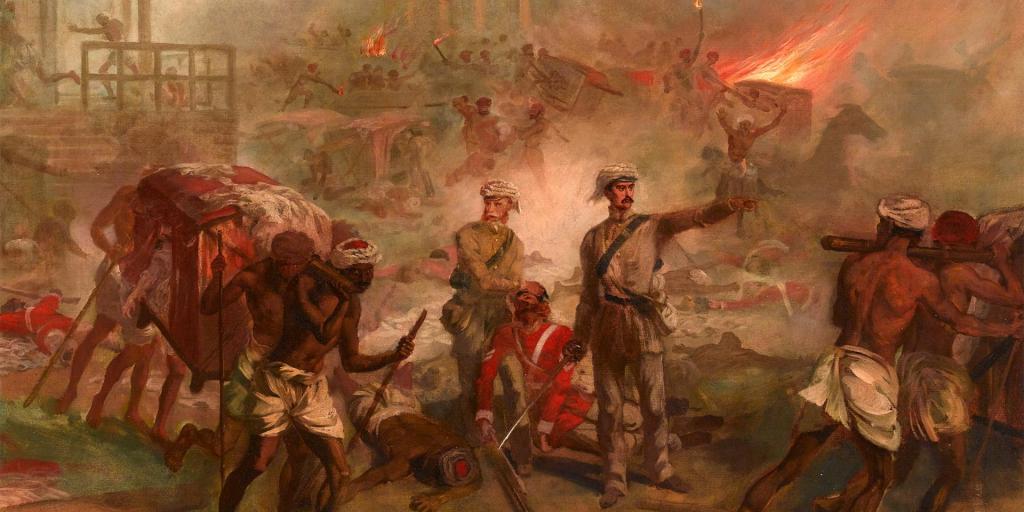
As Havelock and Outram shook hands with Colonel Inglis in the Residency, outside, in the streets of Lucknow, the battle was far from over. The rear guard was caught up in the winding roads of the city, stragglers lost their way in the myriad of courtyards, many of the wounded in their doolies were dropped in the streets by their terrified bearers and as night came on, anyone who found himself outside the walls of the Residency had to prepare for the worst.
Advancing with the column were the regimental surgeons, amongst them Robert Bartrum, eager to meet his wife Kate who was waiting for him in the Residency. Since his flight from Gonda, Robert had been trying to make his way to Lucknow, volunteering his services to Havelock’s force, fighting his way through the battles from Allahabad to Cawnpore, only to find himself frustratingly close to his family and unable to even send his wife a letter.
In the carnage of the 25th of September, Bartrum went alongside the other surgeons assisting the wounded – he would be shot dead within sight of the Residency. Other surgeons would be luckier than Batrum but their situation would be far from easy.
Anthony Dickson Home wrote, of the start of the advance –
“We marched about eight next morning, and at a quarter of a mile from our camp were fairly in action. The shot passed over us in a perpetual hum or scream. Luckily they were mostly high; as it was, no human beings could live in it and advance, so the column lay down till the artillery had silenced them, and we then got amongst some gardens with the walls loop-holed. We were here shot down like so many sheep, till one man broke through the wall. On every side of me, men were falling.
We had now overcome the first opposition, and in a little time, we stormed the bridge over the canal and found ourselves at the entrance to Lucknow. We skirted the suburbs for five miles, shooting great numbers of the insurgents, and losing many of our own men. By this time it was two o’clock, and we had arrived at about a mile from the Residency.
“Now commenced the hardest part. The enemy had possession of a bridge which we had to cross. On this bridge was a battery of three guns, and there were at different points three other batteries all bearing upon us. The houses, gardens and buildings all about us were full of the enemy, and we were in such a fire! I was with the wounded of the 90th, about 300 yards from the bridge battery. They fired a round of grape at us from one gun and killed eight of my doolie-bearers. Of course, many wounded soldiers were killed in the palanquins. All around me, people were falling, and the shot tearing huge branches off trees, throwing mud up in our faces. “
Of the 394 doolie bearers, 80 had been killed on the 25th of September alone. it took four men to lift a doolie as soon as any one of the four was killed, carrying the litter became impossible and it had to be abandoned. The loads too had been increased with two men bundled into one litter, and Surgeon Home saw how officers received precedence over the men – these were left on the side of the road with rifles and pistols in their hands to defend themselves as best they could.
Unable to reach the Residency, by four in the afternoon, many of the wounded along with the heavy guns and most of the ammunition wagons were left behind with Colonel Campbell and his small party of the 90th in the walled passageway of the Moti Mahal( Manzil). They were crammed together, “a veritable pandemonium of men and animals.” Here they remained through the night, under the incessant firing of the rebels from the outer walls of the palace. Campbell was sending messages to the Residency that he could not proceed further – he was severely invested by the rebels and needed reinforcements. On arriving at the Residency, Outram had taken the reins from Havelock – he ordered the forces that had remained outside the enclosure to hold the ground they had won during the day to give the straggling columns a chance to catch up on the next and in the morning, Campbell received a message from Outram – he was to fight his way to the Residency with the guns but it would mean abandoning the invalids.
“The enemy were pressing close and kept up a storm of shot, shell, and musketry, on us. We were cut off from the main body of the army by about a mile, and they could not help us, as they themselves were fighting hard. At last, the colonel came to me and told me that his arrangements were perfected, he would give me a guard of 150 men, and with them, I was to get the wounded into the entrenched camp as best I could. I got the wounded ready in a string, and after a long breath I left the building.”
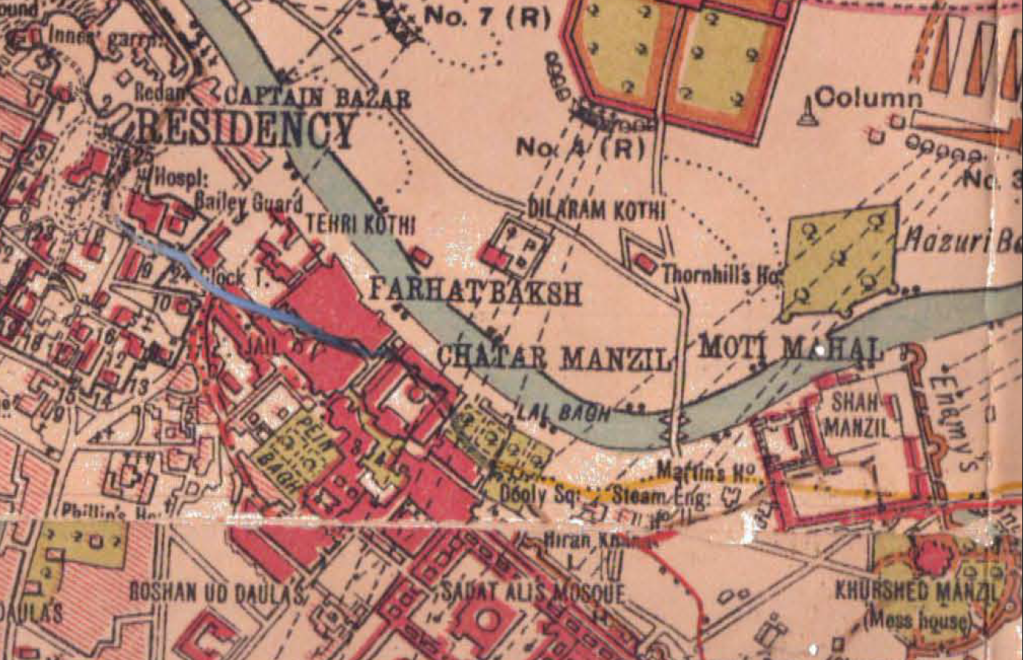
To guide them to the Residency, a civilian, John Bensley Thornhill, had been sent out with the reinforcements for Campbell, consisting of 150 men under Major Simmonds of the 5th Fusiliers and a part of Brayser’s Sikhs. Campbell called out an escort for Home and Bradshaw, who now collected the doolies and made a rush for Martin’s house. They reached the house, reformed the doolies and proceeded.
For 200 yards the enemy did us no harm, but here we had to cross a deepish river; it took me nearly up to my chest, and such a fire we got into here! Some of the wounded were drowned, some killed, but most got across, and on we went to a street where we were promised comparative safety: our escort preceded us fighting all the way, but they really had no chance, they were shot down right and left.”
And then Thornhill lost his way. Instead of proceeding onwards, he led the party to the same square
where, on the previous day, Neill had been killed. The moment he entered, the rebels unleashed a murderous fire on the party – nevertheless, Thornhill rushed on, through the archway. On the other side, a perfect storm was unleashed on them as they were “plied with such volleys of musketry the soldiers and bearers were swiftly mowed down. They then fired upon us within a few paces so that their bullets would tear through several men. “
In the face of this onslaught, with fire from front and rear, the doolie bearers unsurprisingly threw down their loads and fled, others were shot down. Only 2 ran the gauntlet and managed to get through the gateway. Meanwhile, Thornhill had realised his mistake and begged Home to turn the doolies back but it was no longer possible. Dr. Bradshaw and the apothecary of the 90th went back and they rallied together the 20 remaining doolies who had not entered the square. They then retreated back down to the path by the river and made their way to the Residency. Among them went, the dooly carrying Havelock’s son and a wounded man of the 78th. Private Henry Ward had kept watch over Havelock the whole night, his rifle at the ready, not at the rebels but at the doolie bearers, threatening to shoot the first man who abandoned the litter. Then, at the point of the bayonet, he marched them to the Residency in Bradshaw’s wake.
Meanwhile, Thornhill, greatly excited by his error, rushed back through the archway in order to stop any more doolies from entering. As he ran, a bullet shattered his arm and another grazed his temple. He would be brought into the Residency later that morning but would die shortly after of his wounds.
By now, between thirty and forty doolies were scattered in the street, in the square and in the sheds on either side of the square, the bearers either dead or hiding. Dismounted troopers of the rebels entered the square, armed with swords, supported by musketeers and riflemen who poured down a deadly fire.
Home looked on, horrified.
When I reached the entrance of the street I found a number of them lying dead and most of the others had rushed on for their lives. On looking round I found that the palanquin bearers were being killed from the walls, and the remainder flung down the wounded; no menace or entreaty could prevail on them to lift them up again. I tried to get a few wounded together, but by this time the sepoys had gathered around us on every housetop and had nothing to do but bring us down at their leisure. All hope seemed gone, but as a last resource, I ran with four others into a small one-storied house, three rooms on a floor, all doors and windows. “
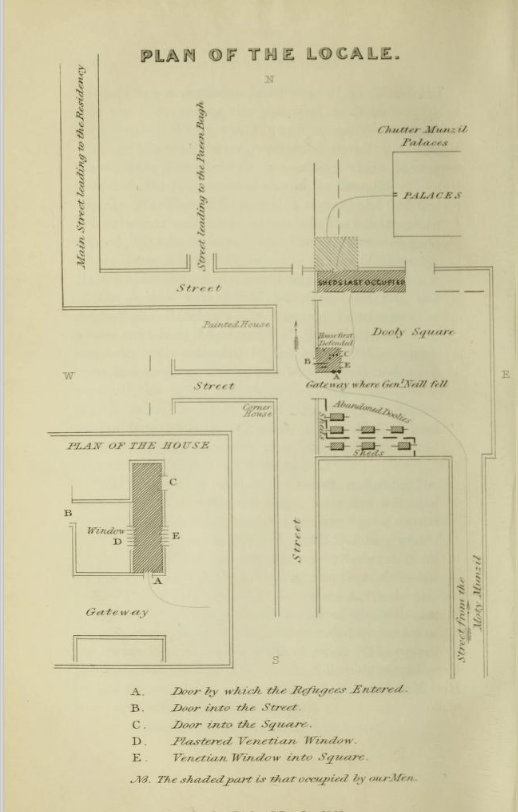
The party consisted of Dr. Home of the 90th, 9 unwounded men of the escort who could use their weapons, and five wounded officers and men. Of these, the two officers, Captain Andrew Becher of the 40th NI and Swanson of the 78th were badly injured.
“At this time we expected instant death: it seemed impossible that ten men could resist a thousand, who were firing a fearful hail of shot through the windows. Three of our number inside were struck down wounded, and this diminished our fire. The sepoys all this time were massacring our wounded men: perhaps they killed forty by firing volleys at the palanquins. The rebels now gave up the attempt to storm us, but crept up to the windows and fired in upon us, and so we had to lie down on the ground for a time, and let them fire over us. “
Posted at the door was Private McManus of the 5th Fusiliers, who for half an hour, kept up a vicious fire on his own – the steps outside the doorway being partially sheltered by a pillar provided enough cover for the private to kill a number of the rebels until “…the fear of his intrepidity was so great, that he had at last often only to raise his piece to cause all the enemy to stoop and leap through their loopholes.” Private Hollowell of the 78th cheered the men on, encouraging them to keep heart, he himself all the time keeping up a steady fire against the rebels. By chance, he managed to kill their leader, “quite an old man,” Hollowell recalled, “dressed in white with a red cummerbund and armed with a sword and shield.”
The rebels however continued to press forward, yelling and jeering, their leader calling on the men to storm the house, there were only three feringhees inside. Home, to “undeceive them” instructed the men to raise as loud a cheer as they could manage, causing the leader to rethink what he might be up against.
As the doorway was missing its door, all the men who could, began digging the dirt floor with their swords and bayonets while the dead sepoys, who were close enough to the house, were dragged inside by the least wounded of the party. The ammunition they found on the dead sepoys served to replenish their dwindling supply while the shirts were hastily stripped off and filled with the dug-up dirt to make impromptu sandbags; then the dead bodies were piled in the doorway, along with whatever lumber could be found in the house. As barricades go, it was undeniably distasteful, but at least for a moment, it stopped a rush being made at the door. Home now, as the only unwounded officer in the party was left giving orders “and encourage the men, as a surgeon to dress the wounded, as a man to use a rifle belonging to a wounded man when he fell.”
Meanwhile, outside, the men who had been abandoned by the doolie bearers were being shot at by the rebels. In one of the lay Captain Arnold of the Madras Fusiliers. Private Ryan, terribly distressed that his officer had so left to his fate, insisted on going out to rescue him – McManus, now wounded, stepped forward, volunteering to join him. They clambered over the barricade and rushed across the gateway, through the deadly fire, into the square. Finding the doolie with Arnold still in it, they tried to lift it but could not get it off the ground – Ryan took Arnold out of the litter and with McManus’ help, carried him to the house. The ground was “torn up by musket balls” but they managed to reach the house but not before Arnold had been shot through the leg. Leaving Arnold inside, they returned to the square to carry out another soldier but he was killed before they reached the house. In all, they rescued another 4 men and one officer from the doolies.
Within the next hour, three of the nine men were further wounded – and now only Private Hollowell and Doctor Home were left uninjured.
Home took up his post at the window – he still had his revolver, but only 5 shots left, with no reserves. Determined to preserve his fire as best he could, Home hid himself to the side of the latticed window and waited.
“After a time a sepoy crept up very cautiously to fire as usual through the window, quite unconscious that at this time a Feringhee had him covered with a revolver. When he got about three yards from me I shot him dead, and another who was coming up was shot by one of the men. For nearly an hour now they were very quiet, only firing at a distance.”
Suddenly everything fell silent. The rebels stopped firing. From the doorway, they could see the street was deserted, and the bodies of several men of the ill-fated escort were “lying without their heads in the street.”
“All at once we heard in the street a dull rumbling noise, which froze me to the very heart. I jumped up, and said, ” Now, men; now, or never; let us rush out into the open air, and not be killed like rats in a hole. They are bringing a gun on us!”
What Home had thought was a gun, was in fact a screen on wheels “against which at the distance of a few yards, a Minie rifle had no effect..” and rebels brought it to the very window behind which Home was stationed. Ably protected from Home and the rifle fire of the others, they then set the thatched roof of the house on fire and threw quantities of lighted straw into the room which quickly filled up with smoke. Suddenly no one knew what to do. Plans were hastily tossed about and just as quickly abandoned but with flight being the only option, Home instructed that the three most severely wounded men be lifted off the ground and dragged as best as possible to an adjacent room. To their luck, it proved to have a backdoor. It opened up into a large square at the far end of which was a shed.
During the rush, Lieutenant Swanson of the 78th was injured again and died before anyone could help him.
The rebels in the meantime were getting over their surprise – they had expected the party to burst through the barricade at the front of the house so they could shoot them as they fled outside – instead, they now had to start the whole siege over again and it was far from over. For Home, the shed proved to be as much of a nightmare as the house had been.
“ Imagine our horror when we found that the street we were in was loopholed everywhere, and the sepoys came creeping up now to the loopholes, firing in suddenly and off again. We now put a man at every loophole as far as they could go, even wounded were put to watch, and this soon checked the bold, brave sepoy, for whom one British soldier is an object of dread. We soon had a worse alarm, the sepoys got on the roof, bored holes through it, and fired down upon us. “
To escape what was now almost certain death, the few survivors broke through the mud wall into the courtyard on the north side where they found two pots of much-needed water and Home spotted, not fifty yards off a small mosque, apparently abandoned. By crawling on all fours, he reconnoitred the position – but before he could devise a plan to drag the remaining wounded to it, he was discovered and he, along with the others, beat a hasty retreat back to the shed.
“Being a long shed, we had a great deal to defend, but luckily the sepoys found out that if they could fire through the roof, so could we, with the advantage of knowing exactly where they were by the noise of their feet: so they kept off the roof. Including wounded, there were nine men fit for sentry, seven men fit to fight, and of these six were unhurt, including myself. It was agreed that if the sepoys forced the street, we should rush out and die outside. “
The sun had set on the day and darkness set in and the rebels had ceased firing – some had taken up another pursuit. As long Home and his party had remained in the house, they could provide some cover for the wounded men in the doolies in the square, but from their location at the shed, it was impossible.
However, unbeknownst to Home, one wounded officer, Lieutenant Knight of the 90th Regiment sprung out of the other side of the doolie as the sowar approached him and had instantly fifty shots fired at him, two of which struck him in the leg, but he still managed to gain distance over his pursuers and joined the rear-guard, shot through the legs in three places.
“By this time all our wounded were in their possession, and they were put to death with horrible tortures, actually before our faces, some were burnt alive in their palanquins; the shrieks of these men chilled one’s blood. The terrors of that awful night cannot be described; raging thirst, fierce rage against those, who as we thought, had left us to perish, uncertainty as to where the sepoys would next attack us: add to this, the exhaustion produced by want of food, heat and anxiety. I now proposed to our men to fight our way back to the rearguard, or forward to the entrenched camp, but there were only two who would go, and so I refused to do so, as we could not desert eight wounded men; still I tried to persuade all to make the trial, someone might escape, as it was no one could.“
By dawn, Home noted the party had fallen into a state of apathy and the men sat on the floor, unable to move. Suddenly they heard the sound of heavy firing and the familiar sharp crack of Enfield rifles. Bryan, who was standing sentry shouted, “Oh boys! them’s our own chaps!” Not trusting what they were hearing no one responded. Then came a regular “rattling volley” such as no sepoy could give and Home jumped to his feet. The Europeans were outside and looking for them.
“Now cheer together!” cried Home.
“Our people outside heard us and sent a cheer back. We replied like madmen and shouted to keep off our side. We also fired through all the loopholes at the sepoys, to keep them from firing at our men advancing. ” Captain Moorsom appeared at the entrance hole of the shed – there was little time to lose – the rearguard of the 90th was waiting on the street to take them to the Residency.
The square in which the doolies had been abandoned would receive a new name – Dooly Square, a stark memorial to the men killed there.
An Uncommonly Unpleasant Day – extending the positions
As for Colonel Campbell, he had managed to get as far as Martin’s house and here, finding he could not proceed, called for more reinforcements. Colonel Napier received orders from Outram to take out 100 men of the 78th under Colonel Sisted with two guns from Olphert’s Battery along with the sowars of Hardinge’s irregulars. Olpherts immediately objected to his guns being used in such a fashion and Napier conceded, taking only his bullocks with him instead. Meanwhile, Olpherts had joined the party as a volunteer as had another man, Mr. Kavanagh, soon to be renowned in his own right, to serve as a guide.
Under Kavanagh’s guidance, Napier led the party along the river bank until they reached Martin’s House where they found Major Simmons under a smart fire from the rebels. Not convinced there were enough reinforcements heading out, Outram ordered Captain Lowe to take out a few men of the 32nd, some Sikhs and a further 50 men of the 78th.
We had an uncommonly unpleasant day of it,” wrote Captain Lowe, “They got jammed up in the road between two walls and were exposed to fire whenever anyone showed themselves, and round shot were being sent into the house our men were put into for the day. What rendered it mortifying was that the brutes fired at us out of our old mess house and my quarters.”
Under the continuous fire of the rebels, it was impossible to move the guns that Campbell had been able to bring from the Moti Mahal and one of the 24 pounders, which had been used in the advance on the previous day, was still sitting on the road where it had been left. It was impossible to move it during the day, but as soon as it was dark, Private Duffy, acting under Olphert’s orders, crept out, unseen by the rebels, and managed to attach to drag ropes to the trail of the gun. These were then fastened to the limber, the bullocks Napier had thought to bring with him were yoked and the gun was drawn in. The action however cost the life of Captain Crump but won Private Duffy a Victoria Cross.
For the remainder of the night, the remaining wounded and reserve ammunition were hastily transported along the river to the Residency with Captain Hardinge making several journeys to bring fresh doolies thus ensuring the sick and wounded were brought out safely. Unfortunately, what worked for doolies, camels and horses did not work for the guns – these would have to proceed along a different route.
At 3 in the morning, the force proceeded, as yet undiscovered, through the rebel lines, until the forward party reached the Chattar Manzil where the heavy guns and wagons were parked in the garden. Meanwhile, a party of sepoys was found in an adjacent garden within the Chattar Manzil grounds – there was nothing for but to flush them out. Led by Colonel Purcell of the 90th and Captain McCabe of the 32nd, a few men of the 90th, the 5th Fusiliers and the 32nd charged in, making quick work of the sleeping sepoys. Their action ensured that now a continuous position along the rear was finally secured and in the morning Captain Lowe with 150 men of the 32nd were told off to clear the Captain’s Bazar and all adjoining positions around the Residency still occupied by the rebels.
The party was divided into three divisions – the first led by Captain Bassano on the right, the second in reserve under Captain Hughes of the 57th BNI and the third under Lieutenant Lawrence. While the first two advanced under the cover of thick bushes between the trenches and the road, the third filed out of the Residency through Innes Post. Surprised by the suddenness of the attack, the rebels turned and fled, many of them drowning in the river. Meanwhile, Lawrence led his party towards the Iron Bridge where Corporal Samuel Cole and Private Michael Power captured a nine-pounder gun “just as a second round of grape was about to be fired at them. ” Taking the gun, Lawrence now joined Lowe and they proceeded to Captain’s Bazaar, capturing an 18-pounder on the way. Lowe proceeded to the Tehree Koti which he found empty so he pushed on towards the Farhat Baksh Palace where a detachment of Aitken’s Post had taken up watch. With this line of communication now in place, Napier could take up his headquarters at the Chattar Manzil and the line to the Residency along the riverside was completely in British hands.
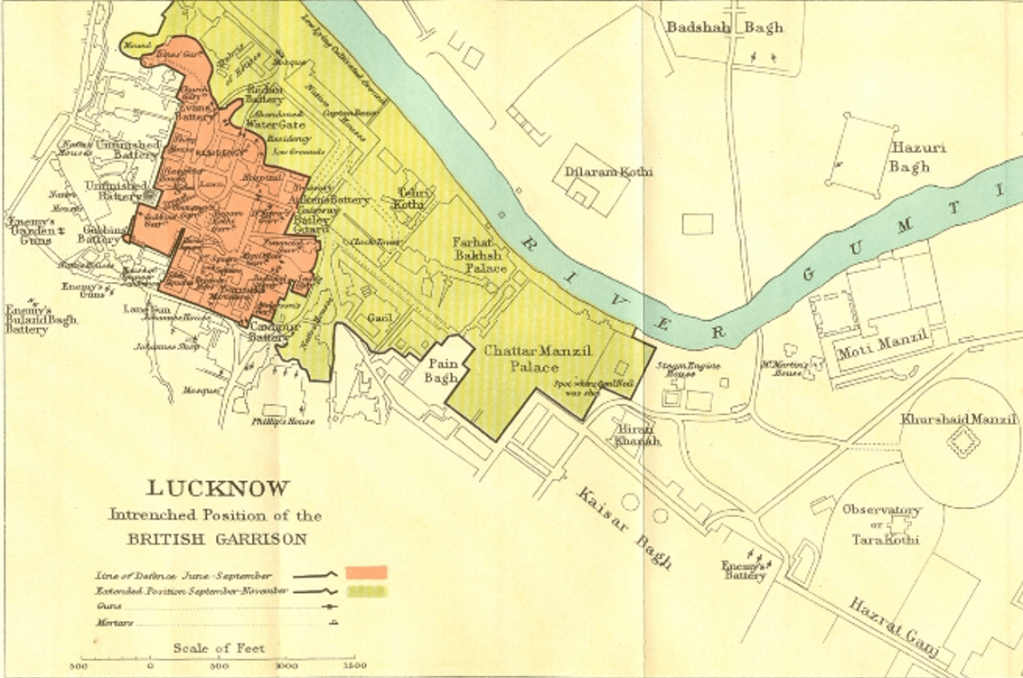
The Residency was now secure but like the garrison, Havelock and Outram found themselves entrapped in it. They had succeeded in reinforcing the beleaguered position and extending its boundaries but the anticipated relief had failed. Hampered by the sick and the wounded, by women and children, the two generals swiftly concluded they did not have enough men left to escort them and fight their way out of Lucknow. So now, like Havelock before him at Cawnpore, Outram would now have to sit and wait for reinforcements. The next 2 months would prove to be a trial in patience.
On the 25th and 26th of September, the First Relief of Lucknow cost the Oudh Field Force 119 officers and men killed, 339 wounded and 77 missing. The missing included Assistant Surgeon Robert Bartrum, shot in the head on the head on the 25th and whose body was never recovered. The remaining 76 were the wounded killed at Dooly Square. In all, out of a force of 2000 men, Havelock had lost 535, killed and wounded. It was a grim tally for two days of fighting that had not brought him any closer to rescuing Lucknow than he had been in August and from the 26th of September, the 2nd Siege of Lucknow began. It would last another 2 months.
Sources:
Forrest, G. W., ed. Selections from the Letters, Despatches and Other State Papers Preserved in the Military Department of the Government of India, 1857-58. Vol. 2, Lucknow, Cawnpore. Calcutta: Military Department Press, 1902.
Goldsmid, F. J. James Outram: A Biography. 2 vols. London: Smith, Elder, & Co., 1880.
Headley, J. T. The Life of General H. Havelock. New York: Charles Scribner, 1861.
Malleson, G. B., ed. Kaye’s and Malleson’s History of the Indian Mutiny of 1857–8. Vol. 3. London: Longmans, Green, and Co., 1892.
My Journal, or What I Did and Saw Between the 9th June and 25th November, 1857: With an Account of General Havelock’s March from Allahabad to Lucknow. By a Volunteer. Calcutta: Baptist Mission Press, 1858.
North, Charles Napier. Journal of an English Officer in India. London: Hurst and Blackett, 1858.
 Mutiny Reflections