Kolhapur
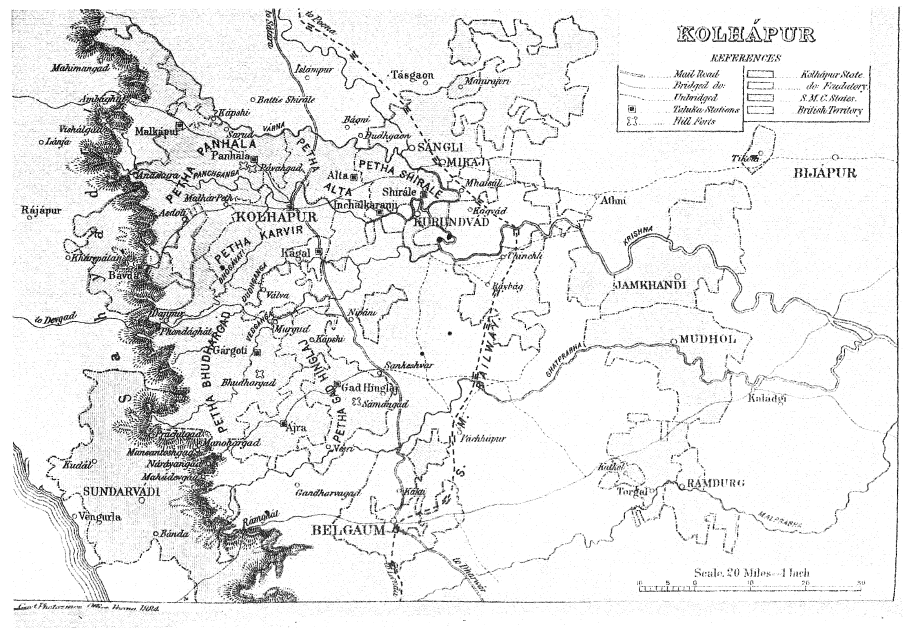
On the 31st of July, the very event Seton-Karr and indeed every officer in the presidency had been dreading occurred – the 27th regiment of the Bombay Native Infantry rose in mutiny in Kolhapur, a station 65 miles away from Belgaum.
Kolhapur was by no means a peaceful place, having been brought under the subjugation of the EICo due to bad governance and misrule – a similar strategy employed in Oudh – in 1842. Unlike in Oudh, the appointment of a minister to run the affairs of Kolhapur had provoked a rebellion, which, in turn, on its suppression, the government assumed the direct administration of the state as long as the raja was a minor. As he would not gain the throne until 1862, the British used the time in between to dismantle forts, do away with the system of the hereditary garrison, and disband the native military. From these men, a new corps would be formed. By 1857, Kolhapur was well under the sway of the British government; however, mutiny would not come from a disgruntled local population, but from an infantry regiment.
Kolhapur, at the time of the mutiny, was garrisoned by one native regiment, the 27th under Major Rolland, and by the Kolhapur Local Infantry, a corps alluded to previously, under the exceptional command of an officer they liked and respected, Captain John Schneider. The political superintendent was Colonel Maughan. There were no European troops any closer than Belgaum.
Dissension had been brewing in the regiment for some time, but on the whole, they could not decide when was the right time to mutiny; their officers still believed they could hold their men, but true to form, they were sadly deceived. Communication between the 27th NI, the 29th at Belgaum and the 28th at Dharwar had been continuous throughout June and July; the regiments were emboldened by the discontented chieftains of the surrounding area, knowing they were superior in numbers, it would simply take one coordinated effort to rid themselves of the British and throw in their allegiance with the sepoys in Bengal. However, instead of settling on a date to proceed with the mutiny, they concluded it was bet Kolhapur should set the example, followed by Belgaum and then by Dharwar.
On the night of the 31st of July, a havildar of the regiment, concerned at the mutterings from the ranks, decided to send his family away from Kolhapur and the men, in their turn, frightened that the havildar would betray them, convinced themselves that an immediate mutiny was the only answer.
The night was intensely dark, and heavy rain was falling as the men broke open the bell of arms, and no longer willing to listen to reason, most of the regiment mutinied. The native adjutant, seeing the position was fraught with danger, ran to the officer’s bungalows to warn them of the impending threat. Captain McCulloch and the officers made their way to the lines and tried to recall the men to their duty, but seeing it was in vain, quickly withdrew. The women and children, after a mad scramble for a few scanty possessions, managed to escape from their houses before the mutineers were upon them. Meanwhile, the mutineers broke open the government treasury and plundered the bazaar.
Three officers, Lieutenant James Thomas Norris, aged 23, Ensign Frederick Heathfield, 18 and Ensign Edward Ironsides Stubbs (of the 9th Bombay Native Infantry and likewise only 18 years old), unable to rejoin the rest of the officers, attempted to make their way across the country. It was their misfortune to meet a body of the mutineers on the road at Selunkur – escape was impossible, and all three were cut down; their bodies were thrown in the river.
The Europeans fled to the Residency for protection, a mile from the sepoy’s lines but close to those of the Kolhapur Local Infantry. Telegrams were flashed off to Belgaum and Satara (81 miles to the north) – the message stated that the 27th had mutinied, the Europeans were in the Residency but had precious few arms and no supplies. The situation was dire, and they needed aid.
It was the one flaw in the mutineer’s plan – they had not reckoned that the news of the rising at Kolhapur would arrive at Belgaum faster than any of their messengers would. While Kolhapur mutinied, the other stations remained quiet, unaware of what had happened.
The news of the rebellion reached Lord Elphinstone in Bombay, and he acted with decision and promptitude. Calling for Colonel George Le Grand Jacob, he told him all that had happened in Kolhapur and that he should make his way with all haste to Puna to receive his orders from the Commander-in-Chief, Sir Henry Somerset, and to take command of any and all troops in that quarter. In a final show of confidence, Elphinstone said to the wily general, ” ‘I am aware that in a crisis like this, a person on the spot ought to be the best judge of any action that might be at once necessary; to wait for orders may allow events to become too strong to master. I have confidence in your judgment; do your best to meet the present emergency, and rely on my full support.’ Elphinstone then mustered as many Europeans as he could and sent them off by sea.
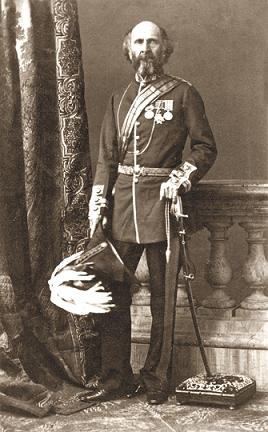
Although Jacob had been planning to travel to Poona, he had not expected it would be quite this soon. He set off at once but would not arrive in Kolhapur before the 14th of August. However, events were still unravelling in that station on the night of the 31st of July.
In the city, the rebels, greedy for plunder, had spent considerable time ransacking the treasury and the station. Not quite satiated, they proceeded to the town itself, only to find the gates were barred. Colonel Maughan had had the sense to close them. Surprised there was no one to let them in and not willing to fight for it, 200 of the rebels retired to a set of small outbuildings next to the town, while the rest simply returned to their lines. Colonel Maughan and Captain Schneider mustered the Kolhapur Local Infantry and marched against them in a premature show of force – a volley of musketry and the realisation they could not dislodge the rebels from their strong position without artillery, sent them back into the town.
The next day, the mutineers marched off fully expecting to rendezvous with their comrades at Ratnagherry. However, as they descended from the Ghats sometime later, to their surprise, they found the road was blocked by European soldiers being landed on the coast by the Indian Navy. Most of the mutineers scattered, and 40 of them alone returned to Kolhapur, back to their position in the outbuildings. To their dismay, they were no longer in any position of power. Lieutenant William Alexander Kerr, upon receiving the telegram at Satara, had taken a detachment of his troop, the Southern Maratha Horse and marched them the full 81 miles in one night, through driving rain, to the assistance of the beleaguered station. Although this action will be looked at in more detail in the next post (as it won Kerr the VC), for now, we will satisfy ourselves by briefly finishing off the mutiny at Kolhapur.
From the moment they returned to their position, it was clear it would be a fight to the death. Only three of the forty escaped the onslaught of Kerr, his men, the Local Infantry Corps and several men of their own regiment who had decided, after all, to stay true to their salt. With no reinforcements from Belgaum or Dharwar, on the 10th of August, the mutineers in Kolhapur were defeated.
When General Le Grand Jacob arrived, he would find that instead of relieving a beleaguered garrison, he was left with the ignoble task of disarming the remains of the 27th Bombay Native Infantry Regiment.
The reason for disarming, in Jacob’s estimation was
“…on the one hand..the danger of the men rising to attack us before our force gather strength or of marching away with their arms, as so many had done before, also of the danger of allowing them time to brood over what might follow on our strength increasing, reinforcements being always magnified by native rumour. On the other hand, if I disarmed at once, lay the risk of our small number tempting them to resist….” He also had little faith in the Local Infantry, regardless of their behaviour up to that point. He would disarm first and ask for reasons later.
The force at Kolhapur now consisted of two guns, horse artillery, two howitzers, the mountain train, 20 men under Captin Scaly, ninety men of the 2 European Light Infantry ( who had been marched up, guns and all from the coast in the pouring rain, wading through mud and swamps for most of the way) 180 men of Kerr’s Southern Maratha Horse, and 350 men of the Kolhapur Local Infantry under Captain Schneider.
On the 18th of August, Jacob drew up the Europeans and the Local Infantry in one line, and loaded the guns with grape and canister; then to the side of these, at right angles, he drew up Kerr’s men. The 27th was formed up in quarter distance column, and Jacob called up the commanders to the front. Addressing them, he said he hoped no resistance would come when the call the lay down arms was given, but should he be “disappointed” he would order the bugle to sound and the one round from each gun would be fired and one volley from each corps who had been instructed to take care not shoot any of the European officers of the 27th and his staff as they advanced on them. The cavalry would then sweep the entire line, saying to Lieutenant Kerr, ” You will, I know, leave little for the Judge Advocate to do, for an example will be specially necessary this being the first regiment of our army that has caught the contagion from their treacherous brethren in Bengal.” He then addressed the men of the 27th. His speech moved more than one sepoy to tears.
Assuring the men that no one would be punished without a fair trial, they were being given the chance to reflect on their conduct and the outcome of their mutinous behaviour that had led them to this position. The government could not trust men who, on ” mutinous explosion had failed to support their officers, allowed the public treasure chest to be broken open and its contents carried off, the shops in the bazaar to be plundered not, on without any attempt at resistance, but as yet without a single individual coming forward to say by whom all this was done; nor have any of your given me the slightest clue to the cause of the mutiny nor mentioned any grievance that accounts for it.” The wheat he said, must be separated from the chaff before any confidence could be restored and their arms returned. As many of the men had shown their loyalty by attacking the mutineers on their return to Kolhapur, Jacob added he was “willing to hope the best, and will not, therefore, disgrace all of you by depriving you of military symbols; until further orders, the ramrod may be used at Parade and on guard instead of the musket, and the native officers many retaining their swords. The regiment will attend parades and do other duty as may be directed.” The order was given to pile arms and then after a slight pause, the regiment obeyed.
True to his word, Jacob embarked on the process of separating, as he said, the wheat from the chaff. For the following court-martials, Europeans and Native were told off for the trials utilising Act 14 of 1857 which empowered commanders to carry out any subsequent sentences at their own discretion. As the 27th had been retained for Roster duty, its Native officers could sit in the court as judges over their fellows one day and on the next be tried and convicted themselves, a strange proceeding if there ever was one.
Twenty-one men of the 27th were convicted the day after the disarming parade and on the same afternoon, eight were blown from guns, two hung and eleven shot. By the time the trials were over, a total of 51 men would be convicted of mutiny with only a few reprieved, the first on the 9th of September. From the very first execution to the last, Jacob would appeal to each man before the sentence was carried out to tell him who had brought him to mutiny – a name and he would be set free. As he passed by a young sepoy already tied to a gun, the man blurted out, ” I only obey the orders of Subadar Daood Beg!” Jacob had him untied and brought to a cell, where he was to be kept under a strict watch to prevent him from talking to others.
The sepoy, besides the name of the subadar, did not have much information to impart. he said that many of his compatriots were in regular contact with men from the mutinied Bengal regiments and that they had been warned thus of the foul cartridges, soon to be served out in Bombay.
A few more men made similar confessions to Jacob but although he made some progress in his investigation, he could never ascertain to his satisfaction what had happened in the ranks of the 27th regiment to make them mutiny. They remain the only regiment in the Bombay Presidency to have done so, although an ineffective uprising was attempted by the 21st Regiment, Bombay Army in Karachi in September. It would, however, not be the end of trouble in Kolhapur, nor had the events gone unnoticed in Bombay. There was little to prevent the presidency from going up in smoke – and yet, it didn’t.
Our sojourn in the Bombay Presidency is not complete, and we shall continue it in the next post.
Sources:
Douglas, James. Bombay and Western India: A Series of Stray Papers. Vol. I. London: Sampson Low, Marston & Company, 1893.
Forjett, Charles. Our Real Danger in India. London: Cassell, Petter & Galpin, 1877.
Gazetteer of the Bombay Presidency. Vol. XXIV, Kolhapur. Bombay: Government Central Press, 1886.
Holmes, T. Rice. A History of the Indian Mutiny. 4th ed. London: W. H. Allen & Co., 1891.
Jacob, George Le Grand. Western India Before and During the Mutinies: Pictures Drawn from Life. London: Henry S. King & Co., 1872.
Kaye, John William, and G. B. Malleson. Kaye’s and Malleson’s History of the Indian Mutiny of 1857-58. Edited by G. B. Malleson. London: Longmans, Green, & Co., 1907.
 Mutiny Reflections