Mark Thornhill, magistrate of Muttra, had already escaped from his station once before. When he returned, a few brief days later, he was ready to stay. The Seths, a powerful family of bankers in the city had assured him the station was quiet and would be even more peaceful with the magistrate present. With some hope, he returned to Muttra. He had left Agra with his trusty clerk, Mr. Joyce and 8 Agra volunteers and along the way, had met Mr. Robert Drummond.
The Honourable Robert Drummond had taken the task of investigating the recent razing of the town of Futtah that Thornhill had seen burning on his first flight. The news Thornhill received from this erstwhile individual was nothing was at it seemed -and Muttra was no exception. As Drummond would not part with a single man of his considerable force, Thornhill was left with nothing in the way of support. If things were as bad in Muttra as was believed, he and Joyce might need to fly – again.
The Agra Volunteers, all young men who were thirsting for adventure, suddenly filled Thornhill with dismay. They were too few to fight and too many to flee with any chance of success. Their lives would be his responsibility, and explaining any untimely demise was not something he wanted to do. The magistrate, at the expense of his immediate safety but out of consideration for theirs, sent the 8 men back to Agra. The Seths, in the meantime, had sent a carriage and a crowd of horsemen to convey Thornhill and Joyce back to Muttra while the volunteers, mounted on elephants, bid him a hearty farewell.
At the entrance of the station, a crowd had gathered. Consisting of police and sundry officials of various grades and departments, they had all turned out to welcome the magistrate and his clerk back. “They had come to show their loyalty, and they expressed it in terms so enthusiastic as, for a time, caused me, in some degree, to believe in it.” The carriage rode on. The burned bungalows, with their bare walls blackened with smoke and the gardens, “strewn with cinders and the fragments of furniture,” were a sobering reminder of what they had barely escaped. As neither of them had a house to live in now and there was indeed nowhere in the station they could occupy with any comfort, Thornhill and Joyce took up the offer of the Seths to live under their roof, at least for the time being.
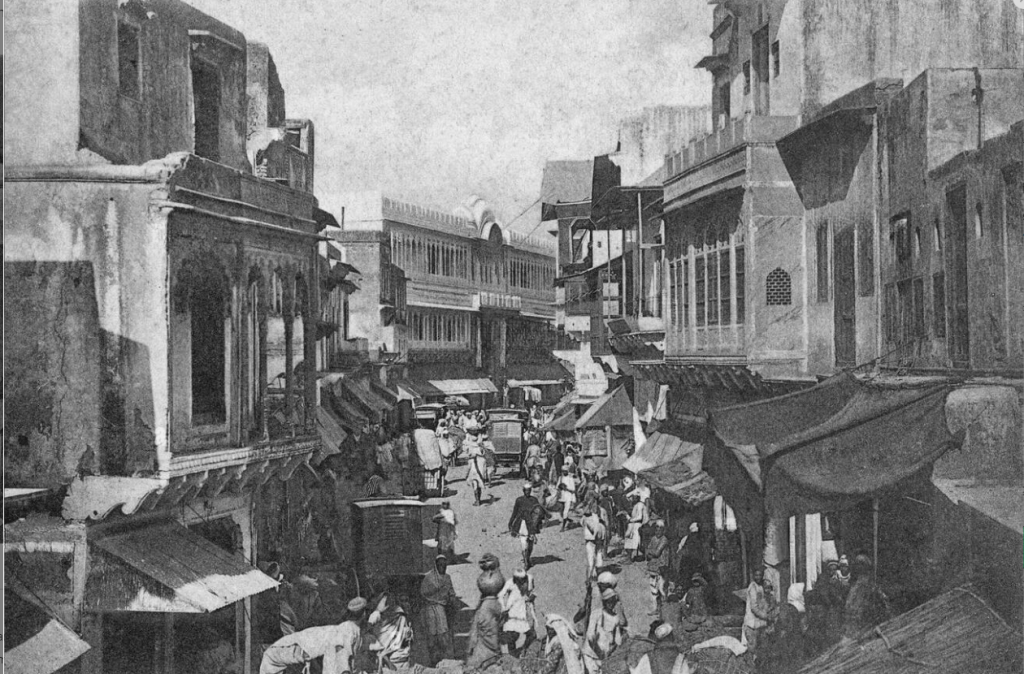
“We drove through the barricade I had lately thrown up and proceeded along a narrow lane of low mud houses. It presently widened, and the houses rose to lofty edifices whose summits, in the darkness, we could only dimly distinguish. The lower storeys consisted of shops, brightly lit by a profusion of small earthen lamps. The street was densely crowded, but the reception afforded me was very different from that which had been given me at the station. No one made way, no one saluted; the only notice we attracted was defiant and insolent glances.”
The Seths, too, were taking no chances. In front of their house, a tall wooden barricade had been constructed that stretched the width of the road and outside it swarmed a mob of armed men. One man came forward and explained to Thornhill the barricade and the levies were there to keep the rabble out – two torch bearers presently appeared, the barricade was opened and the carriage was allowed to proceed. Within, the street was empty and dark, and two large buildings loomed on either side. At the entrance of a narrow lane, they were asked to alight and proceed on foot. Just beyond a stone gateway stood the Seths, waiting to welcome them.
The Seths of Muttra, a powerful banking family which, in 1857, consisted of 3 brothers. With energy and determination, they held the station until Mark Thornhill returned. Now, at great personal risk, they took him and Mr. Joyce into their home. To Thornhill’s surprise, they were not the only Europeans under the Seth’s roof. It was the Hashman brothers, the missing clerks from Thornhill’s office, who had become separated from Colvin, Gibbon and the others when the troops had mutinied in Muttra in May. After dinner, beds were brought out, and the party settled down to sleep.
Early the next morning, Thornhill announced the Seth’s manager that he was returning to visit the station. A carriage was arranged with a large escort of horsemen. On reaching the entrance to the office grounds, Thornhill noticed the ground was thickly strewn with paper, some charred, others torn into pieces. As he approached the office, he found nothing was left but the bare walls, blackened with smoke and scored with the marks of pickaxes and crowbars. The roof had caved in, and the floors were covered with debris. There was nothing left to salvage.
The Seth’s manager had informed Thornhill the night before that Lieutenant Burlton had been shot by his men, but no one had buried him. Somewhere in the ruins of the station was his corpse. With nothing left to do at the office, Thornhill and Joyce went to find the body.
“After a long search, ” he writes, “we found the body lying in a dry ditch at the end of the grounds. There was little left of it but the skeleton, and this a dog was gnawing. We flung clods of earth, and he slunk unwillingly away, snarling and showing his teeth as he retreated. The body was lying on its back with the arms upraised, the hands were untouched; surmounting the fleshless arms they had the appearance of gloves, and gave the skeleton an air of ghastly masquerade.”
Thornhill had only seen Burlton once in his life when the Lieutenant was a guest at his house. He had seen him seated on the verandah, eating breakfast. “As I had then seen him so I now recalled his figure and features, but beneath them there appeared the skull and bones lying before me. The picture was very horrible, but I could not dispel it – for some days, it continued to haunt me.” Thornhill organised a few labourers to dig a grave – there was no time to make a coffin so the remains were wrapped in a white sheet and laid in the ground. Thornhill and Joyce were the only witnesses at his makeshift funeral, and as the grave was being filled in, they stood by, with uncovered heads, their silent prayers Burlton’s only service.
They then proceeded to ride around the station, surveying the destruction. Like the office, no bungalow had escaped the flames. “Round each house was strewed a chaos of broken furniture, scraps of clothing, pieces of glass and china. The gardens were untouched, and their bright flowers and rich foliage made only more melancholy the ruins they surrounded.” Only the church was untouched, but only because no one had been able to set the roof alight. The windows, however, were smashed, the doors wrenched away, parts of the paving dug up, and all the furnishings smashed. With nothing left to see or for that matter, do, they returned to the Seth’s house.
Over the next week, things in Muttra did not improve. Villagers came into the city, imploring Thornhill’s help to save their homes from roving marauders, but there was nothing he could do. He had neither men nor arms and as it was rapidly becoming clear, no authority. At night, he could hear the firing of matchlocks and, from the roof, watched as village after village was razed to the ground. Some villagers commenced looting others – when they were done, it was feared they would all descend on Muttra. The Seth’s too, were becoming increasingly worried. Threatening messages were flung over their walls, demanding they turn the Europeans out of Muttra, and one night, as if to prove the point, a fireball was thrown into the courtyard. Thornhill, the stubborn magistrate, refused to leave. He felt that if he was to continue in his present position, he would need to not only take measures to protect the city but also assert his authority. As such, he called a meeting of all the principal citizens and worked out a plan.
After the usual profusions of loyalty and promises of trust, which, with the exception of the Seths, Thornhill privately did not believe, he commenced with their help to fortify Muttra.
The city had no defences, but its position and construction made it possible to protect it with little effort. On two sides, the river formed a barrier while on the other two sides, the walls of the houses served as near-continuous barricades. He ordered the bridge of boats broken up and then erected barricades at all the entrances to Muttra. Unfortunately, these barricades required men to protect them, and at this, no one was willing or able to raise levies. The citizens were more than willing to protect their own houses and had made ample preparations of their own, even “willing to defend their own lanes…but to unite to defend the city was an undertaking entirely beyond them.” They wanted the Government to do it, but at Muttra, the government now consisted of Mark Thornhill and three clerks. He could not exhort any force, and any argument proved useless. He raised a decent police force, enough at least to protect the two main city entrances, and with “threats, persuasions and something very like bribery,” persuaded the leading citizens to defend the barricades in their parts of the city. This left one barricade unprotected, and this, after consulting with the Seths, would be given over to a detachment of the Bharatpur troops who had been left behind in Muttra by Captain Nixon in May. Thornhill had completely forgotten they were still there; the Seths, after making him aware of the fact, remarking that “after inspecting the men, they did not think… their presence very dangerous.”
 Mutiny Reflections
Fascinating! I read this with a coffee; it was that absorbing a read!! Thanks for the work you put in on this!!
LikeLiked by 1 person
I wish I had a picture of Mark Thornhill. He isn’t perhaps the most fascinating person but certainly a unique one! Glad you enjoyed the read!
LikeLiked by 1 person
I did, very much! :-)
Good luck with your photo hunt!! 🤞
LikeLiked by 1 person
Always enjoyable. Nice. Thanks.
LikeLiked by 1 person