Gaya
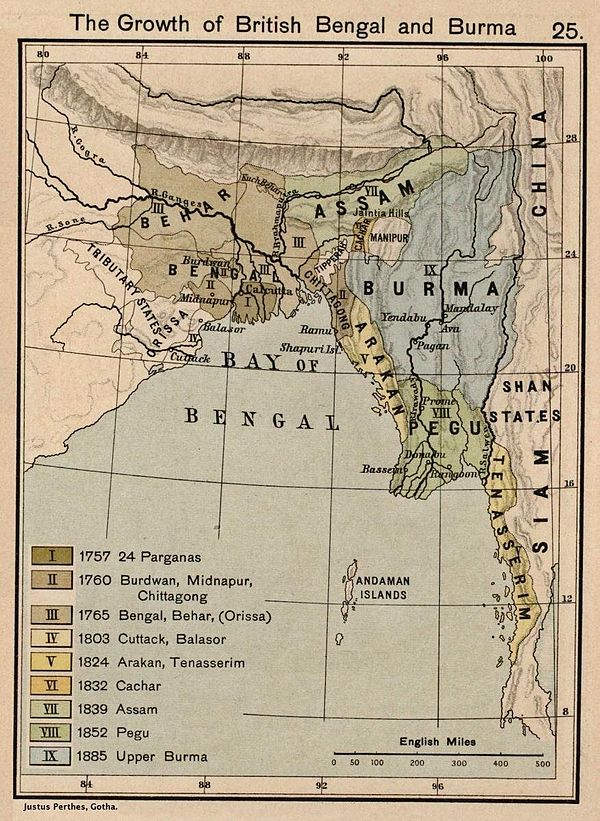
The district of Gaya formed the southernmost portion of the Patna Division. It extended over 4,712 square miles, bounded on the north by the Patna district, on the east by Monghyr and Hazaribagh, on the south by the latter district and Palaman, and on the west by Shahabad, separated from the former by the river Son. The chief town is Gaya, situated 50 miles from Patna.
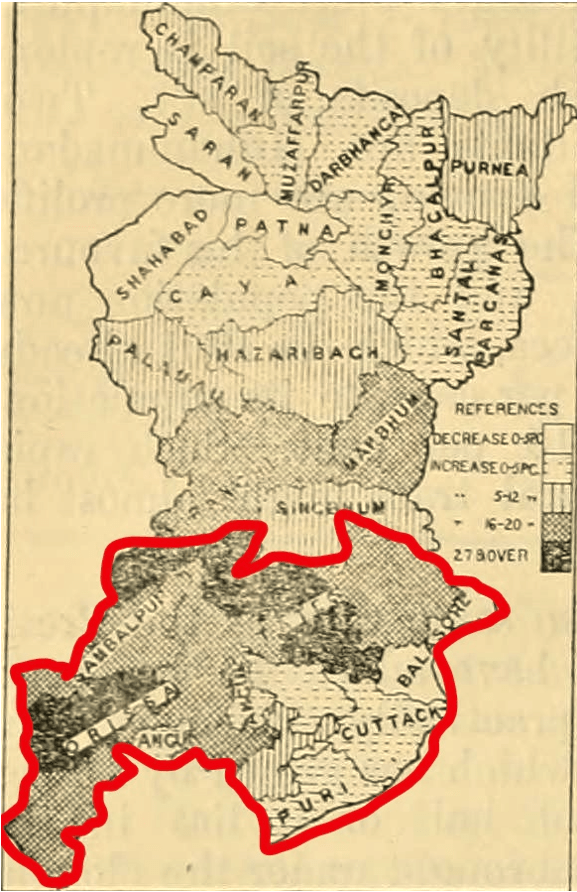
Due to its location, Gaya was problematic – the road served as an ideal connection for mutineers from the east and in consequence, following the uprising in Benares in June, it became imperative to hold Bihar and, in particular, secure the Gaya road. To perform this task, Mr Money had 45 European troops and 100 Sikhs. With the uprising in Dinapore complete, it became clear that the mutineers, if unchecked at Arrah, would proceed to Gaya. However, it must be remembered that the Lieutenant-Governor had stated there was no apprehension of danger in Bihar.
There was indeed an apprehension of danger, but Calcutta was too far away to appreciate it. Mr Money apprised Tayler and the officials of a possible joining of forces between Kunwar Singh, the Raja of Benares and Babu Mondenarain. Had the combination proved fruitful, that could have spelt the end of British rule in Bihar.
20th July 1857. Magistrate.
MY DEAR TAYLER—You tell us to look out; easy advice. You forget, however, that we have but one detachment of English troops, 44 men and 100 Seiks. The former have but sixty rounds a man, the latter twenty.
This is enough, if we had a brush outside with the men, supposing them to be in numbers (or detachments) of 200 or 300. But if they came down in force, say 800 or so, our only chance would be defending a house, and for that the Seiks’ twenty roxmds a man is not sufficient. Moreover, the Irregulars at Monghyr and Bhaugulpore are sure to go, and will probably come by Barh, Behar, and Nowadah this way.
You have now a large force of English at Dinapore, much larger than you can want. It seems to me you might send us a 150 with advantage to the public interests, as the official phrase goes.
Modenarain is in correspondence with Kooer Sing and the Benares Rajah. The latter told him in a letter the other day to ” Jumma hurra Gullah.” This looks suspicious. My authority, though good, did not see the letter. Modenarian has all his guns, about a dozen, nicely cleaned and polished. If we are driven hard and have to defend a house, we shall have some of these guns against us ! ! !
Yours truly,
(Signed) A. MONEY.
Subsequently, before Tayler ordered the withdrawal, even Mr Money admitted Kunwar Singh would make a beeline for the Gaya treasury. As such, he would have no means to stop him. He, like Tayler, believed, should Arrah fall ( and it certainly looked like it after Dunbar blundered), Gaya would be next. It did not help matters that the escaped Ali Karim, still at large, was a Gaya man, and Tayler did not put it past him to stir up mischief in his home town.
Therefore, Tayler felt it imperative for Money to pack up the Gaya treasury and proceed with as much haste as possible to Patna. The order was clear – “Everything must now be sacrificed to hold the country and the occupation of a central position.’’ The order desired him and the other civil authorities to come with all their force to Patna, making their arrangements as promptly mid quickly as possible, and contained an injunction to remove the treasure if their personal safety was not endangered by doing so.”
When he received the order, Mr Money was neither besieged nor threatened. That his position would have been indefensible if the mutineers had descended on his station was clear, but up to that point, Gaya was quiet. So the very first thing Mr Alonzo Money did upon receiving the withdrawal order was to leave the treasure behind in the hands of the Najibs, whom he had recently declared untrustworthy and placed no extra guards at the jail.
When the party had gone 3 miles from the town with Mr Money, Mr Hollings, an officer of the Opium Department, who felt acutely the shame of this abandonment of the station to anarchy and plunder, insisted he would return and see what could be done to preserve order and to save the Government property. Money halted the party and, after some persuasion, went back with Hollings alone.
To their surprise, they found the station in the same order as when they left it three hours before. The treasury was untouched and still guarded: at the jail, the guard was on duty, and all was quiet. Many of the inhabitants welcomed them back, and the more influential among them promised, with the help of the zamindars, to raise a force of 3’000 or 4,000 men to defend the town. As events unfolded, the promise came to nothing- the zamindars were either disinterested or disaffected, the citizens did not really anticipate anyone would attack them, and finally, a force of 100 men, mostly weak and old, was all that could be mustered to protect Gaya from thousands of well-armed and trained mutineers.
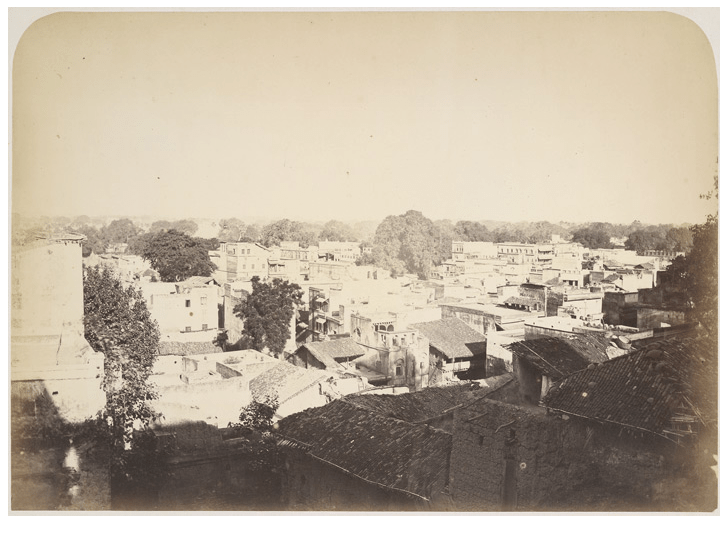
Meanwhile, Mr Money had left the rest of the party on the road. As such, the judge, Mr Trotter, wrote to Tayler in Patna, “intimating…these circumstances, representing the dilemma in which Mr Money’s vacillation had left him and the other officers, and asking whether I adhered to my former order…My reply was that, although Mr Money’s conduct had enhanced my embarrassment, it had not altered the principle on which I had sanctioned the withdrawal…”
For two days, Mr Money remained at Gaya, now without Sikhs and Europeans, still, there was no uprising. He sent a message to Captain Thompson of HM’s 64th who was passing through on their way to Shergatty if they would oblige him and escort the treasure – not to Patna, but Calcutta. It is interesting to note that Mr Money stated in his official letter to the Lieutenant-General that he was initially unable to remove the treasure because he had “no carts and elephants”, which Tayler found this mistifying,
“People do not keep elephants and carts in their houses; and, when I ordered Mr Money to bring the treasure, I of course, and of necessity, contemplated the allowance of such time as was, and always is, necessary for procuring carts and packing treasure.”
The decision to march to Calcutta with the treasure (Money had suddenly found transportation) was based on misinformation that the mutineers must be marching on Gaya, and thus the Patna road was closed; however, the party that had left two days earlier reported the road clear. Even if there had been obstacles, Mr Money had the men of the 64th Regiment with him – 2 nights march to Patna should have been worth more than nearly 300 miles to Calcutta. Before leaving, Money made a great demonstration of burning the Gaya stamp paper for reasons only he himself could fathom. Yet he did nothing to preserve the station’s records.
Consequentially, Money left Gaya on the 3rd of August, when the victory of Major Eyre was already known, and as soon as he turned his back on his station, the Najibs broke open the jail, and together, they looted Mr Money’s house and whatever money he had left behind. The Najibs then left the station, and the prisoners went to their homes, but indiscriminate plundering broke out throughout the town, and for 13 days, Gaya was effectively without either a police force or a government as neighbours murdered, looted and pillaged neighbours. Not even the local zamindars or landed aristocracy bothered to step in and save Gaya from itself. On the 16th of August, Gaya was reoccupied by the British authorities, firstly to restore communication along the Grand Trunk Road and secondly to right the mess Money had made by leaving.
Instead of receiving the rebuke he so rightly deserved for his actions, Mr Money was applauded in Calcutta as a hero for this rather theatrical display for which he eventually received an Indian Mutiny Medal; Mr Tayler was derided as a panic monger. By ordering the withdrawal, had the subsequent victory of Major Eyre not materialised, it would have been the only way for him to secure the lives of the civilians under his charge and with whose help Tayler could have held Patna. None of this was taken into consideration. As it was, Eyre was successful, and Tayler was further accused of meddling.
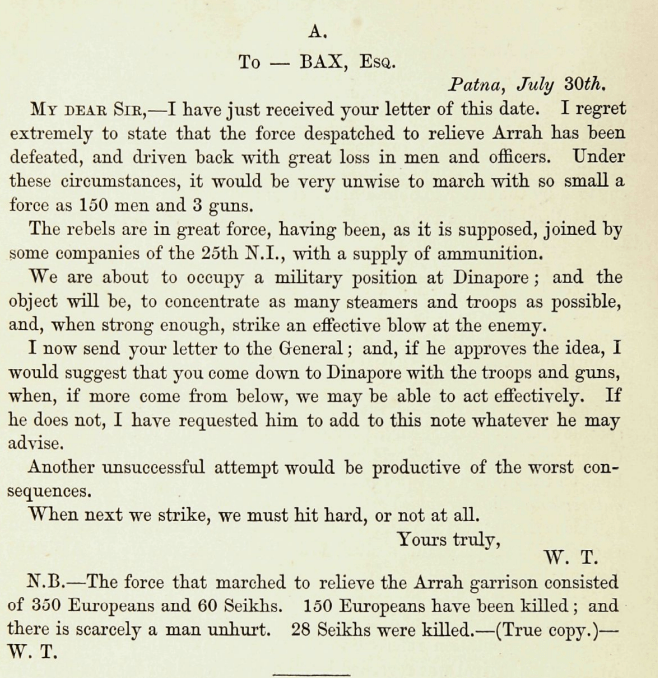
Following the first disastrous retreat, Tayler sent the following letter to one Mr Bax at Buxar:
 Mutiny Reflections