An Account by G. Langdale, late Clerk to Captain P.G.Scot
It is interesting to note that not only Sergeant Kirchoff declared Langdale dead, but Scot also makes mention of it. However, he was, for all intents and purposes, very much alive. It is very likely through this disorganised rout of a flight, he had been mistaken for someone else.
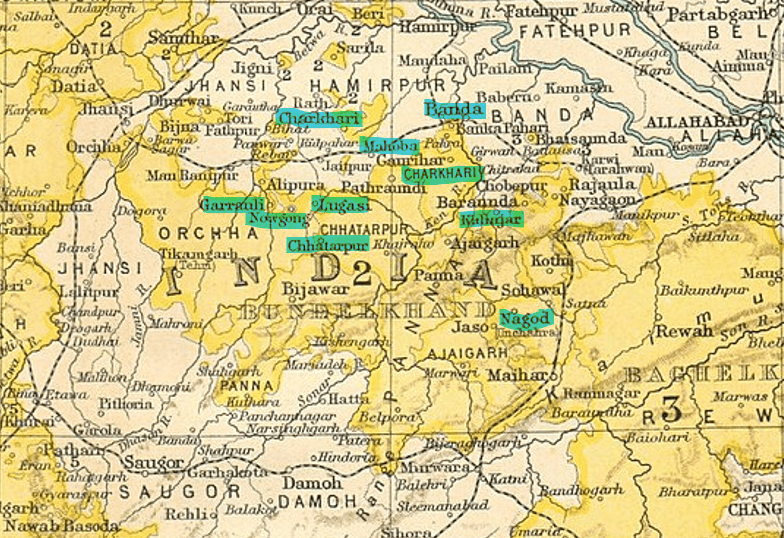
His narrative starts on the 10th of June when Mr. G. Langdale went for his evening walk. At 6pm, he left his house, but scarcely 20 minutes later, he heard the report of firearms, followed by the bugles of the 12th and the trumpets of the 14th Irregular Cavalry sounding the “turn out.” He did not return home; instead, Mr. Langdale continued walking, straight out of Nowgong. He hid himself as best he could in a nullah (a hollow or a dry waterway by a river), where he remained for an hour. Realising he was by no means far enough, he proceeded through the jungle, arriving at 2 in the morning at a small village, hoping to find shelter. However, he was chased off and ended up wandering hither and thither without a clue as to where he was going. Langdale finally reached a second nullah. He laid down for a moment under some bushes but his unquiet rest was disturbed by a goatherd. Leaping to the chance to ask for directions, Langdale asked the man which way was Lugasi. The man replied it was very far away and not at all safe to reach. Not liking the look of the goatherd, Langdale went further up the nullah and again concealed himself under some bushes. The goat herd proved to be most persistent. Here again he appeared, but this time he had friends with him – 2 men carrying axes. They made show of searching the bushes, slowly edging their way towards the crouching Mr. Langdale.
Langdale leaped to his feet and ran as fast as he could, his would-be killers shouting at him to stop, which he had no intention of doing though they followed him for the next two miles. By the time they gave up, Langdale was in the thick of the Lugasi jungle. Fatigue overtook him, and he threw himself under a bush and fell asleep. When he awoke, he found the sun burning his skin and his throat so parched he feared he would choke. In this state, he continued his march. Towards evening, he found a road. Where it led, he didn’t know, but he chose to follow it anyway. Luckily, it took him straight to into Lugasi territory.
He found a well at which he stopped and filled bucket after bucket of water, pouring it down his throat until he felt he could finally speak again. Astonished by just how much water one man could drink, the people around it watched him with some curiosity. Asking them if they could advise him what to do next, they hastily said he should avoid the next village by all costs, mutineers had been by in the morning, asking about fugitives. They advised him to go back to the jungle, but Langdale had no intention of retracing his steps. It would appear a message had been sent to the Lugasi Raja regarding this strange man who had just popped out of the jungle – shortly after, a man came and told Langdale the Raja himself was sending him an invitation to accompany him. Unprepared for this change in fortunes, Langdale decided to take the risk. The Lugasi Raja treated Langdale with the utmost courtesy and kindness, asking him many questions about the mutiny in Nowgong and, in particular, about the safety of the officers. Langdale knew nothing. He stayed the night under the Raja’s protection, and the next morning, Langdale was told by the Raja he was about to write a letter to Major Kirke, who was at Chhatarpur, and he intended to send a spy to Nowgong to see if the mutineers had finished with the station.
The next day, Major Kirke’s reply arrived. From him, Langdale found out his wife was safe in Chhatarpur and Kirke had sent Scot and Townsend back to Nowgong to reconnoitre. At this, Langdale, thinking of a small sum of money he had hidden in his house, asked the Raja for an escort and, with a few matchlock men, returned to Nowgong to retrieve 18 rupees. He then went back to Lugasi but this time accompanied by Captain Scot and Lieutenant Townsend – a fact Scot neglects to mention in his own account.
He then proceeded with them to Mahoba.
Three days later, they left Mahoba to go to Kalingar. Their first march took them to the village of Jorai where, the next day, they would be attacked by the matchlock men who killed Lieutenant Townsend. Interestingly enough, Langdale claims the officers did not offer the money (the 700 upfront and 300 after for safe passage), but the demand came from the leader of the matchlock men.
The attack left the fugitives with the only option left to them – follow the remaining sepoys to Kabrai.
Along the way, Mrs. Langdale died of sunstroke. She had been in much pain and gradually sank under the fatigue of the walk. He had to leave her where she lay; there was no time to bury her. After he left his wife, Langdale found Mr. Smalley sitting under a small bush cradling his dying wife in his arms. After she died, she too was left where she lay, and Mr. Smalley rejoined the party. The Sergeant-Major, who had demanded his daughter carry his sword, expired shortly after.
The party with Mr. Langdale consisted of Mr. Patrick Johnson, pension bugler of the 12th suffering from a rupture, Sergeant Raint of the artillery and Mrs. Tiernney and 2 children. None of them were able to walk any further – Johnson certainly not, and the others were suffering from blistered feet, particularly Langdale, as he had proceeded barefoot, having given his shoes to his wife not long before she died. After a march of 30 miles they reached Kabrai, the story of which we have heard from three sources now and does not need to be related again. However, it differs in one respect – Mr. Langdale chose to remain behind when the party left.
It is interesting to note that although sepoys were convinced they would be murdered in Kabrai, Langdale and the others were well treated, perhaps not with much consideration, but they stayed for 12 days only ejected after the arrival of some sepoys and a gun sent by the Raja of Jalown. With but little choice than to move on, Langdale steered the fugitives towards Mitown on the way to Banda, reaching the village in the evening. Here, they were treated with exceptional compassion. The villagers escorted them in and provided them with food and charpoys to sleep on. The zamindars, upon being asked by Langdale if they could put up for a few days, answered they could stay as long they liked. The zamindars provided them with a new suit of clothes and a blanket, the very grain merchants supplied them with grain and flour in turns, while the people gave them tobacco in abundance. In all, Langdale and the others remained in Mitown for a month. On the 12th of August, after much correspondence with Major Ellis, the Political Assistant of Bundelkhand and Captain Scot, they were transported under a guard of 50 men to Nagode.
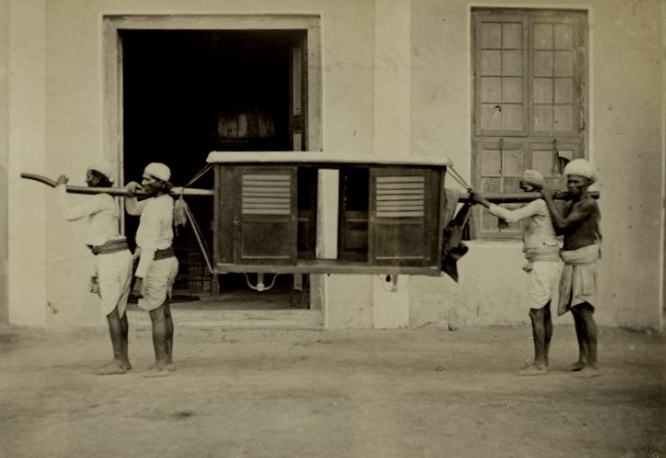
They arrived at Gowrechur, some 15 miles on the road, where they were pressed into staying with Raj Dur, the Jagheerdar of that place. His invitation was so cordial that it was impossible to refuse and subsequently, they remained under his protection for a further 17 days during which time Raj Dur sent to Banda for tailors to make his guests some clothes and he sent for plates, tumblers and basins for their own use. Unfortunately, Raj Dur had but recently quarrelled with the Banda Nawab and his crony, Dawa Sahib, the Kamdar of the Rani of Ajehghar, so subsequently, the messenger only returned to Gowrechur with some shoes, all too big to fit anyone in the party. However, Raj Dur would not be defeated, and he “munificently instructed his people to provide us with everything we desired, irrespective of any reference to him.” The evening before they left, he paid them a parting visit. He induced his guests to accept an opulent gift of 50 rupees for their travel expenses, along with a silver rummer weighing 26 rupees and a silver basin weighing 24 rupees. He also gave them one rifle. They left him on the 28th of August with many expressions of their gratitude, Mrs. Tiernney and the children safely ensconced in a palki and the men astride an elephant.
They reached Nagode on the 1st of September. Mr. Langdale did not stay long – after three days, he proceeded to Allahabad via Rewa, where he faced a delay of 6 days as the mutineers under Kunwar Singh rampaged through the countryside. We will end this narrative with a poignant appeal from Mr. G. Langdale, writer to Captain P.G. Scot, formerly of the 12th BNI.
“On the 12th, I left Rewa in an ekka and arrived at Mirzapore on the 14th instant. At this place, a gentleman heard of my being at the Serai and asked me over to his house, where I was very well treated, and provided with necessaries in the shape of clothes. A steamer conveyed me to Allahabad, where I trust to meet Captain Scot, my late employer, who has kindly offered to maintain me while out of employ. If I can join the volunteer cavalry at Allahabad, I will do so.
I have lost all my property besides a small box of jewellery belonging to my wife, which she managed to escape with from Nowgong, with my father’s Waterloo medal (he was a soldier in the 11th Light Dragoons), my two Cabool medals, Sutledge medal, and Punjaub medal (won in the 3d Light Dragoons), and my watch which property was taken away from us by the inhabitants of Jorai on the morning they fired upon us. My brother was riding master at Meerut, and I am very anxious to hear of his safety. I have written to him, but I suppose the dak route is closed. I shall be much obliged to anyone who can give me information about him.”
Perhaps Captain Scot was wrong after all, the people he had left behind in Kabrai were not as insignificant as he thought but perhaps it was just this insignificance that saved their lives.
Sources:
Chick, Noah Alfred, comp. Annals of the Indian Rebellion, 1857-58. Calcutta: Sanders, Cones and Co., 1859
 Mutiny Reflections