Ofeur Cavanagh, Town Major of Fort William, Calcutta
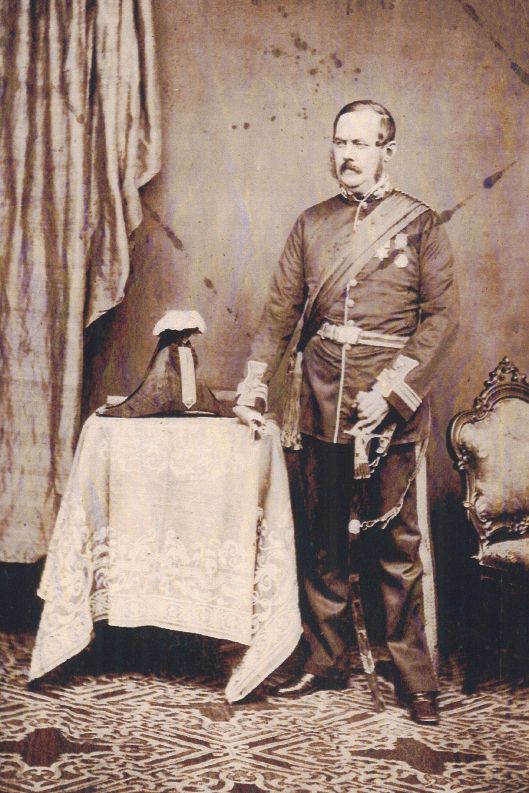
Not wanting the be thrown in together with the Hindu element of the regiments, Orfeur Cavanagh’s Sikh orderly made a passionate appeal on the 4th of June:
“…represented to me that there where nearly a hundred Siekhs in his corps and that they were not to confounded with the Hindustanis; that they were not trammelled with the prejudice of caste; and would eat fowls and drink toddy; whilst they were prepared to go anywhere or do anything they were ordered, and be delighted to be incorporated in one company and attached to a European regiment; that under the existing arrangementst, by which they were distributed amongst different native companies, their services were lost to the State, as in the event of a mutiny they would be overpowered by their Hindustani comrades.”
Cavenagh eagerly brought the petition to the notice of Lord Canning. Shortly after, all the Sikhs were removed quietly from Barrackpore, formed into a separate body and sent to Raniganj, where they performed exemplary service, guarding the railway terminus.
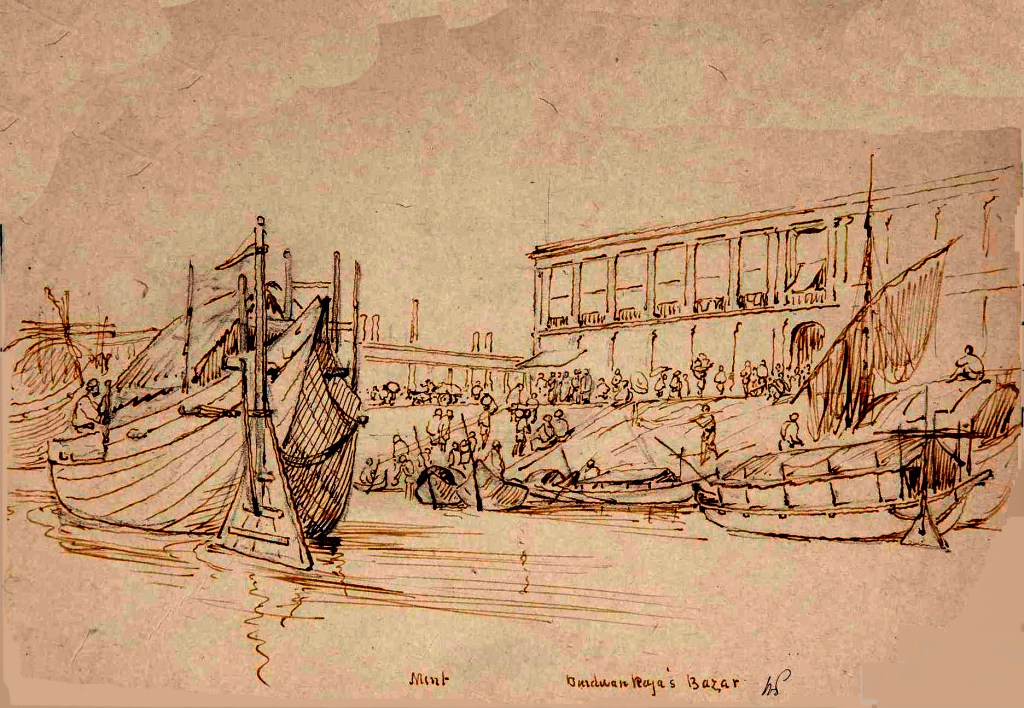
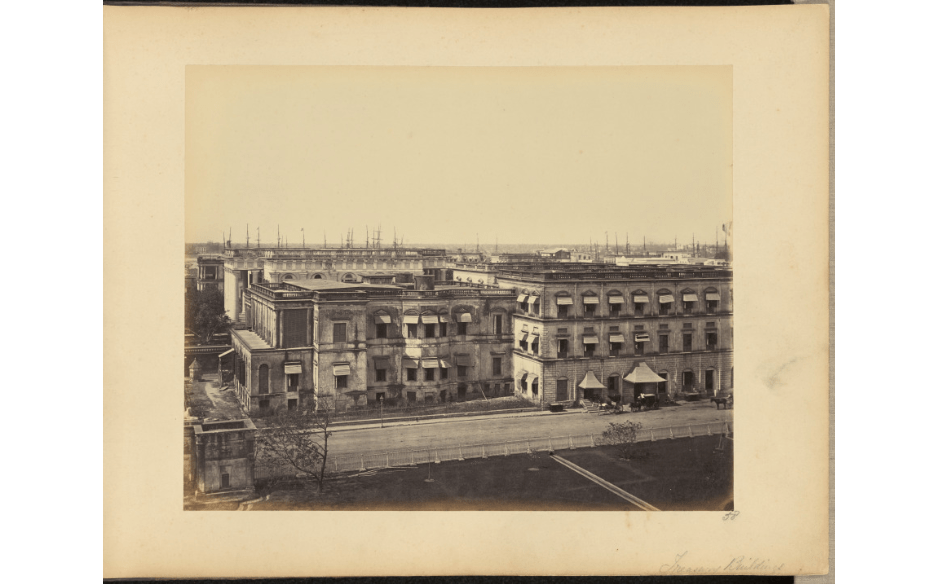
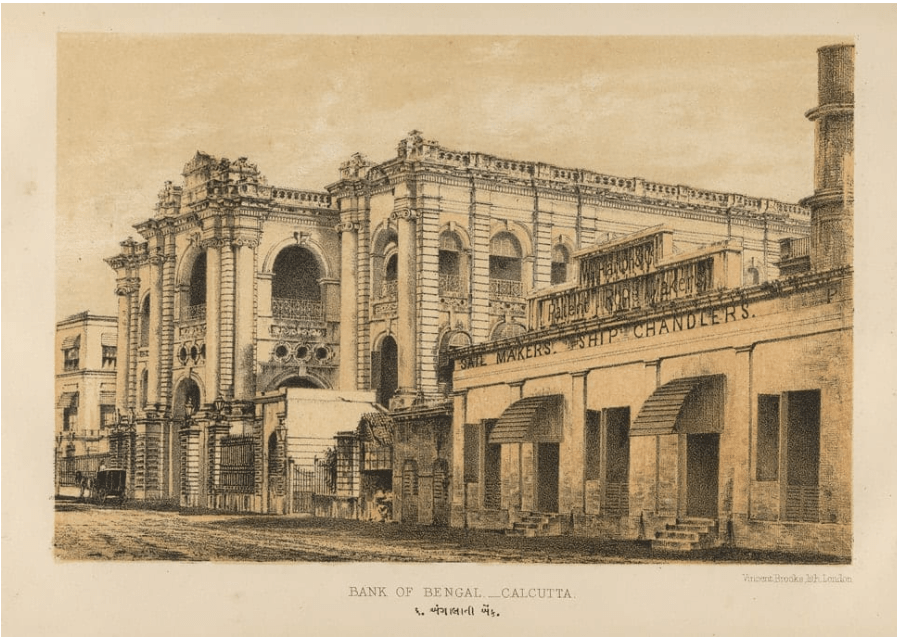
On the 8th of June, Cavanagh received orders from Colonel Birch that the native troops at the bank, the mint and the treasury were to be relieved by European details – however, Cavanagh only received the notice at night. Seeing there was little time to waste, he marched out of the fort with a detachment who had had previously told the remain in readiness in case of orders. With these men, he first marched to the treasury.
Here, Cavangh found all the doors closed and locked. The only entrance was through a narrow passage, at the end of which was a sentry post. Seeing how the sudden appearance of European troops might seem to the Indian guards, Cavanagh resolved to enter the passage himself. Leaving the detachment hidden out of sight but within earshot, he rode up the path. Since it was nothing unusual for Cavanagh to make these rounds at night, the sentry opened the wicket. Cavangh ordered the native officer to draw up his men. Remaining between them and their arms, which were piled up in front of the guard room, Cavanagh explained to the men that the Government desired that part of their duty would be taken over by European troops, half their number would be sent back to Barrackpore. He then called the officer commanding the European detail to come forward, and the relief was completed.
Similar proceedings were held at the Bank and the Mint with no incident. However, Colonel Birch, “who, being anxious as to the success of the measure, had followed and watched my proceedings, remarking to a friend that when he saw me ride up the Treasury passage, he did not expect to see me come out alive again.”
Yet what the government still failed to see was the danger at their very own door.
MR. J.P. GRANT SPEAKS
“In reality,” wrote Mr. Grant early in June, “as well as in appearance, we are very weak here, where we ought to be – and if we can’t be should at least appear to be – as strong as possible. We have as enemies three Native Infantry regiments and a half, of which one and a half are the very worst type we know; one, two, three (for no one knows) thousand armed men at Garden Reach, or available there at a moment; some hundred armed men of the Sindh Amirs at Damdamah; half the Muhammadan population; and all the blackguards of all sorts of a town of six hundred thousand people. Against these, we have one and a half weak regiments, most of whom dare not leave the Fort. There is no reason to expect real help in real danger from the Native Police. The insurrection is regularly spreading down to us. Is this an emergency or not? My conviction is that even a street row at the capital would give us an awful shake – not only in Bengal but in Bombay and Madras – at this moment.”
The Government had reported to the Court of Directors in London that the public display of loyalty made by the 70th Regiment at Barrackpore would “have the happiest influence on the minds of all well-disposed men in the Native Army.” Thus, they unquestioningly allowed three and a half native regiments to retain their weapons. While Calcutta sent forth Europeans at speed to answer the calls of uprising, they remained blissfully unaware that their own station was in danger. Yet, the policy was to trust every native regiment until it actually revolted, thus hindering the very European troops they had sent out, as these often had to remain inactive for weeks, guarding against outbreaks!
What the government could not understand was that the Bengal Army was being moved by one intention, and it was only a matter of time and opportunity before their professed loyalty meant nothing. Allahabad should have been their eureka moment – on the 6th of June, right after the government had praised the native troops for their unswerving loyalty, the self same troops mutinied and murdered nearly all its officers.
As the first week of June progressed, it was becoming clear that Mr. Beadon’s line was no longer sustainable without help. Lord Canning finally did what he could have done a month ago: he sanctioned the enrolment of volunteers.
The Calcutta Volunteers
What should have been done earlier was finally permitted by Lord Canning on the 11th of June after much persuasion from Mr. Grant, who convinced Canning that Beadon’s Line really was “moonshine” and, in reality, Calcutta needed volunteers.
Having annoyed, insulted and fobbed off the civilians, both native and European, the very first thing the shamefaced government had to do was issue a statement, in effect, that the time had come for volunteers. Anyone interested should meet the Town Major at the Fort. It wasn’t so much an apology – the government was not going to stoop so low to admit a mistake. What they did realise, however, was when the Board of Directors in far away London found out they had not organised a volunteer corps, someone would have to answer some very uncomfortable questions.
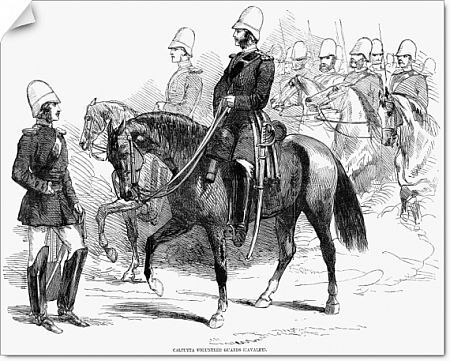
Ofeur Cavanagh, one of the most level-headed men in Calcutta, was asked, pray, how should we go about forming a volunteer corps? In reply, Cavanagh informed Lord Canning and council that the corps did not need to be exceptionally well drilled but sufficiently so to be able to act together and use their arms with ease; a calvary and an infantry corps would be needed – the former for patrols while the latter as pickets for the important buildings in order to organise rendezvous should these be needed. He also wanted it to be led by old army non-commissioned officers, both pensioners and time-expired men, to ensure discipline and that the corps should be divided into troops and companies “each man being, as far as possible, posted to the troop or company composed of persons living in his own neighborhood.” He already had plans for their uniforms – blue holland or brown flannel would be smart and durable.
What Cavanagh did not expect was the enthusiasm with which the announcement would be met with.
“Intimation having been given to the European inhabitants of the acceptance of the offer of their services, all who were willing to be enrolled as volunteers were invited to present themselves at daybreak on the glacis of Fort William. When I rode out by the Chowringhi gate, the plain was covered with a confused mass of men on horseback and on foot, mixed up with numerous carriages and a crowd of native spectators; the task of bringing the apparent chaos into order seemed almost a hopeless one.
At last, I selected the late Mr. Ritchie, then advocate-general, a man well known to and greatly respected by all; he was a big man on a big horse, and his house formed the extreme right of the town. I asked him to ride with me out of the throng, and when we were some distance off, I instructed him to take up a position and remain stationary until further orders. I then retraced my steps, and riding again through the crowd, requested all those who were mounted, and who resided in Mr. Ritchie’s neighbourhood, to form up in line upon him; when a sufficient number were drawn up, I ordered them to move forward, and proceeded to select another gentleman to act as marker for a second troop, and so on, until all the troops and companies were formed; they were then duly numbered, officers were appointed, and, as soon after as possible, the work of issuing arms and accoutrements, which continued -without intermission until nightfall, commenced.“
Over the next weeks, the volunteers were drilled “and reached a fair standard of efficiency.” The cavalry were sent on patrol, and the infantry manned their pickets at public buildings in various areas in Calcutta. This body of men, comprising of lawyers, merchants and tradesmen ” gave themselves up ungrugingly to all fatigues of drill and discipline who, through the long nights of the hot weather, and the inclement rainy season, took all the duties of a corps of the line; who, by their very formation, gave the first check to the insolent demeanour of the natives of Calcutta; who were instrumental in saving that city from the horrors of an insurrection; who, raised in June, were thoroughly organised in July, and who, when brigaded with crack Highland Regiments in November, were halted by Sir Robert Garrett, in order that he might compliment them upon the unsurpassed manner in which they went through their duties. It cannot be denied that but for the Calcutta Guards, Horse and Foot, this city, in the suburbs of which were 60,000 fanatical Mahomedans, ready and waiting the opportunity for a rise, would, in all probability, have been exposed to the most imminent peril.“
I have compiled below a very short list of the earliest volunteers.
- Daniel Mackinlay – Merchant
- Montagu Turnbull
- John Strachey
- Major Davies
- George Kellner
- Frederick Goodenough
- Robert Simson – Under Secretary, Foreign Office
- Von Ernsthausen – a German volunteer
- Wilmer and Tucker – two American volunteers
- Henry Berners – solicitor
- Richard Doyne – barrister
- Arthur Macpherson – barrister
- George Daws – Advocate General
- Sam Wauchope – Commisioner of Police, Civil Service
Ultimately, over 1000 men would serve as Calcutta Volunteers.
Sources:
[Malleson, G. B.] The Mutiny of the Bengal Army: An Historical Narrative. By One Who Has Served under Sir Charles Napier. London: Bosworth and Harrison, 1858.
Cavanagh, Orfeur. Reminiscences of an Indian Official. London: W. H. Allen & Co., 1884.
Great Britain Parliament. Appendix to Papers Relative to the Mutinies in the East Indies (Inclosures in Nos. 7 to 19): Supplement to the Papers Presented July 1857. London: Harrison and Sons, 1857.
Kaye, John William, and G. B. Malleson. Kaye’s and Malleson’s History of the Indian Mutiny of 1857-8. Edited by G. B. Malleson. Vol. I (1914); Vols. III & VI (1889). London: Longmans, Green, & Co. / W. H. Allen & Co
 Mutiny Reflections
Another relative of mine 😉 Orfeur Cavenagh was the brother of my great great grandfather. I wrote about him at https://anneyoungau.wordpress.com/2018/04/17/o-is-for-orfeur/
Sir Orfeur Cavenagh gave his own account of his career in a letter of 1868 included in his private letter book number 11 which included the followng comments about the mutiny:
In 1854, at the special request of the then Governor General Lord Dalhousie, accepted the appointment on his staff of Town Major of Fort William [the fort in Calcutta]. In this capacity as the Governor General’s representative, recommended the numerous alterations in the European Barracks and other buildings as well as general sanitary improvements, which have led to the ordinarily satisfactory state of health of the Garrison.
On the 26th January, 1857, frustrated the design of the Mutineers to seize Fort William (vide statement of Jemadar Durrion Sing, 34th Regiment, N.I.).
Throughout the Mutiny discharged all the arduous duties connected with the command of Fort William and Calcutta, including the charge of the state prisoners, the raising a Corps of Volunteers, the organisation of a body of Native Servants for the use of the troops arriving from England, the management of a large Military Canteen, the protection of the town, the control of all Public Departments, Military Buildings, Hospitals, etc., and the entire charge (arming, clothing and victualling) of all European invalids and recruits, numbering several thousands, of the company’s service. On four occasions received the thanks and commendation of the Supreme Government.
At the close of the mutiny, appointed Governor of the Straits Settlements.
Regards
Anne
LikeLiked by 1 person
Thank you Anne! You have the most fascinating family history. Were any of your relations in Agra too?
LikeLike
At various times relatives were in Agra but not as far as I know at the time of the mutiny
LikeLiked by 1 person
I will be in Delhi soon. Will definitely look for your relatives grave on the Ridge if it is still there. I won’t make it to Calcutta this time.
LikeLike
That would be terrific – it may not have survived the inscription in memory of Captain Smith was published 1910. https://archive.org/details/ALlistOfInscriptionsOnChristianTombsPunjabKashmirNWFPVol1Inscriptions/page/n32/mode/1up
Mathew Reveley’s name is recorded on a tablet in St. James’ Church, Delhi and I guess it is still there.
Another cousin Charles Mainwaring died at Cawnpore and is remembered on a tablet in All Souls Church, Cawnpore. I really liked the film about Cawnpore you linked to in a blog post ages ago (Anniversary)
I was in India in 1989 and didn’t know any family history then. I would love to go back – fantastic country, lovely people, marvellous sites and great food
LikeLiked by 1 person
I am going to Delhi, Meerut, Agra, Cawnpore and Lucknow with side trips to Gwalior, Etawah and Mathura. The church at Cawnpore is definitely on my list.
LikeLiked by 1 person