Mr Beadon Draws a Line
As Canning had already realised, as his own government ran about armed with swords and hiding their families in boats, there were other civilians in Calcutta who still kept their heads. They were British, German, French, Armenian, and American traders who had little confidence in Canning, who felt that the government was being too slow to react to the crisis that was imminent and were prepared to offer their services to the government. Their worries were not without reason; sedition had been rife within Calcutta for some time.
On the 17th of May, some men of the 25th BNI had contrived to hold communication with men of the 2nd Regiment of Guards and the 70th BNI. Their argument was simple – the men in the camp were without ammunition, those in charge of the fort had ten rounds each, and the 25th wanted some of them. If the guard would give up a little ammunition, they, in turn, would attack the fort at night, slaughter the European officers, and then turn the guns, firstly against the ships to prevent any communication leaving Calcutta and then turn them on Calcutta itself to kill the Europeans in its environs. Once accomplished, they would then march into the city and pillage what was left and march in force to Delhi with the plunder. To the surprise of the audacious men of the 25th, the guard was not having it. True as any soldier can be in such trying times, they reported the sedition to Fort Major Ofeur Cavanagh, who was not a man to take this sort of talk lightly.
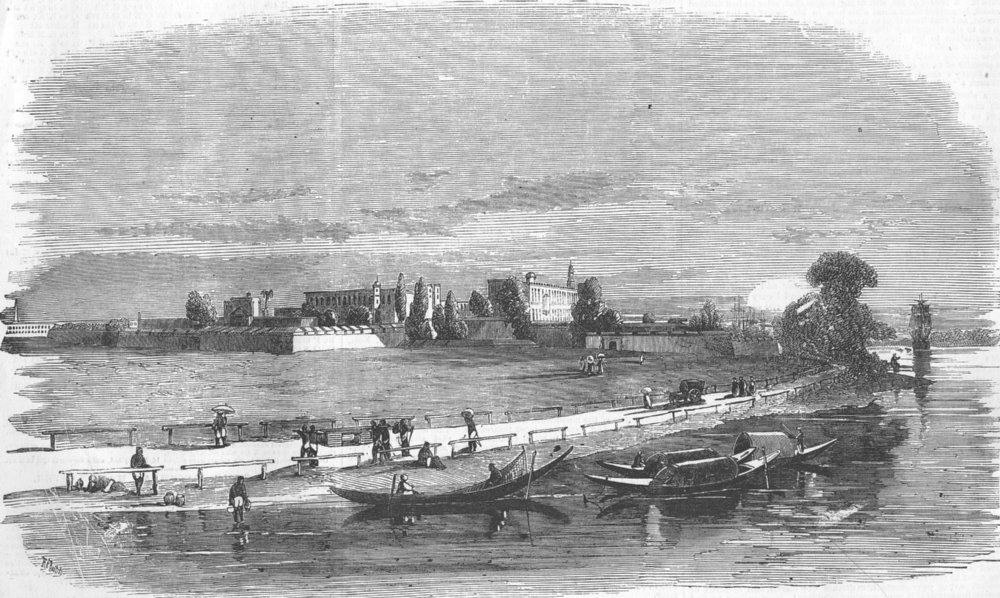
He immediately secured the fort, raised the drawbridges, shotted the bastion guns, placed additional guards over the arsenal, and placed European guards over the officers’ quarters and along the ramparts. He ordered patrols to be carried out uninterrupted the whole night through both inside and outside the fort, thus baffling the would-be mutineers.
Early the next morning, he ordered the 53rd European Regiment to march to Calcutta from DumDum with their families, who would have been practically defenceless if left behind in the DumDum barracks. As soon as the 53rd arrived, the 25th was requested to give up their arms, a proposal they acquiesced to without a fight.
In light of this development and the mounting uncertainty as to what the government was actually doing, several impassioned petitions were sent to Canning by the European and Bengali mercantile communities and the French Consul, offering their services as a volunteer corps to protect the city.
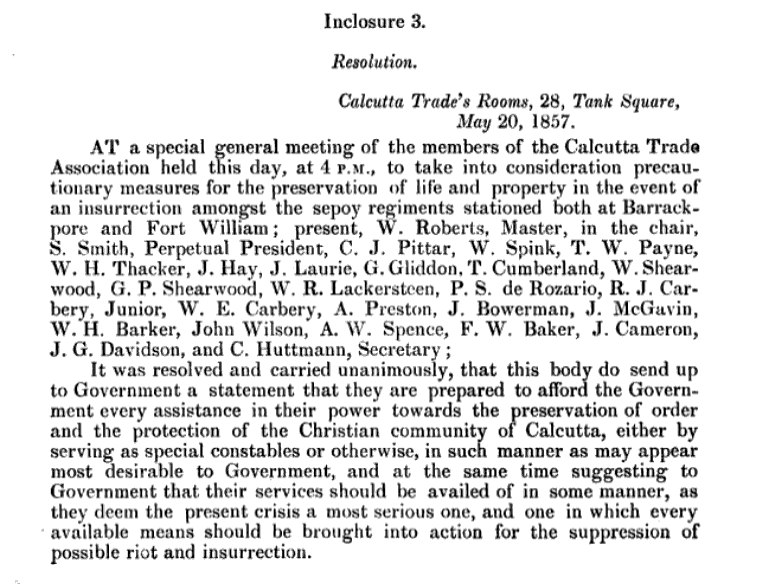
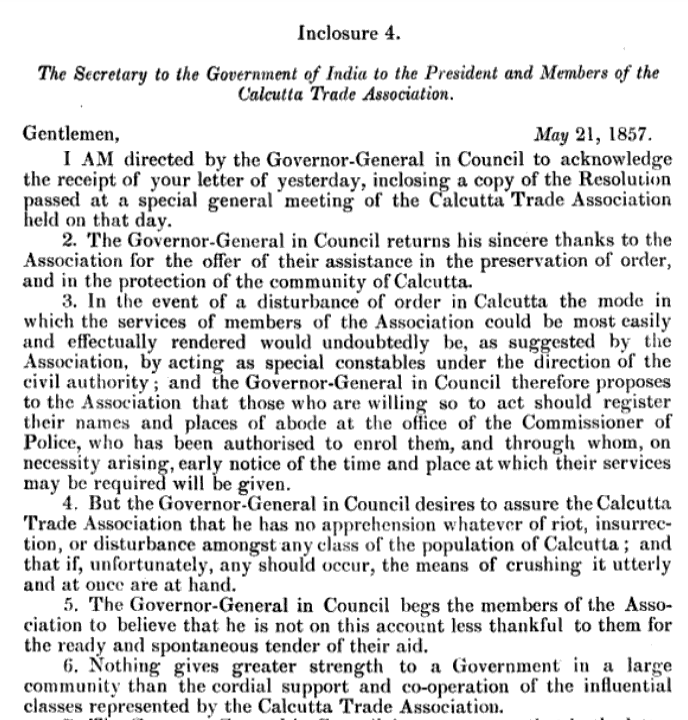
The next to write to the Governor General on the 20th of May was the Masonic Fraternity. Having offered their services “to be employed in such manner as the Governor-General may deem most expidient” – they too were rebuffed. The Armenians in Calcutta decided to try their luck on the 21st.
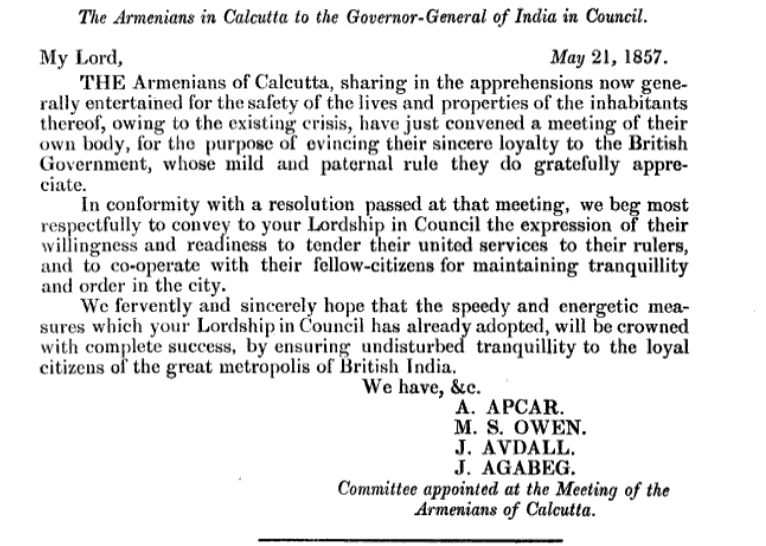
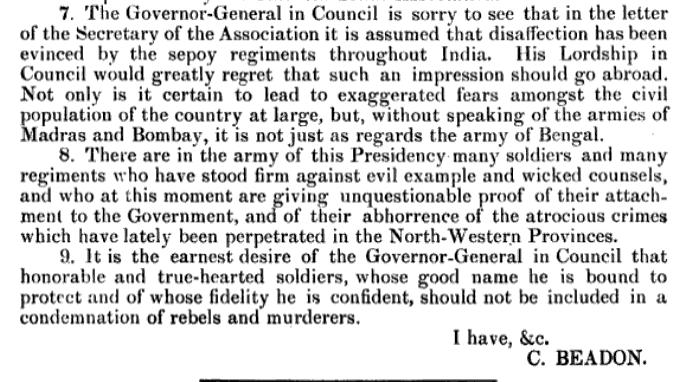
Not that their appeal was met with much more than another curt letter from Mr. Beadon.
The next to try was the British Indian Association.
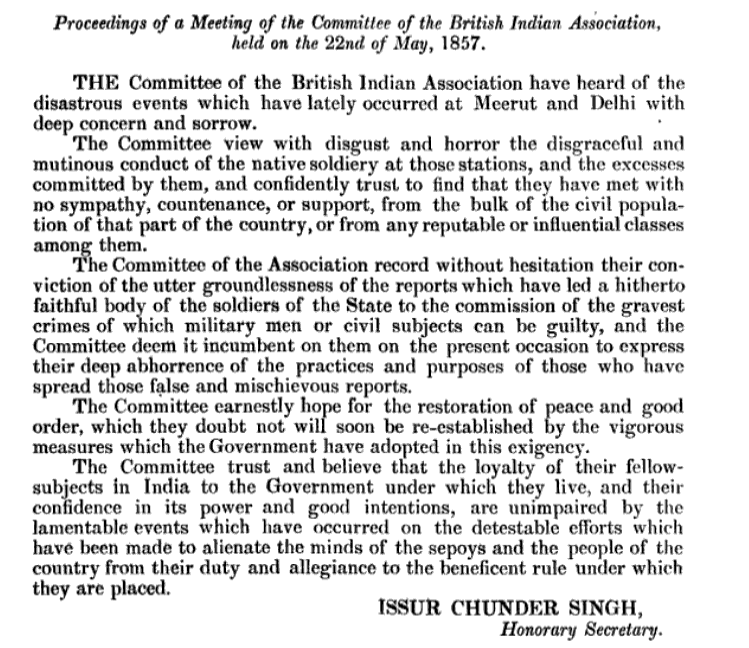
Mr. Beadon was quite beside himself in his reply.
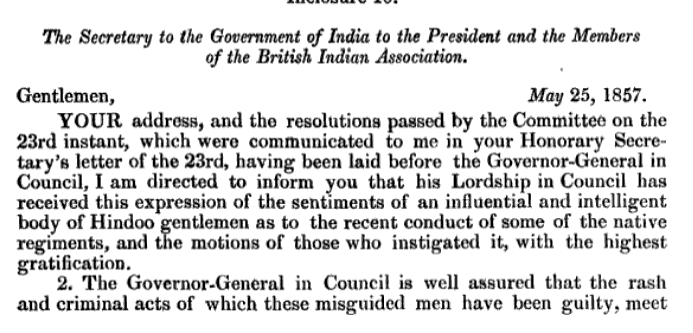
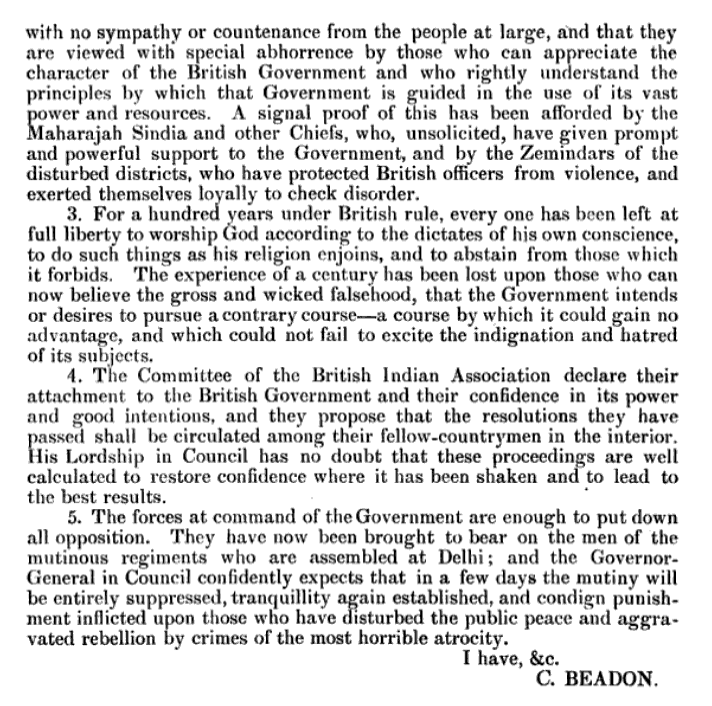
Now Beadon turned his attention to the French.
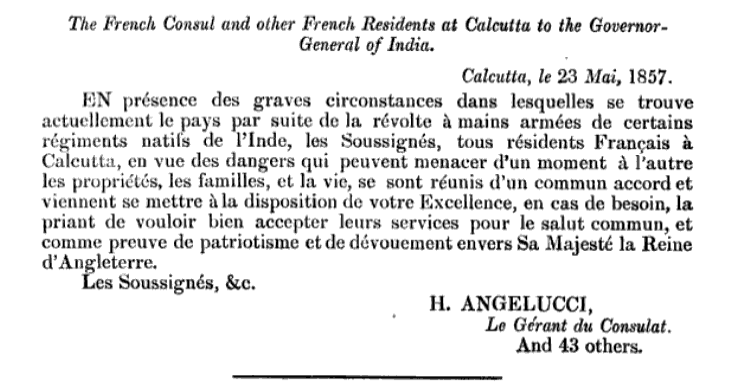
“In view of the grave circumstances in which the country now finds itself as a result of the armed revolt of certain native Indian regiments, the Soussignes, all French residents in Calcutta, in view of the dangers which may threaten their property, families and lives, have come together by common consent and placed themselves at your Excellency’s disposal in case of need, requesting her to accept their services for the common salvation, and as a proof of patriotism and devotion to Her Majesty the Queen of England.”
Knowing full well this was not their war, and they were in no way responsible for it, the French nevertheless had interests in Bengal and decided it was certainly better to throw their lot in with the British, which was probably not the easiest decision they could have made.
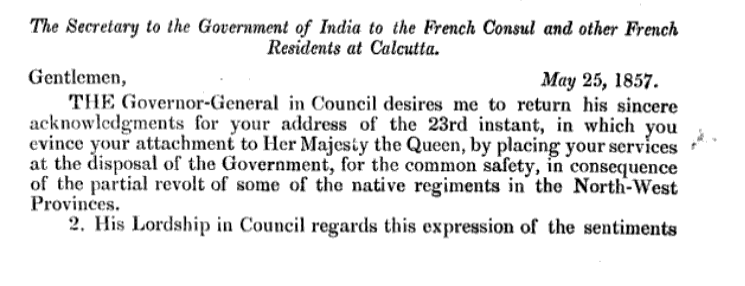
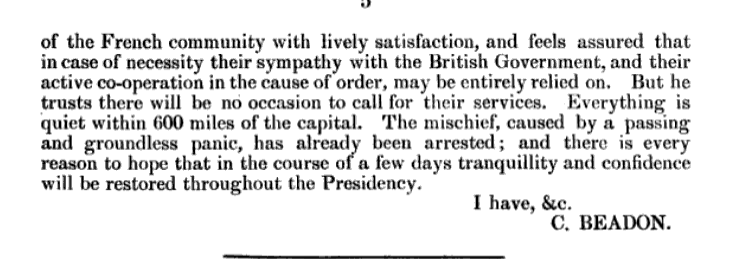
“Everything is quiet within 600 miles of the capital. The mischief caused by a passing and groundless panic has already been arrested, and there is every reason to hope that, in the course of a few days, tranquility and confidence will be restored throughout the presidency.” How wrong Mr.Beadon was.
The petitions kept coming – from Radhakant Raja Bahadur, chairman of the native community offering their services and to publish the meetings of their minutes in the vernacular: Beadon ignored their offer of help but at least he could say that Canning “entirely approves of the intention to print the resolutions in the vernacular dialects of the country, and circulate them amongst the native population.”
Suburban committees were set up – one Hindu and the other Muslim. The Hindus vowed to keep their neighbourhood peaceful, employing “some of the members will alternately take round at every night with the view of catching or detecting any wrong-doer”, further pledging to “put down any internal disdurbance or disorder.” The Muslims expressed their confidence in the government for a swift resolution to the mutiny. The 169 inhabitants of the town and zillah of Baraset signed a letter addressed to Lord Canning – proclaiming they would do “all that in us lies for the maintenance of order and discipline.” What stands out in these letters is the underlying fear – fear they would be blamed for the actions of the sepoys of Meerut and Delhi, and the very justifiable worry that the government would take their wrath out on them. Beadon’s reply to the Muslims was somewhat convoluded.
“The unqualifed and just condemnation which the Mohomedan community of Calcutta have pronounced upon the native soldiers who under the influence of evil councils, have broken their allegiance and committed acts of violence and cruelty, is due in a far higher degree to those by whom they have been deceived and instigated to take this fatal course…”
They could make what they wanted of Mr. Beadon.
What the government was waiting for was order to be restored in Delhi and of it being maintained between Calcutta and Allahabad; on the 20th of May, detachments of the 84th Regiment were dispatched to the North-Western Provinces; and on the 23rd, the 1st Madras Fusiliers under Neill arrived in Calcutta. They were almost immediately sent off in the same direction as the 84th. The government continued to wait for regiments and batteries from Persia, Ceylon, and Rangoon.
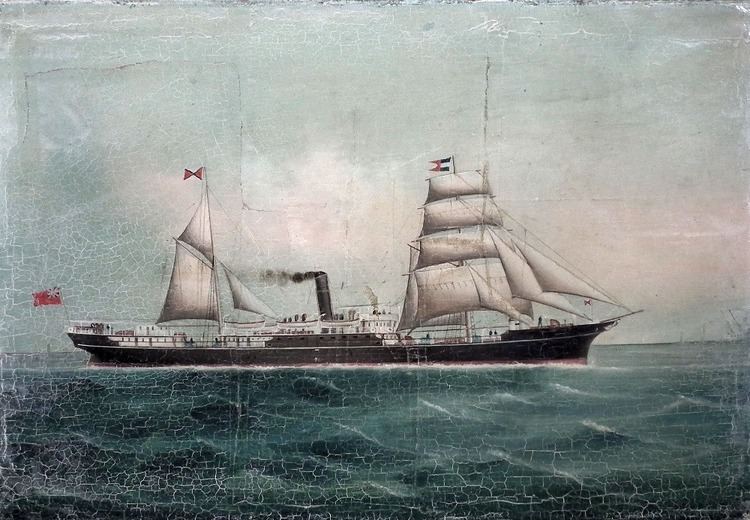
The first troops all arrived in Calcutta mostly at night “like contraband goods,” for upon arrival, the Home Secretary ordered the telegraph to conceal the true names of the ships to disuade any curious spectators and do away with any pomp.
The troops would disembark after dark and would be “smuggled into the Fort.” The reasoning was to prevent any untoward panic among the sepoys who might have thought the arrival of such forces threatening. It would also have forced the government to admit that India was undergoing more than just a passing disturbance.
https://alchetron.com/Apcar-and-Company#apcar-and-company-f0fe2a11-52ee-41f2-8588-26e3726ef34-resize-750.jpg
What the government did not foresee was any danger in the immediate area around Calcutta nor the country south of Allahabad. Yet news now reached Calcutta between the 25th and the 30th of May of the mutinies in Ferozepur, Aligarh, at Mainpuri, Etawah, and Balandshahr. Fear was mounting for Agra, Lucknow, Kanpur, and the surrounding districts. Yet the government remained confident; after all, the retaking of Delhi was imminent, and the troops that were now engaged at Delhi would soon be free to assist the beleaguered districts north of Allahabad. It simply could not be believed that Delhi could withstand the English army.
While Beadon was confident in his line of 600 miles, Canning was feeling a little anxious. On the 31st of May, he wrote a telegram to General Anson:
“I have heard today that you do not expect to be before Delhi until after the 9th. In the meantime, Cawnpore and Lucknow are severely pressed and the country between Delhi and Cawnpore is passing into the hands of the rebels. It is of the utmost importance to prevent this, and to relieve Cawnpore, but nothing but rapid action will do it. Your force of artillery will enable you to dispose of Delhi with certainty; I therefore beg that you will detach one European Infantry Regiment, and a small force of European cavalry to the south of Delhi, without keeping them for operations there, so that Aligarh may be recovered, and Cawnpore relieved immediately. It is impossible to overrate the importance of showing European troops between Delhi and Cawnpore. Lucknow and Allahabad depend upon it.”
While Canning was correct to surmise that the country between Delhi and Allahabad was the weakest point of the British position, he was wrong to suppose that Delhi could be retaken by the artillery.
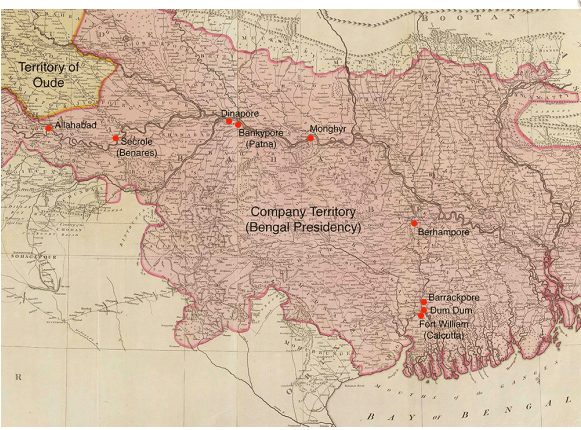
On the 1st of June, the government was still expressing such outward confidence that it did not appear to them problematic that there were only two European regiments to guard Calcutta and the country between it and the town of Dinapore. With the same curtness, they refused the help of 1500 armed European civilians who once again offered to form a volunteer corps and continued to allow three and a half native regiments in Barrackpore, Dinapore and Benares to remain under arms. They were quietly hoping the disaster waiting to happen at these three stations could be delayed until either General Anson would dispatch a regiment from the northwest or until Calcutta itself had enough troops to send to their assistance.
This leaves the question of why the 84th Regiment had been sitting quietly in Barrackpore since the disbandment of the 34th Regiment on the 6th of May. The government offered no explanation – and none was forthcoming. Had they been dispatched to Kanpur on the 6th of May itself, they would have reached there on time – and their presence might have been enough to prevent the outbreak when it happened. As it was, the first detachment did not arrive in Cawnpore until early June, by which time it was too late to prevent the events that cost the lives in Wheeler’s Entrenchment. As mistakes go, it was a fatal one, considering a wing of the 53rd and the Madras European Fusilliers would have soon been marching down the same road.
During the first week of June, news of the mutiny in Lucknow reached Calcutta: the defection of regiments stationed in Oudh and the uprisings in Azimgarh, Benares and Allahabad, followed in short order by the massacre at Jhansi. Suddenly, it became clear that Beadon’s line had some serious flaws.
Oudh was but separated from Cawnpore by a river, and it became clear that garrisoned as Cawnpore was by native troops this close to Lucknow, the situation was alarming. So it was with some relief that the government could watch the arrival to their city of the 64th Foot and 78th Highlanders from Persia, a wing of the 35th Foot from Moulmein, a wing of the 37th Regiment and a company of Royal Artillery from Ceylon. All of these were dispatched without further comment to the northwest with as much speed as possible.
 Mutiny Reflections

Another relative of mine 😉 Orfeur Cavenagh was the brother of my great great grandfather. I wrote about him at https://anneyoungau.wordpress.com/2018/04/17/o-is-for-orfeur/
Sir Orfeur Cavenagh gave his own account of his career in a letter of 1868 included in his private letter book number 11 which included the followng comments about the mutiny:
In 1854, at the special request of the then Governor General Lord Dalhousie, accepted the appointment on his staff of Town Major of Fort William [the fort in Calcutta]. In this capacity as the Governor General’s representative, recommended the numerous alterations in the European Barracks and other buildings as well as general sanitary improvements, which have led to the ordinarily satisfactory state of health of the Garrison.
On the 26th January, 1857, frustrated the design of the Mutineers to seize Fort William (vide statement of Jemadar Durrion Sing, 34th Regiment, N.I.).
Throughout the Mutiny discharged all the arduous duties connected with the command of Fort William and Calcutta, including the charge of the state prisoners, the raising a Corps of Volunteers, the organisation of a body of Native Servants for the use of the troops arriving from England, the management of a large Military Canteen, the protection of the town, the control of all Public Departments, Military Buildings, Hospitals, etc., and the entire charge (arming, clothing and victualling) of all European invalids and recruits, numbering several thousands, of the company’s service. On four occasions received the thanks and commendation of the Supreme Government.
At the close of the mutiny, appointed Governor of the Straits Settlements.
Regards
Anne
LikeLiked by 1 person
Thank you Anne! You have the most fascinating family history. Were any of your relations in Agra too?
LikeLike
At various times relatives were in Agra but not as far as I know at the time of the mutiny
LikeLiked by 1 person
I will be in Delhi soon. Will definitely look for your relatives grave on the Ridge if it is still there. I won’t make it to Calcutta this time.
LikeLike
That would be terrific – it may not have survived the inscription in memory of Captain Smith was published 1910. https://archive.org/details/ALlistOfInscriptionsOnChristianTombsPunjabKashmirNWFPVol1Inscriptions/page/n32/mode/1up
Mathew Reveley’s name is recorded on a tablet in St. James’ Church, Delhi and I guess it is still there.
Another cousin Charles Mainwaring died at Cawnpore and is remembered on a tablet in All Souls Church, Cawnpore. I really liked the film about Cawnpore you linked to in a blog post ages ago (Anniversary)
I was in India in 1989 and didn’t know any family history then. I would love to go back – fantastic country, lovely people, marvellous sites and great food
LikeLiked by 1 person
I am going to Delhi, Meerut, Agra, Cawnpore and Lucknow with side trips to Gwalior, Etawah and Mathura. The church at Cawnpore is definitely on my list.
LikeLiked by 1 person