Warnings
Since the Court of Inquiry, Meerut had been in a state of unrest. The signs and portents of worse to come were rife around the station, with nightly incidents of arson – the empty bungalow of the Quarter-Master Sergeant of the 3rd LC and the old hospital had been burnt, and the next to follow was the Barrack Master’s godown. Rumours continued to circulate, but no one seemed to have been too concerned. After all, this was Meerut, the strongest station in this part of India.
His last duty to his men done, Gough returned to his quarters. That night, a native officer of his troop came to him under the pretence of “making up the accounts.” After a moment, he reported to Gough that a mutiny of the native troops was imminent and would happen no later than the very next day. The Native Infantry was going to rise, and with them, whatever was left of the 3rd. They were going to free the prisoners. Gough reported immediately to his colonel, who scoffed at the very notion of an uprising. He then approached the brigadier, whose reaction was the same. With a sense of foreboding, Gough returned to his bungalow, unable to shake off the dread he now felt.
In the Sudder Bazaar, where many of the Indian troops went after the fettering parade, they had been jeered at by the civilians and then no less by the bazaar prostitutes, who called them cowards. Instead of sympathy for their sorrow, they found dirty looks and insults.
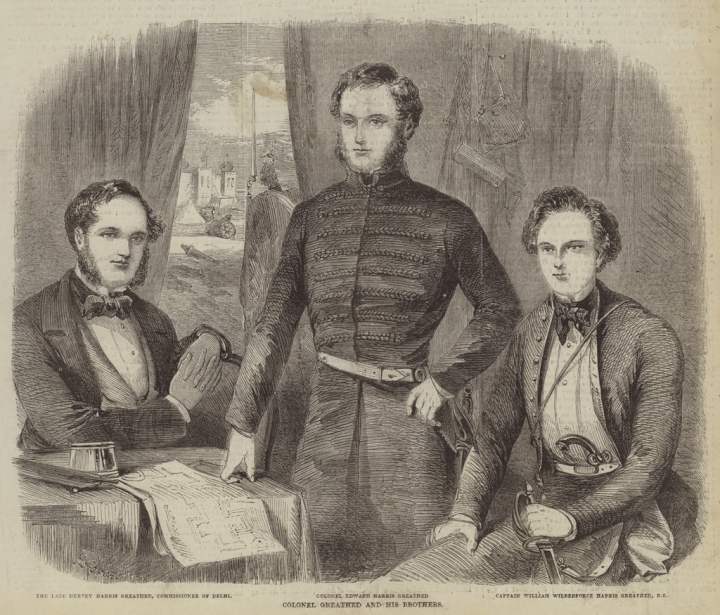
Hervey Greathed had been out of Meerut at the time of the sentencing hearing; he rushed back to be with his wife, Elisa and arrived back on the 9th. At a dinner later that evening with Colonel Custance of the Carabineers, Elisa mentioned hearing about placards in the city that called upon Muslims to rise up and slaughter the English. It was a passing remark, and no one paid much attention, meeting it with “indignant disbelief.”
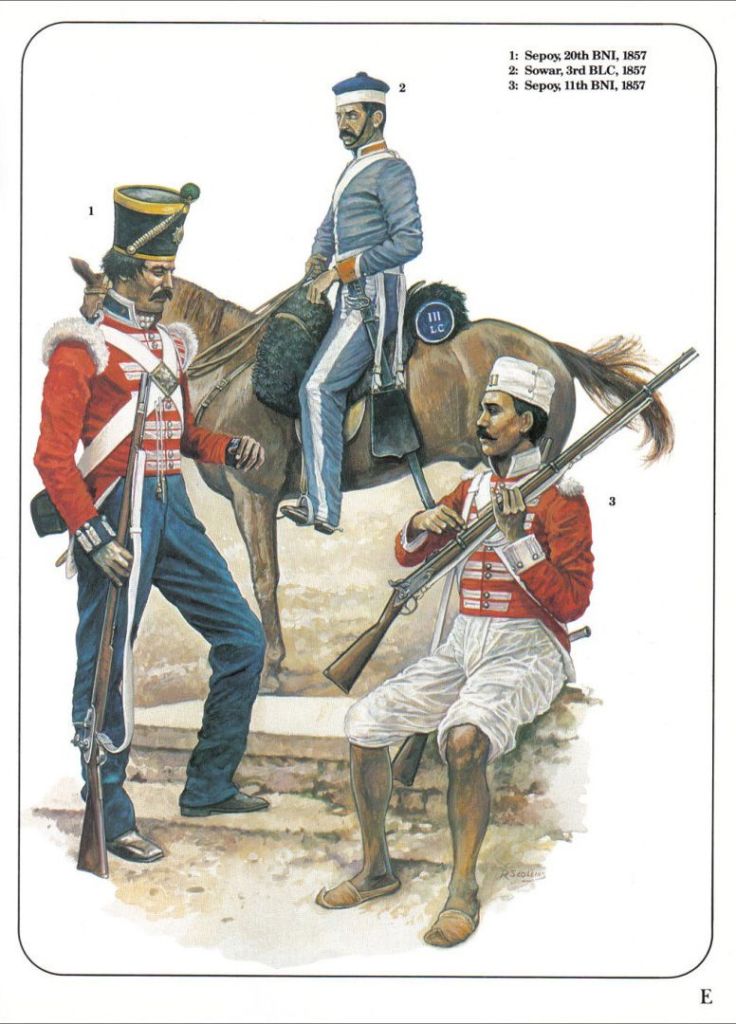
On the morning of Sunday, the 10th of May, the ayah of the Reverend Rotton implored him to cancel services as an uprising was imminent. He paid her no mind and continued as usual. The morning service was well attended, with Gough and McNabb included in the assembly. It was a hot and stifling day, and the men were in their summer uniforms. Gough could not help chaffing McNabb for wearing the wrong type of lace on his alpaca frock coat, something undoubtedly Hewitt would never stand for. The service passed quietly, and afterwards, everyone returned to their homes, except McNabb, who went to spend the day with some friends of the artillery. Even though Elisa Greathed remarked the day had “dawned in peace and happiness,” not all was well in Meerut. The native troops of the station were morose, and some were even weeping; the shock of seeing their comrades humiliated in such a fashion was not something they could forget. It was a double-edged sword — on one hand, sympathy for the 85 men was heavy in the hearts of the native troops, but at the same time, while the 85 had stood their ground, the others “had become stooges for the Christian sahibs.” It was further proof of what fate awaited them when their turn came to take the cartridges. They could no longer trust their British officers.
Many servants remained absent from their places of work, while others continued trying to warn their employers of things to come. Rumours from the bazaar continued to circulate freely throughout the day. By the afternoon of the 10th, events were coming to a head.
Fuelled by untrue stories of further fetters — some 2000 in number supposedly being prepared for the rest of the troop — and that the British were coming to wrest control of the magazine from the 20th Bengal Native Infantry, the sepoys were finally pushed out of control and by evening, hysteria broke out. In the bazaar, a cry came up that the Europeans were coming – whether to destroy the bazaar or destroy the troops themselves no longer mattered. The fear that now infected the troops spread over to the civilian population. In fact, the Europeans weren’t coming, but the very idea was enough to set the disaster in motion. The Europeans who were in the bazaar became easy targets for the first signs of rage.
The subsequent disaster at Meerut will be described in the next chapter.
Sources:
Gough, General Sir Hugh – Old Memories (London: William Blackwood & Sons, 1897)
Greathed, H.H. – Letters Written During the Siege of Delhi, edited by his Widow (London: Longman, Brown, Green, Longmans & Roberts, 1858)
Keay, John – The Tartan Turban: In Search of Alexander Gardner (Kashi House, 2017)
Palmer, J.A. B. – The Mutiny Outbreak at Meerut in 1857 (Cambridge University Press, 1966)
Rotton, John Edward Wharton – The Chaplain’s Narrative of the Siege of Delhi from the Outbreak at Meerut to the Capture of Delhi (London: Smith, Elder & Co., 1858)
Wagner, Kim A. – The Great Fear of 1857 -Rumours, Conspiracies, and the Making of the Indian Uprising (Oxford: Peter Lang Ltd., 2010)
A History Of The Reigning Family Of Lahore: Smyth Carmichael G. Major : Free Download, Borrow, and Streaming : Internet Archive).
 Mutiny Reflections
Not much has changed since those days when one considers the continuum of incompetence, posturing and grandstanding of the military establishment to this day. As we are witnessing once more similar occupational debacles of western might right now.
LikeLike
Afghanistan has been called the Graveyard of Empires and with good reason. But everyone seems hell bent on proving their might over the region. The armies of today could learn a lot if they would read about the past, even mutiny literature would be instructive on how not to treat an army and a people.
LikeLike