1907 – Fifty Years After the Mutiny
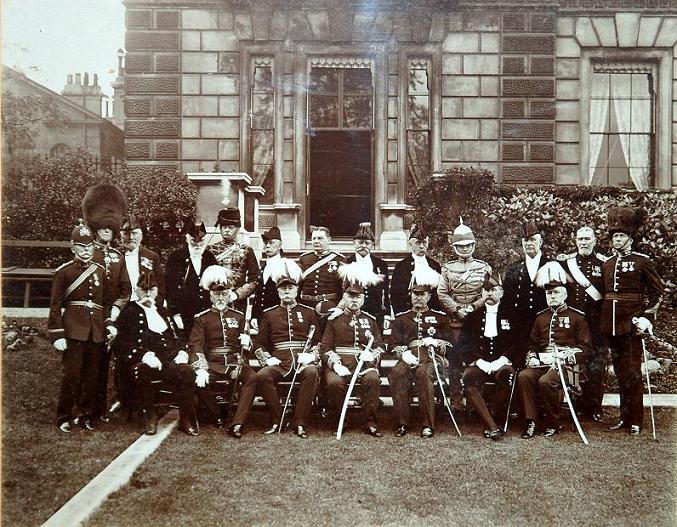
Standing left to right: Surgeon-Major H.M. Greenhow, Colonel W. Cleland, Captain J. Robertson, Mr Simon Martin, Colonel John Pilkington Blake, Colonel W. Charsley-Thomas, Colonel J. Bonham, C.B., Mr L.E. Rees, Mr J. Berrill, Colonel G. Stewart, C.B., Captain J.B. Pearson, Major C.H. Dale, Lieutenant-Colonel A.M. Graeme.
Sitting: Mr C. Dodd, Major-General J. Ruggles, Major-General H. Cook, General Sir Digby Barker, K.C.B., Lieutenant-Colonel Sir Clerk-Rattray, K.C.B., Major J. Finlay, Major-General F.E.A. Charmier, C.I.E.
The 50th Jubilee brought the two dinners together on 6 June in a joint commemoration: held at the Holborn Restaurant under the chairmanship of Lt. General J.J. McLeod Innes, VC, Mrs R.H.M. Aitken was chosen to give a speech, representing the “Ladies of the Garrison”.
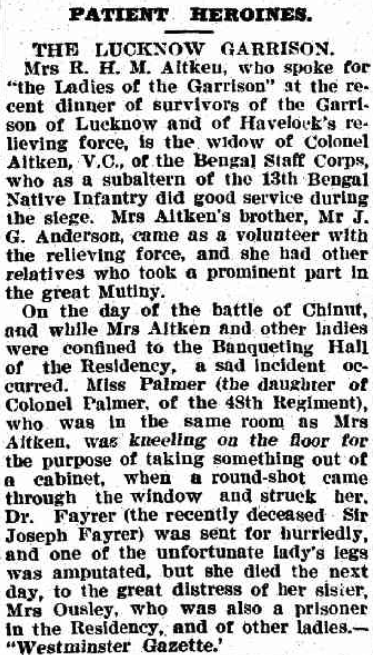
Likewise, in Australia, the jubilee did not go unnoticed. Yearly events would continue, albeit on a smaller scale, and the memory of the mutiny continued on.
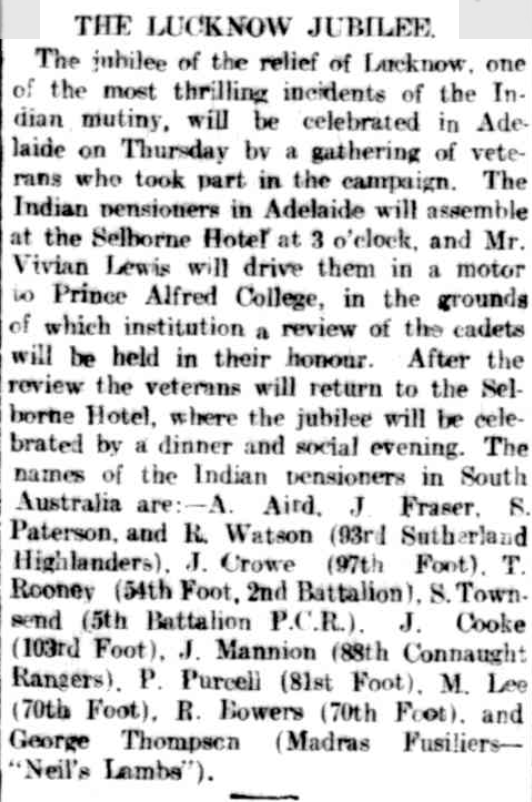
The Grand Events
The Melbourne Celebrations of November 1907
Not to be outdone, in Australia, a grand event took place at the Victoria Barracks in Melbourne on 23 November. Mr Ewing, the Minister of Defence, “entertained the survivors of the military and naval forces engaged in the Crimean and Indian Mutiny campaigns…” The date had been suggested by the final evacuation of the Lucknow Garrison 50 years previously; some 80 or 90 men who had taken part in the Crimea or the Mutiny (in some cases, in both wars) were still alive at the time in the state. Two were unable to attend as they were bedridden, one was forbidden from attending by his wife (as he stated, in an apology letter to Mr Ewing) and several others simply lived too far away from Melbourne to attend. In the end, 70 veterans did come and they were deemed to be “hale and hearty.” The oldest attendees were 85 and none of them was under age of 70. Poignantly, several were showing their “records of service in an armless sleeve pinned across the breast….every man has an old, discoloured sheet of paper, generally frayed at the edges, and sometimes signed by names that live in history, containing a record of his services. These are taken from tobacco tins and purses and reverently handled. A little inquiry discloses strange tales, sometimes a life-story summed up in a few sentences.” One of the guests was Lieutenant H.R. Beetson, aged 70 and a one-time member of the Bengal Yeomanry Cavalry.
At 6 pm, the veterans were drawn up in two lines on either side of the barrack school room, the Crimea men on one side, the Mutiny men on the other. The Governor-General, Lord Northcote, then passed down the lines, shaking hands with each man. Dinner was then served, and the men were given a new pipe and a tin of tobacco, compliments of Lord Northcote and Mr Ewing. In honour of the veterans, the evening continued with a spectacular event. A military tattoo, featuring a parade of the massed bands, the Lancers put on a display with their horses (including quadrilles); the artillery had mounted “a quick-firing gun and discharged ten shots in record time.” Not to be outdone, the signalers “gave an exhibition of their skills,” and the infantry formed square and “repulsed an imaginary enemy with great expenditure of powder.” However, the best was saved for last and it was time for a re-enactment of the Relief of Lucknow.
“Soon parties of Sepoys deployed and laid siege to the northern annexe, which, by a stretch of the imagination, was assumed to be Lucknow. Their fire was returned with vigour, but it was evident that the garrison was in sore straits. Frantic signals by lamps and flags were made from the walls, but the attack grew stronger. At last, the skirl of the bagpipes was heard, faintly at first, but growing momentarily stronger. Soon, the advanced party of the red coats appeared in sight and was supported by others, including a strong naval brigade. Caught between two fires, tho Sepoys put up a gallant resistance. By short rushes and volley fire, they were driven back; however, and yard after yard was gained by the Britishers, the discharge of the guns of the naval men materially contributing to the result. The ambulance men picked up the wounded and carried them away on stretchers or across their backs. Shortly, the Sepoys were beaten, and those who were not in extremis made off round the Exhibition annexe. Lucknow was relieved, the veterans then marched round the arena amid the frantic applause of the 12,000 or 15,000 spectators. ( The Mercury (Hobart, Tas. : 1860 – 1954) Thu 28 Nov 1907)
Following the playing of the National Anthem, the event was brought to a close.
Golden Commemorative Dinner of the Indian Mutiny Veterans
However, on December 23, 1907, a far grander event took place, commemorating not just Lucknow, but all the veterans of the mutiny.
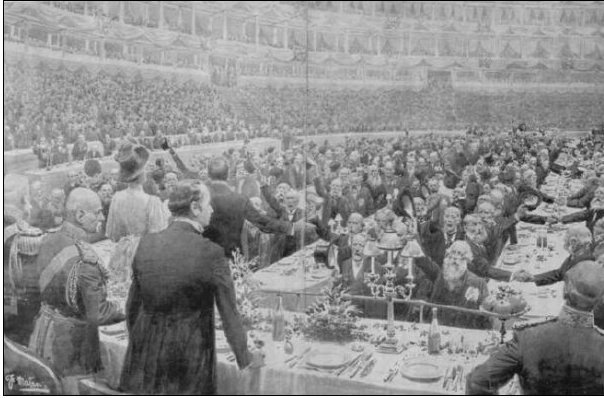
A dinner in commemoration of the heroism and endurance of the British troops in 1857, the year of the great mutiny, was held in Albert Hall yesterday and was attended by 700 officers and men, veterans of the historic campaign.
Field Marshal Lord Roberts presided, and he and Lord Curzon, late Viceroy of India, delivered impressive speeches. The chairman read a message which had been received from the King, expressing his Majesty’s great gratification that so many survivors of the campaign were present on that interesting occasion. His Majcsty added, “I am confident that the whole Empire deeply appreciates the conspicuous services and the gallantry and endurance which, under Providence, saved the Indian Empire from a grave peril.” Lord Milner, Viceroy of India, and Lord Kitchener, Commander-in-Chief of the Indian army, also telegraphed felicitations.
The commemoration dinner was organised by the proprietors of the “Daily Telegraph,” and officials of the War Office and the Admiralty co-operated. Owing to various circumstances, 660 mutiny veterans were unable to participate in the function, and to each of these Christmas hampers were sent. (The Age, 25 Dec. 1907)
The Times had their own variation on the event:
At the Albert memorial the commemoration began with a review by Lord Roberts, witnessed by a large gathering of the public. The band of the 1st Duke of Cornwall’s Light Infantry, the old 32nd Foot, the defenders of Lucknow, played a selection of music.
The old soldiers were enthusiastically cheered as they took their places. All wore their medals conspicuously displayed. Many who were lame were tenderly helped by Guardsmen or their friends, but the majority were upright, well-preserved men who bore their years bravely. The last piece of music before the speeches was “The Campbells are Coming” by Piper Angus Gibson of the Black Watch, the only surviving piper of those who took part in the Mutiny.
Curzon made the chief speech and finished to loud cheers with a toast to the surviving veterans among them ‘the hero who was still their hero in 1907, endeared to the nation by half a century of service and sacrifice not one whit less glorious than that of his youth.’ That hero, a moment later, was on his feet to reply, greeted by prolonged cheers. Modestly, he pointed out that those present were mere boys at the time and they must all feel that this commemoration was an honour not paid to them but to the memory of those by whose skill and courage ‘that great epoch’ in our Indian history was brought to a successful close. ” – The Times, January 1907
And of course, Rudyard Kipling, born seven years after the mutiny composed a poem in their honour:
The Veterans

TO-DAY, across our fathers’ graves,
The astonished years reveal
The remnant of that desperate host
Which cleansed our East with steel.

Hail and farewell! We greet you here,
With tears that none will scorn—
O Keepers of the House of old,
Or ever we were born!

One service more we dare to ask—
Pray for us, heroes, pray,
That when Fate lays on us our task
We do not shame the Day!
A few days later, another event took place but garnered only a cablegram from London.
Lucknow Veterans Saluted
Remarkable scenes were witnessed at Lahore on Saturday in connection with the celebration of the jubilee of the formation of Hodson’s Horse. The two regiments which fought at Delhi and Lucknow were formerly known as the 9th and 10th Bengal Lancers. Lieutenant-Colonel M. Cowper, Commandant of the 10th Duke of Cambridge’s Own Lancers, led the march past and the soldiers saluted the retired native veterans who were on the parade ground. This act of recognition evoked a spontaneous demonstration of loyalty on the part of the native officers and soldiers, who cheered warmly. They afterwards solemnly declared that they had not participated in recent agitations and abominated all seditionmongers.
(The Border Morning Mail and Riverina Times (Albury, NSW), Tue 31 Dec 1907)
 Mutiny Reflections