Life & Death
There had been little time to consider the sanitary conditions before the siege began, and after, improvements in this regard were carried out haphazardly. The compound was never meant to house this many people and whatever facilities were available were soon overwhelmed by the sheer storm of humanity. Besides smallpox, cholera and dysentery, lice were commonplace. The ladies jokingly called these pests “small infantry” and many cut their hair as a result. Scurvy made its appearance as the siege wore on due to the lack of fresh fruit and vegetables, even though some posts had started boiling grass to make up for the lack of green stuff on their plates. One of the harbingers of disease in the camp, too, were the myriads of flies that settled on the place – it is just as well that time does not preserve the smells of the Lucknow Residency. The unwashed population, together with the rotting corpses of unburied animals, the shallow graves hurriedly dug and covered with a small layer of dirt, coal and lime, questionable sanitary arrangements, the heat, dust and finally the humidity, which followed the rains, made it a perfect cesspool of disease.
The Residency had an ample supply of doctors, 11 in all, including three Indian ones, apothecaries and assistants; however, the conditions under which the men worked were far from ideal. Although medicine had made advances in the 19th century, there was still much left to be desired. It was a hard, uncompromising medicine which, while relying on the doctor’s skills, left much up to the patient in terms of recovery, with fitter men standing a better chance of survival. However, it was a time before penicillin, before the causes of sepsis were fully understood, and above all, a kill-or-cure attitude prevailed in the hands of many of the most well-meaning surgeons.
Before the advent of the Listerine principles of antiseptic surgery, which would not be in common practice a full 13 years after the mutiny, amputation was considered the safest treatment for compound injuries to limbs. Although the hazards of sepsis following the surgery were well known and still accounted for most of the post-operative deaths, at Lucknow this took on staggering proportions. 17 out of 27 amputations performed on Indians during the siege proved unsuccessful, among the Europeans only 2 cases are known to have survived at all. The conditions in the hospital were so abhorrent, that Dr. Home, who arrived with Havelock’s force, witnessed amputees with sloughing, maggot filled wounds, laying on the floor on nothing but coats, covered in flies. Limbs were discarded in ugly heaps just outside the hospital, to be carried away by sweepers when any could be found. The hospital itself – in this case, the Banqueting Hall – was dark as the windows had been barricaded and the air was positively poisonous, as the only door which could be safely opened, was at the far end of the long hall. It is no wonder that officers chose to be cared for at their respective posts.
Following the Battle of Chinhat, one young officer, Lieutenant Farquhar had to avail himself of the services of the surgeons, with hardly the pleasing result he had expected. Having been shot in the face, he let Fayrer and Boyd set to work “They put me to a great deal of pain in probing the wound and taking out pieces of the fractured jaw; but they could not make out what had become of the ball, and I was not wiser. The doctors believed at first that it was all up with me, thinking that the bullet had lodged in my head.” The mystery solved itself some ten days later when Farquhar discovered, instead of the ball being in his head, it was in fact in his stomach. “…I had swallowed and digested it; — my digestion must have been good at the time! The ball, on going through my jaw, must have taken the direction of my throat, and I must then have swallowed it, together with the blood collecting in my mouth. The ball, when it struck me, must
have been getting spent. Otherwise, it would probably have gone through both jaws, and come out on the opposite side.”
An opium tincture, called laudanum, was also widely resorted to as a pain killer but was also touted as an elixir for everything from dysentery to rheumatism. Some ladies in Lucknow kept a small supply of the drug for their personal use – if the Residency were to be forced by the rebels, they planned to poison themselves and their children to save themselves the horror of murder. It was a measure deplored by some – Julia Inglis believed her husband would have the grace to shoot her instead, while Georgina Harris, the reverend’s wife, believed suicide, even in such circumstances, was abhorrent. She prepared herself to meet whatever God intended.
Among the diseases at the Residency, which included the dreaded smallpox, dysentery was common, and cholera made its unwelcome appearance. For this latter ailment, there was no sound reasoning at the time; it was mostly believed that cholera was an airborne disease, although it had been proved in London that it was, in fact, spread by contaminated water. Unfortunately, in practice, it fell somewhere between both as medical officers could, through experience, make an argument for both causes. Not that this helped anyone, since there was no cure. Surgeon Greenhow had his remedy for cholera, consisting of a pill containing both opium and creosote, which he recommended consuming with congee water and dilute sulphuric acid. He further found that treating patients with tea, beef tea, arrowroot, rice, minced meat and sago aided in recovery. Unlike the general school of thought, Greenhow forbade his patients from drinking alcohol, which, in his estimation, was debilitating rather than curative. Dr Fayrer, working next to Greenhow, seemed completely unable to treat the disease.
While cholera would kill, diarrhoea and the other stomach complaint, dysentery, were curable, and Dr Greenhow found that the best was rest and the regulation of diet. While rest could be had in a limited form, diet was difficult. He did, however, recommend the following: “The indications were to avoid greasy cookery, meat and chuppaties; while rice, soojee, arrowroot, sago and tea, and subsequently broth, minced meat and port-wine were allowed. For children, port-wine, soojee or milk and ground rice, with some sugar added, were found to constitute the best diet; and, after a time, minced meat and rice could be borne and were relished.” One lady, suffering from a complaint of the bowels, listened patiently as the doctor recommended, she had “a change of air”, to which the lady replied, rather sarcastically, that it It was a good thing he did not recommend she take a voyage by sea.
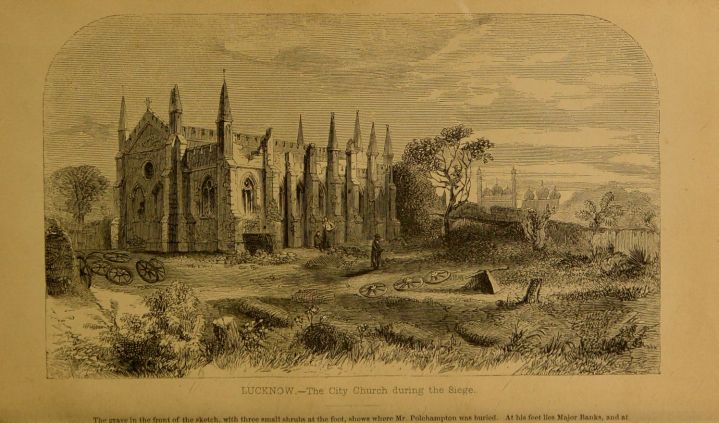
Much of the nursing at the Residency was given over to the ladies, and as some of them, particularly Mrs Harris and Mrs Polehampton, both had trained as such; as wives of men of the cloth, they viewed nursing not just as a salvation for the needy but, by extension of their husbands’ work, a treatment for the soul. Following the death of their husbands, both Mrs Case and Mrs Polehampton took to nursing as a way to assuage their grief. On the whole, the women in the Residency, next to looking after their families, were independent and able to take care of any invalids in their respective homes. In critical cases, they would refer to the doctors in case of need, but they tried to alleviate the sufferings of the other women and their children within the confines of their posts and with what knowledge they had. They attended to each other in times of need and adopted orphaned children without question when their friends died.
Unfortunately, hardly a day passed at the Residency when there wasn’t a death. While everyone could agree that the loss of Sir Henry Lawrence was a catastrophe, and his suffering in the two days it took him to die was beyond horrifying, it did occur at the very beginning of the siege. Over the next weeks, the garrison would see and suffer the deaths of children, dying of hunger, of their friends, either through injury or disease, and if that was not enough, a few people simply could not handle the siege and committed suicide. Both Rees and Inglis mention several suicides that took place in the early part of the siege; however, out of respect to the surviving families, they do not mention any names. Julia Inglis and Captain Wilson recall one name, that of Captain Graham, who shot himself in his bed on the 5th of September. His death was brought on by a fit of temporary insanity, according to Captain Wilson. Driven to despair by the death of his infant daughter, perhaps Graham did not see any point in the endless misery. Unfortunately, he left behind a young widow and another daughter who soon joined him in his grave. His poor wife survived alone.
Another man, Lieutenant Fullerton, who supposedly fell from the upper storey of the Banqueting Hall while either delirious or walking in his sleep, seems to have been exempt from this rule. Perhaps his death was vague enough to be attached to his name.
Other incidents of a more human nature occurred during the siege, which show that, after all, the garrison was still manned by people suffering under immense stress. Two doctors fell into fisticuffs when one slighted the other on his performance; an argument over a partition curtain between two wives led to a fight between the husbands in which one shot the other dead; women bickering over space and place, for Maria Germon, a tremendous source of irritation was Mrs Boileau’s noisy, screaming children. Rees noted quite sanguinely that a siege is the best place to learn the truth about your fellow man!
Sources:
Anderson, R. P. A Personal Journal of the Siege of Lucknow. Edited by T. C. Anderson. London: W. Thacker & Co., 1858.
Bartrum, Katherine Mary. A Widow’s Reminiscences of the Siege of Lucknow. London: James Nisbet and Co., 1858.
Fayrer, Joseph. Recollections of My Life. Edinburgh: William Blackwood and Sons, 1900.
Gubbins, Martin Richard. An Account of the Mutinies in Oudh, and of the Siege of the Lucknow Residency. London: Richard Bentley, 1858.
[Harris, G.] A Lady’s Diary of the Siege of Lucknow: Written for the Perusal of Friends at Home. London: John Murray, 1858.
Hilton, Edward. The Tourist’s Guide to Lucknow. Lucknow: Murray’s London Printing Press, 1891.
Home, Anthony Dickson. Service Memories. Edited by Charles H. Melville. London: Edward Arnold, 1912.
Hutchinson, George. Narrative of the Mutinies in Oude: Compiled from Authentic Records. London: Smith, Elder & Co., 1859.
Inglis, Julia Selina. The Siege of Lucknow: A Diary. London: James R. Osgood, McIlvaine & Co., 1892.
Innes, J. J. McLeod. Lucknow and Oude in the Mutiny: A Narrative and a Study. London: Innes & Co., 1895.
Joyce, Michael. Ordeal at Lucknow: The Defence of the Residency. London: John Murray, 1938.
Kavanagh, T. Henry. How I Won the Victoria Cross. London: Ward and Lock, 1860.
Maude, Francis Cornwallis. Memories of the Mutiny. 2 vols. London: Remington & Co., 1894.
Ruutz-Rees, Leopold Edward. A Personal Narrative of the Siege of Lucknow: From Its Commencement to Its Relief by Sir Colin Campbell. London: Longman, Brown, Green, Longmans, & Roberts, 1858.
 Mutiny Reflections
This proves once more, we are only able to hold up our so-called sophistication, ethical standards and rationality, as long as our life’s and comfortable living conditions are not under threat. As shocking as it must appear to us over civilised members of the human species, extreme circumstances as those you have described, inevitably revive the survival instincts of the beast.
LikeLiked by 1 person