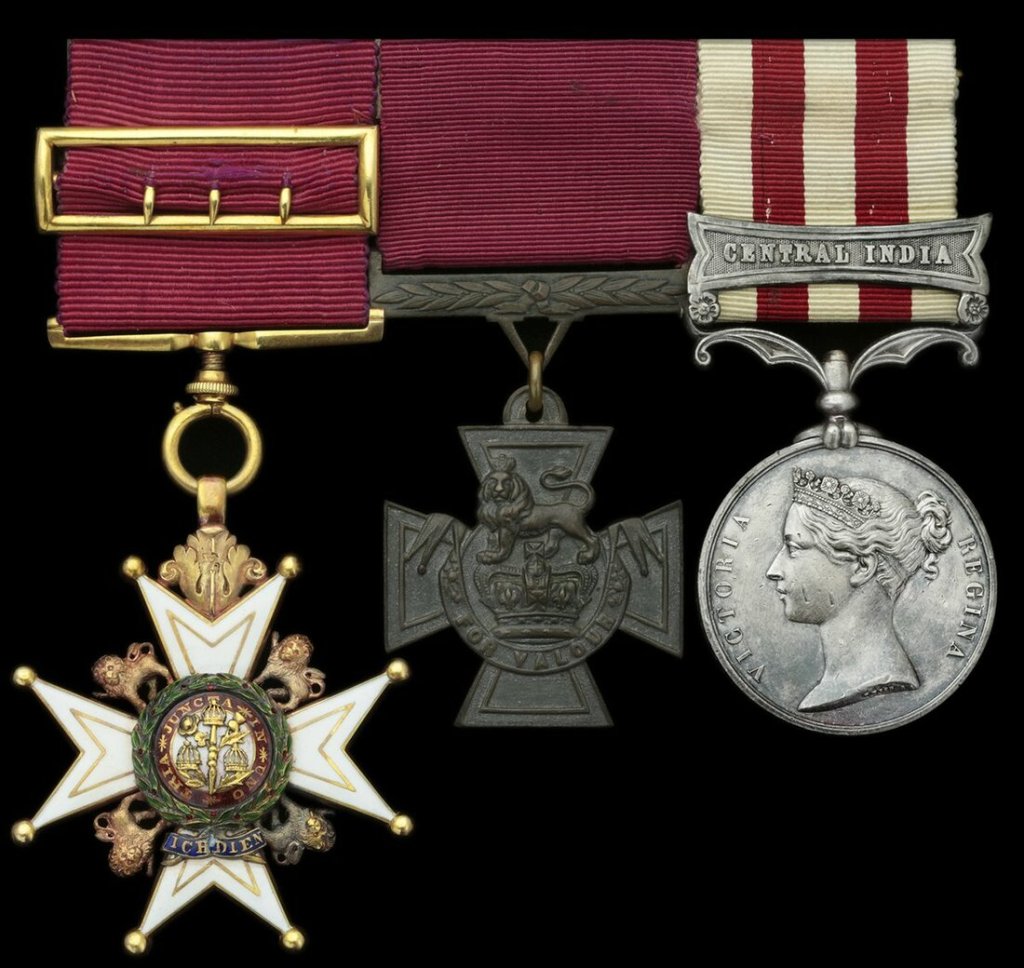
For having on two occasions distinguished himself by his gallant and daring conduct.
1. On the night of the 12th of August 1857, at Neemuch, in volunteering to apprehend 7 or 8 armed mutineers who had shut themselves up for defence in a house, the door of which he burst open. He then rushed in among them and forced them to escape through the roof; in this encounter, he was severely wounded. In spite of his wounds he pursued the fugitives, but was unable to come up with them, in consequence of the darkness of the night.
2. On the 23rd of October 1857, at Jeerum, in fighting his way most gallantly through a Body of rebels who had literally surrounded him. After breaking the end of his sword on one of their heads and receiving a severe sword cut on his right arm, he rejoined his troop. In this wounded condition, and with no other weapon than the hilt of his broken sword, he put himself at the head of his men, charged the rebels most effectually, and dispersed them.’ (V.C. London Gazette 25 February 1862)
James Blair had been born in Neemuch, the son of Captain E.M. Blair of the Bengal Cavalry, on the 28th of January 1828. He was commissioned as 2nd Lieutenant, 2nd Bombay Light Cavalry on the 10th of June 1844 and gained his lieutenancy on the 19th of March, four years later.
The 2nd Bombay Light Cavalry was sent up to Central India in June 1857 as one of the regiments that would replace the Bengal regiments that had mutinied. Marching from Deesa, they were part of a larger force, consisting of four hundred men of H.M.’s 83rd Regiment, the 12th Bombay Native Infantry and a troop of European Horse Artillery. Brigadier George Lawrence sent 100 men to reinforce the Mairs at Ajmer; a portion of the forces would remain at Nasirabad while the rest would proceed to Neemuch. The sight of the destroyed station where Blair would have spent at least some of his childhood was undoubtedly a melancholy return. However, he would have other concerns.
Not everything was well with the Bombay troops. There had been signs of dissatisfaction affecting, by and large, the Purbeahs, in other words, the men from the Bengal Presidency who called Oudh and not Bombay their home. As they were in both the Bombay infantry and, to a lesser degree, in the cavalry, there was some cause for concern. As soon as they laid foot in Neemuch, two days after their arrival, Colonel Jackson, commanding the Bombay troops, was made aware that indeed something more serious was brewing and a plot was revealed. The mutinous elements of the 12th Bombay Infantry and the 2nd Light Cavalry were intending to rise and murder all the Europeans in Neemuch. His answer was to march the 83rd down to their lines and attempt to capture the ringleaders.
In the ensuing scuffle, things could have gone better. A portion of the mutineers dashed to a house and barricaded themselves. Out on the grounds, one private of the 83rd was killed. For Lieutenant Blair, there was little for it but to evict the rebels from their retreat, which he did by breaking open the door. The mutineers had not been slow on the uptake, and they quickly escaped through a hole they had cut out of the thatched roof. Blair, though injured, dashed after them, only to lose them in the dark.
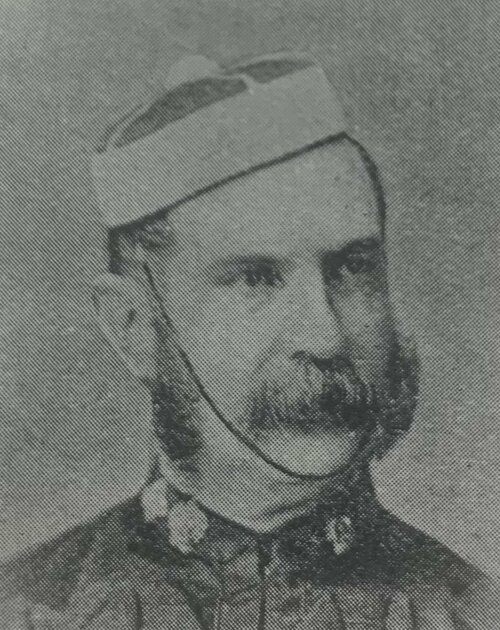
Blair had little to do but recover from his injuries and wait for the next fight. This came rather sooner than anyone thought when Captain Showers decided, of his own volition, to take Nimbahera out of the hands of the Tonk Nawab. Blair managed to get out of this affair unscathed, but had it gone wrong, there would most likely have been no citation at all for this courageous young man.
As if one foolhardy captain was not enough, Blair appears to have been surrounded by men who were desperate for him and his comrades to lose their lives. So it was at Jiran when Captains Tucker and Simpson decided to put on a show of force against the rebels. They had taken little heed to discover how many rebels they were facing and, indeed, seemed to believe that a show of force would be enough to scatter them. They were wrong. Tucker lost his life and his head, and Simpson received a smack over his head that was so hard, he was still on the sick list in October.
For Lieutenant Blair, Jiran nearly proved fatal. Captain Read was killed leading his men; Captain Soppitt was quickly wounded — the men, on seeing their officers fall, faltered and started to retreat. Emboldened by this reverse, the rebels rushed on the infantry. They quickly took possession of the mortar and were nearly on the guns when Captain Simpson, with Lieutenants Blair and Le Geyt and Riding-Master Steers, charged with one squadron and beat them back, retaking the mortar. Simpson was severely wounded in the head, Lieutenant Blair was cut by a tulwar, and Le Geyt was shot, though not mortally. Earlier, when surrounded by rebels, Blair had smashed his sword over one man’s head with enough determination to break it to the hilt. He then led the final charge, using what remained of it to lead it. Wounded once again, Blair returned to Neemuch.
His recovery was cut short by the Siege of Neemuch, where a paltry force of 327 fighting men (after the sick and the wounded) was left to protect a large civilian population of nearly 800. The square, as it could hardly be called a fort, was surrounded by 18-foot-high walls and had bastions on each of the four corners — here they would remain for two weeks, until the Malwa Field Force took care of Mandsaur. They had been besieged by at least 2000 men, but in those two weeks, except for attempts at scaling the walls, they had been unable to take the square. Inside, the men were running out of ammunition, so the end of the siege, on the 22nd of November, could not have come soon enough.
By now, Blair would not have been wrong in thinking the men he was serving under, be it Showers or Simpson, had taken leave of their senses, but things did improve. While his citations for the Victoria Cross end here, his fight did not. The 2nd Bombay Light Cavalry formed part of the larger Central India Field Force under Sir Hugh Rose.
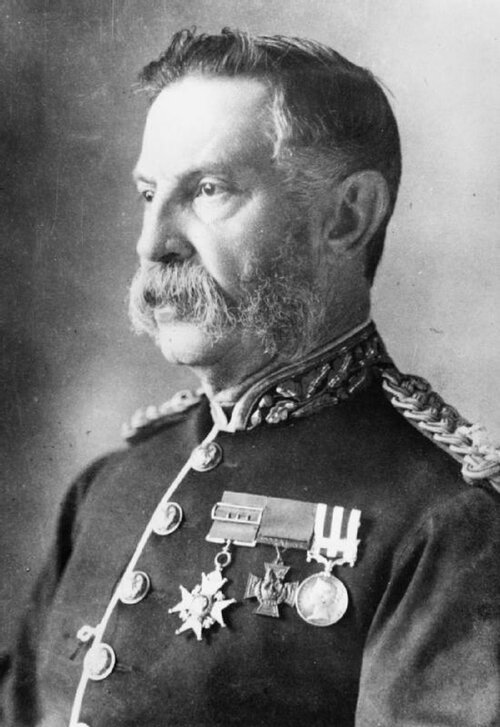
Blair was promoted to captain after the affair at Jiran, he was presented his Victoria Cross by Lieutenant-General Sir W. Mansfield at Bombay in 1862, the 150th cross to be awarded. He advanced to Major in 1864, Lieutenant Colonel in 1870, and to Colonel of his regiment in 1875. Shortly after, the 2nd Bombay Light Cavalry was renamed the 2nd Bombay Lancers in 1883. By then, however, Blair, since 1882, was serving as the Resident at Aden. Swiftly promoted to Brigadier-General, he stepped up to Major-General in 1885 and left Aden shortly after. He received his C.B. in 1889, was promoted to General in 1894 and retired to Scotland. He died in 1905 at home.
The mutiny had, in many respects, been a personal affair for James Blair. His father, Edward McLeod Blair, had been lost in the retreat from Kabul in 1842 at Jagdalak, a loss his mother, Susan, never recovered from. Convinced her husband was still alive, she returned to India with her young daughters, Isabella and Susan, in 1856. With her three sons, James, Charles Renny and Thomas Hawks, already safely settled in the Bombay army, Susan visited her parents and her sister in Benares and then took her daughters to Cawnpore. They settled down to life with Charlotte Newenham, her youngest sister (married to Dr Robert Newenham). Cawnpore in 1856 was still the finest and, above all, the gayest station, with regular balls, races, picnics, and entertainment. Young Gilbert Augustus Master, the son of Susan’s sister Marian, with his parents at Lucknow, would most likely have given his attention to introducing his, by all accounts, pretty cousins to the station of Cawnpore.
In June 1857, the last note, written by Master, arrived in Lucknow. Addressed to his father, he wrote, “We have now held out for twenty-one days under tremendous fire. The Raja of Bithoor has offered to forward us in safety to Allahabad, and the General has accepted his terms. I am all right, though twice wounded. Charlotte Newnham and Bella Blair are dead. I’ll write from Allahabad. God bless you. Your affectionate son, G.A. Master.”
By the time his father read it, Gilbert Master, the doctor, Mrs Blair and her daughter, Susan, were dead.
For James, the loss was incomparable. In one fell swoop, he and his brothers had lost their mother, two sisters, an aunt, an uncle, and a cousin. Nor did things fare well for his other cousin, Robert, who, after fighting his way through the Siege of Delhi, was severely wounded at Bulandshahr. While Robert, too, won the Victoria Cross, he did not live to wear it for very long. At age just 25, he died on the 18th of March 1859 of smallpox in that place which had cost James so much — Cawnpore.
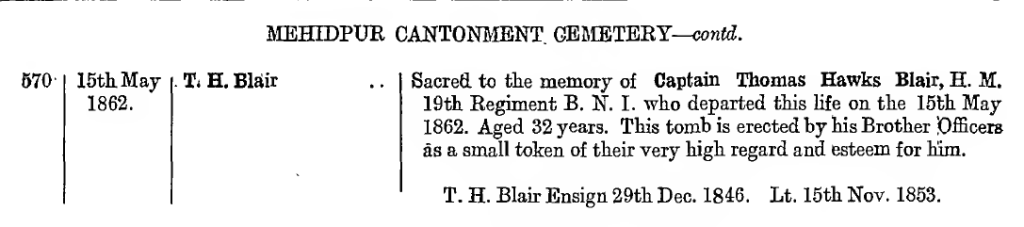
As for his brothers, Charles Renny finished his career as a general and died in 1912, but Thomas Hawks of the 19th Bombay Infantry died at Mahidpur, aged just 32.
 Mutiny Reflections