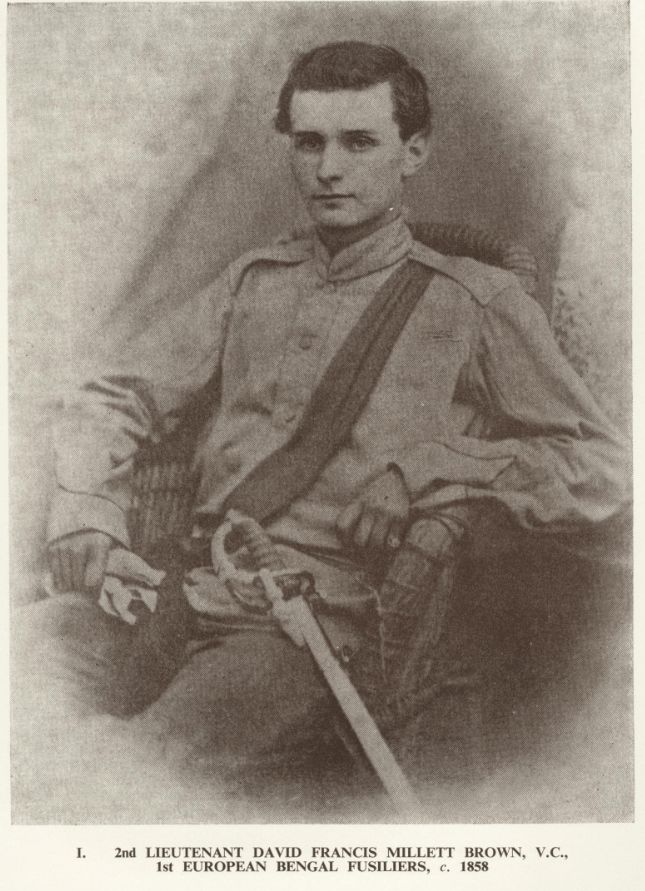
Francis David spent his formative years in India, but his education was English – at Grosvenor College in Bath, followed by two years of private tuition by Brisco Morland Gane, “late curate of Honiton, Devon,” his uncle.
A petition had already been submitted to the EICo for Francis to join the service as a cadet in the Bengal Infantry. His nominees were none other than Ross Donnelly Mangles, M.P. and company director and his aunt, Mrs. Wilberforce Bird. He passed his examination in 1855, and skipping Addiscombe, he travelled the same year in November to India by the overland route, taking in the sights of Egypt on his way. Francis arrived in Calcutta in January 1856. Gazetted an ensign and posted on the 9th of February to do duty with the 11th NI, he missed the first 6 months of duty, having been granted leave to visit his parents in Bhagalpur.
He would never serve with the 11th NI nor spend any time as an ensign. On the 7th of March 1856, Francis was posted, as 2nd Lieutenant, to the 1st Bengal European Fusiliers and received his next promotion in the same regiment to Lieutenant, in June 1857. His regiment was at Dagshai when they were given orders to march to Ambala on the 13th of May. Brown would fight at Badli-ki-Serai and then on the 26th of August at Najafgarh under Brigadier Nicholson — he was present at all the engagements throughout the Siege of Delhi and the final assault on the 14th of September. The left wing of his regiment (150 men) formed part of the 4th Column under Major Charles Reid of the Sirmoor Battalion — unfortunately, they were the only column that failed on that day. They would fight, however, and Brown would manage to survive the day unscathed.
Nor did it end there.
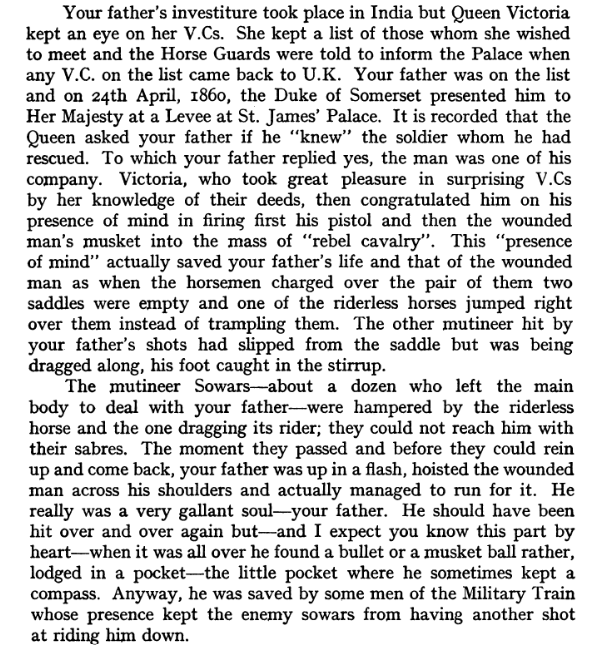
It was the 1st Bengal European Fusiliers who marched in Colonel Gerrard to Narnaul. The citation for his VC is rather plain and bereft of details:
“For great gallantry at Narnoul, on the 16th November 1857, in having, at the imminent risk of his own life, rushed to the assistance of a wounded soldier of the 1st European Bengal Fusiliers, whom he carried off, under a very heavy fire from the enemy, whose cavalry was within forty or fifty yards of him at the time.”
– No. 22357, The London Gazette. 17 February 1860
His aunt, Margaret Pratt, however, presented a far more spirited account in a letter to Brown’s son, which is worth quoting in full:
Following Narnaul, Lieutenant Brown marched under the command of Brigadier Sir T. Seaton and saw every action, from Gungeeree to Mynpoorie, between the 14th and 27th of December 1857, and then in March 1858, now under Sir Colin Campbell, he was at the final taking of Lucknow. The same year, at the action at Shaditgunge in October, with Hodson long since dead, Brown commanded a troop of Hodson’s Horse. For the rest of the mutiny, until its very end in 1859, Francis Millet Brown fought with his regiment. His mutiny medal would bear 2 clasps — Delhi and Lucknow.
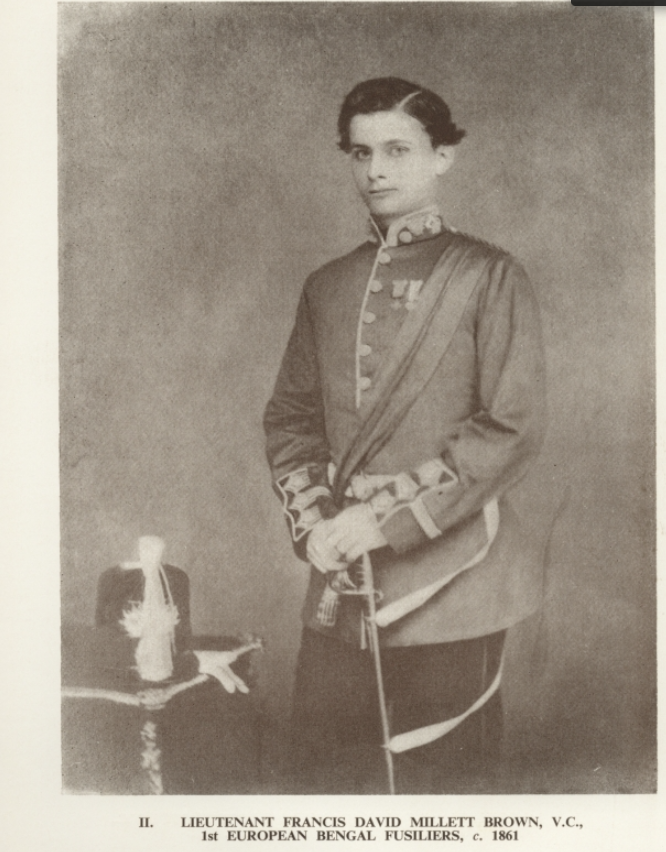
In 1861, when the European Bengal Fusiliers were granted the title “Royal” and not only re-designated but re-titled the 101st Regiment of Foot (Royal Bengal Fusiliers), Brown elected to remain in their service. Peace was but brief, and in 1863, he was off to the Ambeyla Campaign, where he again distinguished himself – in the attack and capture of the Conical Hill – and received a medal – the India General Service Medal of 1854-1894 with a clasp for Umbeyla.
However, with the campaign over, Brown left his regiment, opting instead to join the Engineering College at Roorkee, and while studying was certainly a large part of his life, Brown took advantage of the entertainment Roorkee had to offer and by 1864, was having thoughts of trying for the Staff Course. Now a captain (promoted 23rd August 1864), he did not seem to relish returning to the army and was thinking of transferring to the Bengal Staff Corps, even writing to his father for advice. His high life, however, had thrown the young man into some serious debt – a Staff appointment was, he knew, the only way to save his sinking purse. By March 1865, he had finally made up his mind to leave his regiment and, obtaining leave to say goodbye, he travelled to Dagshai to see them fire “feu-de-joie.”
Brown was working for the Department of Public Works (gazetted in September 1865) and the same year, back in Roorkee, where he had taken the title, “Assistant Instructor of Survey.” His fighting days were well and truly over, and his debts were fast clearing. From here, Brown’s career works its way up through various appointments, but first, in 1869, he went on leave out of India and did not return to India until January 1871.
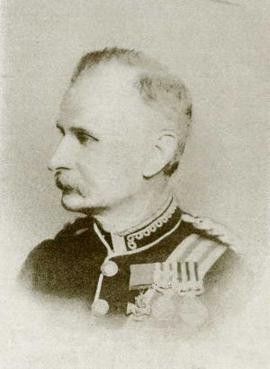
While Assistant Principal of Thomason College, Roorkee (1868) he mastered his engineering degrees, from Assistant Engineer 4th Class in 1872 up to Executive Engineer, 2nd Grade, in 1874, followed a year later by his promotion to Major. By 1881, he was Lieutenant-Colonel Brown and, in 1891, Principal of Thomason Civil Engineering College. His full colonelcy had been granted in December 1885. In 1892, he left the college and returned to the military department but was placed on the Supernumerary List in 1894 — he died one year later, in November 1895 in Sandown, Isle of Wight and lies buried in Winchester Cemetery.
After India
This is hardly the end of the Browns in warfare.
Francis married twice; his first wife, Jessie Rhind Russell, died in 1875, and he remarried in 1883 to Jessie Doris Childs. From his first marriage, his two sons, Frank Russell and Claude Russell, would both serve in South Africa — Frank in his father’s old regiment, now the Royal Munster Fusiliers — and Claude in the Royal Engineers. For Lieutenant Frank Russell Brown, it would be a short career; he died of wounds received at Sanna’s Post on the 3rd of April 1900.
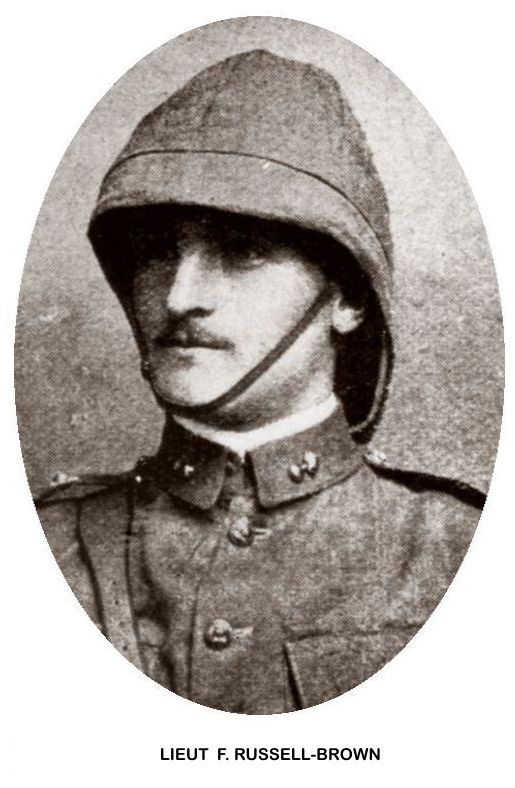
Claude too would see action in South Africa, be severely wounded, but survive, ending his career as Colonel Claude Russell Brown, C.B., D.S.O.
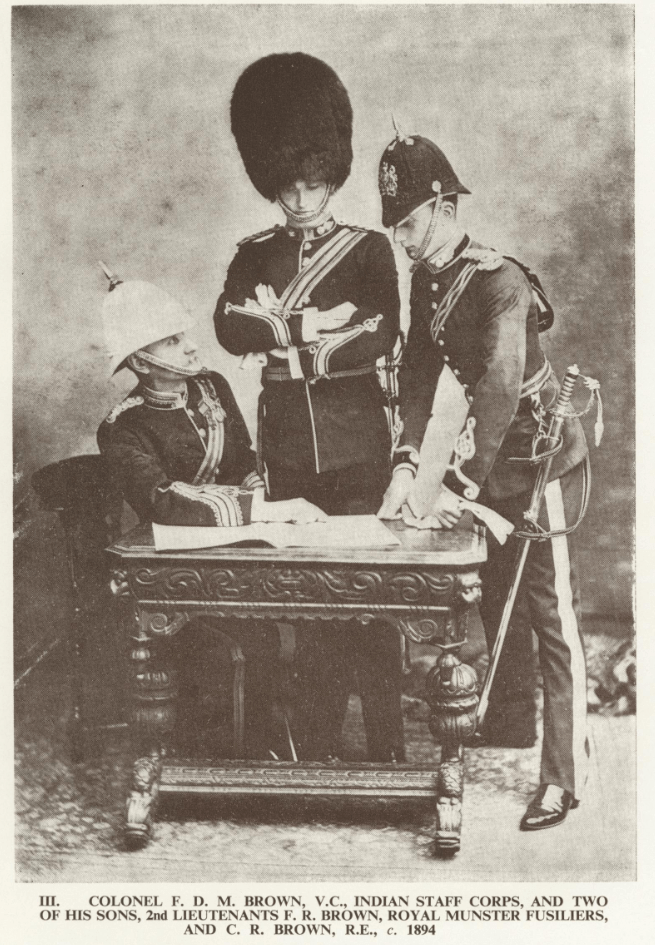
The children from his second marriage — four sons and one daughter — kept up the military tradition, with all four men serving in the army.
Lieutenant-Colonel Eric Carmichael Brown (transferred from the 6th Gurkhas to the Royal Artillery)
Captain Wynyard Keith Brown, 1/5th Gurkha Rifles (killed in Gallipoli on the 4th of June 1915) https://livesofthefirstworldwar.iwm.org.uk/story/29314
Colonel Christopher Lawford Brown, Royal Marines (killed in Belgium in 1940 when G.SO.I. to Field Marshal Viscount Montgomery, commanding the 3rd Division)
Major-General Reginald Llewellyn Brown (Royal Engineers), C.B., C.B.E., M.A., F.R.C.S.,
while his only daughter, Jessie Vera Brown would be awarded an M.B.E. and is the founder of Yateley Textile Printers, now Yateley Industries for the Disabled, Ltd. http://yateleylocalhistory.pbworks.com/w/page/66424964/JesseBrown
When Reverend David Brown landed in Calcutta in 1786 he would see an empire in its infancy; little did he know his descendants would see it end. The Browns were hardly an unusual family by the standards of their times, yet their legacy still continues today.
Sources:
Annand, A. McKenzie. “Colonel Francis David Millett Brown V.C.” Journal of the Society for Army Historical Research 50, no. 201 (Spring 1972): 29–41. https://www.jstor.org/stable/44223020.
Innes, P. R. The History of the Bengal European Regiment, Now the Royal Munster Fusiliers, and How It Helped to Win India. London: Simpkin, Marshall & Co., 1885.
The London Gazette. No. 22357 (February 17, 1860): 557.
Royal Munster Fusiliers Association. “Lieutenant-Colonel Francis David Millett Brown V.C.” Accessed May 26, 2026. Archived at https://web.archive.org/web/20160304054942/http://www.royalmunsterfusiliers.org/e6brown.htm.
Sources:
 Mutiny Reflections