The Three VCs of Arrah
The Blunder of Captain Dunbar
It is perhaps not altogether fair to place all the blame for the first attempt to relieve Arrah on Captain Dunbar. He had been given the duty by Captain Fenwick, who had thrown his hands up in disgust, firstly at Lloyd’s behaviour at Dinapore and then when asked to lead a force of 150 men instead of the promised 300, he had refused. He passed the command to Captain Charles Dunbar, who had spent most of his army life in the paymaster’s office. Perhaps Dunbar felt he had something to prove. Unfortunately, he lacked the acumen of a born leader, and when the situation finally told itself, he proved to be stubborn and uncompromising. He could have followed the advice and stopped his men on the bridge, allowing them to eat, drink and sleep; instead, he decided to push on in the dark toward Arrah. It is his blunders for which he is remembered.
Until they reached the bridge, the Sikhs had acted as skirmishers, but Dunbar chose to proceed toward Arrah as one body; no skirmishers were sent ahead. When the first volley burst out of the dark trees, they were not just unprepared – if anyone had shot back, they probably would have shot each other, and according to some accounts, that is exactly what happened. To understand the whole horror of the situation, we shall let 24-year-old Ross Lowis Mangles speak to us:
“We were passing a thick black mango grove to our right when all of a sudden, without any warning, the whole place was lighted up by a tremendous volley poured into us at about thirty or forty yards’ distance. It is impossible to say how many men fired into us — some say 500, some 1,500. The next thing I remember was finding myself alone, lying in the middle of the road, with a crack on the head and my hat gone. I suppose I must have been stunned for a minute. When I recovered, there were several men lying by me, but not a living soul could I see. There were lots to hear, though, for the bullets from right to left were whistling over my head. I was just thinking where our men could be and which way I should run when I saw the Sepoys advancing out of the grove with their bayonets within a dozen yards of me. I fired my double-barrel right and left into them and then ran towards our men, whom I could hear shouting on the left, under a tremendous fire from both parties. Everything now was in a most dreadful confusion: the men were all scattered in groups of fifties and twenties, firing in every direction, and, I fear, killing each other. At last, a Captain Jones, a very fine fellow — our commander was never seen again after the first volley — got hold of a bugler and got the men together in a sort of hollow place, a half-filled pond. There we all lay down in a square.
I was in the middle with the doctor, helping him to tie up the wounds of the poor fellows and bringing them water. The firing was all this time going on. The enemy could see us, as we were all dressed in white, while they were nearly naked, and behind trees and walls. However, the men fired about at random. At last, the poor doctor was knocked over, badly wounded. It was dreadful to hear the poor wounded fellows asking for help.”
“Not Fit to Die…” The VC of Ross Lowis Mangles, I.C.S.
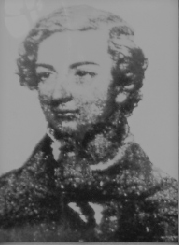
They spent the remainder of the night in the hollow only to find by dawn, that the situation had hardly improved as the enemy had now brought cannons into play. Retreat was the only option, but this was easier said than done – they had to traverse 16 miles back to the boats and “the ditches, the jungles, the houses, and, in fact, every place of cover along the road was lined with Sepoys. We kept up a fire as we went along, but what could we do? We could see no enemy, only puffs of smoke. We tried to charge, but there was nobody to charge; on all sides, they fired into us and were scattered all over the country in groups of tens and twenties.”
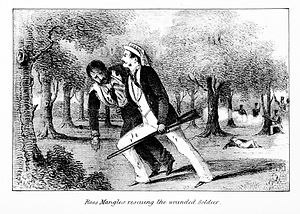
In the confusion as men scattered and ran for their lives, Ross Mangles heard a voice pleading not to be left behind. Lying on the ground was wounded Private R. Taylor of the 37th Regiment. Unable to stand much less walk, Taylor would have been left for dead on the field had it not been for the singular action of this young man.
“The last five miles of the road I carried a poor wounded fellow, who begged me not to leave him, and though we had had nothing to eat for more than twenty-four hours, and I had no sleep for two nights, I never felt so strong in my life, and I stepped out with the man as if he had been a feather, though he was as big as myself. Poor fellow! The men, most of them more or less wounded, were leaving him behind, and the cowardly Sepoys, who never came within 200 yards of us, were running up to murder him. I got the poor fellow safe over the nullah. I swam out and got a boat, put him in, and went over with a lot of others. The poor fellow thanked me with tears in his eyes. At the crossing of the nullah, we lost a great many men; they threw away their muskets to pull the boats and to swim over and were shot down like sheep.“
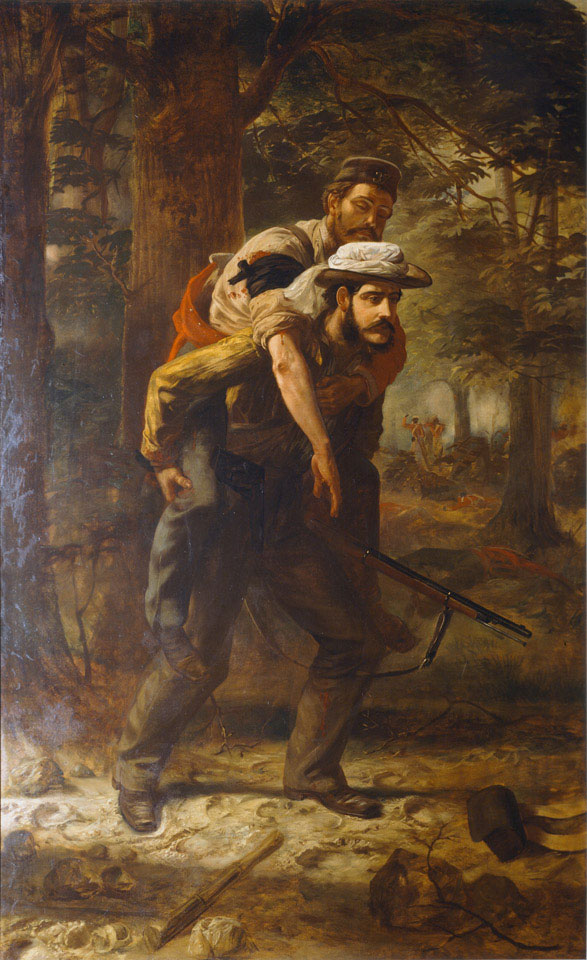
Oil on canvas, by Louis William Desanges, painted between 1859-1862.
https://collection.nam.ac.uk/detail.php?acc=1958-12-47-1
“I never before knew the horrors of war, and what I have gone through I hope will make a lasting impression on my mind and make me think more of God and His great goodness to me. I am sure God spared me because He knew I was not fit to die, and I pray to God that He will prepare me, for we can truly say we know not what a day may bring forth. I had several extraordinary escapes; one bullet went between my legs as I was walking and broke a man’s leg in front of me; another bullet hit me on the back of the head, knocking me down, but hardly breaking the skin...I cry to think of the way we were beaten and of the number of poor fellows who were killed.“
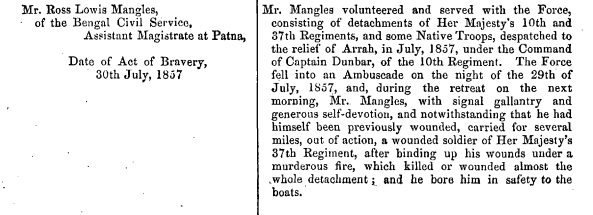
Mangles was unaware he had done anything particularly brave; however, the man he saved thought otherwise. After a year of searching, Private Taylor finally found out the name of his benefactor and forwarded it thus to the authorities, who saw it fit to award Ross Lowis Mangles the Victoria Cross for a deed of exceptional valour under fire. His citation appeared at the same time as that of another brave civilian, Mr Thomas Henry Kavanagh of Lucknow.
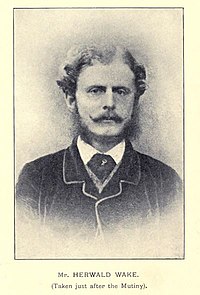
Mangles had joined the Arrah expedition to save “one of the greatest friends” he had – Herwald Wake – and had ridden with William Tayler from Patna to Dinapore to “pitch into the old muff” (General Lloyd), which is precisely what William Tayler did until Lloyd agreed that saving Arrah was possible. Mangles only hoped he could give his besieged friend in Arrah ” a hand.”
“I had no such excuse for permitting young Mangles to go,” said Tayler, “and felt a heavy responsibility in having done so. The fact is, that, almost at the last moment, and when all our hearts (at least I can answer for my own) were beating with excitement at the preparations for departure, he had suddenly made his request, and with such evident earnestness, that I could not find it in my heart to refuse.”
Born in Calcutta in 1833 and the son of Ross Donnelly Mangles, a member of the Bengal Civil Service and later a chairman of the East India Company, young Ross Lowis joined the same service as his father after graduating from Haileybury College. He served as Assistant Magistrate at Patna until 1857, and after, he took the position of Magistrate, Chunparun District, North Bihar. From September 1858 to January 1860, Mangles was in England on sick leave and attended the ceremony at Windsor Castle to be invested with his Victoria Cross by Queen Victoria. Ross Lowis Mangles died on the 28th of February 1905 in Pirbright, Surrey, and was buried in Brookwood Cemetery.
 Mutiny Reflections