Of the 1358 VCs awarded until 2015, 182 were given for conduct befitting of it in the Indian Mutiny. The men range from privates to officers and 4 civilians – on the scale of 19th-century conflicts it outranks Crimea (111 VCs awarded) and remained the conflict with the most VCs until WWI (627 medals awarded).
The Victoria Cross is the highest and most prestigious award a British soldier can receive, given to those who display “valour in the presence of the enemy.” However, between 1858 and 1881, the VC was also awarded for actions “taken under circumstances of extreme danger,” even when not in the face of the enemy.
Instituted in 1856 by Queen Victoria to acknowledge the bravery of the men who served in the Crimean War, it was open to all ranks with the first 85 awards announced retrospectively in the London Gazette on the 24th of February 1857 for acts of bravery dating back to the start of the Crimean Campaign in 1854. Since 1856, 1358 VCs have been awarded, the last in 2015. To date, the VC has taken precedence over all other orders, decorations, and medals and, with some notable exceptions, has always beenpresented by the reigning monarch during an investiture at Buckingham Palace.
The cross itself has remained unchanged since the first one was made by the London jewellers, Hancock and Co. – like the design, the manufacturer has remained the same since 1856. Originally, the ribbon colour was divided by service – blue for the Royal Navy and crimson for the Army – in 1918, King George sanctioned crimson for all three services.
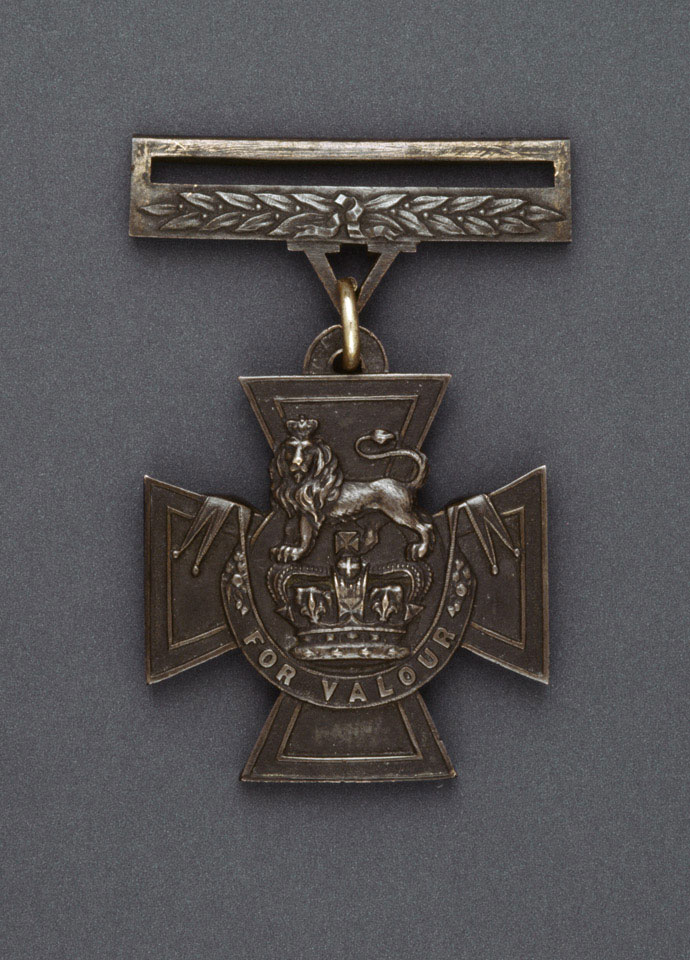
The inscription “For Valour” was chosen by Queen Victoria herself, over the original recommendation of “For Bravery.” Not wishing to imply that only the awarded recipients were brave in battle, the Queen felt valour better described those who wore the cross.
The men who were awarded the Victoria Cross during the Indian Mutiny, which has more than its fair share of brave men, showed an exceptional degree of courage, though in many cases, they themselves were unaware they had done anything particularly incredible. (We will look into them in subsequent posts). Although the Victoria Cross was open to all men of rank, it was not awarded initially to brave civilians; this rule rankled some men in Delhi, who argued vigorously to have the VC awarded to their bhisti, a man who, in their estimation, deserved the VC far more than any soldier. The suggestion was laughed at by the authorities, and the bhisti never received his award.
A recommendation for a VC could only be issued by an officer and needed to be supported by three witnesses. When the case was accepted as a contender for the award, the recommendation would be passed up through the military hierarchy until it fell into the hands of the Secretary of State for War and then onto the reigning monarch. It was further stated -rule 13 – that the VC could be awarded by ballot “if a large body of men – such as a battalion or ship’s crew – performed the act of bravery collectively. Normally, the officers engaged selected one of their number to receive the cross, and in like manner one petty officer or non-commissioned officer and two seamen or private soldiers were selected by their equals.” (https://www.nam.ac.uk/explore/victoria-cross)
14 further Royal Warrants – set out since the award’s inception – have changed the original regulations and conditions. The Indian Mutiny led to the VC being open for civilians who were serving “with the forces.” Of the 7 civilian VCs awarded to date, 4 were given out during the Indian Mutiny. It would not be until 1867 that the VC was made available to local forces serving with Imperial troops, and then in 1881, this was extended again to include all colonial and auxiliary troops.
In 1900, during the Boer War, the first VC was awarded posthumously, an exception to one of the first rules of the VC; it had been decided from the start the medal “would not be awarded for an act in which the potential recipient was killed, or where he died shortly after.” The death of the son of Field Marshall Lord Roberts (who himself served in the Indian Mutiny and had received a VC) led to this change. Lieutenant Frederick Roberts, who had been mortally wounded while trying to save the guns of the 14th and 66th Batteries, died barely a day after his recommendation for the VC. “This was the first award that included after the recipient’s name ‘since deceased. ’ Roberts’ case established the precedent that the VC recommendation could still be processed if a soldier subsequently died before publication in ‘The London Gazette. However, it would not be until 1920 that a specific provision would be made by Royal Warrant for the granting of posthumous VCs.
In 1911, a Royal Warrant extended the eligibility of the VC for Indian troops; until then, it had been strictly restricted to European troops – hence, the bhisti, although his valour was without exception, would have had to wait until 1911 to receive his VC. It is a sad fact that this provision came in far too late for the Indians who served with the British in the Indian Mutiny. By 1911, the bhisti had been forgotten.
Since 1911, 29 Indian soldiers have received the VC.
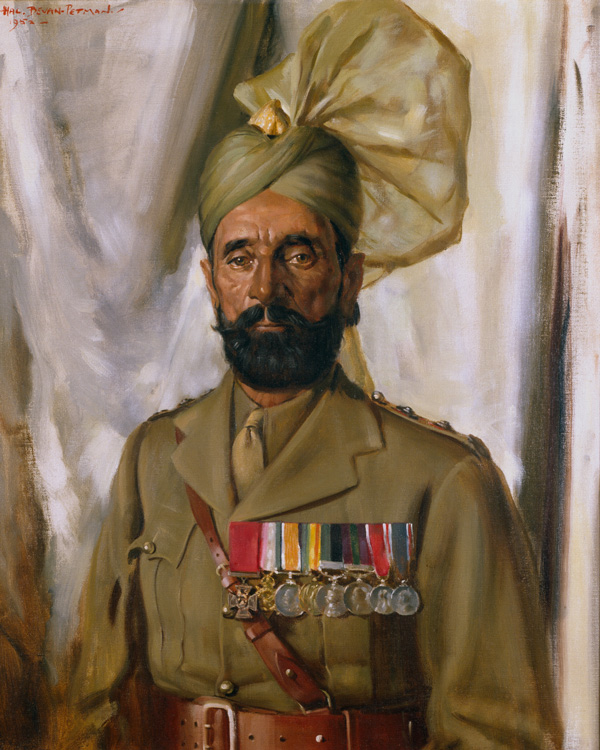
A VC can also be awarded more than once to the same individual, however, in the whole history of the VC, only three men have had this honour between the years 1902 and 1942.
Although it is an award for life, the VC could be forfeited if an individual should prove himself unworthy of wearing it. Under the terms of the original Royal Warrant, a recipient’s name could be erased from the official list. Between 1856 and 1908, 8 unlucky men had their VCs revoked, all for conduct which was anything but valorous. Although in one case, the inability to pay a fine due to reduced personal circumstances appears as a rather ridiculous reason to remove a man’s VC, the problem, however, was not so much the fine itself- unfortunately, the man went to jail because of it. VC recipients were expected, at all times, to keep themselves well away from problems with the law.
Other charges ranged from theft and embezzlement to bigamy; however, King George V was magnanimous enough to state in 1920, “The King feels so strongly that, no matter the crime committed by anyone on whom the VC has been conferred, the decoration should not be forfeited. Even were a VC to be sentenced to be hanged for murder, he should be allowed to wear his VC on the scaffold.’ It remains the right of the sovereign to cancel forfeitures and restore not just the award itself but the pension which goes with it. As a result, all 8 forfeitures remain on the list of VC holders.
For our purposes, we will only focus on the Victoria Cross Warrant in place from the 29th of January 1856. Three subsequent amendments were made in quick succession as a result of the Indian Mutiny.
I. Eligibility of Indian Establishment, 29th October 1857
II. Non-Combat Operations, 10th August 1858
III. Civilian Service During the Mutiny, 13th December 1858
I have left a link below in sources for anyone who wants to read the amendments in full.
THE ORIGINAL WARRANT INSTITUTING THE VICTORIA CROSS, 29 JANUARY 1856
Victoria by the Grace of God of the United Kingdom of Great Britain and Ireland Queen
Defender of the Faith &c. To all to whom these Presents shall come, Greetings! Whereas We taking into Our Royal consideration that there exists no means of adequately rewarding the individual gallant services either of Officers of the lower grades in Our Naval and Military Service or of Warrant and Petty Officers Seamen and Marines in Our Navy and Non-commissioned Officers and Soldiers in Our Army. And Whereas the third Class of Our Most Honourable Order of the Bath is limited except in very rare cases to the higher ranks of both Services and the granting of Medals both in Our Navy and Army is only awarded for long service or meritorious conduct, rather than for bravery in Action or distinction before an enemy, such cases alone excepted while [sic] a general Medal is granted for a particular Action or Campaign or a Clasp added to the Medal for some special engagement, in both of which cases all share equally in the boon and those who by their valour have particularly signalized themselves remain undistinguished from their comrades. Now for the purpose of attaining an end so desirable as that of rewarding individual instances of merit and valour We have instituted and created and by these Presents for Us Our Heirs and Successors institute and create a new Naval and Military Decoration, which We are desirous should be highly prized and eagerly sought after by the Officers and Men of Our Naval and Military Services and are graciously pleased to make ordain and establish the following rules and ordinances for the government of the same which shall from henceforth be inviolably observed and kept.
Firstly, It is ordained that the distinction shall be styled and designated the ‘Victoria Cross’
and shall consist of a Maltese Cross of Bronze with Our Royal Crest in the centre and
underneath which an Escroll bearing this inscription ‘For Valour’.
Secondly, It is ordained that the Cross shall be suspended from the left breast by a Blue
Riband for the Navy and by a Red Riband for the Army.
Thirdly, It is ordained that the names of those upon whom We may be pleased to confer
the decoration shall be published in the London Gazette and a registry thereof kept in the office of Our Secretary of State for War.
Fourthly It is ordained that anyone who, after having received the Cross, shall again perform an Act of bravery which, if he had not received such Cross would have entitled him to it, such further act shall be recorded by a Bar attached to the riband by which the Cross is suspended and for every additional act of bravery an additional Bar may be added.
Fifthly, It is ordained that the Cross shall only be awarded to those Officers or Men who
have served Us in the presence of the Enemy and shall then have performed some signal act of valour or devotion to their Country.
Sixthly, It is ordained with a view to place all persons on a perfectly equal footing in
relation to eligibility for the Decoration that neither rank nor long service nor wounds nor
any other circumstance or condition whatsoever save the merit of conspicuous bravery shall be held to establish a sufficient claim to the honour.
Seventhly, It is ordained that the Decoration may be conferred on the spot where the act
to be rewarded by the grant of such Decoration has been performed under the following
circumstances:
I. When the Fleet or Army in which such Act has been performed is under the eye and
command of an Admiral or General Officer commanding the Forces.
II. Where the Naval or Military Force is under the eye and command of an Admiral or
Commodore Commanding a Squadron or detached Naval Force or of a General Commanding a Corps or Division or Brigade on a distinct and detached Service when such Admiral Commodore or General Officer shall have the power of conferring the Decoration on the spot subject to confirmation by Us.
Eighthly, It is ordained where such act shall not have been performed in sight of a
Commanding Officer as aforesaid then the claimant for the honour shall prove the act to the satisfaction of the Captain or Officer Commanding his Ship or to the Officer Commanding the Regiment to which the Claimant belongs and such Captain or such Commanding Officer shall report the same through the usual channel to the Admiral or Commodore Commanding the Force employed on the Service or to the Officer Commanding the Forces in the Field who shall call for such description and attestation of the act as he may think requisite and on approval shall recommend the grant of the Decoration.
Ninthly, It is ordained that every person selected for the Cross under rule seven shall be
publicly decorated before the Naval or Military Force or body to which he belongs and with which the act of bravery for which he is to be rewarded shall have been performed and his name shall be recorded in a General Order together with the cause of his especial distinction.
Tenthly, It is ordained that every person selected under rule eight shall receive his Decoration as soon as possible and his name shall like-wise appear in a General Order as above required, such General Order to be issued by the Naval or Military Commander of the Forces employed on the Service.
Eleventhly, It is ordained that the General Orders above referred to shall from time to time be transmitted to our Secretary of State for War to be laid before Us and shall be by him registered.
Twelfthly, It is ordained that as cases may arise not falling within the rules above specified
or in which a claim though well founded may not have been established on the spot We will on the joint submission of Our Secretary of State for War and of Our Commander-in-Chief of Our army or on that of Our Lord High Admiral or Lords Commissioners of the Admiralty in the case of the Navy confer the Decoration but never without conclusive proof of the performance of the act of bravery for which the claim is made.
Thirteenthly, It is ordained that in the event of a gallant and daring act having been performed by a Squadron Ship’s Company a detached body of Seamen and Marines not under fifty in number or by a Brigade Regiment Troop or Company in which the Admiral General or other Officer Commanding such Forces may deem that all are equally brave and distinguished and that no special selection can be made by them, Then in such case the Admiral, General or other Officer Commanding may direct that for any such body of Seamen and Marines or for every Troop or Company of Soldiers one Officer shall be selected by the Officers engaged for the Decoration; and in like manner one Petty Officer or Non-commissioned Officer shall be selected by the Petty Officers and Non-commissioned Officers engaged; and two Seamen or Private Soldiers or Marines shall be selected by the Seamen or Private Soldiers or Marines engaged respectively for the Decoration; and the names of those selected shall be transmitted by the Senior Officer in Command of the Naval Force Brigade Regiment Troop or Company to the Admiral or General Officer Commanding who shall in due manner confer the Decoration as if the acts were done under his own eye.
Fourteenthly, It is ordained that every Warrant Officer Petty Officer Seaman or Marine or
Non-Commissioned Officer or Soldier who shall have received the Cross shall from the date of the act by which the Decoration has been gained be entitled to a Special Pension of Ten Pounds a year; and each additional bar conferred under rule four on such Warrant or Petty Officers or Non-Commissioned Officers or Men, shall carry with it an additional pension of Five Pounds per annum.
Fifteenthly, In order to make such additional provision as shall effectually preserve pure this Most Honourable distinction it is ordained that if any person on whom such distinction shall be conferred be convicted of Treason, Cowardice, Felony or of any infamous Crime, or if he be accused of any such offence and doth not after a reasonable time surrender himself to be tried for the same his name shall forthwith be erased from the Registry of Individuals upon whom the said Decoration shall have been conferred by an especial Warrant under Our Royal Sign Manual, and the pension conferred under rule fourteen shall cease and determine from the date of such Warrant. It is hereby further declared that We Our Heirs and Successors shall be the sole judge of the circumstances demanding such expulsion; moreover We shall at all times have power to restore such persons as may at any time have been expelled, both to the enjoyment of the Decoration and Pension.
Given at Our Court at Buckingham Palace this twenty-ninth day of January in the Nineteenth Year of Our Reign and in the Year of Our Lord One Thousand Eight Hundred
and Fifty Six.
By Her Majesty’s Command
Panmure
And that, dear readers, is how to win a Victoria Cross.
The Indian Order of Merit and Indian Distinguished Service Medal
However, it must be pointed out here that Indian troops were eligible for the Indian Order of Merit, the oldest British gallantry award for general issue, which excluded European officers and men serving in the EICo forces. The VC was extended to cover Europeans serving in India in 1857.
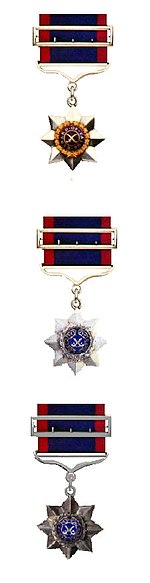
The Indian Order of Merit (IOM) was introduced in 1837 under the name “Order of Merit” and continued to be awarded after the dissolution of the EICo in 1858. The object was to “afford personal reward for personal bravery without reference to any claims founded on mere length of service and general good conduct.” It would remain the only gallantry medal made available to Indian soldiers until 1907 when the Indian Distinguished Service Medal (IDSM) was introduced; in 1911 Indian soldiers finally became eligible to receive a VC.
The IOM was initially introduced with three classes – first, second and third – until other medals became available to Indian troops. It was like many things in the EICo a complicated system and technically a solider needed to have a lower class medal first before being considered for a higher one – an exception could be made if the soldier had performed multiple acts of gallantry which would make him eligible for a higher class even if he had not obtained a lower one first. Nor was the award limited to the medal itself; it not only increased pay but pension as well, and in certain circumstances, a rise in rank. They also received the postnominal letters, IOM affixed to their name. The IOM could be awarded posthumously, in which case the soldier’s widow would receive a substantial payment. Although the IOM was only conferred for conspicuous gallantry in action, it was awarded for every engagement in which Indian soldiers were deployed, including the Indian Mutiny. All the awards were announced in the Gazette of India.
4219 IOMs were awarded throughout the medal’s history – 1124 for the Indian Mutiny alone; 1000 of those were IOM 3rd Class, with 89 2nd Class and 35 1st Class. With only 64 1st class medals ever minted before the change to a single class in 1944, it remains one of the rarest medals in existence.
The name Indian Order of Merit was introduced in 1902 to avoid confusion with the other medal, the Order of Merit established by King Edward VII. The VC replaced the first class IOM in 1911; by 1944, there was only 1 class of IOM available.
Both the IOM and the IDSM were discontinued after Indian Independence in 1947.
The Indian Mutiny Medal
As the last campaign medal to be awarded under the rule of the Honourable East India Company, these medals were approved by General Order 363 on the 18th of August 1858 and General Order 733 of 1859, which initially only approved these medals to be awarded to troops who had served in operations against the mutineers. However, General Order 771 of 1868, like the Victoria Cross, made the Indian Mutiny Medal available to anyone who had “borne arms or been under fire” thus allowing civilians of all branches to receive it.
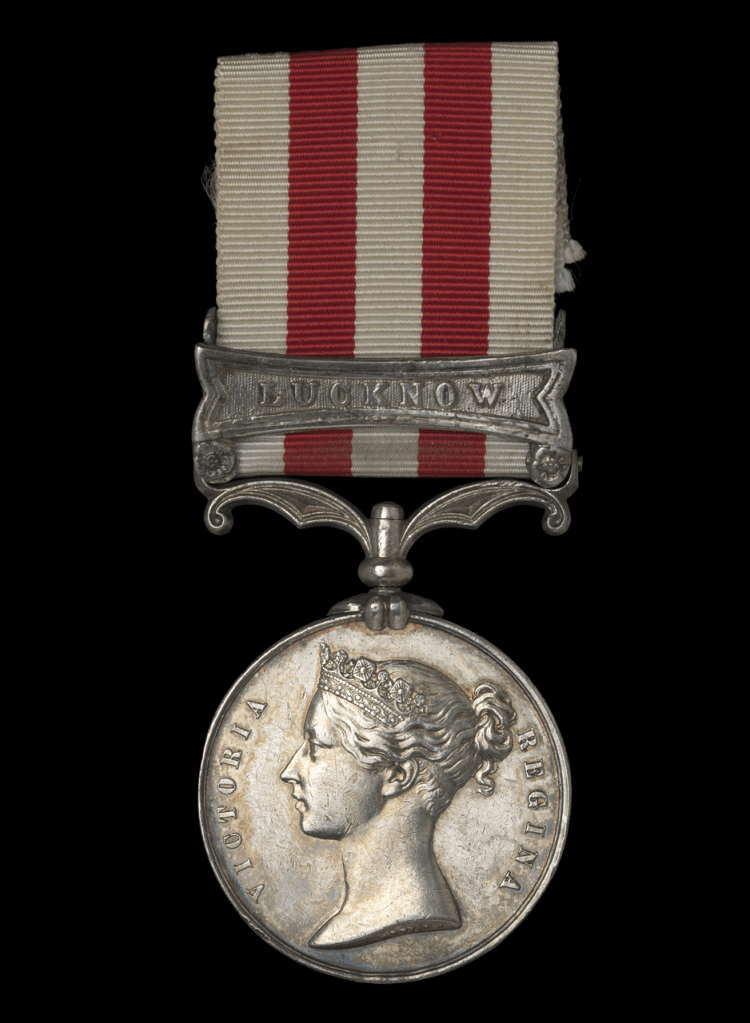
Although most of the Indian Mutiny Medals were minted in solid silver, some bronze versions were given out, mostly issued to Indian non-combatants. The type of metal aside, the design remained unaltered in both versions, with clasps denoting any particular campaign the individual participated in. The clasp itself is a single-faced metal bar on the ribbon, which itself is attached to the medal. There were 5 clasps in all, yet the maximum ever awarded to any one man was four.
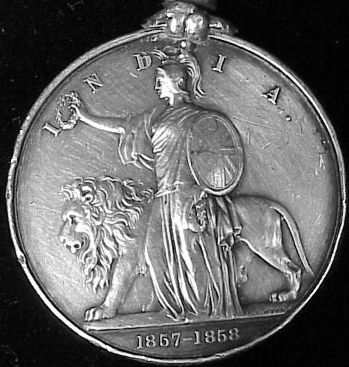
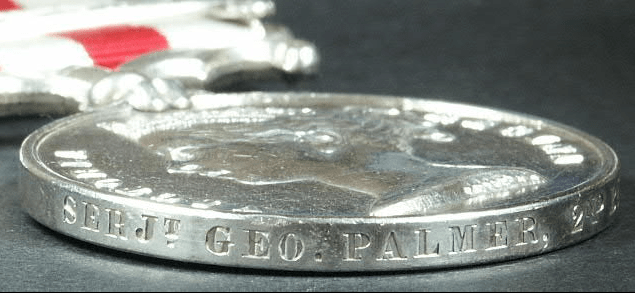
Back of the Indian Mutiny Medal. The name of the recipient was inscribed around the edges of the medal as seen below.
A Campaign Medal is awarded to a member of an armed force who serves in a particular military operation or has performed duty within it. They were invented to recognize general military service in a war and are not associated with any act on the part of the individual as they neither denote acts of bravery nor speak of conduct; campaign medals, however, have a higher status than service medals.
For the Indian Mutiny, the clasps are as follows.
Delhi – 30 May to 14 September 1857: for troops who participated in the capture of Delhi.
Defence of Lucknow – 29 June to 22 November 1857: Awarded to original defenders of Lucknow, including the principal, masters and boys of La Martinière College. It was also awarded to troops of Havelock’s first Relief Force.
Relief of Lucknow – November 1857: This particular clasp was only awarded to the second relief force under Sir Colin Campbell
Lucknow – November 1857 to March 1858: The third Lucknow clasp it was awarded to Sir Colin Campbell’s troops who participated in the final operations leading to the surrender of Lucknow and the following clearing operations in the surrounding country.
Central India – January to June 1858: This clasp was awarded to those who served under Major-General Sir Hugh Rose in the action against Jhansi, Kalpi, and Gwalior. It was also awarded to those who served with Major-General Roberts’ Rajputana Field Force and Major-General Whitlock’s Madras Column between January and June 1858.
At first, the Indian Mutiny Medal was issued without a clasp to anyone who had served in operations against the mutineers – from 1868, the majority of the clasps were then awarded to those individuals who had become eligible when General Order 771 came into effect. In all, 290,000 Indian Mutiny Medals were awarded; the most coveted to date are those which were presented to the original defenders of Lucknow.
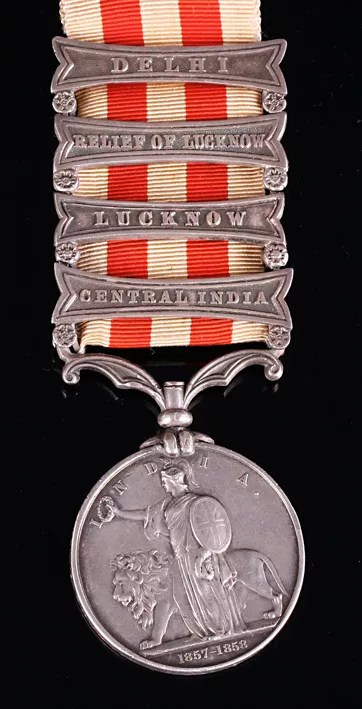
4 clasps, Indian Mutiny Medal
Sources:
https://www.nam.ac.uk/explore/victoria-cross
https://www.forces-war-records.co.uk/medals/victoria-cross
https://www.forces-war-records.co.uk/medals/indian-distinguished-service-medal-idsm
https://www.forces-war-records.co.uk/medals/indian-order-of-merit-iom-1st-2nd-3rd-class
http://www.victoriacross.org.uk/ccinarvc.htm
https://www.dcmmedals.co.uk/24897-2/
https://www.warwickandwarwick.com/news/guides/a-guide-to-indian-mutiny-medals
To read the Royal Warrant in full and it’s amendments, please go to:
https://link.springer.com/content/pdf/bbm:978-0-230-58335-1/1.pdf
For anyone researching the Indian Mutiny Medal Roll, 50’000 names can be found under:
https://fibis.ourarchives.online/bin/aps_browse_sources.php?mode=browse_components&id=169&s_id=67
To read about some individual medals and their clasps, readers will find the following source most interesting:
https://www.dcmmedals.co.uk/?s=Indian+Mutiny
 Mutiny Reflections