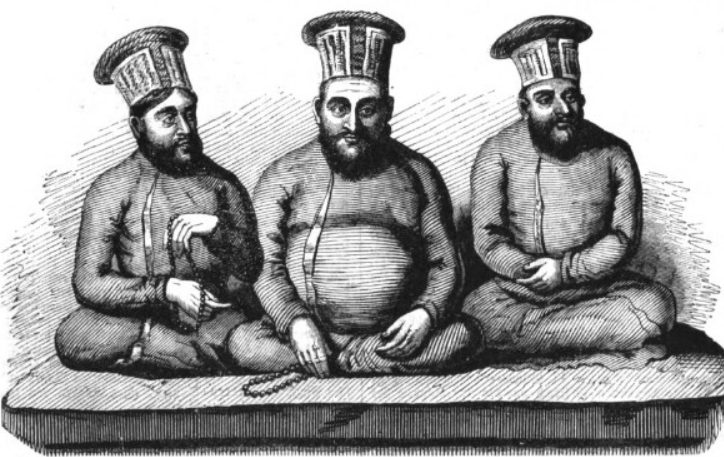
It would not be fair to end this venture into the history of the annexation of Sindh without exploring the accusations the EICo, namely Ellenborough and Napier, levelled against the Mirs as justification to expel them from Sindh and annex the province. If one were to solely read Napier’s point of view, one would be left believing the Mirs were little more than depraved monsters.
“First, as to their merits as Sovereigns.
The Ameers governed by the sword, and by no other law. The Belooches were their troops; the Scindians and Hindoos their subjects, their victims; up to the battle of Meeanee, any Belooche might kill a Scindian or Hindoo with impunity, for pleasure or profit: this license was widely exercised, especially where women were concerned.
The Ameers dealed largely in the slave trade, and so did all their feudal chiefs, both as importers and exporters. “
They had, to form shikargahs or hunting grounds, laid waste, in less than sixty years, more than a fourth of the most fertile land in Scinde, a country nearly 500 miles in length, and from 100 to 300 in breadth. And to form one of these hunting wildernesses for a child of eight years old, they would depopulate whole villages with less hesitation and feeling than an English farmer smokes a hive of bees.
They extorted money from Hindoos and other merchants by torture and mutilations. They forced labouring men and mechanics to work for them by the same means, at about twopence daily wages, when their services were worth ten times as much; and, more often than not, they cheated them even of that pittance: this oppression they carried to such an extent, that when Sir Charles Napier took possession of Scind, scarcely could a mason, or carpenter, or other handicraft man be found; all had fled with their skill to distant countries.
The Ameers also restricted commerce and oppressed merchants and traders, because they disliked the presence of strangers, who might draw comparisons between their rule and that of other Princes. They dreaded lest their subjects should be told the inflictions they endured were unknown save in Scinde, the most fertile and most miserable country of all Asia. Finally, they stopped one of the great water-courses derived from the Indus purposely to destroy the fertility of the neighbouring kingdom of Cutch, which had been irrigated from it.”
While all of this might have been true, or in part not altogether false, it still delivers an unwarranted and overly harsh portrait of the Mirs. It especially shocked men, like Outram, who had worked in Sindh and were on a better footing with the Mirs than Napier ever would be. By all accounts, the Mirs ruled Sindh as generations of Talpurs, Kalhoras and Mughals had governed before them; their methods were not compatible with Christian values nor with Christian morality, something men like Napier and Ellenborough were unable or unwilling to understand. As Outram would correctly assert:
“To affirm that as men the Meers were immaculate, or, as rulers, a pattern worthy of general imitation, would, of course, be absurd. Scinde was a demi-barbarous government,—its rulers necessarily but partially advanced in civilization. In such a country, certain errors of government were unavoidable, and its Sovereigns partook, to a certain extent, of the vices of their subjects. Many of the institutions of the country, I readily admit, were such as Christianity would frown upon. As I have already said, there was much room for philanthropic exertion, but, as I have likewise maintained, there was nothing that called for revolutionary interference, even had we possessed a moral right to interfere, which we had not.
The Ameers of Scinde were, as men, singularly free from the vices which prevail in Mahommedan communities; more intellectual than their com-peers in other eastern countries,—temperate, and strongly averse to bloodshed,—affectionate, kind, and gentle almost to effeminacy. As sovereigns, they were mild and little oppressive in their sway, and ruled with an unity of design (and it is therefore but fair to assume with a singleness of purpose) that greatly astonished the earlier visitors to their Court, who, hearing of the strange constitution of the Scinde Government, expected to find perpetual confusion and quarrels.”
The very laws and institutions of Sindh were suited, and only suited for Sindh. They governed by the same means and powers as any other Mahommedan power, a law encoded in the Koran, which was perfectly understandable to the people who lived under it. For Hindus living in Sindh, while they were undoubtedly faced with oppression, there was never any evidence that they were mutilated and tortured, nor did Napier ever present any.
The charge of participating in the slave trade, as one of the accusations levelled against the Mirs, is written to give the reader the impression that the Mirs were running a flourishing business, an open market in humans in Karachi. This again gave the false impression. While slaves were being imported into Sindh, there were distinctions that the EICo purposely dismissed in their accusations. At the time, there were four classes in the slave population in Sindh – those imported from Africa, the Georgians and Abyssinians, a race called Guda who were the descendants of Sindhi fathers and African mothers and “those born in bondage in the country.” This particular topic would require a longer and far more detailed analysis than is warranted for this article; however, recently The Dawn published an interesting article that addresses slaves in Sindh, and it does not deviate from what the British themselves found when they abolished slavery in Sindh in 1844. The article is well worth pursuing:
HISTORY: THE STORY OF SINDH’S AFRICAN SLAVES
In the context of the accusations against the Mirs, in regard to slavery, Mir Hussain Ali had this to say.
“It is also stated by Sir Charles Napier that the Ameers used to deal in slaves. Dealing in slaves is allowed by the religion of Moslems, and therefore it was the practice in Scinde. The Ameers did not introduce this custom into Scinde, but it is now 1261 years since the practice was introduced into Islamism, and it is still carried on in the Persian and Arabian territories. Previous to the establishment of the British Government in India, such a custom was current through the whole of Hindustan, and up to this time the custom is not totally abolished, for we have seen the Nazim of Moorshedabad has in his service many negroes and eunuchs of Abyssinia; and the merchants of this place (Calcutta,) such as Meerza Mahommed Kurbellai, and several other Moossoolmans, also entertain them.”
While to our modern sentiments, any excuse to justify slavery is abhorrent, we must view this in the context of its times and understand that his statement was not so much an excuse as an attempt to expose the hypocrisy of the British.
Outram, who lived in Sindh for three years, found slavery to be mild, the slaves well-treated, and unlike those imported in their thousands to America, neither chained nor beaten. Laws regarding the holding of slaves were clear, infringements were punishable, and it was on the honour of the holder of slaves to ensure they were well treated. If he did not do so, his reputation in the community would be irrefutably tarnished. The British would find out just how much regard slaves were held when, during the Siege of Lucknow, the most-feared marksmen on the side of the rebels were Africans of the former Awadh Court.
As to the Shikargarhs, or the hunting grounds of the Mirs, it was here implied that the Mirs had taken over lands that had previously been populated and cultivated to make way for grounds in which they could shoot at wild animals for pleasure. As it was, there was no evidence the Mirs had displaced anyone; the shikargarhs utilised land that was no longer in use or had never been used for cultivation, until the EICo turned up, Sindh had been producing so much grain they were able to export it to other states and in times of hardship had taken in cultivators from Kutch and Rajwarra to work in their abundant fields rather than face starvation at home. Land was not scarce in Sindh, and the shikargarhs were innocuous. In the rare case that a shikargarh was established over an existing village, the Mirs granted the villagers land elsewhere, which was again, according to the very law they lived under.
As Outram pointed out in 1846:
“Under our benign sway and admirable administration, the price of the necessaries of life has been more than doubled; new taxes have been imposed in augmentation of the distress; and the only party likely to benefit is the Government, who will be able to show an increase of revenue, by being enabled to dispose of the grain collected as revenue, at nearly famine prices. Such are the blessings we have conferred in the third year of the Conquest of Scinde!
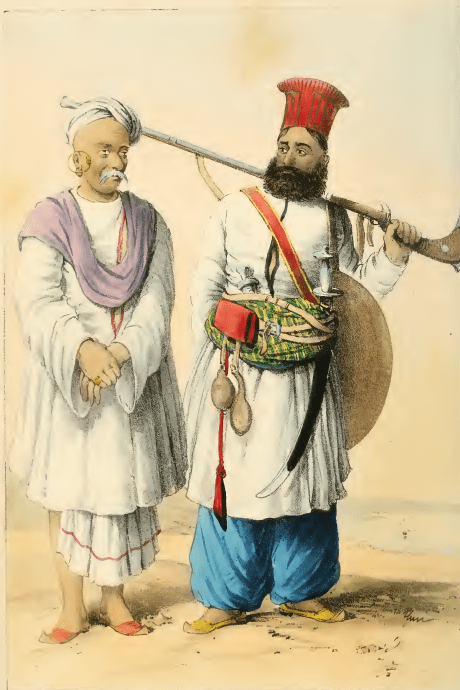
The mistreatment of Hindus was another charge that Napier tacked on to their growing list of misdeeds to prove that, besides being practically barbarous, they were also cruel. This particular point met with derision from men who had worked in Sindh. The Hindus to whom Napier is primarily referring were not general merchants; they were, in fact, moneylenders and bankers. They were powerful and well-organised, perfectly capable of protecting themselves. The Mirs had no need to resort to extortion; that it was practised by underlings in their government, no one denied. As for the Hindus themselves, had they been so severely oppressed as Napier would have everyone believe, they would not have remained in Sindh and would have migrated to the neighbouring Hindu states of Kutch, Gujarat and Jaisalmer. As to the punishment meted out, we once again see Napier seeing things from his own narrow view. Mutilation was a common practice in dealing with criminals and sanctioned by the Koran, and anyone who lived in Sindh knew exactly what awaited them.
“In Scinde, the penal code was milder than in most Mussulman countries, and during the whole period of our connexion with that province, mutilation was seldom if ever inflicted, save for offences which, according to our own code, would have been punished with death. So far as my own memory serves me, I can call but one instance to mind in which a hand was cut off: the criminal was a murderer.” (Outram)
Mir Hussain Ali had a few things to say to Napier regarding the accusation of exploitation:
“Again, it is stated that the Ameers used to force the work-men—such as carpenters, bricklayers, &c.—to work at the coolie’s rate of six pice (twopence) a day, and that this tyranny had reached to such a degree, that when Sir Charles Napier conquered Scinde, there could scarcely be found a bricklayer or carpenter, because they had all fled away to distant countries through tyranny.
In reply. The cause of the workmen fleeing away, was not the Ameers’ tyranny, but the tyranny of the General himself. The workmen reflected, that when the Ameers, who were the rulers of the country, suffered such excessive oppression at the hands of Sir Charles Napier, what would be their own fate had they (who were subjects, and helpless) remained there; and consequently they all, both old and young, fled away from Hyderabad, and there remained none except a few Hindoos, who were the poorest of all.”
The picture Napier was painting was a villainous one, but he certainly tripped over his own tongue when he accused them of being bad economists. The Mirs might not have been skilled in the modern politics of the craft, but they knew a good deal when they saw one. Trade was not restricted, and they allowed passage along their rivers, even decreasing the toll if the goods being transported would turn a good profit in Sindh. He forgets to mention that after the EICo arrived in Sindh, the Mirs remitted all river tolls for them but continued collecting them from not only their own subjects but from outside merchants. Before the merciless meddling of the EICo, Sindh had a bustling trade with goods from various countries — including Russia, Burma, Afghanistan, Turkey, Persia, Arabia and Tibet — being openly sold in their markets. Their bankers readily supplied letters of credit to foreign merchants. It was the EICo that repeatedly insisted through their treaties to stop all trade with other nations and on occasions, the Mirs even complied.
As to the last, and very lame accusation, no one could remember exactly on which occasion the Indus had been diverted; that it had happened was now doubt, but it was tactic used in old warfare of cutting off water supplies from one’s enemies and had not been used in living memory, since these Mirs had warred with no one of such calibre that they needed to cut off water.
Napier could not help himself, but as the old saying goes, once you start digging a hole, you either fill it or you make it deeper, and his observations on the habits of the Mirs is even more ridiculous than his accusations but it gives a measure of who Sir Charles Napier really was – a bigoted, ignorant man.
Throughout his letters and dispatches, he continually refers to the Mirs in these terms:
He knew the Ameers to be debauched men, habitually intoxicated with bhang.
Together with the horrible debauchery, sensuality, and ignorance of the Princes themselves.
Roostum was old, and nearly imbecile from debauchery.
But nervous and cowardly from sheer debauchery, many of them being constantly drunk with opium and bhang.
The imbecile Ameer Roostum, excited by false reports, and constantly intoxicated with bhang.And their constant intoxication rendered the intelligence probable.
The nervous timidity attaching to debauchery.
Roostum, the Reis or Chief Ameer, an old debauched wretch, being influenced by fear, anger, hope, and drunkenness alternately. The continual inebriety, the unsettled policy and clashing interest of these broods of Ameers.
Napier fails to mention that Rustum, to whom he alludes so terribly, was over 80 years old.
Once again, no one who worked in Sindh or was close the court could recall the Mirs being in a constant state of inebriation and a drug-fuelled fog. Surgeon Hawthorn would even state he never met a more sober lot of men in his life.
From Dn. HAWTHORN, Surgeon, 3d Regiment, Light Cavalry.
” 17th August 1845.
” SIR,—I have the pleasure to acknowledge the receipt of your letter of the 21st ultimo, and have much satisfaction in bearing testimony to the gentlemanly demeanour, and strictly sober habits of the Ameers of Hydrabad when they were in power in 1835-1836.
” I resided at Hydrabad for a period of seven months, during which I was in professional attendance on his Highness the late Meer Noor Mahommed Khan. I had almost daily an opportunity of seeing the other Ameers, either in durbar or in their private dwellings, and frequently accompanied them on their hunting
excursions. I never had any reason to suppose they were in the slightest degree addicted to intemperance: on the contrary, they had the greatest horror of any intoxicating liquor or drug, and would never take medicine without an assurance from me that it did not contain opium.
Captain Leckie agreed. Leckie had served first arrived in Sindh in 1830 and later in 1838 Outram, served as assistant political agent for Lower Sindh until 1842.
During this time, I was frequently with the Ameers, both in open durbar and at private interviews, on business and in a friendly way. With one solitary exception, I never knew them deviate from their style and bearing, which was always frank and gentlemanly. ” In their habits they were temperate, and I never saw them in any way excited. As parents they were kind and took a pride in the education of their sons. They were beloved by their chiefs and dependents who were at Hydrabad, and in constant attendance on them.
(Signed) ” J. D. LECKIE.”
These are but two of the ten character references provided by officers who had served in Sindh, and they all say the same thing: the Mirs were not drunkards, they were neither cruel nor debauched. They showed a keen interest in the welfare of their people and, in return, were well-liked. Napier, they unanimously believed, was pulling things out of a hat.
The attestations in their favour continued to pour in. Captain Gordon had served in Sindh prior to the annexation. During their stay in Calcutta, it fell on him to oversee their captivity
I observe, therefore, in reply to your first query, that the Ameers are the most temperate of men, rigidly abstaining from wine, and every kind of liquor; while to smoking also they have a strong aversion, and cannot oven endure the smell of tobacco, and it will not be supposed that their present habits of `total abstinence’ in these respects are newly acquired, or different from those they have hitherto been accustomed to. In regard, therefore, to ‘smoking’ and ‘drinking’, the Ameers are examples to most of us who boast a higher civilisation and a more self-denying morality.
With regard to your second query, I am unable to conjecture on what grounds it has been asserted that the Ameeri memorials were written for them by persons at Bombay and not by the Ameers themselves. In my opinion, the memorials referred to are in no respect superior to the usual correspondence of the Ameers, who are quite as capable of representing their own case, and proposing and answering objections, as are educated men among ourselves; and this fact will not be disputed by any person who has had opportunities of observing their good sense and shrewd and pertinent remarks on men and things. I am aware that an opinion is abroad that the Ameers are a set of ” illiterate barbarians;” but this is not the case, for with one or two exceptions they are well acquainted with, and appreciate, the boat Persian authors, (in prose and verse,) and the knowledge thus ac-quired from books, improved by their own sagacity and experience, has made them no mean judges of the motives which ordinarily govern men in their actions. After these observations, I need not obtrude my opinion that the Ameers were fully equal to write the petitions alluded to,—that they did write them, is my most firm conviction, and on this point I can scarcely be mistaken.
The Ameers solemnly deny the allegations referred to in your third query, regarding the destruction of infants in their zenanas; and in justice to them I cannot withhold my testimony, that while I was employed in Scinde and the neighbouring countries, I never once heard that such a practice existed among the Ameers, and had it prevailed it is scarcely possible that it could have been concealed from you and others who resided constantly for several years at, I may say, the doors of the Ameers.
“It was, I believe, the wish of the ex-Ameers that their ladies should not accompany them from Scinde; and since their arrival in India, they have always expressed the utmost repugnance to their removal, in the hope, no doubt, that they themselves would eventually be restored to their own country. This hope they still cherish, and while it lasts (although far less intensely than before) they will never sanction a proceeding which, as we are well aware, is so offensive to their ideas of female honour and decorum.”
 Mutiny Reflections