“Luck seemed to be turning in our favour; for Bazar rumours which in India are borne from mouth to mouth with almost inconceivable rapidity, and, though gathering impetus as they fly, generally are substantially correct floated in the air, and predicted the approach of calmer times.” (Nash)
The calmer times that John Tulloch Nash was hoping for were still many months away. For the Sarun Field Force, as for the Bengal Yeomanry Cavalry, there was still more fighting to be done.
The Action at Lampti and at Harriah, 29 August
Although the Nazim was currently off the field, the Gorakhpur District still had its fair share of insurgents. One of these was the Raja Devi Bakhsh Singh of Gonda. His ire against the British was clearly tied up in the annexation of Oudh. Gonda was historically an independent-minded but structurally integrated principality within the framework of the Oudh state – when Dalhousie annexed Oudh on the pretence of “maladministration”, the Gonda Raja disapproved, like many other petty rulers in Oudh at the time. He was further vexed when the British assigned Gonda as part of a separate district, known in 1856 as Gonda-Bahraich, under the commissionership of Mr Charles Wingfield. The raja was so vexed, he initially refused to meet the new district officer and could only be persuaded with much difficulty to leave his fort to meet him. Of course, the Raja had valid reasons to be irritated – the East India Company was not going to allow a province as valuable as Oudh to remain unprofitable. Their aggressive land revenue assessments, which had proved to be a bane to just about everyone they affected proved something of a boon for the Gonda Raja who was allowed to he was allowed “to engage for practically the whole of his estate at a revenue of Rs. 80,000.” Although this was good news for the raja, the summary settlement still went directly over the heads of the traditional taluqdars to deal with the village communities with the aim of dismantling the power of regional rulers. Rightly, the Gonda Raja saw this as a threat to his sovereignty.
When the mutiny finally broke out in Gonda and the British had fled, the district, like many others, fell into a state of anarchy with the various taluqdars engaging, first and foremost, in strengthening their own positions, and wherever possible, weakening their neighbours. The Gonda Raja found himself in the unique position of being strong enough to assume the role of leader of the insurgents in the district, and he quickly took great care to level the forts and holdings of anyone likely to oppose him. Then, in July, on the invitation of Begum Hazrat Mahal, he assembled his army of 1000 men and marched to Lucknow to join her cause. Nor was he the only one.
“Shortly afterwards he was reinforced by four hundred of the Gauraha Bisens under the several heads of the clan, the only exception being Bhaiya Har Ratan Singh, of Majhgawan, who remained with the English officers throughout, escorting them from Balrampur to Gorakhpur and afterwards doing good service with Mr Wingfield and others. Raja Drigbijai Singh maintained his allegiance to the last, and steadily refused to join the rebels or to recognise their rule: orders were given for the confiscation of his property, but no one was found strong enough to carry them out. The Rani of Tulsipur, whose husband was a prisoner in Lucknow, sided actively with the rebels and collected a large force to assist in the rebellion and strengthen her own position. Raja Riasat Ali Khan of Utraula expended his energies in renewing the old feuds with his cousins, the descendants of Mubarak Khan; and Ashraf Bakhsh Khan of Burhapara, after having harried his own pargana, joined Muhammad Hasan, once nazim of Gonda-Bahraich and now the rebel ruler of Gorakhpur, and carried his depredations into that district.
“Raja Devi Bakbsh Singh had left behind him his nearest kinsman, Pitthipal Singh of Mahnon, in charge of the south of the district; but, owing to the independence of the various chieftains and the necessity of a strong hand to represent the central government, the Begam sent back from Lucknow with plenary powers over the whole country held by his ancestor, the famous Datt Singh. He fixed his camp at Lamati, a fort on the Chamnai on the borders of Mankapur and Mnhadewa, where he was joined by levies amounting, it is said, to twenty thousand men.”
Although he had remained inactive for much of the mutiny, the arrival of the Gurkhas and the Sarun Field Force had of course changed that. He had variously engaged the Rowcroft in battle but had managed until now to keep things at something of a stalemate between them. While Rowcroft marched about from place to place, the Gonda Raja had been keeping his peace. However, by August 1858, he had designs on Amorha.
Brigadier Rowcroft left the affair in the able hands of Captain Gerrard of the 27th Madras Infantry, but considering that the Raja’s force would have made short work of the Amorha outpost, with his 150 sowars, 300 sepoys, 1900 irregulars and four guns, Rowcroft dispatched a force from Basti to act under Gerrard’s command.
This time Gerrard had a force to reckon with, consisting of
Naval Brigade – 50 men with two guns
HM’s 13th Regiment – 50 men
Sikhs – 40
27th MNI – 350
6th Madras Cavalry – 1 troop
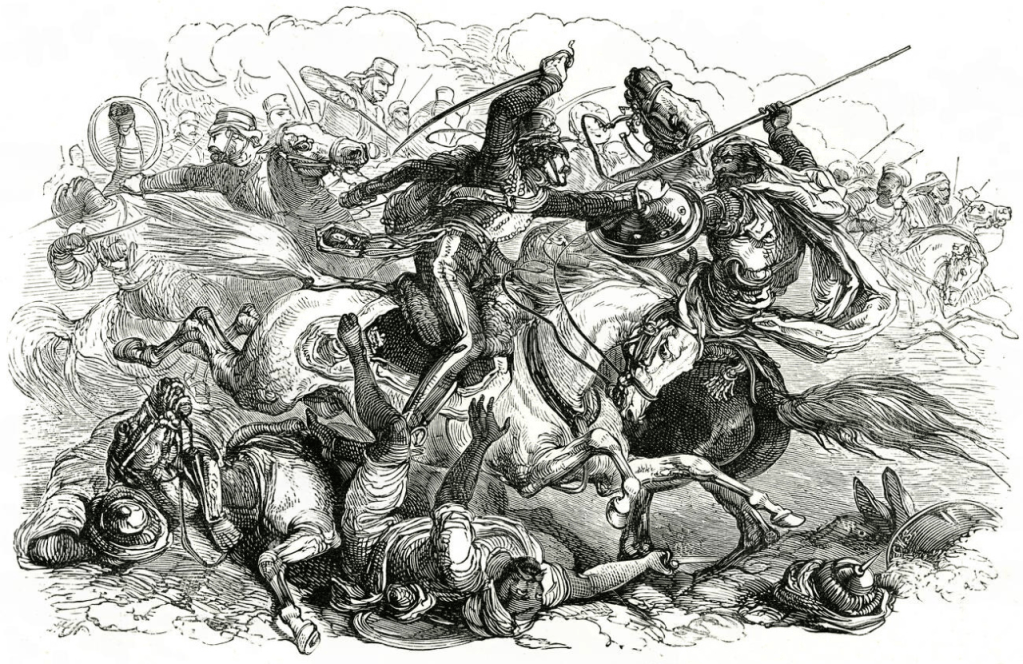
The idea was not to allow the Raja to set foot in Amorha; instead, they met him in the open at the village of Lampti. Gerrard allowed the Gonda force to march to within two miles of his position on the road to Amorha – he ordered HM’s 13th to take a position on the left of the road in a tope of trees, and the 27th MNI on the right under the cover of a village. He placed the Naval Brigade and the guns in the centre, covering their rear by another village. The Gonda Raja, realising he was in for a warm reception, divided his men into three columns and attacked the left and the centre; HM’s 13th and the sailors fired steadily, and the guns let loose salvo upon salvo – the Gonda men retreated and then advanced again, but every reception was as hot as the last. His third column, unable to make any headway, and by four in the afternoon, the whole thing was given up as a bad job. The Gonda men began to retreat, and Gerrard ordered the pursuit with the guns and the cavalry. The Naval Brigade was up to the mark and advanced rapidly, silencing the Gonda guns and forcing a general route, with the cavalry on the heels of the fleeing men. The chase continued for another four miles and then, seeing the work was done, Gerrard ordered a halt to the proceedings and the force returned to Amorha.
Of course, this was bad news for the Harriah outpost just eight miles distant, for at half past five in the evening, 800 insurgents and three guns were reported to be on the way. Intelligence was sent to Basti, and at ten in the evening Major Cox with 350 men of HM’s 13th, two guns under Lieutenant Turnour, and one troop of the BYC were on their way to help. However, Captain Vine with his small detachment had managed to keep the insurgents at bay. They either had no stomach for a fight or had been ensuring the Raja and the rest of the force could make their retreat unmolested, for as soon as Cox showed up on the horizon, they left.
 Mutiny Reflections