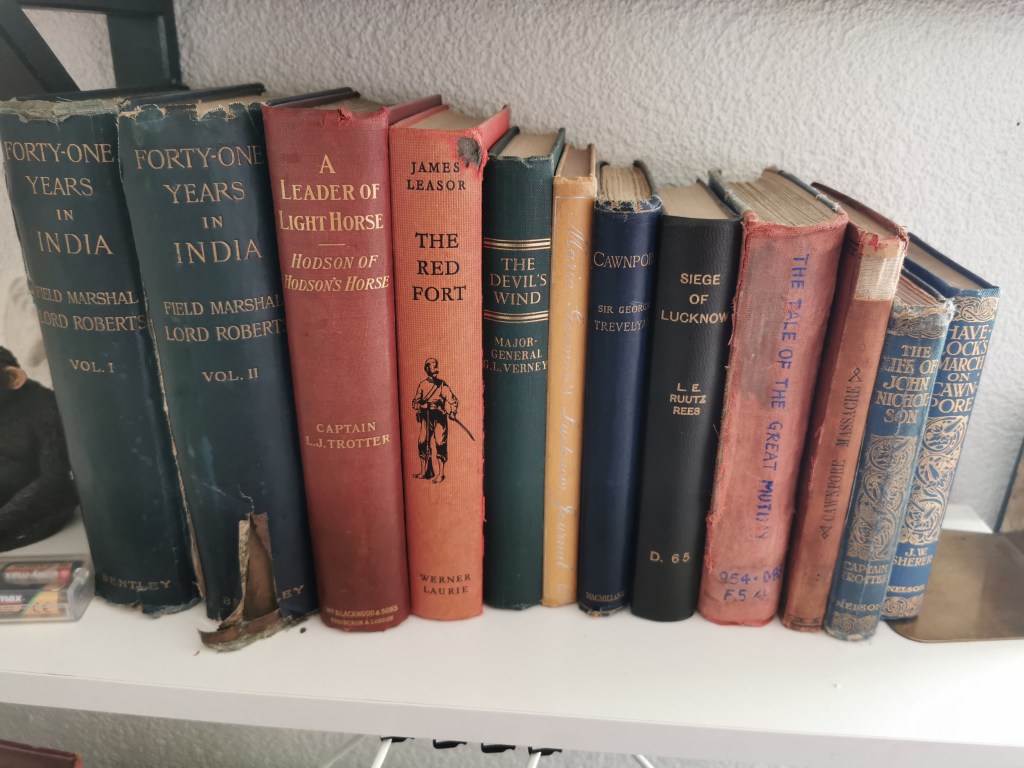
The books utilised to research Mutiny Reflections take many different guises, from district gazetteers and dispatches to autobiographies and biographies, burial ground lists and even works on surgery. For an event that rightly only lasted just over two years, bibliographers like Harold E. Raugh Jr. estimate that there are several thousand books, including hundreds of participant biographies, diaries, and official dispatches.
Of course, I could just refer to Raugh and his magnificent The Raugh Bibliography of the Indian Mutiny, 1857-1859 (Published by Helion and Company, 2016) and be done with it, but that would seem, after spending the better part of two decades collecting books, somewhat disingenuous. When I first started writing about the mutiny, I relied on physical books and gradually, as technology became an integral part of research, I was able to tap into other resources, such as archive.org, the Hathi Trust and the ever-intriguing Wellcome Library. Some sources have come and sadly disappeared. I continue to buy second-hand books, and whenever I visit India, I add some more to my collection. The majority of the books on these lists are available online as PDFs of varying quality, and almost all are still on archive.org.
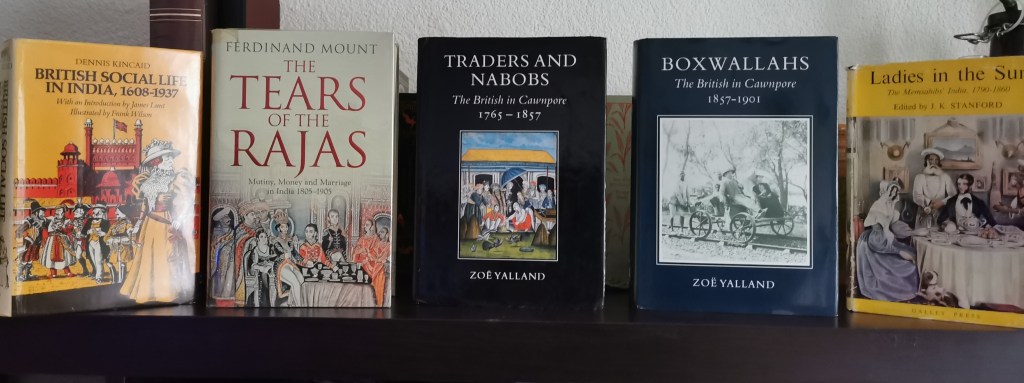
For second-hand books, I still look to World of Books. If I am feeling a little more cash happy, then it is off to Abe Books, and occasionally, something interesting turns up at Bates & Hindmarch. As it always is with second-hand books, one must be prepared for disasters and surprises; my copy of T.R. Holmes “The Indian Mutiny” fell to pieces, who ever rebound Rees’ ‘The Siege of Lucknow” removed the map, Trotter’s “A Leader of Light Horse” still stains my fingers blue, and all the maps in Sedgewick’s “The Indian Mutiny, 1857, A Sketch of Principal Military Events” have been written on, in pencil, by a very enthusiastic previous owner. These things cannot be helped; the books have been used, admired and passed on. One book I purchased even came with all the pages uncut. However, both my copies of Zoe Yalland’s books on Cawnpore are signed by the author, so there are also upsides to buying second-hand books, and there are author signatures, likewise, in Wallace’s “Rifles and Kukris,” and Wilkinson’s “The Two Monsoons.”
Back to the lists.
I have decided to only include books I use on this site and use often. It makes little sense to add the numerous cookbooks, travel guides, medical advice and social histories I have collected about life in India. I have some 20 books devoted to shikar. While this is fun, and some of those men who wrote about hunting did fight in the mutiny, their interests in writing did not extend to chronicling their experiences in 1857 and are thus not much use in this field. So, the books here are related, some more, others less, to the mutiny. The regimental histories, for the most part, only have a few paragraphs, if that, pertaining to the mutiny; however, they hold other interesting bits of information, such as how long a regiment stayed in India, and, if one is lucky, mention names of officers and detail their careers. Every book on these lists has proved its usefulness. I hope these lists include books that will give you joy and pique your interest in exploring the Indian Mutiny.
 Mutiny Reflections